
Ice Cream Freezer or Gelato Display? Match the Cabinet to the Job
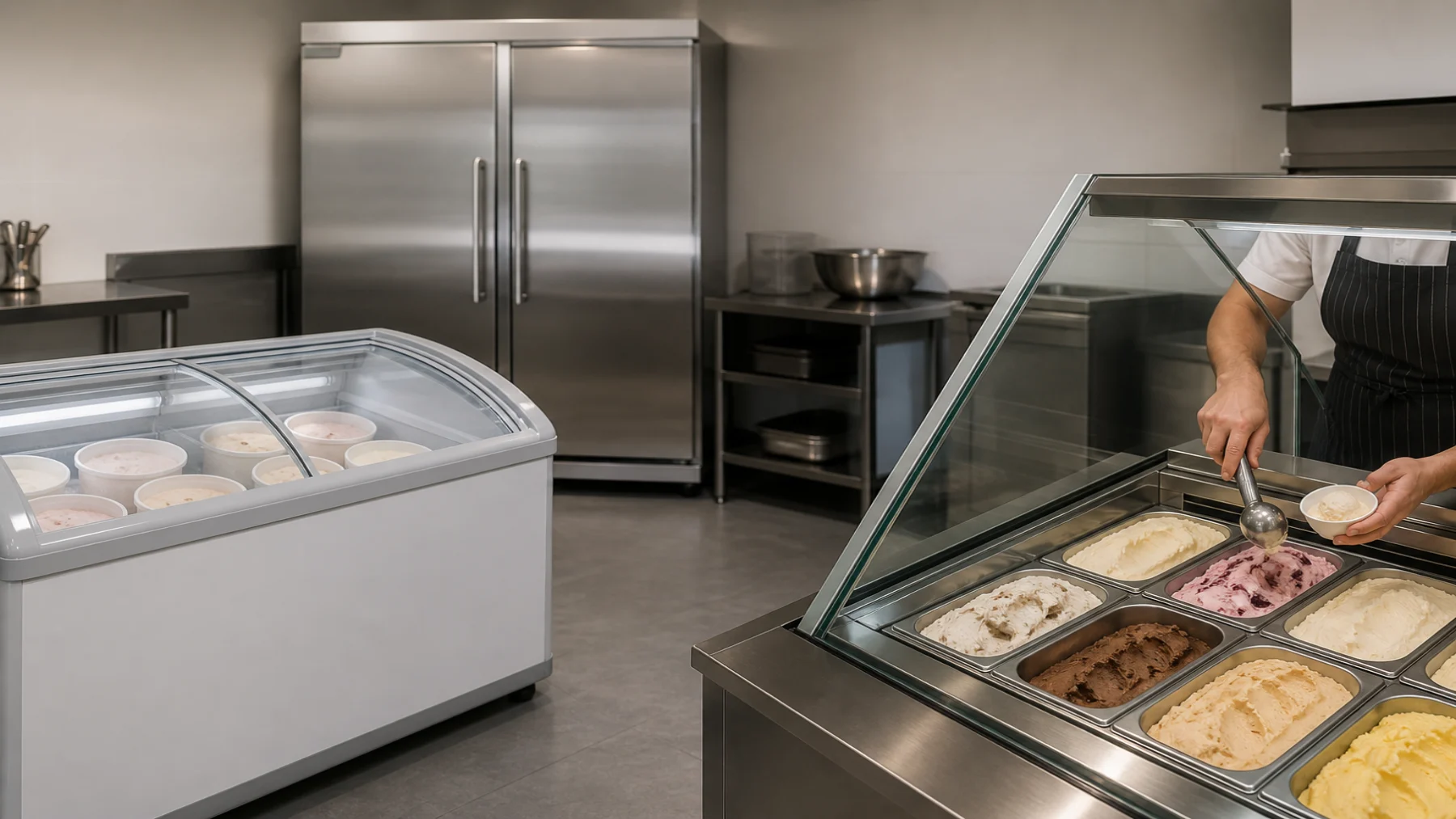
An “ice cream freezer” is not automatically a storage cabinet, and a “gelato display” is not automatically a scooping cabinet. Those names describe products loosely; they do not prove what the cabinet was designed, tested or registered to do.
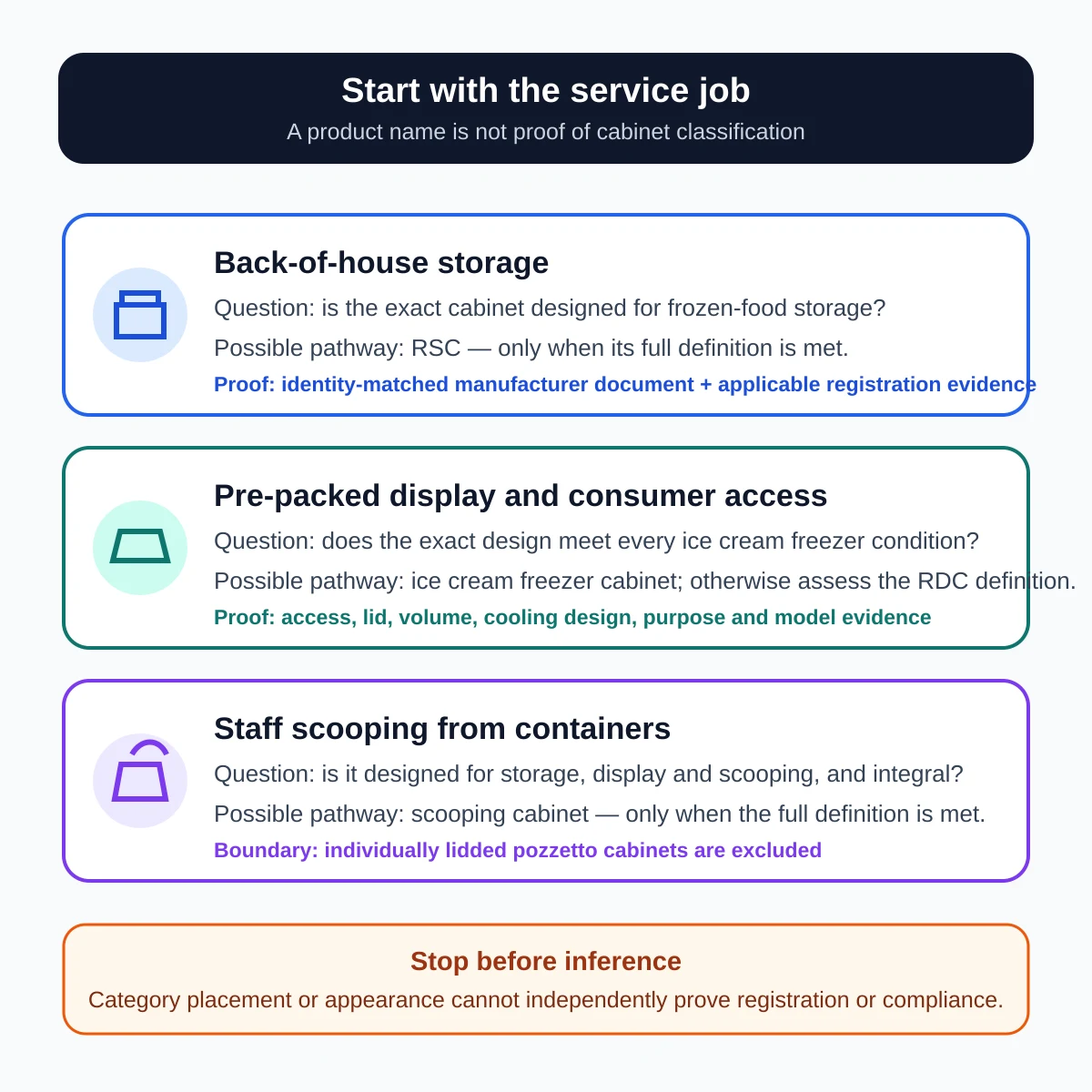
Start with the service job. Is the cabinet holding back-up stock, giving customers access to pre-packed ice cream, or holding open containers for staff to scoop? Only then do its temperature, climate and energy fields become useful evidence.
Three frozen-product jobs that should not be collapsed
Back-of-house storage
The product stays in reserve rather than being presented for customer selection or repeatedly opened for scooping. The buyer’s first question is whether the exact cabinet is designed for frozen-food storage under the intended operating conditions—not whether its title contains “gelato”.
Pre-packed display and consumer access
Customers select packaged ice cream through a lid or another retail access point. Under the current Australian refrigerated-cabinet determination, an ice cream freezer cabinet has a much narrower definition than “a freezer containing ice cream”: it is integral, designed for consumer access to pre-packed frozen ice cream, lid-accessed, no more than 500 litres, and subject to specified construction conditions.
Scooping service
Staff serve frozen gelato or ice cream from containers held for display and scooping. The determination defines a scooping cabinet by that designed purpose and requires it to be integral. A pozzetto—where each gelato container remains individually lidded except while scooping—is expressly excluded from the determination’s covered classes.
These are designed-purpose distinctions, not labels KW can assign by looking at a photograph. A manufacturer title, catalogue category or pan layout may suggest a job, but the exact product documentation and, where applicable, registration evidence must support the classification.
How the Australian cabinet classes fit around those jobs
The Greenhouse and Energy Minimum Standards (Refrigerated Cabinets) Determination 2024 commenced on 5 October 2024. It defines five regulated cabinet types, including ice cream freezer cabinets, scooping cabinets, refrigerated display cabinets (RDCs) and refrigerated storage cabinets (RSCs).
An RDC is designed for retail storage, display and consumer access to chilled or frozen items, but it excludes cabinets that meet the scooping-cabinet or ice-cream-freezer-cabinet definitions. An RSC is an integral storage cabinet that is not an RDC, scooping cabinet or ice cream freezer cabinet. The distinctions turn on designed purpose and the complete definition; they are not interchangeable marketing categories.
“Frozen hard” is a product outcome, not a thermostat setting
FSANZ guidance for displaying food says frozen food on display must stay frozen hard. It does not give one universal temperature for all frozen food in Standard 3.2.2 guidance, and it does not turn a cabinet’s adjustable range into a prescribed gelato setting.
The product and the cabinet answer different questions. A cabinet controller may be set to a number, and a display may report a reading from the equipment’s sensor. Neither alone proves the condition or temperature of every container in every part of the cabinet. Load, door or lid opening, product placement, airflow and measurement location can all sit outside what one displayed number tells you.
The safe conclusion is deliberately narrower: the operator must keep the displayed frozen product frozen hard and use an appropriate verification method for the food and the business’s controls. The cabinet display is useful operational information; it is not a substitute for product verification.
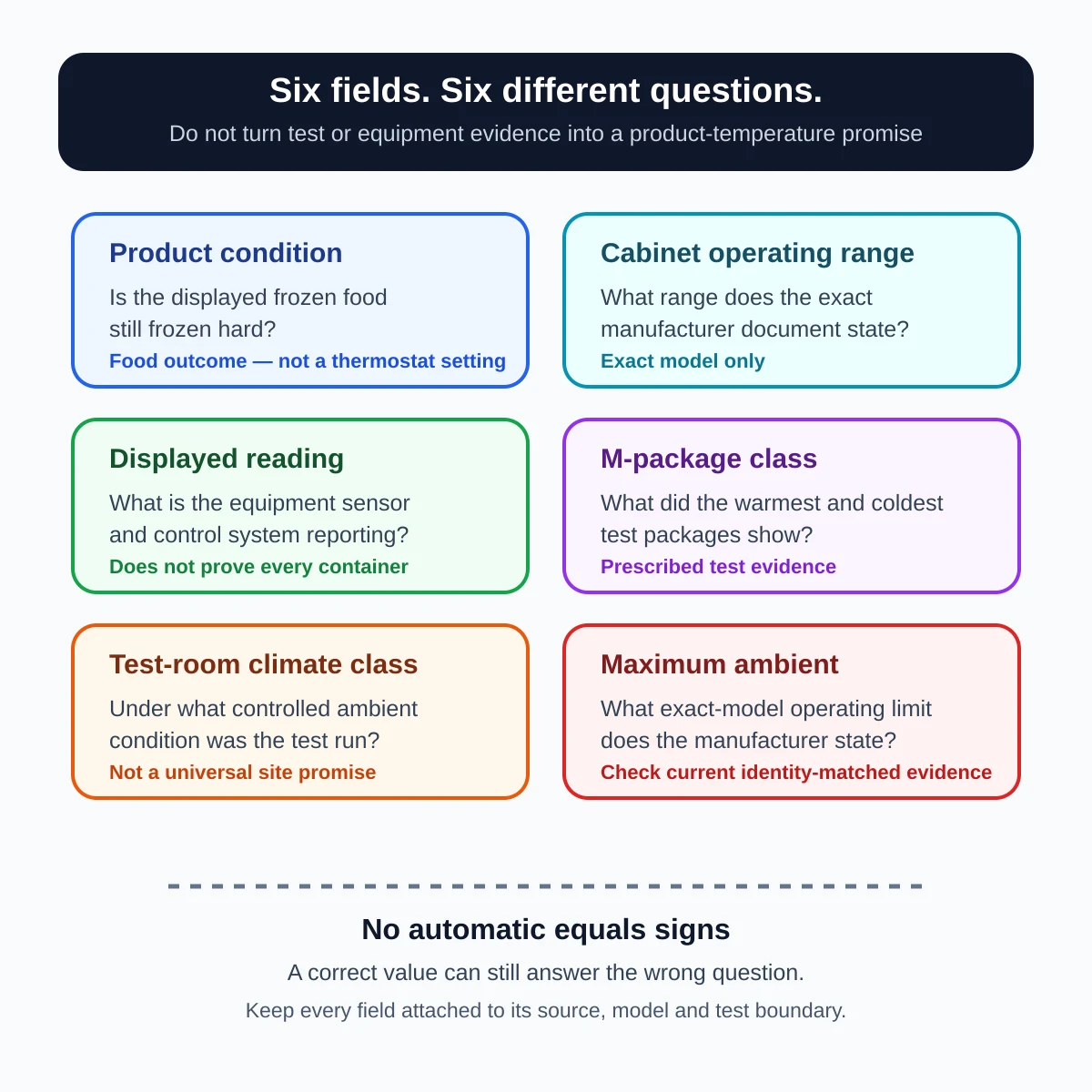
Six specification fields, six different questions
- Cabinet adjustable or operating range
- The range the exact manufacturer says the cabinet can be controlled or operated within. It does not prove the temperature or texture of the product, and it cannot be copied to other models.
- Displayed temperature
- A reading associated with the cabinet’s sensor and control system. It does not prove that every product container has the same temperature.
- Product condition or food temperature
- The state of the food itself. For this decision, FSANZ’s clear display outcome is that frozen food remains frozen hard; a universal gelato setpoint is not supplied by that rule.
- M-package temperature class
- A classification based on the warmest and coldest test packages recorded during the prescribed cabinet test. It is test evidence, not a serving recipe, thermostat instruction or live product reading.
- Test-room climate class
- The controlled ambient condition used for a prescribed test. It helps define how the test evidence was produced; it is not permission to infer performance in every installed site.
- Manufacturer-stated maximum ambient
- An exact-model operating condition stated by the manufacturer. It should be checked in the current identity-matched document and should not be freely substituted for the test-room climate class.
This separation matters because a buyer can otherwise combine individually accurate numbers into an unsupported conclusion. A model’s operating range and maximum ambient may both be correctly copied from its specification sheet, yet neither proves that a particular product load will stay in the required condition at a particular site.
Read an exact-model specification without turning it into a category rule
The Bromic GD0007S-NR, part number 3735262-NR, is useful here as a specimen because the manufacturer publishes several fields together. Its current specification lists an adjustable range of −22°C to −12°C, a 35°C maximum ambient, climate class 4L1, energy consumption of 3.99 kWh per 24 hours and an eight-star GEMS rating.
Those numbers do not establish a general operating range for gelato cabinets. They also do not, by themselves, tell a buyer:
- what temperature a particular recipe or product should be served at;
- what every container will measure during a real service period;
- how the cabinet will perform outside the documented conditions;
- what another model’s climate, energy or temperature fields will be; or
- that KW has independently verified this model’s registration record.
The specimen demonstrates the reading method: preserve model identity, keep each field attached to its source and interpret only the question that field answers. Before purchase, read the current manufacturer document and check the exact registration record where a GEMS registration claim matters.
Energy information is comparison evidence, not a savings promise
Commercial refrigerated cabinets covered by this framework do not have to display a mandatory Energy Rating Label. Suppliers may present a governed star rating, and registered-product information can also be checked through the Energy Rating Registration Database.
The official Energy Rating guidance for refrigerated cabinets says to compare star ratings only for cabinets of the same type, size and operating temperature. That is especially important here: comparing a storage cabinet with a scooping cabinet, or comparing unlike temperature duties, can make a precise star figure answer the wrong question.
E24h is energy consumption measured over 24 hours under the applicable test method. It is not a forecast electricity bill. A site-cost estimate would still need the exact model’s verified E24h, the buyer’s tariff and explicit assumptions. This article therefore makes no generic energy-saving, running-cost or payback promise.
What must be proved before a model becomes the answer
Once the intended job is clear, the remaining proof becomes smaller and more exact:
- Confirm designed purpose. Use the identity-matched manufacturer specification or manual—not the product name alone.
- Read each field within its boundary. Keep operating range, product condition, displayed reading, M-package class, test-room climate class and maximum ambient separate.
- Check the exact regulated evidence where applicable. Do not infer registration from a category listing, a star graphic or another model in the same family.
- Verify the real operating condition. Confirm the site ambient, intended load and service pattern against the exact manufacturer conditions, then verify the product through the business’s food-safety controls.
Only after those questions are separated does model browsing become useful. The Gelato Display Freezers Category can show the available commercial range; the exact PDP, manufacturer document and registration record must supply the model-level proof.