
Commercial Spiral Mixer Buying Guide: Six Proofs Before You Order
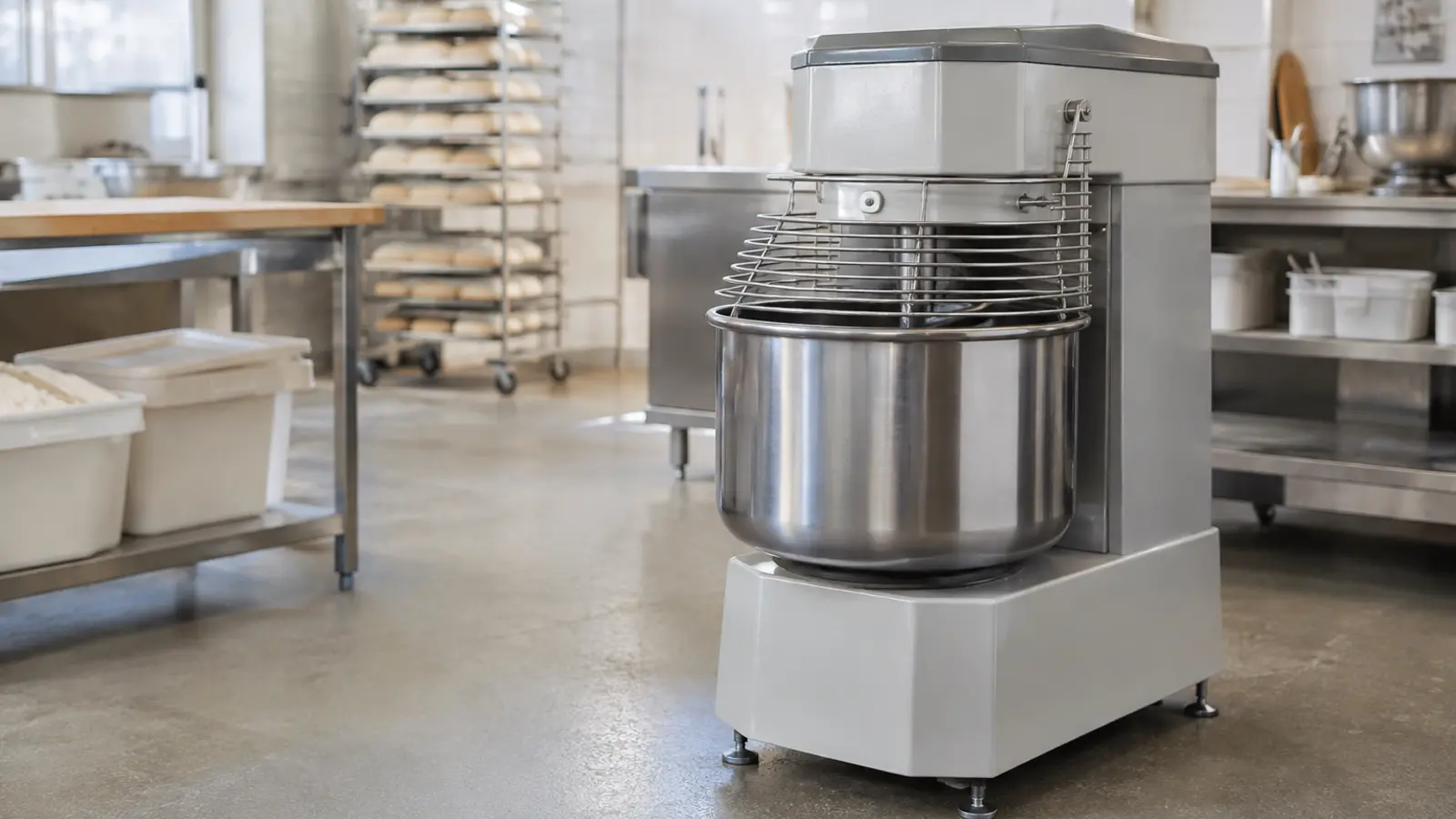
A commercial spiral mixer should make the shortlist only when six separate proofs agree: the primary task, the real recipe range, the exact model’s capacity definitions, the bowl and head workflow, the site and utilities, and the guarding and cleaning plan. A litre label, venue type or brand reputation cannot answer all six.
If one proof is missing, hold the selection and get the exact document or site input. That is a better buying rule than choosing a nominally larger mixer and hoping the unknowns disappear.
Start with the job: is dough the main repeated workload?
Spiral mixers are a dough-focused machine family. Official manufacturer ranges commonly describe a rotating bowl, spiral tool and central shaft or breaker arrangement, but the exact construction and controls vary by series. That makes the first question operational: is repeated dough mixing the primary job this machine must perform?
If the same station must also whip, beat or mix a wide range of non-dough preparations, do not assume a spiral mixer replaces a multi-tool mixer. Route that decision to the commercial planetary mixer guide. A planetary mixer may also have documented dough capacities; a spiral label does not prove it is automatically better for every recipe.
The safe distinction is workload, not marketing language. Shortlist the machine family first, then verify the exact model against the real recipe and workflow.
Treat the purchase as six proofs, not one specification
The central buying error is allowing one field to stand in for the whole decision. Capacity does not prove discharge workflow. A removable bowl does not prove throughput. A compact closed footprint does not prove the machine fits when its head or guard is open.
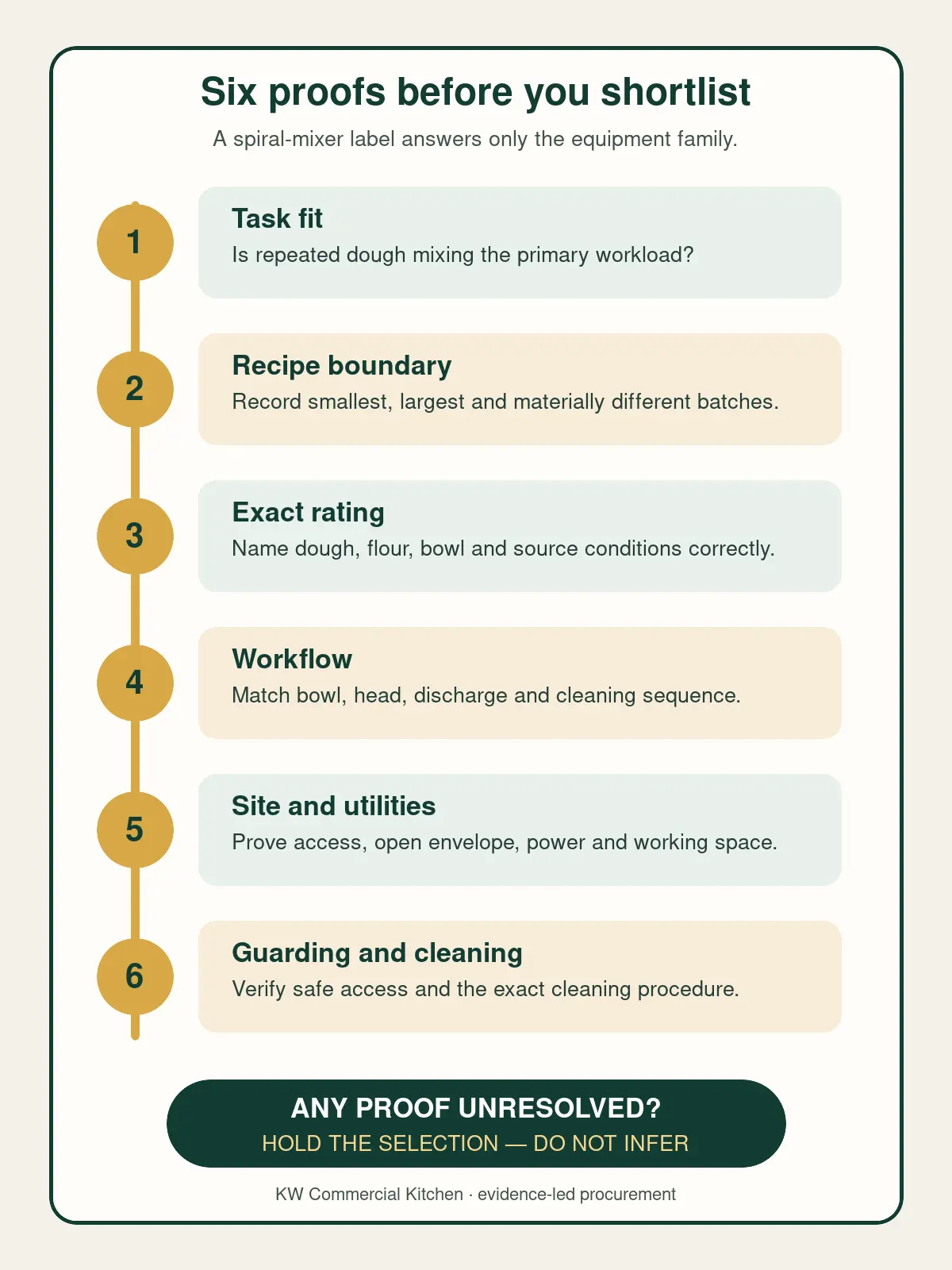
The six-proof chain keeps those decisions separate:
- Task fit: repeated dough mixing is the intended primary workload.
- Recipe boundary: the smallest, largest and materially different recipes are recorded.
- Exact rating: dough weight, flour weight, bowl volume and any stated conditions are identified correctly.
- Workflow: loading, mixing, discharge, reset and recipe-change cleaning fit the operation.
- Site and utilities: delivery access, operating envelope, power and working space are verified.
- Guarding and cleaning: the exact safety devices and cleaning method suit the workplace procedure.
Capacity is a separate proof—and already has an owner
Do not convert bowl litres into dough kilograms. Manufacturer documents demonstrate why: they may list kneading or dough weight, flour capacity, bowl volume, hourly output, hydration conditions and model variants as separate fields. Mecnosud’s IM sheet, for example, states that its kneading-capacity figures use a named hydration basis and may vary with ingredients. Prismafood publishes dough weight and bowl capacity separately. Those examples establish the need to read the exact field; they do not create a cross-brand conversion.
Use the commercial mixer sizing guide to calculate the complete recipe batch and separate batch fit from throughput fit. This spiral guide does not repeat that calculation.
Bring the sizing result back as evidence: exact recipe version, smallest and largest batches, materially different doughs, required batches in the production window, and the exact manufacturer document. If a recipe falls outside the published condition, ask for written confirmation rather than selecting from a nearby model or convenient number.
Choose the bowl and head configuration from the workflow
Two mixers with a similar nominal capacity can create different work at the bench. Official manufacturer ranges include fixed-head/fixed-bowl machines and configurations with a liftable head and extractable bowl. Larger production systems may add bowl handling or discharge equipment. The correct choice depends on what happens before and after mixing.
Map the complete cycle in the proposed space:
- how ingredients are weighed and loaded;
- how the operator works with the guard and controls;
- how dough is discharged without an awkward lift or uncontrolled manual handling step;
- whether the bowl must move to another station;
- how the next batch is reset; and
- what cleaning is needed between materially different recipes.
A removable bowl may help one workflow and add handling, storage and cleaning steps to another. A fixed bowl may be simple in one operation and obstruct discharge in another. Treat configuration as a workflow choice, not a universal upgrade.
Verify controls model by model
Single speed, two speeds, timers, bowl direction, programmable controls and emergency functions are not safe category-wide assumptions. Manufacturer ranges often vary these features by model, voltage or option.
For every shortlisted model, record what is standard, optional or unavailable. Then match each control to a real process requirement. A timer can support a repeatable sequence, but it does not prove the correct time for a recipe. A second speed may be documented on one variant and absent on another. A reverse-bowl function, where offered, needs its exact manual-defined purpose; it should not be promoted into a general performance claim.
The operating manual is the authority for sequence, speed, ingredient order, minimum and maximum load, and stop conditions. Generic Blog instructions cannot safely replace it.
Measure the machine open, in use and on the delivery path
A closed product dimension is only one part of site fit. Mecnosud’s official IM data sheet illustrates a larger envelope for a liftable-head version. That is the practical lesson: measure the configuration as it will be loaded, opened, cleaned and serviced.
Before ordering, verify:
- the exact model’s width, depth, height and operating/open envelope;
- doorway, corridor, lift, threshold and turning access to the final position;
- bench capacity or floor position, including the model’s stated weight;
- clearance for the guard, head, bowl and normal operator stance;
- a cleaning route that does not require unsafe reaching; and
- the exact voltage, phase, connection and installation requirements.
Do not infer electrical fit from motor power alone. Give the current manufacturer specification to the applicable electrician or project owner and confirm the final connection before delivery or installation. Wheels, brakes and mobility also require exact configuration evidence; a wheeled machine still needs a stable operating position and a workplace procedure.
Guarding and cleaning belong in the buying decision
Dough mixers contain moving parts with serious entanglement risk. WorkSafe Queensland’s incident alert identifies access to moving parts and operation with guards removed or open as hazards, and describes interlocked guarding as a control. Its reported incident remained under investigation, so this article does not claim a final cause.
For the buyer, this creates clear evidence questions. Does the exact model have the required guard and interlock arrangement? Can the workplace inspect the safety function under the manufacturer’s procedure? Can dough be removed and food-contact surfaces cleaned without defeating a guard or reaching into moving equipment? If a guard or interlock is damaged, the machine is not made acceptable by staff experience.
FSANZ distinguishes cleaning from sanitising: cleaning removes dirt, grease and food residue, while sanitising destroys microorganisms. Food businesses must keep relevant equipment clean and sanitary, and commercial sanitiser use follows its manufacturer’s instructions. The spiral-mixer purchase therefore needs an exact cleaning method, accessible food-contact surfaces, suitable facilities and a staff procedure. It does not need a generic weekly or annual schedule invented by an article.
Never reach into the bowl while the mixer is moving. Isolation, repair, electrical work and guard changes belong to the exact manual, workplace controls and the applicable competent or licensed specialist.
Compare evidence, not brand adjectives
“Premium”, “value”, “heavy duty” and “best” do not reveal whether the offered configuration fits the operation. Replace the brand league table with a comparable evidence pack.
| Proof | Evidence to obtain | HOLD when |
|---|---|---|
| Task | Primary preparations and required tools | Mixed duties are unresolved |
| Recipe | Smallest, largest and materially different batches | Recipe or batch range is incomplete |
| Rating | Exact model sheet and every capacity condition | Litres, flour and dough are conflated |
| Workflow | Loading, discharge, reset and cleaning sequence | Bowl/head configuration is assumed |
| Site | Access, open envelope, weight, power and installation | A site or utility input is unknown |
| Safety | Manual, guard/interlock and cleaning procedure | Safety access or procedure is unresolved |
This approach still allows meaningful comparison. It simply compares facts with the same scope instead of rewarding the strongest adjective.
Send the six-proof pack before requesting a quote
Send KW the intended preparations, recipe and batch evidence, production window, preferred bowl workflow, access measurements, working-space constraints and available utilities. KW can then compare current commercial spiral mixer options with exact manufacturer documents and identify what still needs confirmation.
The output is not “the biggest model that fits the budget”. It is an exact shortlist with each proof marked supported, owner-confirmation required or HOLD. Price, stock, delivery, warranty and final suitability remain current quote facts; this guide does not pre-approve them.