Speed Oven vs Combi Oven: The Velocity vs Volume Audit (2026)
KW Engineering White Paper • Volume 03
The 2026 Thermal Processing Audit: Speed Ovens vs. Combi Technology
To: Project Managers, Head Chefs, and Venue Owners.
For the full combi buying, installation and operations picture, see our commercial combi oven guide.
If you are reading this, you are likely standing in an empty shop fit-out, holding a quote for $50,000 worth of equipment, and wondering: “Do I really need a Combi Oven, or is the sales rep just trying to hit his commission target?”
We are not here to sell you a box. We are here to prevent you from installing a machine that requires a $5,000 extraction hood you didn’t budget for, or a machine that creates a bottleneck during your Saturday morning rush.
This is a forensic engineering audit. We will strip away the marketing “fluff” and look at the Thermodynamics, the AS1668.2 Regulations, the Electrical Load, and the Total Cost of Ownership (TCO).
- 1. The Physics: Heat Transfer Mechanisms
- 2. Operations: The “Queue Theory” Trap
- 3. Texture Audit: Maillard & Moisture
- 4. The Sparkie’s Nightmare: Infrastructure
- 5. The Regulatory Minefield (AS1668.2)
- 6. Comparison Matrix: The Data
- 7. ROI & TCO: The Hidden OpEx
- 8. Common Mistakes: The Buying Trap
- 9. Food Chemistry: Dielectric Constants
- 10. Labor Arbitrage: De-Skilling
- 11. Maintenance: Arcing vs. Scale
- 12. Verdict & Case Studies
- 13. Technical FAQ
Chapter 1. The Physics of Heat Transfer
To understand the difference, we must look at the molecular level. A Combi Oven and a Speed Oven are not just “ovens.” They are different species of thermal engines.
1.1 Combi Oven: Convective Saturation & Latent Heat
A Combi (Combination Steamer) operates on the principles of Convection (Moving Air) and Steam (Phase Change).
Steam carries 6x more energy than dry air at the same temperature. When steam touches the cold surface of a chicken, it condenses back into water. This phase change releases massive amounts of energy (Latent Heat) directly into the food.
However, Combi cooking is limited by Thermal Conductivity. The heat must travel from the outside (Crust) to the inside (Core). You cannot rush this. If you increase the temperature too much to speed it up, you burn the outside before the inside is safe (75°C).
The Limit: Physics dictates that a roast chicken takes 45 minutes. No fan speed can change the density of the meat.
1.2 Speed Oven: Molecular Excitation & Impingement
A Speed Oven (like Menumaster MXP or Pratica) bypasses the laws of conductivity by using a “Hybrid Engine”:
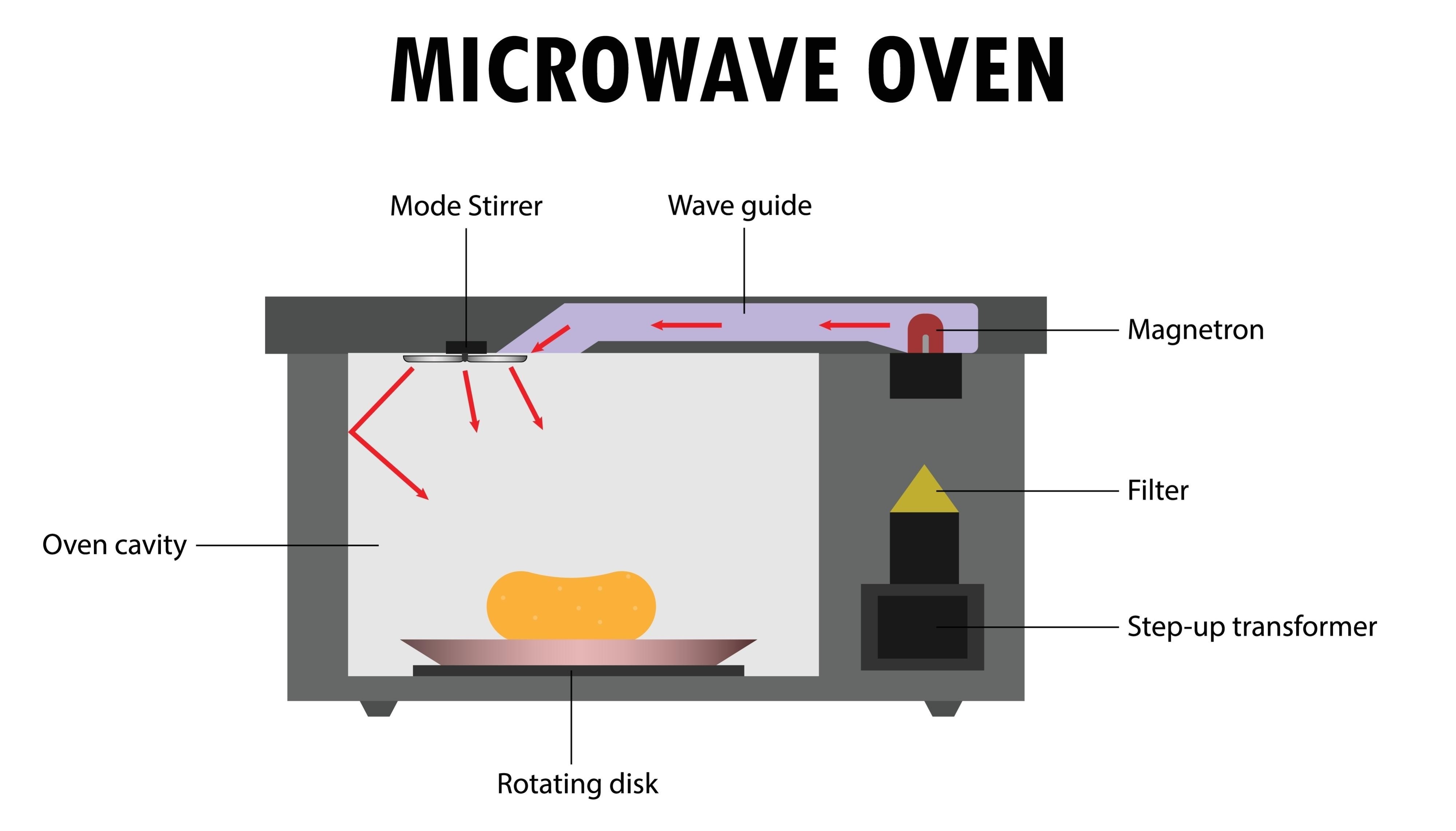
- Dipole Rotation (Microwave): The oven emits waves at 2.45 GHz. These waves penetrate the food and find water molecules. The polarity of the wave flips billions of times per second, causing the water molecules to rotate and rub against each other. Heat is generated INTERNALLY.
- Planar Impingement (Air Jets): While the inside is heating, vertical columns of hot air blast the surface at 100km/h. This strips away the “Boundary Layer” of cold air that insulates food, forcing heat transfer.
The Result: You are heating the Core (Microwave) and the Crust (Impingement) simultaneously. This is why a Speed Oven is 10x faster.
Chapter 2. Operational Logic: The “Queue Theory” Trap
Engineers use “Queue Theory” to design traffic lights. We use it to design kitchens. The type of oven you need is dictated entirely by how your customers arrive.
2.1 The “Stochastic” Arrival (The Cafe/Subway Model)
In a Cafe, customers arrive randomly (Stochastic process). One toastie at 8:05. Two muffins at 8:12. Nothing at 8:20.
The Pain Point: If you use a Combi Oven here, you have a massive thermal mass. Heating a 6-tray oven for one Ham & Cheese Croissant is Energy Suicide. Plus, the recovery time means the next customer waits.
The Speed Oven Solution: It sits in “Standby” mode (low energy). When an order hits, it spikes to 100% power, executes the job in 45 seconds, and resets. It is a “Low Latency” device.
2.2 The “Batch” Arrival (The Restaurant/Banquet Model)
In a Restaurant, 50 guests order at 7:00 PM. This is a Batch process.
The Pain Point: A Speed Oven has a capacity of ONE. To serve 50 steaks, you would need 50 cycles x 2 minutes = 100 minutes. The first guest finishes eating before the last guest is served.
The Combi Solution: It is a “High Throughput” device. You load 50 steaks at once. They all cook in parallel. Efficiency increases with volume.
Chapter 3. The Texture & Chemistry Audit
The biggest fear Cafe owners have is: “Will it taste like microwaved rubber?” Let’s look at the chemistry.
3.1 The “Soggy Bottom” Issue
In a domestic microwave, water turns to steam inside the food. The steam tries to escape but gets trapped by the bread, making it soggy and chewy.
In a Speed Oven, the Air Impingement is violent. It hits the surface at 260°C. This evaporates surface moisture instantly, faster than it can soak into the bread. This creates a crisp “shell” that traps the internal steam.
The Result: A Speed Oven creates a crispier product than a sandwich press because it doesn’t crush the cellular structure of the bread.
Chapter 4. The Sparkie’s Nightmare: Infrastructure Audit
This is a common failure point. You buy the oven, and then the electrician tells you your building can’t handle it.
4.1 The Myth of “Plug & Play”
Speed Ovens:
- Small Units (Menumaster Jetwave): 10A or 15A Plug. Easy.
- Performance Units (Menumaster MXP / Pratica): These are 20A Single Phase or even 3-Phase. Most older shops DO NOT have 20A circuits. Installing one involves running new cable from the main board.
- Cost Impact: $300 – $800 for a new circuit.
4.2 The Combi Infrastructure Bill
A Combi Oven is not an appliance; it is a piece of heavy plant machinery. It requires:
- Electrical: Almost always 3-Phase (Hardwired). Upgrading a Single Phase shop to 3-Phase costs $3,000 – $10,000 depending on the street supply.
- Gas: If choosing Gas, you need a certified Type B installation and a high-flow regulator.
- Drainage (The Hidden Killer): You cannot use PVC pipes. The discharge water is 98°C. It will melt standard plumbing. You must install Copper Tundish Drainage with an air gap.
Chapter 5. The Regulatory Minefield (The Hidden $6,000 Bill)
This is the chapter your sales rep hopes you don’t read. In Australia, installing commercial cooking equipment is governed by strict Standards. Ignorance is not a defense; the Council Health Inspector will shut you down.
5.1 AS 1668.2: Ventilation & Exhaust
The Law: Australian Standard AS 1668.2 dictates that any appliance generating grease-laden vapor or steam is a “Type B” appliance and MUST be under a mechanical extraction hood (Canopy) vented to the atmosphere.
- Combi Oven: It generates massive steam and grease (when roasting). HOOD REQUIRED.
Cost Impact: $3,000 – $8,000 for hood, ducting, fan, and roof penetration. - Speed Oven (Ventless): Most modern units (Menumaster MXP, Pratica, Unox Speed-X) contain integral Catalytic Converters. These honeycomb filters break down grease molecules into CO2 and water vapor at 600°C.
Ventless option: Where they meet the relevant grease-emission limits, many councils exempt small ventless units from hood requirements — but this varies by LGA, so verify locally.
Cost Impact: No canopy cost where an exemption applies (you can place it on a front counter).
5.2 AS 3500: Plumbing & Backflow
The Law: Any equipment connected to mains water that uses chemicals (detergent) is a “High Hazard” connection. You must prevent dirty water from flowing back into the town supply.
- Combi Oven: Connects to water + chemicals.
Requirement: You must install an RPZ Valve (Reduced Pressure Zone Device).
Cost Impact: $500 Install + $200 Mandatory Annual Testing. - Speed Oven: Most are “Tank Models” (fill manually) or require no water.
Cost Impact: $0. No plumber required.
Chapter 6. The Comparison Matrix (The Data)
Forget the brochure. Here is how the numbers compare.
| Feature | Combi Oven (The Volume King) | Speed Oven (The Velocity King) |
|---|---|---|
| Throughput Model | Batch (Parallel Processing) | Single (Serial Processing) |
| Time (Sandwich) | 6 – 8 Minutes (Dry) | 35 – 50 Seconds (Crisp) |
| Raw Dough Baking | EXCELLENT (Rise & Structure) | POOR (Collapsed Structure) |
| Ventilation (AS1668.2) | HOOD REQUIRED ($5k+) | Ventless (may qualify for exemption) |
| Plumbing (AS3500) | RPZ Valve + Copper Drain | None / Tank Only |
| Ideal Business | Restaurants, Caterers, Hotels | Takeaways, Cafes, Servos |
Chapter 7. ROI & TCO: The Financial Audit
This is where we do the “Landed Cost” calculation. Most people think a Speed Oven is expensive. Let’s run the numbers for a standard Cafe setup.
SCENARIO: Opening a New Cafe
Option A: The “Cheap” Combi Oven (6-Tray)
- Machine Price: $18,000
- Extraction Hood: +$5,000
- Plumbing (RPZ + Drain): +$1,200
- Electrical Upgrade (3-Phase): +$1,500
- TOTAL COST TO OPEN: $25,700
Option B: The “Expensive” Speed Oven (High End)
- Machine Price: $22,000
- Extraction Hood: $0 if the ventless unit qualifies for exemption
- Plumbing: $0
- Electrical (20A Circuit): +$300
- TOTAL COST TO OPEN: $22,300
THE VERDICT: Where a ventless unit qualifies for hood exemption, a Speed Oven can be cheaper to install — it trades infrastructure (hoods/drains) for on-board technology (catalytic converter). Confirm eligibility with your council.
7.1 The Consumables Cost (OpEx)
It’s not just about Day 1. It’s about Day 1000.
- Combi Consumables: Chemicals (Tablets/Liquid) + Water Filters. Cost: ~$800/year.
- Speed Oven Consumables: Magnetrons. These are “Wear Items” like tyres. Expect to replace them every 3-4 years in high volume. Cost: ~$1,200 every 3 years.
Chapter 8. Common Mistakes: The “Buying Trap”
We have seen these mistakes cost owners thousands. Don’t make them.
-
❌ Mistake 1: Buying a Combi for a Sandwich Bar.
You will bottleneck your service. Customers will walk away. You paid $25k for a machine that is too slow. -
❌ Mistake 2: Buying a Speed Oven for Raw Dough.
You try to bake croissants from scratch. They collapse. You blame the machine. The machine is fine; your physics is wrong. -
❌ Mistake 3: Ignoring the “Door Swing”.
Combi Ovens have huge doors. In a tight galley kitchen, opening the door might block the walkway. Speed Ovens usually have “Drop Down” doors that save space.
Chapter 9. Food Chemistry: The Dielectric Danger
Why do some foods explode in a Speed Oven? It comes down to the Dielectric Constant of the ingredients.
9.1 The “Salty Ham” Effect
Microwaves are attracted to ions. Salt (Sodium Chloride) is highly ionic. Ingredients like Ham, Bacon, or Anchovies have high conductivity.
In a Speed Oven, the energy focuses aggressively on the salt. The ham reaches 150°C and “explodes” while the cheese next to it is still at 40°C.
The Engineering Fix: You cannot fix physics. You must adjust your assembly. Bury the ham under the cheese. The cheese acts as a dielectric shield/buffer.
9.2 The “Metal” Risk
Can I use metal trays? NO.
Microwaves reflect off metal. If you put a metal pan in, the waves bounce around violently. If the pan gets close to the wall, the voltage potential jumps the gap, creating Arcing (Plasma Sparks). This will pit the stainless steel cavity and eventually kill the Magnetron.
Chapter 10. Labor Arbitrage: The Cost of De-Skilling
In 2026, the hardest resource to find isn’t stainless steel; it’s a qualified Head Chef. Buying a Speed Oven is a strategy to “De-Skill” your service period.
THE LABOR ARBITRAGE CALCULATION
Scenario: You are open 7 days a week.
Option A: The Combi Kitchen (Chef Dependent)
Requires a Chef to manage humidity, core probes, and doneness.
Cost: Head Chef @ $45/hr x 40 hours = $1,800/week.
Option B: The Speed Oven Kitchen (System Dependent)
Requires a Junior to press a photo of a “Chicken Panini.”
Cost: Junior Staff @ $25/hr x 40 hours = $1,000/week.
Wage savings
Cutting skilled-labour hours on assembly-line tasks can offset the unit’s cost over time.
Chapter 11. Maintenance Reality: Arcing vs. Scale
Every machine has a mortality rate. Knowing what kills them helps you prevent it.
11.1 The Speed Oven Killer: Carbon Arcing
Because the cavity is small and energy density is high, any food debris left inside becomes a target. If staff leave a piece of cheese on the ceiling plate, the microwaves focus on it. It carbonizes (turns black). Carbon conducts electricity.
The Result: The microwave energy arcs into the carbon, burning a hole right through the ceiling liner. This is NOT Warranty. This is negligence. Clean your oven daily.
11.2 The Combi Oven Killer: Limescale
Australia has hard water. When water turns to steam, calcium stays behind. It coats the heating elements and boiler sensors like concrete.
The Result: The boiler overheats and fails. Repair cost: $2,000. The Fix: Install a Reverse Osmosis (RO) filter.
Chapter 12. The Verdict & Case Studies
The debate should not be “Speed vs. Combi.” In a high-performance Tier 0 kitchen, the answer is usually “Both, but separated by Time.”
A Hybrid Line in Practice
A hybrid line lets a venue stop choosing “one or the other”:
- 06:00 – 10:00 (Prep): They use a Rational Combi in the back to bake muffins, roast chicken breast, and steam eggs. (Volume).
- 10:00 – 14:00 (Service): They use two Menumaster MXPs on the front counter to assemble and toast sandwiches in 45 seconds. (Velocity).
Result: Throughput up and labour pressure eased at peak, without over-buying either format.
Chapter 13. Technical FAQ (Engineering Level)
Q: What is the lifespan of a Magnetron?
The magnetron is a consumable part, like the tyres on a car. In a high-volume venue (100+ cycles/day), expect to replace magnetrons every 3 to 4 years. As they age, their power output drops. This is a normal OpEx cost.
Q: Can a Speed Oven replace a Deep Fryer?
For some products (like hash browns or wedges), yes. The air impingement mimics frying. However, for wet-battered products (like Tempura or Fresh Fish), NO. The air velocity will blow the wet batter off the food before it sets.
Q: Does a Speed Oven need a hood if I cook raw meat?
Technically, the catalytic converter can handle grease. However, if you cook 50 raw burgers back-to-back, you will saturate the catalyst. Smoke will escape. For heavy protein menus, we always recommend a hood, even with a Speed Oven.
Stop Guessing. Start Engineering.
Don’t spend $25,000 on a guess. Send us your menu. Our engineering team will calculate your thermal load, check your power supply, and tell you exactly which machine fits your business model.
*Consultation is free for Australian venues.