The Australian Combi Oven Survival Manual (2026)

The Australian Combi Oven Survival Manual (2026)
Installation reality, ventilation truths, water protection, workflow, and ROI — written for owners, chefs, and project teams running real Australian commercial kitchens.
Published: January 2026 | Last updated: January 2026
Executive Summary: If you only read 3 things
- Don’t guess on ventilation. “Electric” doesn’t automatically mean “no extraction required”. Steam plume, grease-laden vapour, and heat load still need a compliant plan (and a kitchen that stays cool enough to operate).
- Water quality can decide reliability and warranty support. Most manufacturers publish specific water parameters (hardness, chlorides, pH, TDS). Treat “no water treatment” as a gamble, not a strategy.
- A standard combi oven is not a fridge. If your goal is overnight dough control and a later start, you’re describing a retarder prover + oven workflow — not a single magic box.
Part 1: The Reality Check
Buying the oven is easy. Making it work is where venues bleed money.
A commercial combi oven can be the most productive square metre in your kitchen — but only when the system around it is right: ventilation, make-up air, drainage, water treatment, commissioning, training, and daily habits. Miss one, and the “smart” oven becomes a very expensive stress test.
This guide is written by KW Commercial for Australian operators and project teams who want fewer surprises: fewer variations in fit-outs, fewer breakdowns, better service flow, and a clear path to ROI. It’s not a brochure. It’s the playbook you wish you had before you signed the quote.
Myth Buster #1: “Can I Sleep In?”
The request sounds innocent: “I want to load croissants at night, set a timer, and arrive at 6am to perfect bakes.” In many Australian kitchens, that idea fails for one simple reason.
The reality: a standard combi oven does not actively refrigerate
A standard combi oven is built to add heat (dry heat, steam, or both). It does not contain a refrigeration compressor designed to hold dough safely cold for hours. In a warm kitchen, yeast activity continues overnight. Depending on your formula and room temperature, dough can over-proof or collapse before morning service.
The professional solution: retarder prover + combi oven
If your goal is a later start without sacrificing pastry quality, the industry-standard workflow uses two tools:
- Retarder prover: holds dough cold overnight (retarding yeast activity), then switches to controlled proofing so product is ready when staff arrive.
- Combi oven: finishes baking with controllable humidity and heat for consistent colour, lift, and internal bake.
Key takeaway: don’t force one machine to do a job it wasn’t built for. Build the right equipment pair and the right workflow.
Part 2: The Installation Zone
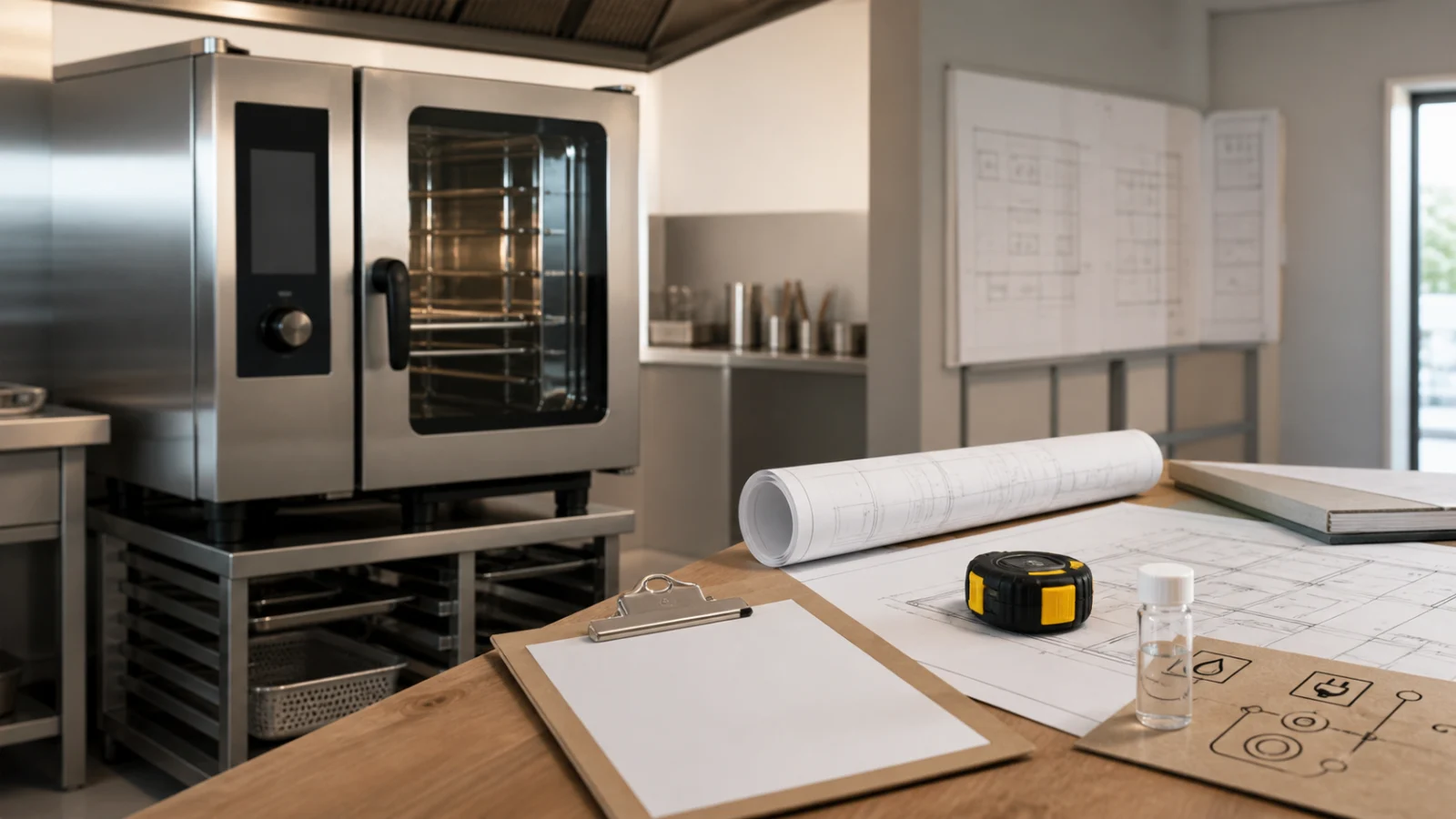
This is where most “cheap oven” purchases become expensive projects. Before you choose a model or a tray size, check the site. Installation is not a footnote — it’s a budget line.
The “Short-Run Rule” (budgeting without fantasy)
As a rule of thumb, installation cost and risk increase sharply when power, water, and drainage are not close to the oven’s final position. The longer the run, the more trades, penetrations, shutdowns, and variations you buy. Treat “services not nearby” as a planning problem, not a delivery-day surprise.
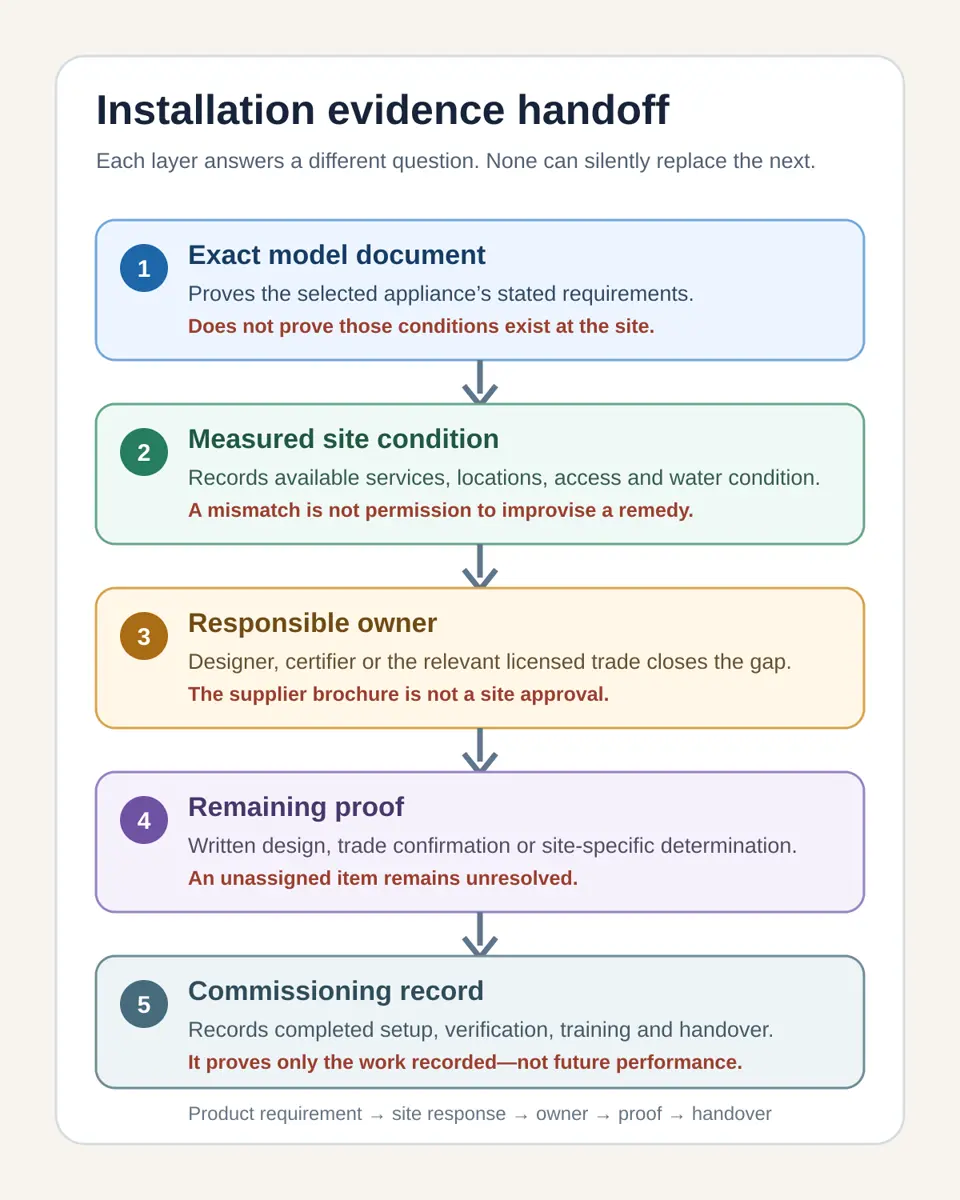
Site readiness checklist (print this for your designer and trades)
| What to verify | Where to check | Why it matters | Who confirms |
|---|---|---|---|
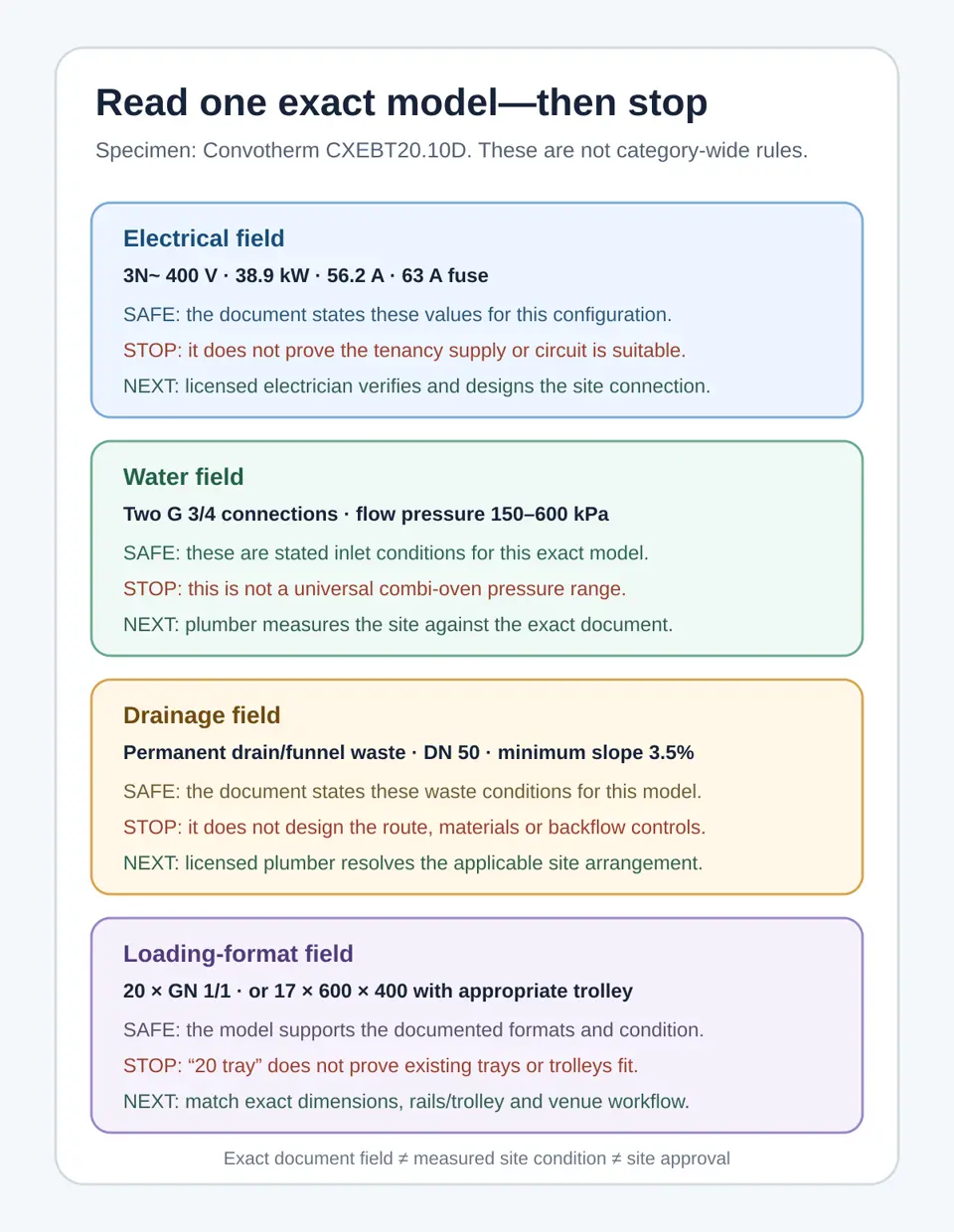
| Electrical supply (phase, amps, connection type) | Oven data plate + installation manual | Many commercial combis need dedicated circuits, isolation, and sometimes three-phase. “Electric” is not a plug type. | Licensed electrician + project designer |
| Water connection (cold feed, pressure limits) | Installation manual + on-site pressure check | Incorrect pressure can damage valves/solenoids; wrong connection planning causes delays and variations. | Licensed plumber |
| Drain arrangement (heat + hygiene + backflow prevention) | Installation manual + plumbing plan | Combis discharge hot condensate and cleaning water. Many installs require an indirect waste / air-gap approach to prevent contamination. | Licensed plumber |
| Ventilation / exhaust path (ducting, hood, discharge, make-up air) | Kitchen ventilation design | Ventilation is often the most expensive part of a fit-out. It also affects comfort, staff safety, and oven uptime. | Mechanical designer + certifier |
| Clearances + access (doorway, turning, service access) | Site measure + oven dimensional drawings | Delivery failure and “can’t service the unit” problems are preventable with pre-checks. | Builder + supplier + service agent |
Ventilation in Australia: what the NCC actually triggers
The National Construction Code (NCC) contains Deemed-to-Satisfy triggers for when a commercial kitchen must be provided with a kitchen exhaust hood complying with AS 1668.1 and AS 1668.2. These triggers are based on appliance power input (electric and gas) and, for multiple appliances, power input per square metre of floor area.
NCC 2022 (Volume One) kitchen local exhaust ventilation triggers (plain English)
| Trigger (summary) | What it means for your project | Why operators should care |
|---|---|---|
| High input single appliance (electric & gas thresholds apply) | Expect a compliant hood and designed exhaust solution referenced to AS 1668.1 / AS 1668.2. | This is where “we’ll deal with it later” becomes a major variation cost. |
| Multiple appliances (combined input per m² of kitchen floor area) | Even smaller appliances can trigger requirements when the total heat input is high for the room size. | Small tenancies (CBD, laneways, kiosks) are most at risk of heat and steam problems. |
| Exhaust hood compliance to AS 1668.1 and AS 1668.2 | Design and installation detail matters: hood type, capture, ducting, discharge, and fire/maintenance considerations. | A “working” fan is not the same as a compliant and effective system. |
If you want a deeper industry reference for designers and operators, AIRAH’s commercial kitchen exhaust management guideline explains the role of AS 1668.1 (fire and smoke control requirements) and AS 1668.2 (design and installation requirements, including kitchen exhaust as a form of local exhaust ventilation). It also points to AS 1668.2 Appendix E for hood-related detail.
Gas vs electric combi ovens (how to think about it without tribal politics)
Gas combi ovens
Gas appliances introduce combustion products, air supply considerations, and gas installation compliance. In many commercial designs, mechanical extraction and safety interlocking are treated as a planning assumption until the certifier and gasfitter confirm the final solution. If the safe operation of an appliance depends on mechanical air movement, interlocking and shut-off logic may be required as part of compliant design.
If you are also weighing a speed oven for high-velocity service, see our speed oven vs combi oven comparison.
Electric combi ovens
Electric ovens avoid combustion gases, but they still generate steam plume, heat load, and sometimes grease-laden vapour depending on menu and use. Even when a space uses condensation hoods or “ventless” accessory systems, you still must plan for:
- Room heat load: if the kitchen’s HVAC cannot remove heat, ambient temperature rises and electronics may fault or derate to protect themselves.
- Moisture management: unmanaged steam becomes condensation on walls, ceilings, and joinery — and it turns into mould and maintenance issues.
- Workflow reality: door-open service and frequent loading changes the plume and capture behaviour compared with a quiet demo.
Water & drainage: the “quiet failure” behind many service calls
Combi ovens are water machines as much as they are heat machines. Steam generation, rinsing, and cleaning cycles all depend on water quality and correct drainage. The installation manual for your specific model is the source of truth — not what “usually works”.
Water pressure (don’t guess)
Confirm your site’s water pressure and compare it to the oven’s rated inlet limits. If pressure is above the manufacturer’s maximum, your plumber may specify a pressure limiting valve to protect solenoids and valves. This is a prevention step, not an upsell.
Drainage (heat + hygiene)
Combi ovens discharge hot condensate and cleaning water. Many commercial installs use heat-rated drainage close to the outlet and an indirect waste / air-gap approach (often via a tundish) to help prevent contamination risks. Requirements vary with the site and local plumbing rules — confirm with your licensed plumber and your appliance documentation.
Part 3: Configuration
Don’t buy the wrong format: GN vs 600 × 400 (the tray ecosystem trap)
“How many trays?” is the wrong first question. The right first question is: which tray standard runs your kitchen? Choosing the wrong format can force you to replace trays, racks, trolleys, and shelving — an expensive mistake that doesn’t show up in the oven quote.
| Standard | Most common in | What it fits | Common mistake |
|---|---|---|---|
| Gastronorm (GN 1/1) | Restaurants, catering, hotels, clubs, many production kitchens | GN pans, stainless steam trays, line integration | Buying a bakery-format oven and realising your GN inventory doesn’t sit correctly on rails |
| Euronorm / Bakery (600 × 400) | Bakeries, patisserie, high-volume tray baking | 600 × 400 bake trays, bakery racks, bakery workflow | Buying GN format and discovering your 600 × 400 trays and racks don’t fit |
Sizing that matches service (not showroom fantasies)
The practical way to size a combi oven is to map it to your busiest hour. Instead of “10 trays sounds big”, measure:
- Peak covers per 60 minutes (or peak production volume)
- Menu mix (items that can batch cook vs items that must cook to order)
- Average cook cycle time including loading/unloading and recovery
- Holding strategy (hot holding, controlled humidity holding, or cook & chill + regen)
- Door-open frequency (rush behaviour changes output)
This is also where a pass-through (two-door) combi can make sense in larger kitchens: it separates raw-to-cooked flow, reduces cross-traffic, and supports cleaner HACCP discipline.
Tray selection guide (small accessory choices, big outcome differences)
The oven is the engine. Trays are the tyres. Wrong surfaces distort airflow, browning, and moisture release. Use the right tray surface for the job and you’ll get better colour, better lift, and less rework.
| Tray / accessory | Best used for | What it changes in the oven |
|---|---|---|
| Perforated trays | Pastry bases, croissants, items where base crispness matters; some steaming applications | Improves airflow/steam contact under the product, reducing soggy bases |
| Solid enamel / heavy trays | Roasting, potatoes, heavier bakes, bulk items | More thermal mass can improve browning stability compared with thin, warped trays |
| Non-stick trays / grids | Delicate proteins, sticky marinades, lower-stick workflow | Reduces sticking and tearing, often lowering labour and waste |
| Wire racks | Whole birds, roasts, items needing airflow around the product | Promotes more even browning and reduces “sweating” underneath |
| Food probe | Proteins, batch cooking, consistency across staff | Reduces overcooking and improves repeatability (especially with less-experienced teams) |
Cleaning systems: tablets vs liquids (the safety and consistency trade-off)
Most combi ovens are only as reliable as their cleaning routine. If cleaning doesn’t happen consistently, grease and scale build up, sensors drift, and service calls follow.
- Solid tablets / cartridges: often easier to dose consistently and reduce direct chemical handling.
- Liquid chemicals: can be cost-effective, but require disciplined handling, storage, and dosing to reduce splash and exposure risk.
Choose the system your team will actually follow on a Friday night — not the one that looks best in a showroom.
Part 4: The ROI Engine
ROI is not one number — it’s four levers
In Australian hospitality, the best combi oven ROI usually comes from a blend of: food yield, labour stability, service throughput, and reduced rework. You don’t need magic claims — you need a method you can measure.
For the labour-cost and ROI method in detail, see our combi oven ROI and labour-cost breakdown.
Lever 1: Yield (how to calculate it in your kitchen)
Humidity control and controlled cooking cycles can reduce drying and overcooking compared with basic ovens, but the only number that matters is your yield on your menu.
Yield worksheet (copy this table and fill it with your own data)
| Item | Raw weight (kg) | Cooked weight (kg) | Yield % (cooked ÷ raw) | $ per kg | $ value kept (vs your current baseline) |
|---|---|---|---|---|---|
| Beef roast | Your value | Your value | Your value | Your value | Your value |
| Pork belly | Your value | Your value | Your value | Your value | Your value |
| Chicken | Your value | Your value | Your value | Your value | Your value |
Quick formula (no hype, just math)
- Yield % = cooked weight ÷ raw weight
- $ impact = weekly raw volume × $/kg × (baseline shrinkage % − improved shrinkage %)
Lever 2: Labour stability (the hidden profit)
In many venues, consistency is the real win: fewer remakes, fewer “only one chef can do it”, easier onboarding, and fewer service failures. A combi oven that runs reliable programs can reduce chaos — if the team is trained and the oven is maintained.
Lever 3: Throughput (serving more with the same footprint)
When you batch cook smartly, you stop using the busiest 20 minutes of service as your only cooking window. That’s what a combi oven can unlock: shifting work to quieter times and smoothing the rush.
Lever 4: Cook & Chill + Regeneration (where combis become a system)
If you run catering, clubs, aged care, or any high-volume kitchen, the combi oven becomes far more valuable when paired with a blast chiller: cook in quiet periods, cool safely, store, and regenerate fast at peak.
For a deeper look at building this into a full production workflow, see our cook-and-chill and central production guide.
Food safety reality (Australia): cooling and reheating targets you must hit
Food Standards Australia New Zealand (FSANZ) publishes clear guidance for cooling cooked potentially hazardous food: cool from 60°C to 21°C within 2 hours, then from 21°C to 5°C within 4 hours. If reheating to hot hold, heat quickly to 60°C or hotter (FSANZ notes this should ideally be within 2 hours).
| Cook & Chill step | What “good” looks like | Why it matters |
|---|---|---|
| Cook (combi oven) | Consistent core temperature and repeatable program | Consistency reduces waste and rework; probe cooking helps standardise results |
| Cool (blast chiller or validated alternative process) | Meet FSANZ cooling guidance: 60°C → 21°C within 2 hours, then 21°C → 5°C within 4 hours | Rapid cooling limits time in the bacterial growth zone |
| Store | Cold holding at 5°C or colder wherever possible | Protects food safety and product quality |
| Regen (combi oven) | Reheat quickly to 60°C+ for hot holding | Fast, controlled reheating supports safe service and better texture |
The 2-hour / 4-hour rule (operators should know this cold)
FSANZ also explains the 2-hour / 4-hour rule for potentially hazardous food between 5°C and 60°C. The important operational point: time is cumulative across preparation, display, transport, and service. This matters when you’re doing cook & chill, banquets, off-site catering, or busy pass service.
Part 5: The Operating System (how you stop breakdowns and protect service)
Commissioning Day checklist (don’t sign off until these are done)
- Water treatment installed and documented: confirm it matches the oven’s required water parameters in the installation manual.
- Drain test: run a rinse/clean cycle and confirm the drain handles flow without backing up.
- Ventilation running as designed: verify capture and comfort during real operation (not just with an empty hotbox test).
- Electrical isolation accessible: isolator location is safe and reachable without moving the oven.
- First clean cycle completed: confirm chemicals are set up correctly and staff know the safe routine.
- Basic programs validated: at minimum: roast protein with probe, steam veg, bake pastry, retherm/regeneration.
- Service contact locked in: who to call, response expectations, and what photos/errors to send first.
Daily / weekly / monthly habits (the difference between uptime and downtime)
| Frequency | Action | Why it matters |
|---|---|---|
| Daily | Run the correct cleaning cycle; wipe door seal area; clear obvious debris | Prevents grease build-up and seal failure; reduces odours and sensor issues |
| Weekly | Inspect door seals; check spray arms/nozzles (if accessible); confirm drain is clear | Protects steam performance and prevents leak-related faults |
| Monthly | Review water filter condition / logs; confirm staff are dosing and storing chemicals correctly | Water issues and chemical mistakes are common causes of avoidable service calls |
| Quarterly | Planned service review (depending on usage); validate key cooking programs | Small issues caught early prevent service-killing failures later |
A simple training rule that works in real kitchens
Your combi oven should not live inside one person’s head. Train the team to master a small set of core programs and standards (probe cooking, baking, steaming, regeneration, cleaning). Consistency is where the profit is.
Part 6: Buying Checklist + FAQs
Buying checklist (questions that force clarity)
- Utilities: What exactly are the electrical (phase/amps), water, and drain requirements for this model?
- Water specs: What water parameters does the manufacturer require (hardness, chlorides, pH, TDS)? What treatment do they recommend?
- Ventilation: What does your mechanical designer/certifier require under the NCC and referenced standards for your specific site and menu?
- Format: GN or 600 × 400 — and does it match your trays, racks, trolleys, and workflow?
- Service: Who services this brand in your city (Sydney / Melbourne / Brisbane / Perth / Adelaide and regional areas)? What’s the typical response process?
- Commissioning: Who trains staff, validates cleaning setup, and confirms the installation meets the manual?
- Warranty conditions: What documentation do you need to keep (water treatment, cleaning chemicals, servicing logs)?
FAQ
Do I need a canopy / extraction for an electric combi oven in Australia?
Not every site is identical, but you should assume you need a ventilation plan. The NCC includes Deemed-to-Satisfy triggers for kitchen local exhaust ventilation based on appliance power input and references AS 1668.1 and AS 1668.2. Even when “ventless” accessories are used, heat load and moisture management still matter for comfort and reliability. Confirm your specific design with a qualified mechanical designer and certifier.
Can a combi oven proof or hold dough overnight?
A standard combi oven is not designed to refrigerate. For overnight dough control, use a retarder prover (cold hold + controlled proof) and then bake in the combi oven.
What should I check first: brand, trays, or installation?
Start with installation and tray format. If your kitchen can’t support ventilation, power, drainage, and water requirements, or if you buy the wrong tray ecosystem (GN vs 600 × 400), the “best brand” won’t save the project.
Is reverse osmosis (RO) always required?
No. Water treatment should match your measured water quality and the oven manufacturer’s required specifications. Some sites only need sediment/chlorine filtration; others need more advanced treatment depending on hardness and chlorides. The correct answer starts with a water test and the installation manual.
What’s the simplest way to plan ROI without guesswork?
Measure yield on your top proteins, map throughput to peak service, and quantify labour saved through repeatable programs and reduced rework. Use the yield worksheet in this guide and track results over a month — then annualise using your actual purchasing and sales volumes.
Sources and standards (Australia)
Below are primary and industry references used to keep this guide grounded. Always confirm site-specific requirements with qualified professionals.
- NCC 2022 (Volume One), Part F6: Kitchen local exhaust ventilation clause and referenced standards.
National Construction Code (ABCB) — Part F6 Light and ventilation - AS 1668.2:2024: Current edition spotlight and overview.
Standards Australia — Spotlight on AS 1668.2:2024 - AIRAH commercial kitchen exhaust guidance: Industry best-practice context for kitchen exhaust systems and referenced standards.
AIRAH — Commercial Kitchen Exhaust Management (PDF) - FSANZ cooling and reheating guidance: Time and temperature targets for cooling and reheating potentially hazardous food.
FSANZ — Cooling and reheating food - FSANZ 2-hour / 4-hour rule: Guidance on time as a control between 5°C and 60°C (time is cumulative).
FSANZ — 2-hour / 4-hour rule - Example state regulator resources (gas): Commercial kitchen installation guidance and checklists (state-specific).
Energy Safe Victoria — GIS 18: Connecting commercial catering equipment