
Choose a Commercial Vacuum Sealer by Food, Bag Type and Batch Demand
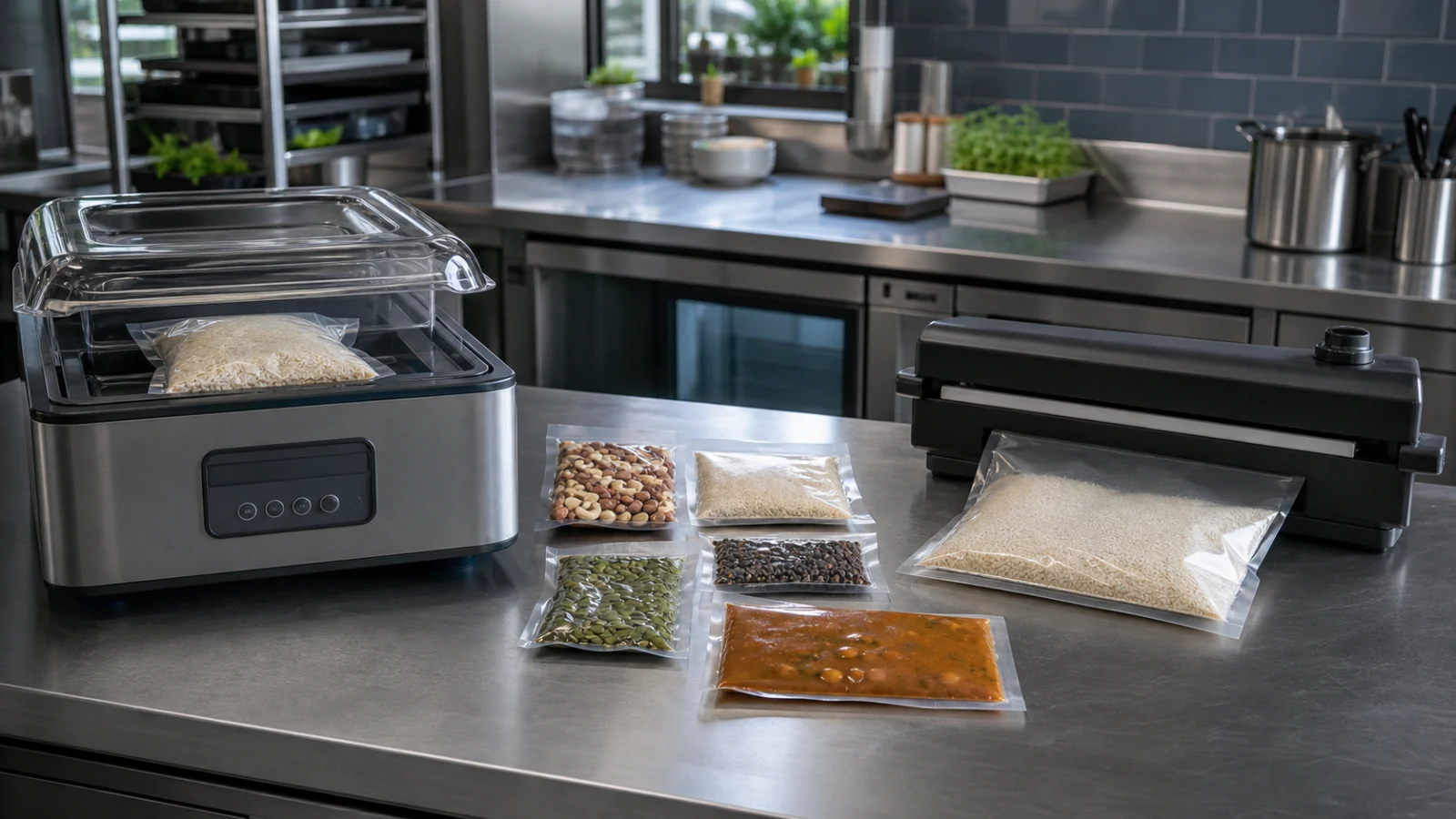
Short answer: For bagged soups, sauces, marinades and other products containing free liquid, start by assessing a chamber vacuum sealer that explicitly supports liquid packaging. For dry products, occasional sealing and compatible embossed or channel bags, an external suction model may be more practical. Assess production demand separately using the exact model’s chamber layout, controls, loading pattern and duty guidance.
The important word is start. “Chamber” does not automatically prove that a machine has the right liquid-control function, and “external” does not automatically mean domestic or unsuitable for professional work. A defensible choice joins five checks in order: food condition, vacuum mechanism, bag system, filled-pack fit and peak workflow.
Should You Buy a Chamber or External Vacuum Sealer?
Choose the mechanism from the product and packaging process, not from a venue label. A small café sealing dry portions occasionally may have a different answer from a café batching liquid sauces before service. A butcher packing large dry cuts may value the open workspace of an external machine, while another operation may need the enclosed control of a chamber machine.
A chamber machine lowers pressure around the whole open pouch inside an enclosed chamber, then seals the pouch before pressure returns. A conventional external suction machine leaves the product outside and draws air through the open end of the bag. That difference changes how liquids behave, how the bag must preserve an evacuation path and which pack dimensions matter.
Quick Decision Matrix
| Buying input | Start by assessing a chamber machine when… | Start by assessing an external machine when… | Still verify |
|---|---|---|---|
| Food condition | The filled bag contains free liquid, sauce or marinade, or the product needs controlled decompression. | The product is dry or otherwise approved for extraction through the open bag end. | The exact model’s approved product types, controls and procedure. |
| Bag system | You use compatible smooth chamber pouches or a documented chamber process. | You use the embossed or channel bag specified for the machine. | Exact machine, bag construction and operating mode; accessories can create exceptions. |
| Filled-pack size | The filled pouch can sit inside the usable chamber space with a clean, flat mouth across the bar. | The pack is awkward or long enough that enclosing it would be impractical. | Filled length, width, thickness, height, support and seal position. |
| Peak workflow | The exact chamber layout, controls and documented duty suit the peak loading pattern. | The exact external model and bag-handling routine suit the required repetition. | Bags per load, consecutive loads, operator time, changeover and documented duty. |
| Packaging objective | The documented process covers the required storage, cooking, cook-chill or container mode. | The documented bag or container mode covers the required dry-product process. | Bag time and temperature rating, food-process controls and any named accessory. |
This table narrows the investigation; it does not approve a model. The same venue can need different equipment when the food, bag or peak preparation window changes.
How Chamber and External Vacuum Sealers Work
Chamber vacuum sealers
With a chamber machine, the open pouch is placed inside the chamber and its mouth is positioned across the sealing bar. Pressure falls around the bag as well as inside it. The machine seals the pouch before the chamber returns to atmospheric pressure.
This mechanism is why chamber machines are the usual starting point for free liquids—but the mechanism is only the first gate. As pressure falls, a liquid’s boiling point also falls. Henkelman’s Liquid Control guidance explains that its named sensor detects evaporation and moves the cycle to sealing, helping reduce overflow and moisture reaching the pump. Confirm whether the exact machine provides suitable sensor control, insert plates or a manufacturer-approved procedure.
External suction vacuum sealers
With a conventional external machine, the product remains outside while the bag opening sits in the suction and sealing area. The machine needs a way to keep air moving out before the mouth is sealed. Embossed or channel bags commonly provide that path.
External does not mean “home use only”. Orved’s Fast Vacuum, for example, is presented for domestic or professional use and packages solid products in channelled bags. It handles liquids only through a named external container system—not by drawing loose liquid through the open end of a bag. That distinction matters more than the broad machine label.
Start with the Food: Dry, Moist or Free-Flowing Liquid?
Dry foods
Dry portions are the least complicated starting point, but they still need the correct bag and a clean sealing edge. External suction may be practical for occasional batches, especially when the pack would be inconvenient to enclose. Chamber equipment remains an option when other needs—such as repeatable programs, chamber loading or a wider packaging workflow—justify it.
Moist and marinated foods
“Moist” is not one condition. Surface moisture, a thick marinade and free-flowing sauce behave differently at the bag mouth and as pressure falls. Record which condition actually reaches the machine. Do not assume a marketing description such as “suitable for moist food” defines the procedure, fill limit or control setting.
Soups, sauces and free liquids
Start with a chamber model that explicitly documents the intended liquid process. The exact Sammic SE-208, for example, separately lists sensor control, safe liquid packing, pulse-controlled decompression and an internal chamber size. Those are distinct facts. Its pump-capacity number alone would not establish liquid handling or output.
Delicate, crush-sensitive or sharp products
These products may need a controlled vacuum level, staged cycle, gentle decompression or a stronger pouch. Sharp edges can also threaten the pouch after sealing. Treat the product risk and bag specification as separate checks; changing the machine type does not automatically solve either one.
Match the Bag to the Vacuum Path
The useful general rule is mechanical: the bag and operating mode must preserve the evacuation path the machine expects. Conventional external suction commonly uses embossed or channel material. Conventional chamber operation commonly uses smooth chamber pouches.
But “external equals embossed and chamber equals smooth” is not a universal compatibility law. Orved’s exact EVOX 25 technical data sheet lists smooth bags for storage, cooking and cook-chill inside the chamber, while also listing embossed bags for an external-vacuum accessory. Other external machines use probes that support particular smooth bags. Always confirm the exact machine, accessory, bag and operating mode together.
Machine compatibility is also different from the bag’s intended use. A pouch may evacuate and seal correctly but still lack the documented temperature-and-time rating for a planned cooking or cook-chill process. Check the exact bag document; do not treat the word “sous-vide” as an unlimited rating.
Why Seal-Bar Width Alone Does Not Prove the Pack Will Fit
A 310 mm sealing bar does not prove that every filled bag with a nominal 300 mm mouth will sit correctly. Filling changes the pouch’s length, thickness and height. The open edge still needs enough clean material to lie flat, without food, liquid, folds or crowding interrupting the seal.
The EVOX 25 sheet demonstrates why labels must be read separately: it lists a 260 mm sealing length, a 290 × 300 × 109 mm chamber and 235 mm of useful chamber space. Those numbers answer different questions. Filling plates, an inclined insert, the position or number of sealing bars and the shape of the product can change the usable arrangement again.
Before shortlisting a chamber machine, measure a representative pouch after filling. Record its mouth width, overall filled length, thickest point and product height. Then check how it lies—not merely whether an unfilled bag is narrower than the bar.
For the complete method, use the filled-pouch and chamber-layout verification guide to record the clean pouch neck, working space and proposed pack arrangement before comparing exact models.
Separate Machine Capacity from Production Throughput
Pump capacity is an equipment parameter, not a finished bags-per-hour promise. Throughput also depends on chamber volume, target vacuum, product condition, sealing and decompression settings, bags per load, loading and unloading time, bag-mouth preparation, labelling, cleaning and changeovers.
Production class matters as well. MULTIVAC separates tabletop, free-standing, double-chamber and chamber-belt machines, and describes tabletop formats for small batches. This is why “chamber” cannot automatically mean high output. A double-chamber layout can support a different loading rhythm from a compact single-chamber unit, but the exact model and process still determine the result.
Instead of asking only “How many bags per day?”, record the busiest packaging window. One hundred bags spread across a day is a different requirement from one hundred bags needed before lunch service. Note bags per load, consecutive loads, available minutes, product changes and who will load, unload, label and clean.
Chamber or External Sealer by Venue Type
Venue type can suggest a starting question, but it cannot decide the machine:
- Café or small restaurant: an external unit may suit occasional dry portions; regular bagged sauces or liquid-heavy prep changes the starting mechanism and control requirements.
- Butcher or deli: filled cut size, sharp bones, pouch strength and the peak packing window may matter more than a simple daily total.
- Caterer: variable pack sizes and short pre-event production windows may make loading pattern and changeover particularly important.
- Central production kitchen: peak throughput, repeatable programs, chamber layout, workflow integration and documented duty deserve a separate production assessment.
Use these examples to identify what to measure, not to skip exact-model verification.
Special case: coffee roasters with a bakery operation
Freshly roasted coffee beans expose an important exception: a dry product does not automatically make conventional external vacuum packaging the correct process. Roasted beans continue releasing carbon dioxide after roasting. A peer-reviewed study of roasted-coffee degassing describes the common use of one-way-valve packaging so excess gas can escape without significant pressure build-up. Its experiments also show that degassing behaviour varies with the coffee and roast conditions. See the Journal of Agricultural and Food Chemistry study.
Before recommending a vacuum sealer to a roaster, establish whether the product is freshly roasted whole bean, rested whole bean or ground coffee; confirm the cooling and degassing process; and identify whether the intended retail pouch uses a one-way valve. The right packaging station may be a heat sealer for compatible high-barrier valve bags, or a separately engineered gas-flush process, rather than a conventional vacuum cycle. Do not infer a fixed waiting time or packaging temperature: these require the roaster’s validated process, coffee profile, pouch and valve specifications.
Assess the bakery products as a separate workflow. Bread, croissants and soft cakes may deform under strong vacuum; biscuits and other firm dry products may be more workable; moist fillings, sauces and free liquids introduce different machine, hygiene and temperature-control questions. A combined coffee-roastery and bakery venue may therefore need one sealing solution for valve coffee bags and a different vacuum workflow for selected bakery products—not one machine chosen from the venue name.
What to Record Before Requesting a Quote
- Product condition: dry, moist surface, marinated, free liquid, powder, delicate or sharp.
- Current bag: brand or specification, smooth or channelled, pre-cut or roll, and storage/cooking purpose.
- Filled pouch: mouth width, filled length, thickness and maximum product height.
- Peak workflow: bags per load, consecutive loads and the busiest available time window.
- Packaging objective: storage, freezing, cooking, cook-chill, external container or MAP.
- Product risks: sharp bones, fragile food, powder, liquid at the mouth or likely folds.
- Machine location: bench or floor area, open-lid clearance, landing space, power and cleaning access.
- Maintenance capacity: who will clean the chamber and bar, inspect gaskets and manage documented pump care.
With those inputs, you can browse KW’s commercial vacuum sealers without treating every listed machine as equivalent. If the shortlist is still unclear, send KW the completed measurements and workflow for an exact-model documentation check.
Food-Safety and Sous-Vide Boundary
Machine-compatible, temperature-rated and food-process-safe are three different decisions. Vacuum sealing does not validate shelf life or make food automatically safe. It also does not replace hygiene, cooking, cooling, refrigerated storage, labelling or cross-contamination controls.
The NSW Food Authority’s sous-vide guidance identifies risks across preparation, low-temperature cooking, cooling and refrigeration. A commercial food business must manage the whole process under the applicable requirements; choosing a sealer is only one equipment step.
Frequently Asked Questions
Can a chamber vacuum sealer use embossed bags?
Sometimes, but only when the exact chamber model supports an approved external-vacuum mode or accessory. In normal chamber operation, smooth chamber pouches are common. Confirm the machine, accessory, bag and selected program rather than assuming all chamber machines accept every bag.
Can an external vacuum sealer package liquids?
Do not assume an external machine can draw free liquid through an open bag. Some models support liquids in compatible rigid containers or other named accessories. For bagged soups and sauces, start with a chamber model that explicitly documents the intended liquid process.
Does a bigger vacuum pump mean more bags per hour?
No direct conversion is defensible without exact operating conditions. Chamber volume, target vacuum, product, seal and decompression settings, bags per load, loading time, labelling, changeover and documented duty all affect output.
Should freshly roasted coffee beans be vacuum sealed?
Do not decide from the fact that coffee beans are dry. Freshly roasted coffee continues releasing carbon dioxide, so the roaster’s cooling and degassing process, whole-bean or ground format, pouch barrier and any one-way valve must be assessed first. The appropriate station may use compatible valve bags and heat sealing rather than a conventional vacuum cycle; confirm the exact process instead of applying a universal waiting time.
How much smaller must a bag be than the sealing bar?
There is no universal allowance. The bag mouth must fit the documented sealing arrangement, but the filled length, thickness, height, usable chamber space and clean flat material at the mouth also matter. Test a representative filled pouch against the exact model drawing or manual.
Does vacuum sealing establish a safe shelf life?
No. The machine creates and seals a package; it does not validate the venue’s shelf life or food process. Hygiene, formulation, cooking, cooling, refrigeration, labelling and reduced-oxygen risks require separate control and, where necessary, specialist validation.