
Check Whether a Filled Vacuum Bag Will Fit Before Choosing a Chamber Sealer
Commercial vacuum sealer sizing
A filled vacuum pouch fits correctly only when the real filled pack can lie in the machine’s exact working chamber configuration and its clean, food-free open end can sit flat over the sealing bar. Chamber dimensions, seal-bar length and pump capacity are separate specifications; none proves fit alone.
Start with three separate questions. Pack-fit asks whether one representative filled pouch can be positioned and sealed correctly. Layout-fit asks whether the number of packs you want to load together can be arranged correctly. Throughput-fit asks whether the machine can complete the peak workload in the available time. This guide owns the first two questions. Throughput needs a separate assessment of cycle controls, loading work and documented duty.
If you have not yet decided whether your product and bag system call for chamber or external suction, begin with the commercial chamber-versus-external vacuum sealer guide. Once the mechanism is chosen, use the method below before comparing prices or assuming that a nominal dimension will work.
Measure the Filled Pack, Not Only the Empty Pouch
An empty pouch is flat. Filling it changes the footprint: product occupies length, pushes the sides outward and creates height. An irregular cut of meat, block of cheese or container-shaped portion may use the same nominal pouch as another product while forming a very different pack.
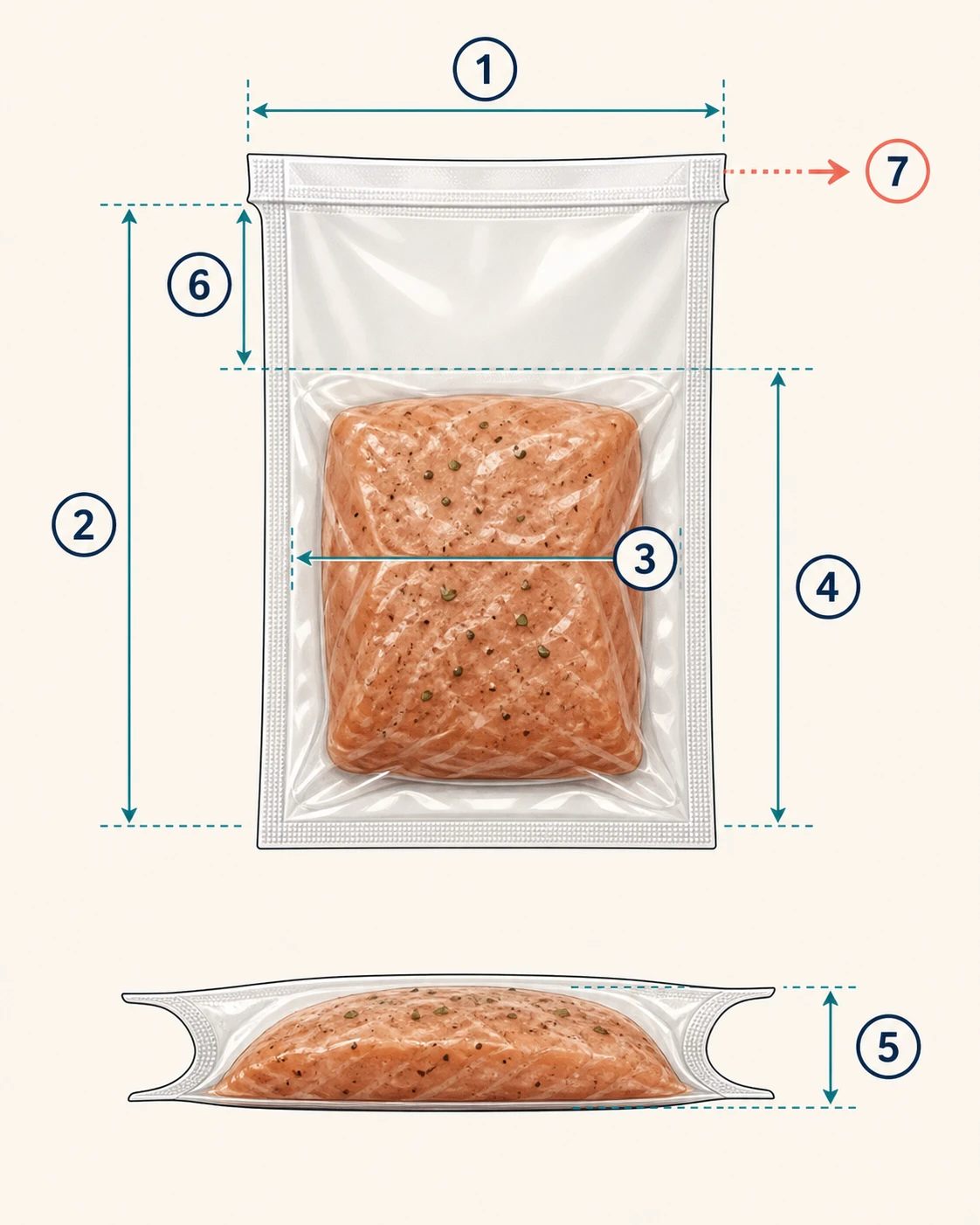
Measure the largest portion you genuinely expect to pack, not an average portion and not the empty bag alone. Fill the pouch in the normal orientation, place it on a flat surface and record:
- the empty pouch width and length;
- the exact bag SKU, if it has already been purchased;
- the maximum filled width and length;
- the maximum filled height or thickness;
- which edge of the pouch remains open;
- the clean, food-free pouch neck between the product and open edge; and
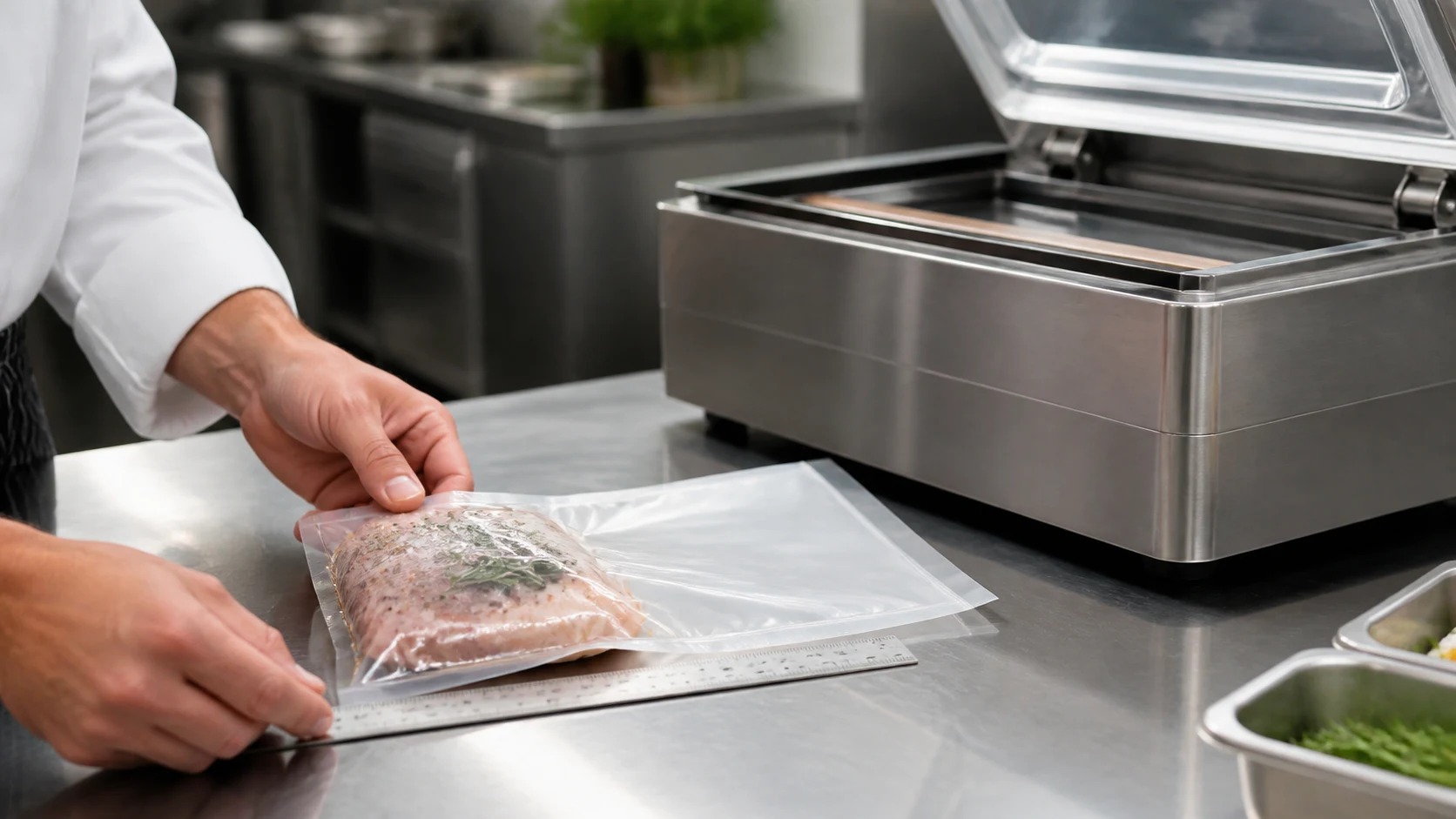
- a photograph of the representative filled pouch beside a ruler.
Do not add a generic allowance such as 50 mm or 75 mm to every pouch. The correct free material and placement depend on the exact bag, product, machine and manufacturer instructions. The useful observation is whether the neck remains clean and can lie flat where the machine seals it.
Why Published Chamber Dimensions Do Not Automatically Equal Usable Pack Space
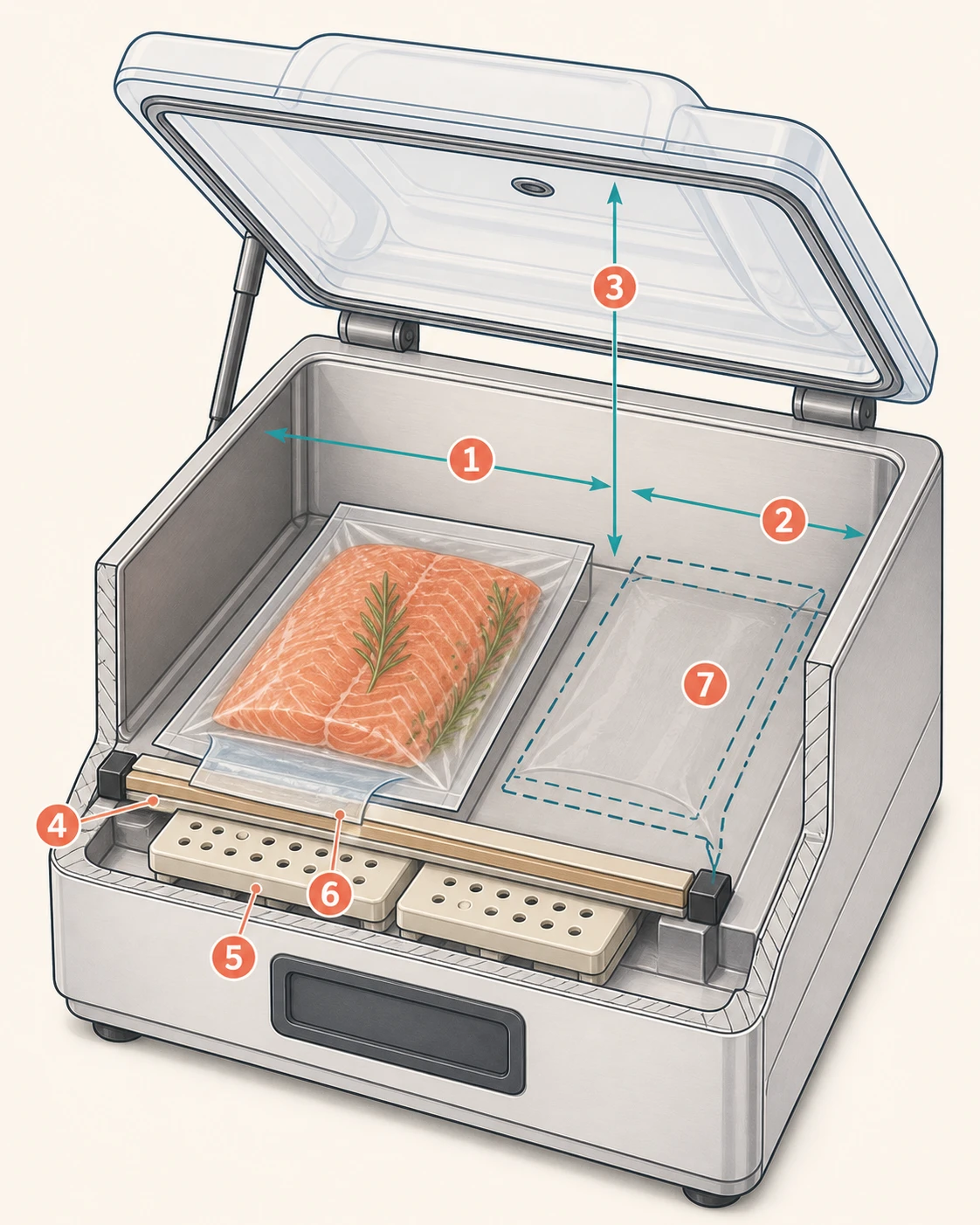
Published chamber dimensions describe a manufacturer-defined internal measurement. They do not automatically describe every part of the space available to a filled product in its working position.
Lid shape, chamber depth, sealing-bar location, filling plates, an inclined insert and the shape of the product can all affect the arrangement. A domed or shaped lid is not a rectangular box. A filling plate changes the level at which the pouch rests. Removing or adding an approved plate may change placement, but it does not authorise an improvised configuration outside the manufacturer’s instructions.
The exact Orved EVOX 25 technical sheet demonstrates why the labels must remain separate. It publishes a 260 mm sealing length, chamber dimensions of 290 × 300 × 109 mm and a separate 235 mm “useful space chamber” field. It also lists two PE filling plates. Those figures answer related but different questions; the sheet does not turn them into a universal filled-pouch envelope.
Screening rule: compare the filled pack with the available manufacturer fields, but treat a dimensional screen as provisional. A screen pass still requires verification against the exact chamber and sealing layout.
Never Calculate Maximum Bag Size from Chamber Dimensions
Maximum bag dimensions should be quoted only when the manufacturer publishes them for the exact model. Do not calculate them from chamber width, depth and height.
Orved’s current Idea 30 product page, for example, lists each field independently: vacuum chamber dimensions of 351 × 334 × 190 mm, a 310 mm sealing bar and maximum bag dimensions of 300 × 350 mm. The maximum-bag field is manufacturer evidence; it is not an arithmetic result derived from the chamber dimensions.
There is also a source-version warning. The current Idea 30 technical PDF retrieved during this research lists chamber dimensions of 334 × 347 × 190 mm, while the current product page lists 351 × 334 × 190 mm. KW has not combined those figures or chosen one by convenience. When current manufacturer sources disagree, send the actual filled pack and exact proposed configuration for verification.
Even a manufacturer-published maximum bag size does not prove that every filled product in that nominal bag will fit. A flat pouch and an irregular filled pack do not occupy the same shape, and the open edge still needs to reach the sealing bar correctly.
Check the Clean Pouch Neck and Open-End Position
The pouch needs a clean, flat path from the filled product to the sealing position:
Filled product ends → clean, flat pouch neck → open edge positioned over the sealing bar
Photograph this section of the real pack. The image should show where the food ends, how much uncontaminated pouch remains and which edge will sit across the bar. A ruler in the same plane gives the supplier something more reliable than “the bag is about 300 mm”.
Record a screen fail when an observable physical condition already prevents correct placement:
- the product reaches or crosses the sealing bar;
- the pouch mouth cannot lie flat without twisting;
- food, oil or free liquid occupies the intended seal area;
- folds or wrinkles remain where the closure must form; or
- the pack crowds the lid, bar or another pack in the proposed arrangement.
These are screening observations, not repair instructions or a guarantee of seal quality. Bag construction, sealing settings, product condition and the exact machine procedure remain separate checks.
Screen a Multi-Pack Layout Without Inventing Bags per Cycle
Once one pack has passed the physical screen, arrange the number of representative packs you would like to load together. Do not estimate the answer by dividing the sealing-bar length by the nominal bag width.
The relevant relationship is:
Bag-mouth width + filled-pack footprint + bar position + chamber geometry + working configuration → potential physical layout
Henkelman’s single-chamber product guidance explains that the number of sealing bars and the corresponding net chamber dimensions determine the size and quantity of products that can be vacuum-packed in one cycle. Both parts of that statement matter. Two sealing bars do not automatically mean two bags, and a 500 mm bar does not prove that two nominal 250 mm pouch mouths will fit once the products are filled and positioned.
Sketch or photograph the intended arrangement. Mark which pouch mouth reaches which bar, whether the packs overlap or crowd each other, and whether the lid can close in the approved working configuration. The result is still a proposed layout, not a throughput promise.
A Larger Vacuum Pump Does Not Make a Larger Bag Fit
Pump capacity, chamber geometry and sealing configuration are different specification families.
The exact Sammic SE-208 page separately lists an 8 m³/h pump, internal dimensions of 288 × 333 × 110 mm and a 280 mm sealing bar. The pump figure describes part of the vacuum process. The internal geometry helps screen physical placement. The sealing bar determines where closure is formed. A larger pump number does not create more room for a pouch.
| Specification or input | Question it helps answer | What it cannot decide alone |
|---|---|---|
| Filled pack W × L × H | What physical shape must be accommodated? | Whether the exact machine layout is approved |
| Chamber dimensions | What internal dimensions has the manufacturer published? | Guaranteed usable working space |
| Manufacturer maximum bag dimensions | What nominal limit has the manufacturer explicitly stated? | Fit of every filled or irregular product |
| Seal-bar length and position | Where and across what published length can closure occur? | Maximum filled-pouch width or bags per cycle |
| Pump capacity | Which pump specification belongs to the exact model? | Physical pouch capacity or bags per hour |
| Desired packs per cycle | Which physical arrangement should be checked? | Peak production output |
Complete the Filled-Pack Verification Card Before Comparing Models
Use one representative card for the largest real pack. If you have several materially different products, create a card for each shape rather than assuming that the pouch label tells the whole story.
| Field | What KW needs |
|---|---|
| Empty pouch | Width × length and exact SKU if already purchased |
| Filled pack | Maximum actual width × length × height/thickness |
| Product | Product form, including whether it is liquid, irregular or bulky |
| Open end | Which edge must be placed across the sealing bar |
| Clean pouch neck | Photo showing clean, flat material between the product and open edge |
| Largest portion | The actual maximum representative portion, not an average |
| Desired packs per cycle | One, two, three or more as a layout request—not an output claim |
| Peak batches | Operational context for the separate throughput assessment |
| Evidence photo | The filled representative pouch beside a ruler |
| Machine candidate | Exact brand, model and intended chamber/bar configuration |
Classify the first screen honestly:
- Screen fail: an observable physical condition already prevents correct positioning.
- Screen pass: the available dimensions appear compatible, but exact layout verification is still required.
- More evidence required: the pack, machine configuration or manufacturer field is missing or conflicted.
To narrow the right models, send KW the completed card, a ruler photo of the largest filled pack and the exact machine you are considering. That gives the team a concrete pack and layout to verify before price becomes the deciding factor. You can then browse the commercial vacuum sealer range or contact KW Commercial Kitchen with the measurements ready.
Frequently Asked Questions
Can I choose a chamber sealer from the bag’s printed size?
No. The printed empty-pouch size is one input. Measure the actual filled pack, identify the clean pouch neck and verify the open-edge position against the exact chamber and sealing layout.
Does a 300 mm sealing bar accept every 300 mm pouch?
No. Seal-bar length alone does not prove that the filled pack can lie correctly or that its mouth can sit flat without crowding, folds or contamination.
Do two sealing bars mean two bags per cycle?
Not automatically. Potential layout depends on bag-mouth width, filled-pack footprint, bar positions, chamber geometry and the exact working configuration.
What photograph should I send before requesting a quote?
Photograph the largest representative filled pouch beside a ruler. Show its overall filled dimensions, where the product ends, the clean pouch neck and which open edge must reach the sealing bar.