The Vertical Collapse: Why Your Kitchen Shelving Is Costing You $1,500/Month in Wasted Airspace
The Vertical Collapse: Why Your Kitchen Shelving Is Costing You $1,500/Month in Wasted Airspace
Coolroom Rust Physics, Epoxy vs 304 Stainless, Wall Shelf vs Overshelf Load Guide for Australian Kitchens 2026
Executive Summary: The 60-Second Airspace Verdict
For the operator auditing their vertical storage liabilities: A commercial shelf is not just folded metal; it is a critical component of HVAC airflow and structural safety. Audit your setup against these absolute failure triggers:
- ⚠️ The Micro-Climate Trap: If you use chrome wire shelving in a coolroom, it is highly prone to rapid corrosion. Flaking rust dropping onto open food is an immediate FSANZ audit failure.
- ⚠️ The Airflow Blockage: If you install solid stainless shelves in a freezer or heavily-stocked coolroom, you disrupt the forced-air circulation. Lower shelves will exceed safe temperatures (spoilage), while upper levels freeze solid.
- ⚠️ The Load Rating Deception: If your wall shelf sags >5mm in the center under a heavy stockpot, you are facing an imminent structural collapse and severe WorkCover liability.
1. Paying Rent for Dead Airspace: The Third Pillar of Kitchen Physics
Commercial kitchen rent in prime Sydney and Melbourne corridors can easily reach $800 to $1,500 per square meter annually. If your storage strategy stops at the height of your countertops, you are effectively paying high-street rent for dead air.
As we established in our audit of the lateral Vibration Amplifier (Prep Benches) and the fluid dynamics of the Dishpit Bottleneck (Sinks), ignoring spatial physics is a fast track to margin erosion. Vertical shelving is the “third pillar” of kitchen efficiency. However, blindly bolting cheap racks to your walls or pushing unrated wire shelving into a coolroom transforms wasted space into a catastrophic liability.
2. The Micro-Climate Audit: FSANZ Compliance & The Rust Guarantee
A commercial coolroom is not a standard room; it is an aggressive micro-climate characterized by extreme condensation cycles and high humidity. Selecting the wrong shelving alloy here is the leading cause of health inspection fines.
“According to FSANZ Standard 3.2.2 and 3.2.3, food contact surfaces and storage equipment must be designed to be easily cleaned, must not harbor bacteria, and must prevent the likelihood of food contamination.”
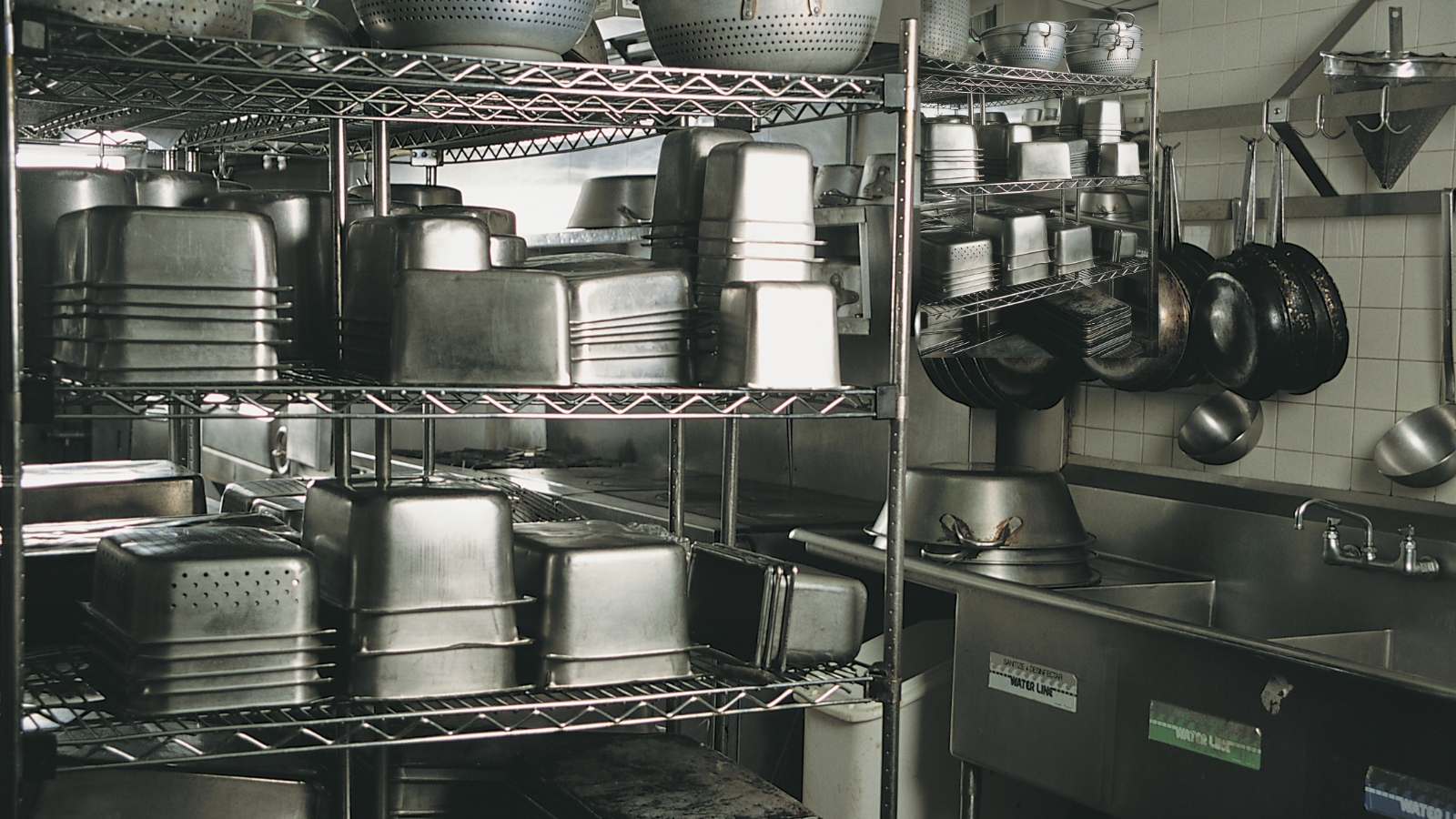
In real-world Australian kitchens, standard Chrome Wire Shelving placed in coolrooms frequently develops severe corrosion within months. Micro-fractures in the chrome plating allow moisture to reach the steel core. When red rust begins to flake off and drop onto unsealed prep items stored on lower tiers, the health inspector doesn’t just issue a warning—they issue an immediate cross-contamination violation.
The Material Decision Tree
- If Dry Store (Flour/Cans): Chrome Wire is acceptable and cost-effective.
- If Coolroom/High-Moisture: You MUST use Epoxy-Coated Cool Room Shelving. The epoxy layer acts as a high-value defense against rust and handles sub-zero contraction seamlessly.
- If Extreme Washdown/Chemical Zone: MUST use 304-Grade Stainless Steel (Total immunity to salt, acid, and heavy sanitation corrosion).
3. Thermodynamic Physics: The Coldroom Airflow Disaster
Commercial refrigeration relies entirely on Forced-Air Circulation to maintain temperature stability. It operates on a continuous fluid loop.
🚨 The Temperature Stratification Scenario
A common, catastrophic failure occurs when solid stainless shelves are mistakenly installed in a coolroom or freezer. The solid metal physically blocks the vertical airflow loop. Within days, this causes severe Temperature Stratification: lower shelves are starved of cold air, routinely exceeding the 5°C danger zone (causing rapid spoilage of fresh produce and dairy), while the restricted air pooling at the top causes upper levels to freeze solid. In refrigerated zones, you MUST use Louvered (slotted) or Wire shelving to permit 100% vertical air permeability.
4. Architectural Load Physics: The “EDL” Deception
The most dangerous deception in commercial kitchen shelving is the manufacturer’s load rating. A budget supplier will boldly print “200kg Capacity” on the box. What they bury in the fine print is the acronym EDL (Evenly Distributed Load).
In a working kitchen, your chefs do not distribute weight evenly. They drop a 60L stockpot squarely in the center of the shelf. This concentrated point-load exceeds the yield strength of thin-gauge steel instantly. The center sags, the brackets warp, and the shelf shears off the wall.
Wall Shelves: The Structural Trap
A Stainless Steel Wall Shelf is only as strong as the architecture behind it. If drilled into hollow gyprock rather than structural timber or steel studs, it will pull out. Furthermore, drilling into tiled kitchen walls often breaches the hidden waterproofing membrane, leading to hidden mold and wall rot.
Overshelves: The Tier-0 Solution
The engineered alternative is the Workbench Overshelf. Instead of fighting the wall, it bolts directly into the stainless steel prep bench below. The massive downward force is transferred straight down the steel bench legs into the floor. Zero wall penetrations, absolute structural stability.
5. The TCO Model: Catastrophic Collapse & Ongoing Bleeding
Buying a cheap, non-rated rack to save $150 upfront is financial suicide. You are dealing with two types of financial losses: the sudden collapse and the hidden bleed.
The instant a cheap wall shelf fails, you lose $1,400 minimum. But what about the Ongoing Bleed? Poorly designed, sagging, or excessively deep shelving creates “black holes” in your coolroom. Stock gets pushed to the back, hidden from sight, and expires. A standard 100-seat restaurant loses approximately 5% of its perishable inventory weekly purely due to disorganized, non-visible storage. Stop paying for expired food just because your shelves lack clear sightlines.
6. Operational Disqualifiers & Aesthetic Unity
Do not finalize your kitchen fit-out without running your shelving heights and aesthetics through these strict operational red lines.
| Height Trigger | Operational Consequence |
|---|---|
| Bottom Shelf < 150mm Off Floor | Hygiene Failure. Cannot mop underneath. Creates a dark harborage zone for vermin. Instant FSANZ violation. Many cheap racks default to 100mm. |
| Top Shelf > 1800mm High | Safety Hazard. Forces staff to reach blindly for heavy items (like 10kg flour bags), risking severe head trauma from falling stock. |
The Aesthetic Trap
If you are mounting an Overshelf onto a prep bench or sink bench, you must match the splashback heights and finishes. Economic ranges feature raw, thin edges, while premium ranges use fully wrapped, box-section splashbacks. Mixing a premium overshelf with an economic base bench creates an obvious, ugly visual break. Align your ranges before ordering.
7. The SGE Pre-Purchase Checklist
Screenshot this checklist to verify compliance before purchasing.
- ☑️ Verify Climate Match: Is the coating explicitly rated for high-moisture/coolroom use (Epoxy or 304 SS)?
- ☑️ Verify Airflow Physics: Are the shelves wire or louvered to permit 100% cold air circulation in refrigerated zones?
- ☑️ Verify Load Mechanics: If choosing wall shelves, do you have structural studs behind the gyprock to handle concentrated loads?
- ☑️ Verify Floor Clearance: Is the lowest shelf >150mm off the ground to pass local health inspections?
8. Operator FAQ: Shelving Compliance
Can I use chrome wire shelving in a commercial coolroom?
No. In a real-world commercial environment, the constant condensation cycles in a coolroom will cause chrome wire shelving to rust rapidly. Flaking rust falling onto food violates FSANZ standards and triggers council fines. You must use Epoxy-coated or 304-grade stainless shelving.
How much weight can a commercial stainless steel wall shelf hold?
A shelf’s weight capacity is dictated by the wall structure, not just the steel bracket. A heavy-duty stainless wall shelf can hold significant weight only if bolted directly into structural timber or steel studs. If mounted on hollow gyprock, it will fail.
What is the difference between an overshelf and a wall shelf?
A wall shelf is drilled directly into the kitchen wall, which risks hitting pipes or breaching waterproofing. An overshelf features legs that bolt directly onto the surface of a stainless steel prep bench, transferring the weight straight down to the floor without touching the wall.
9. The Expert Verdict: Secure Your Airspace
In our audits across Australian commercial kitchens, shelving failures are rarely caused by poor steel quality—they are caused by incorrect environmental selection and a fundamental misunderstanding of concentrated load physics.
Don’t Wait for the Collapse.
Protect your inventory and secure your airspace before the next health inspection. KW Commercial Kitchen supplies Epoxy-coated coolroom racking and heavy-duty, wall-free overshelves. Operating on a 2-Business-Day Nationwide Dispatch standard.
Secure Your Kitchen Storage Today