
One Chassis, Two Capacity Decisions: When Does a Commercial Oven Range Fit the Line?
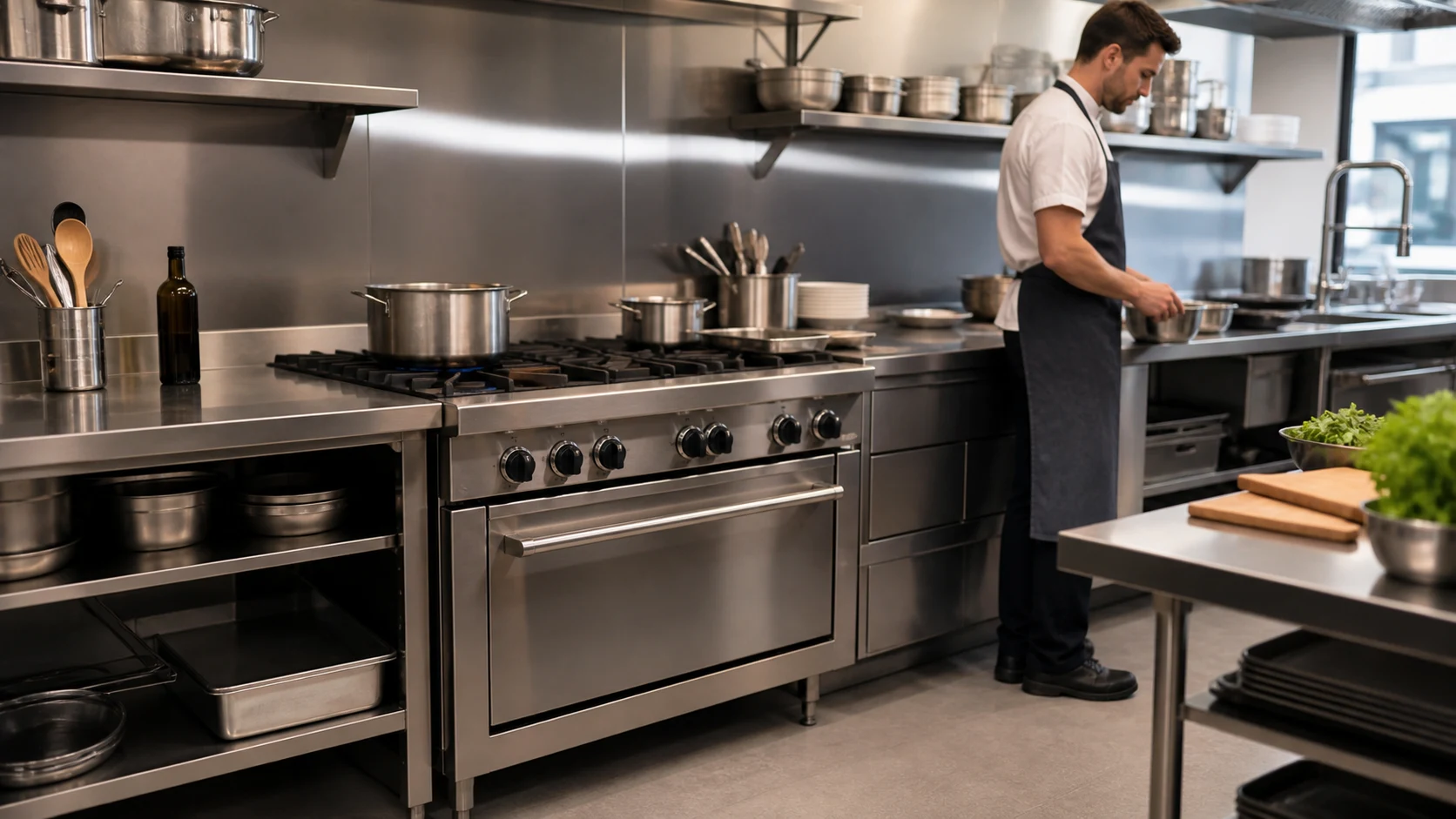
A commercial oven range puts a cooking top and an oven in one chassis. It does not turn them into one capacity decision.
The top still has to handle its own peak cooking job. The oven still has to handle a different set of products, loads and timings. An integrated range is a good fit only when those two jobs suit the exact configuration, belong at the same station and can be installed with the required access and services.
That is the decision hidden by the familiar description “cooktop with oven”. The shared cabinet is visible. The two separate demands inside it are easier to miss.
Start with two jobs, not one appliance
Before looking at burner counts or oven dimensions, describe what each half has to do during the same peak window.
On the top, list the cooking tasks that must run at once. A pot occupying an open burner is not the same job as a pan moving repeatedly on and off the heat, and neither is interchangeable with a griddle section. The useful input is not covers per day. It is the set of simultaneous top-side tasks, the cookware they require and how long they occupy their positions.
Then treat the oven as a separate production question. What products need it during that same window? What cooking process applies? How many loads overlap with top-side demand? A published cavity or rack field describes part of the exact oven. It does not, on its own, establish the useful output of a menu with particular products, temperatures, load patterns and recovery needs.
This distinction changes the purchase question. A six-burner top and an oven cavity are not one combined capacity number. One side can fit its job while the other is under-sized, over-specified or simply needed at a different point in service.
One chassis, two demand axes
| Demand axis | Establish from the kitchen job | Verify on the exact model | Do not infer |
|---|---|---|---|
| Top cooking | Simultaneous pots, pans or top-surface tasks; cookware; task duration | Open-burner, griddle or other top configuration; documented controls and input | Peak throughput from burner count alone |
| Oven cooking | Products, process, batch/load pattern and when oven work peaks | Oven type; documented cavity, rack arrangement, controls and input | Whole-line capacity from cavity or rack count alone |
| Shared station | Whether the cook using the top also needs the oven at that location and time | Overall configuration, dimensions and documented access | Better workflow merely because both functions share a chassis |
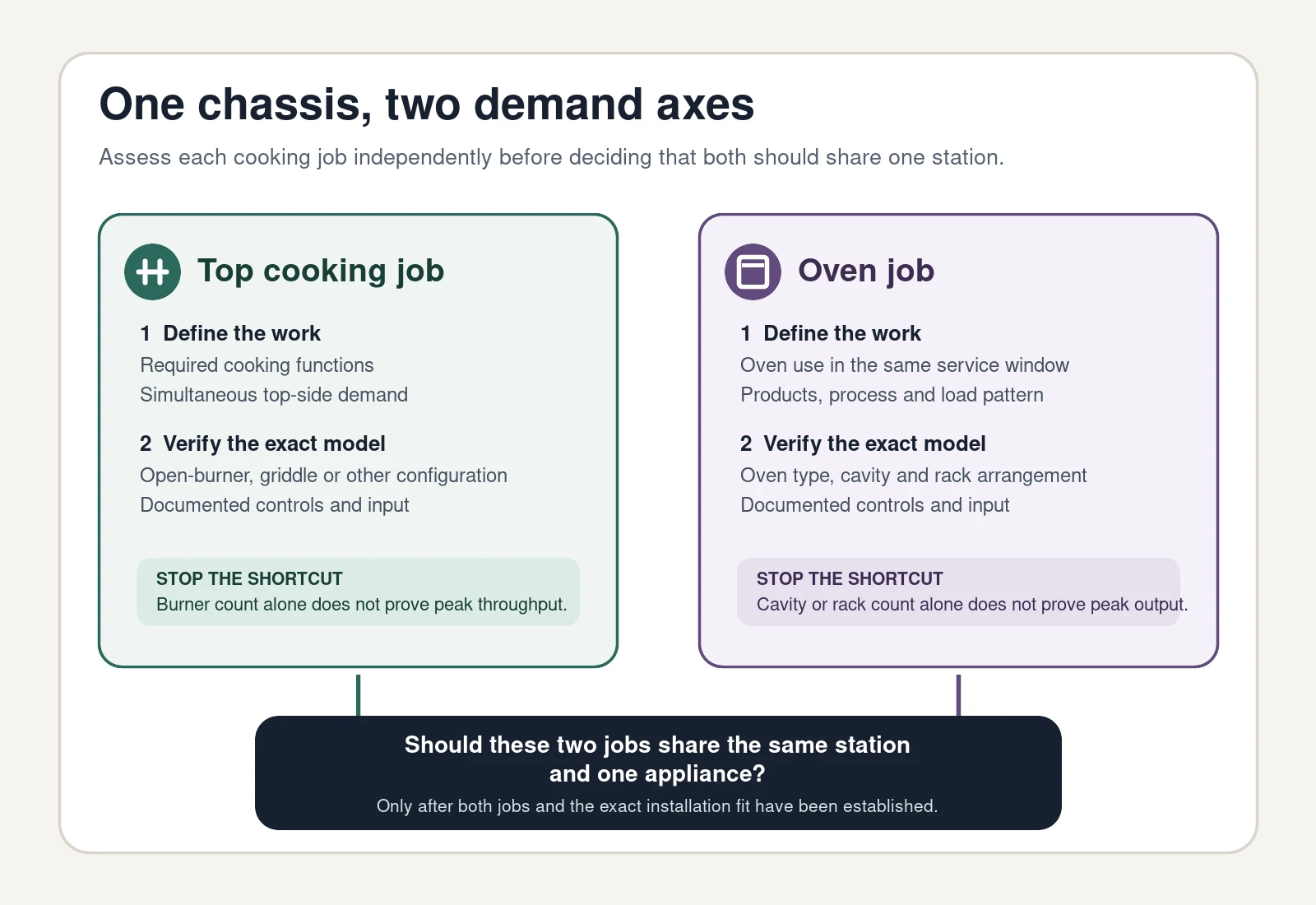
The point of the table is not to calculate a generic range size. It prevents the readily available product fields from replacing the workload evidence they cannot contain.
Do the two jobs belong at the same station?
An integrated range fixes the top and oven in the same location. That can be appropriate when both are part of the same station’s work. It is not proof that they are.
Ask where ingredients arrive, where cookware is handled and where finished items need to go. Then ask when the oven door must be opened, loaded and unloaded relative to top-side work. This is not a claim that an integrated range improves or obstructs workflow; either outcome depends on the actual line. It is a reason to test placement before choosing the chassis.
Separate equipment keeps the two appliance identities separate, so each can be specified and placed independently. That is a configuration distinction, not a universal recommendation. It may matter when the top job and oven job require different locations or different sizing, but the project still has to establish whether those differences outweigh the value of integration.
The same restraint applies to service continuity. It is reasonable to ask what access a technician needs and what functions are affected by a particular fault or isolation procedure. It is not safe to claim that any fault on an oven range necessarily removes both cooking functions. That requires the exact design, failure and service evidence.
Manufacturer specifications reveal the split
Official product documents often describe an oven range as separate top and oven systems even though they share a model name.
For example, Moffat’s Waldorf RN8610GC documentation identifies a 900 mm range with configurable open-burner and griddle sections, then specifies a GN 2/1 convection oven with its own burner, controls and electrical requirement. The same document lists cooktop and oven construction separately. Those details belong to the RN8610GC family; they are not category-wide promises.
Blue Seal’s G506A/B/C/D documentation shows another useful boundary. Models within the 900 mm static-oven family use different open-burner and griddle arrangements while retaining a separately described oven. A common module width therefore does not tell a buyer which top-side job the appliance was configured to perform.
The American Range AAR.10B provides a different exact example: its documentation describes a wider chassis with ten open burners and two integrated static ovens. That does not prove greater real-world output than another range. It proves that “oven range” covers materially different combinations and that the top and oven fields must be read, not assumed.
Across these examples, the defensible general lesson is narrow: manufacturers publish top configuration and oven configuration as distinct evidence. The documents do not say that the two halves are matched to a particular kitchen’s peak work. That judgement remains with the buyer and project team.
“Space saving” requires the whole station envelope
The chassis width is only one dimension of fit. It is not enough to prove that the installation saves usable kitchen space.
The complete question includes the exact appliance dimensions, how the oven door opens, the space needed to load and unload it, service access, nearby working clearances, the route for services and the requirements of the installation. A shared chassis may reduce the number of separate appliance bodies, but that observation is not a measured space-saving result.
Consider the under-hob volume as well. If the oven carries a necessary job at that station, using that volume for an oven may make sense. If the oven work belongs elsewhere, occurs at a different scale or is not required, the presence of an oven does not become valuable merely because it fits beneath the top. The decision is about the use of the station, not the compact appearance of the product photograph.
Clearance numbers must come from the exact installation documentation and the project design. The same applies to ventilation and extraction. Appliance type, cooking process, hood design, site conditions and applicable requirements can all matter, so a category article should not supply a universal clearance or ventilation figure.
Integration fit conditions
An integrated range earns its place when the relevant conditions can be established together. Each condition needs its own evidence.
| Condition to establish | What may support the decision | What remains unproven without exact evidence |
|---|---|---|
| The top suits the peak job | Task concurrency plus the exact top configuration and documented input | Finished meal output or throughput from burner count |
| The oven suits the peak job | Actual oven process plus exact type, cavity/rack fields, controls and input | Useful service capacity from cavity size alone |
| Both jobs belong at one station | Line plan and the timing of top and oven tasks | An automatic workflow improvement |
| The appliance fits the site | Exact dimensions, door/loading space, installation and service-access documents | Space saving from chassis width alone |
| The services are supportable | Exact gas/electrical data and project verification | Lower installation or operating cost |
| Cleaning and service fit the operation | Exact construction, removable components, manual and service information | A fixed cleaning time, maintenance interval or easier servicing across the category |
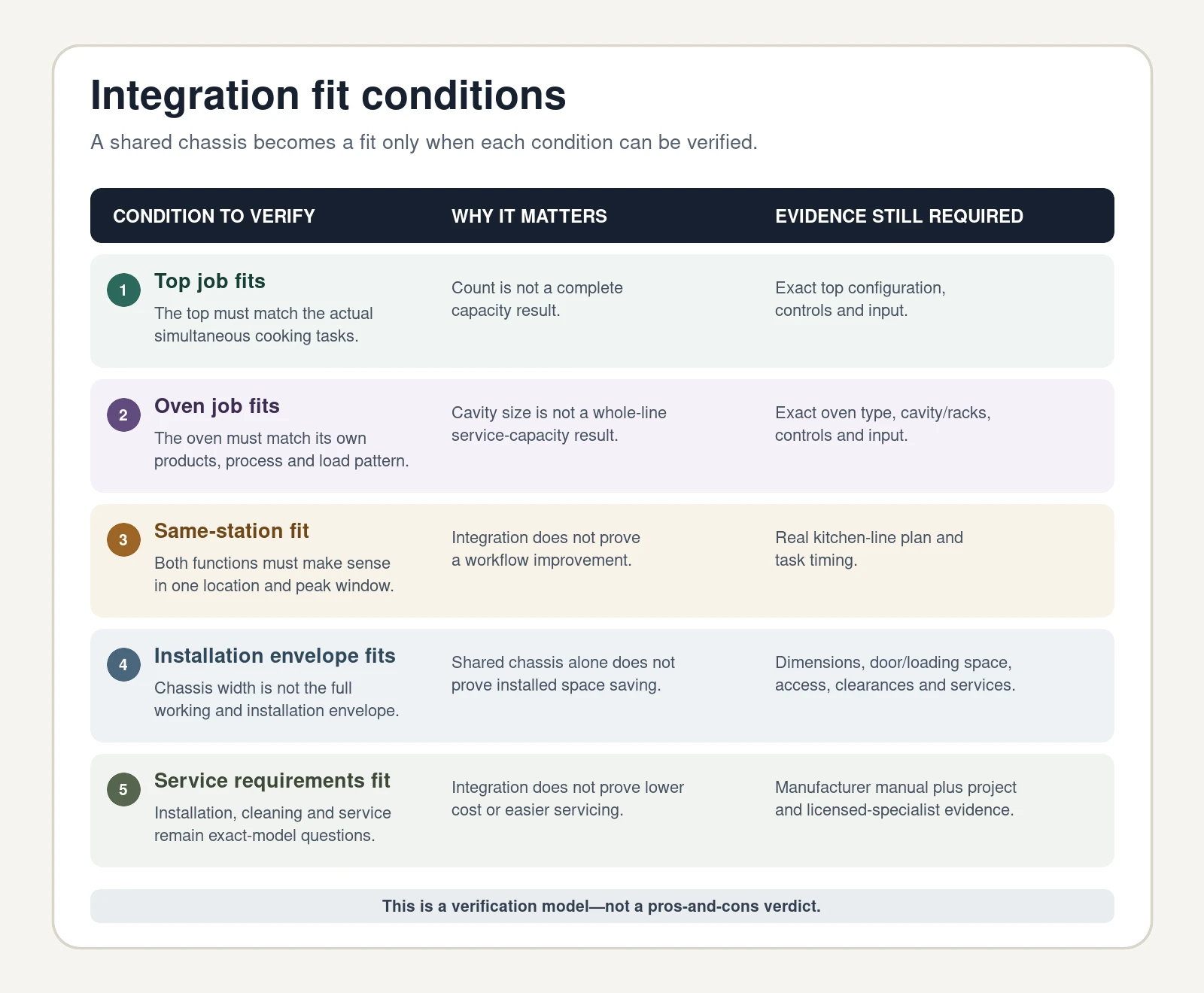
This is deliberately not a pros-and-cons table. A condition can pass for one kitchen and fail for another without making the equipment type generally better or worse.
Fuel type is an input, not the verdict
Gas, electric and combined configurations can change the services and exact operating characteristics that must be checked. The fuel label does not establish which option is better for a restaurant, or which will cost less to operate.
A defensible operating-cost comparison would need like-for-like equipment capability, rated inputs, actual usage, local tariffs and the other costs included in the comparison. Without those inputs, “gas is cheaper”, “electric is more efficient” and “dual fuel gives the best of both worlds” are purchasing slogans rather than conclusions.
For selection, verify the exact gas type and load, electrical supply and connection requirements on the manufacturer’s current documentation. Installation, commissioning and any associated ventilation work belong with appropriately qualified project specialists—not a generic Blog rule.
Cleaning and service remain exact-model questions
An oven range still has cleaning and service requirements on both sides of the appliance. Their design can differ by model.
The cited Moffat documents, for instance, identify particular removable components and describe front access on named models. That is useful evidence for those products. It does not prove that every commercial range is easy to clean, quick to service or front-accessible.
Use the exact manual to establish which parts can be removed, how food and grease traps are accessed, what the cleaning procedure permits and what inspection or service schedule applies. A universal daily, weekly or annual maintenance timetable cannot be derived from the category. Nor can a category-wide working life.
Food-contact and surrounding surfaces still need a cleaning approach appropriate to the equipment, its use and the food-safety needs of the business. FSANZ’s guidance on cleaning and sanitising explains the distinction between removing contamination and applying an appropriate sanitising process. The appliance instructions and the business’s food-safety procedures still govern the exact work.
Proof to obtain before choosing the shared chassis
The Blog can identify the evidence boundary. It cannot select an exact range without the range, site and workload evidence.
Before treating integration as a fit, obtain:
- the exact top configuration and its documented input and controls;
- the exact oven type, cavity/rack arrangement, controls and input;
- the simultaneous top and oven tasks during the real peak window;
- overall dimensions plus door, loading and working access;
- the current installation manual, including model-specific clearance and service-access requirements;
- exact gas and electrical requirements;
- project-specific ventilation, extraction and commissioning advice where required; and
- the cleaning and service information for the shortlisted model.
That evidence may confirm that one range fits both jobs at one station. It may instead show that the two functions need different capacities, locations or equipment identities. Either result is more useful than beginning with “integrated saves space” and trying to make the kitchen fit the claim.
The current cooktops with ovens category owns current models, price, stock and product-level comparison. Individual product pages and the manufacturer’s current documentation must prove exact specifications. KW sales, kitchen design or service can help reconcile the remaining line, access and support questions, with licensed specialists handling installation requirements where applicable.
One chassis can be the right answer. The proof is not that it combines two appliances. The proof is that both cooking jobs—and the site around them—fit the same exact decision.