
Choose a commercial benchtop griddle by plate area, service peak and site fit
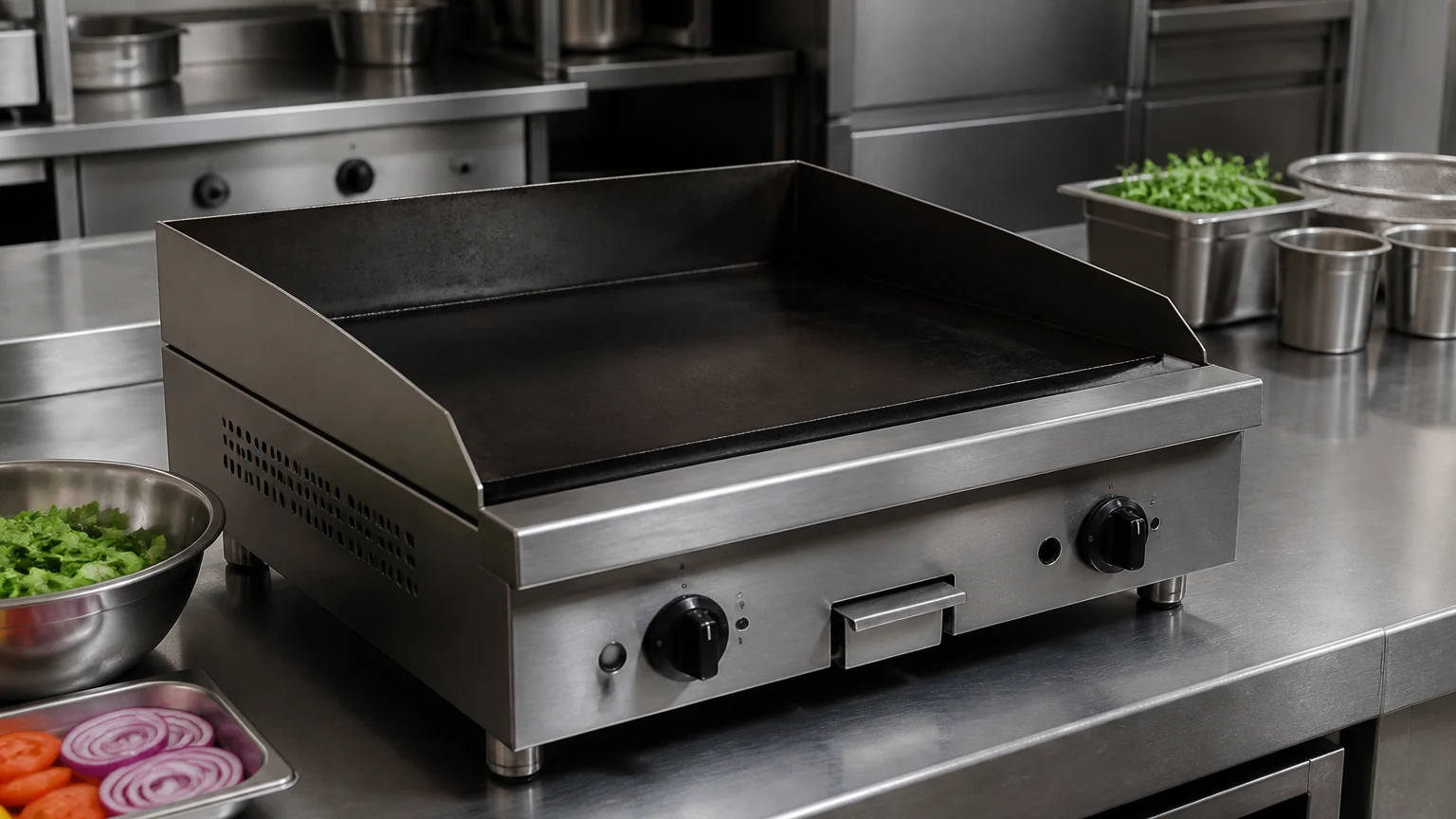
A commercial benchtop griddle is a heated flat cooking plate built into a compact commercial appliance. Do not size one from daily cover count or venue type alone. Start with the food that must be on the plate at the same time during the real service peak, then test that layout against the exact cooking surface, appliance footprint, utilities and installation requirements of each model.
That order matters. A wider appliance does not automatically provide the same increase in usable cooking surface, and a larger plate does not prove that a kitchen can connect, ventilate or operate the unit as planned.
Start with simultaneous plate demand, not meals per day
Daily volume hides the moment that creates the bottleneck. A café serving 200 meals across a long day may place less simultaneous demand on a griddle than a smaller venue receiving one concentrated run of burgers, eggs and toasted items.
Use the busiest representative service record you actually have. For each griddle item, note:
- the product and finish required;
- the number that must cook at the same time;
- the measured footprint of one representative portion on the cooking surface;
- any separation or working space your documented process requires; and
- whether different items can genuinely share one temperature-control zone and cleaning state.
Then lay those footprints out as scaled rectangles inside the exact model's published cooking-surface dimensions. This is a fit test, not a throughput formula. It does not predict cooking time, recovery, a finished-service rate or suitability under load.
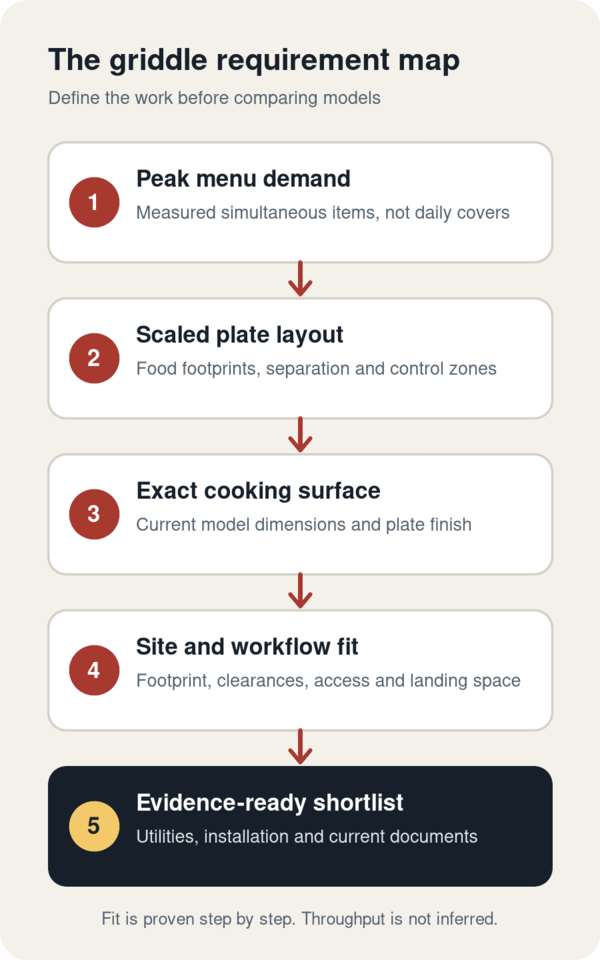
The useful result is not “we need a 600 mm griddle”. It is a bounded requirement such as: these measured items must fit simultaneously; the appliance and required clearances must fit this bench position; and the site must support the documented connection.
Separate cooking surface from appliance footprint
Manufacturers commonly publish both numbers, and they answer different questions. Cooking-surface dimensions tell you what can be placed on the plate. Overall dimensions tell the designer what occupies the bench or line before clearances, service access and adjacent workflow are considered.
Roband's current published data illustrates the distinction without creating a category rule:
| Exact model | Overall dimensions (W × D × H) | Published cooking surface (W × D) | Published electrical input |
|---|---|---|---|
| Roband G500 | 538 × 443 × 263 mm | 515 × 340 mm | 2,300 W, 10 A, single phase |
| Roband G700 | 725 × 529 × 263 mm | 700 × 400 mm | 4,240 W, 18.4 A, one or two phase plus neutral |
These are exact-model facts from Roband, not performance equivalents. The G700 documentation also says installation must be carried out by a licensed electrician and that the connection arrangement is decided with the electrician. That is why width, plate area and fuel label cannot replace the installation document.
When another model is considered, restart from its current datasheet and manual. Do not transfer the Roband dimensions, controls or electrical arrangement to another brand, model or revision.
Build the griddle requirement map in five passes
1. Define the peak cooking job
Write down the menu items that make the griddle a bottleneck and the simultaneous quantity observed during a representative peak. Keep daily covers, average orders and hoped-for growth separate from this record. They may inform planning, but they do not describe the plate state at the hard moment.
If the peak is not measured, mark it unknown. A guessed peak should not become a model recommendation.
2. Test the physical plate layout
Draw the published cooking surface to scale and place the measured item footprints inside it. Keep any operating separation used by the actual kitchen. If items require different control zones, surfaces or handling states, show that in the layout instead of treating the whole plate as interchangeable area.
This exposes geometry that a single area total misses. Two layouts with the same total occupied area may not fit the same plate shape or control arrangement.
3. Test the bench and workflow position
Now use overall appliance dimensions, not plate dimensions. Record the available bench width and depth, the exact manufacturer's required clearances, service access, grease collection path, adjacent landing space and any load-bearing requirement owned by the bench or design plan.
The word “benchtop” does not prove that an appliance fits any bench. A unit that physically fits its rectangle may still fail the documented clearance, service or workflow requirement.
Ventilation is a separate decision. Use the commercial kitchen exhaust requirements guide and the project’s qualified designer or authority rather than inferring exhaust requirements from “gas”, “electric” or “benchtop” alone.
4. Verify the available utility against the exact connection
For electric models, compare the site's verified supply with the datasheet and installation manual: voltage, current, phase, plug or hard-wired connection, and any circuit requirement. Do not assume that two electric griddles of similar width connect in the same way.
For gas models, lock the exact gas type, rated input, connection and certification evidence before selection. The Gas Technical Regulators Committee says fixed gas appliances require an authorised gasfitter for installation and commissioning. Licensing and approval details remain jurisdiction- and project-specific, so the article does not replace the relevant regulator, manufacturer or gasfitter.
Fuel price alone is not a selection method. Running-cost comparisons require the exact rated input, the site's tariff and a defensible duty profile. Rated input is not the same thing as actual energy consumption or food output.
5. Compare only models with complete evidence
A model is ready for commercial comparison when the required facts are present on the same exact identity and current document revision:
- model and fuel variant;
- cooking-surface dimensions and plate finish;
- overall dimensions and manufacturer clearances;
- control-zone arrangement;
- rated electrical or gas input and connection;
- installation, ventilation and service-access instructions;
- operator cleaning procedure and removable parts; and
- the current Category/PDP facts for price, stock, freight and warranty.
Missing evidence does not prove that a model is unsuitable. It means the comparison is not yet supported.
Gas versus electric comes after the site check
“Gas or electric?” is often asked too early. Both are equipment families containing different plate sizes, control layouts, inputs and connection requirements. The defensible sequence is:
- define the simultaneous cooking job;
- prove the plate and appliance fit;
- verify available utilities and installation constraints; and
- compare exact models on like-for-like documented facts.
This avoids generic claims that one fuel is always faster, cheaper, more precise or better for a venue type. Those outcomes depend on the exact appliance, site, tariff, load and operating method.
Plate material and controls need exact-model evidence
Flat, grooved, steel and chromium-finished plates can serve different food and cleaning decisions, but the material label alone does not establish recovery, release, energy use, durability or menu suitability. Record the exact plate construction, thickness or finish only when the current manufacturer document states it, then follow that model's operating and care instructions.
The same rule applies to control zones. Independent controls may let an operator manage sections separately, but the number, layout and permitted use of those zones belong to the exact model documentation. Do not infer them from appliance width.
Cleaning is a food-safety duty and a model-specific procedure
Food Standards Australia New Zealand distinguishes cleaning from sanitising and requires food-contact surfaces to be clean and sanitary. It also says items must be cleaned before they are sanitised.
That authority establishes the hygiene outcome; it does not supply a universal griddle shutdown, scraping, chemical or re-seasoning procedure. Follow the exact manufacturer's manual for isolation, cooling, removable parts, approved tools and chemicals. Keep the site's food-safety plan and local regulator requirements alongside that manual.
Do not inherit a generic “daily” or “weekly” procedure from another griddle. Plate finish, controls and removable components can differ, and an unsupported procedure can damage equipment or create a safety problem.
What to take to the product shortlist
Bring one page of evidence, not a venue label:
- the representative peak order record;
- the scaled simultaneous plate layout;
- the measured bench and workflow position;
- the verified site utility and project constraints;
- the evidence fields still missing; and
- the exact model documents used, with revision or access date.
Then compare the current commercial griddle range or narrow to benchtop griddles. Use each exact PDP, datasheet and manual for model facts, and involve the qualified electrician, gasfitter, kitchen designer or regulator wherever the installation crosses their boundary.
The editorial judgement is simple: the first model to compare is not the one with the broadest marketing claim or the nearest nominal width. It is the one whose exact cooking surface, site fit, utilities and documentation can be reconciled with the measured service requirement.