
Replacing a Commercial Fridge: Keep Food Cold During the Changeover
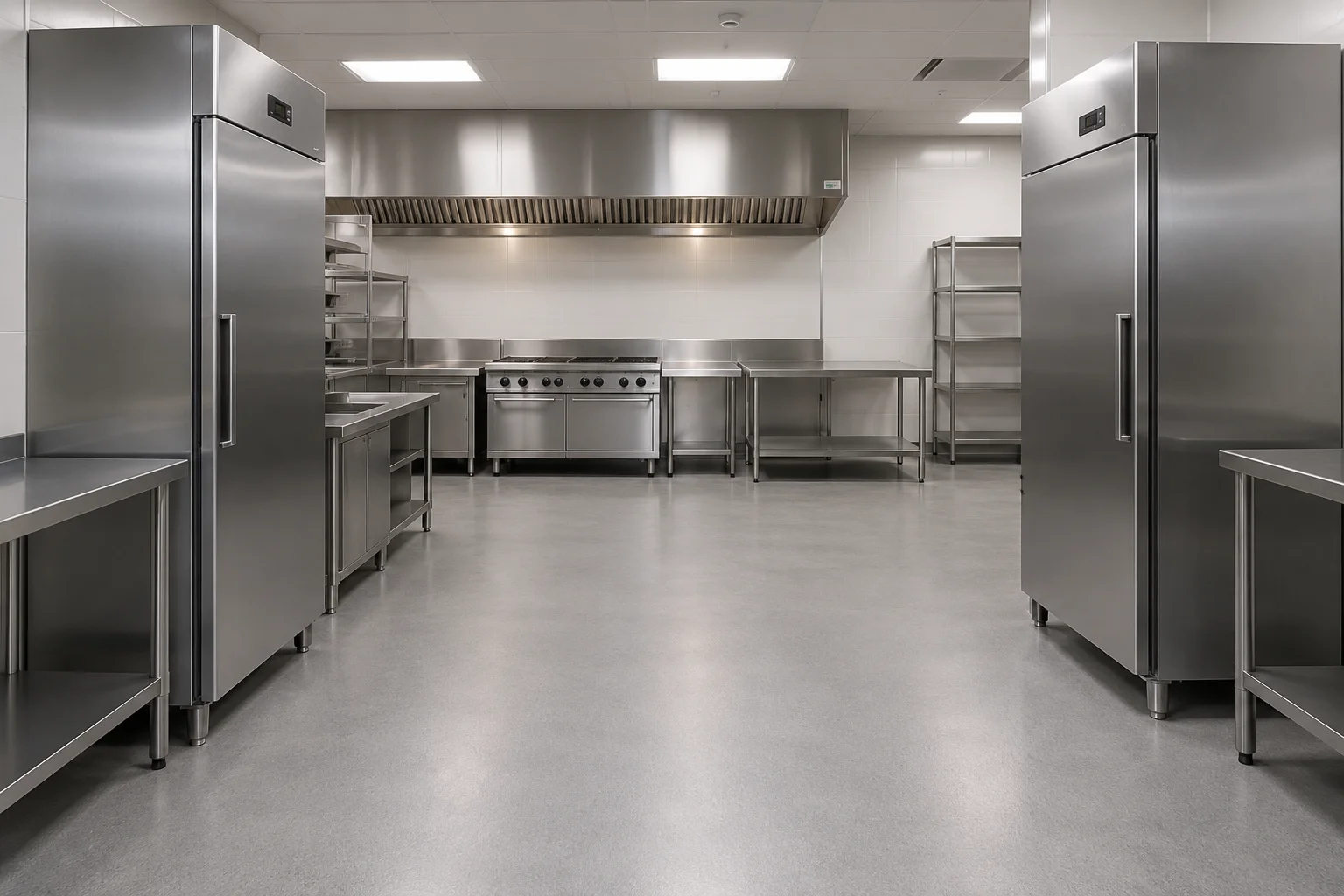
Book replacement around when food can safely move into the new cabinet, not when the truck arrives. Every item in the old fridge needs a suitable destination through removal, positioning, the exact model’s start-up instructions and acceptance for the intended load.
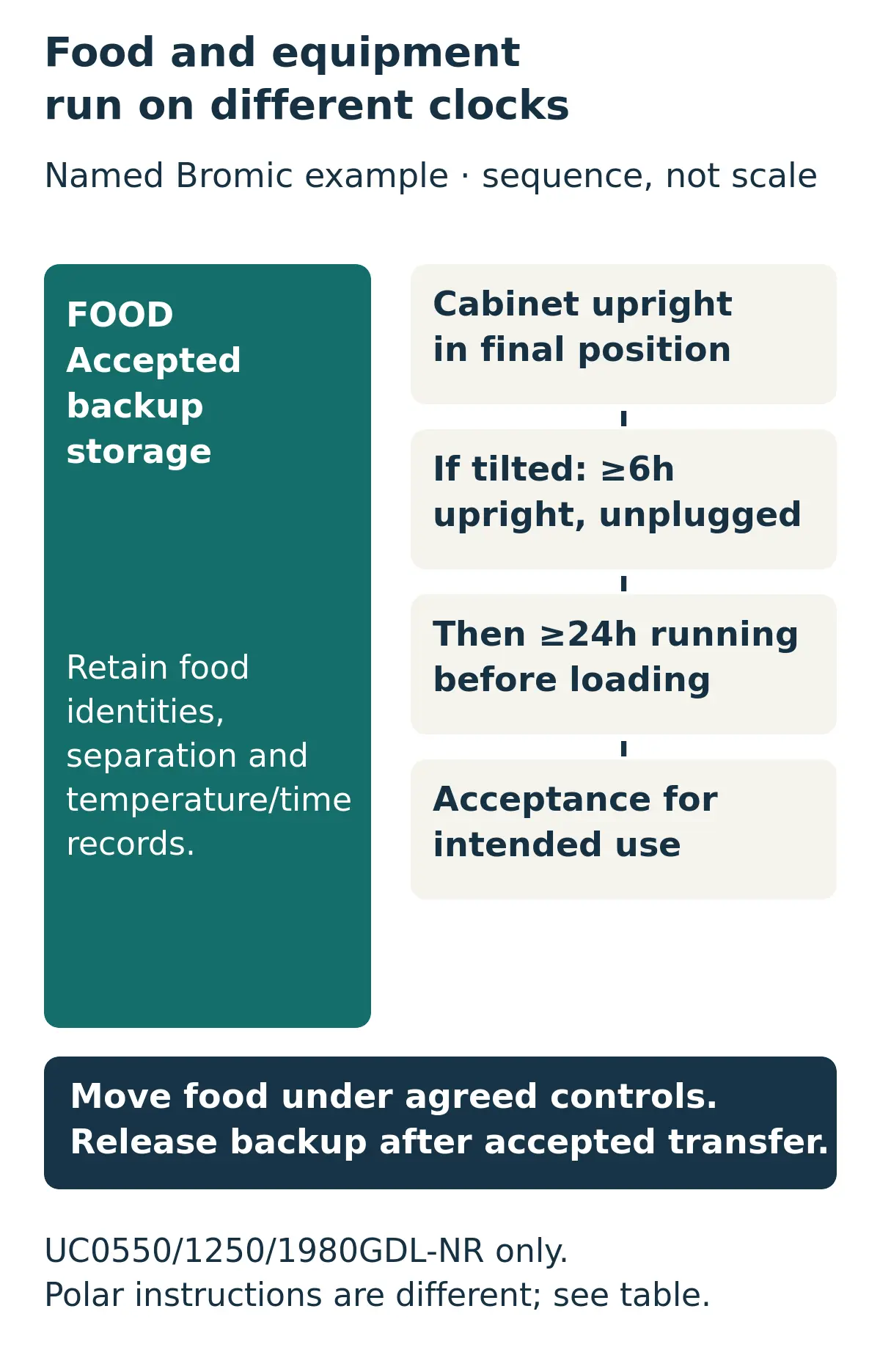
The delay can cross a trading day. For three named Bromic upright refrigerators, the manual requires at least 24 hours running before loading. If tilted, first allow at least six hours upright and unplugged. Two Polar refrigerator manuals instead specify approximately 12 hours upright before operation when the unit has not been stored or moved upright. Food moves only after the destination has passed its checks, so the backup must cover that whole interval.
This guide concerns a planned chilled-food changeover in an Australian food business. If the old fridge has failed and food safety is uncertain, make that food decision now with your food-control lead; a forthcoming replacement cannot establish that existing stock is safe.
Use the exact manual to set the equipment clock
We compared three manufacturer documents retained in KW’s equipment evidence library, including freshly retrieved Polar manuals. The difference is in both the waiting period and what ends it.
| Named refrigerator and document | Before switching on; then before loading |
|---|---|
| Bromic UC0550GDL-NR, UC1250GDL-NR and UC1980GDL-NR; January 2026, Version 3 | Always: at least 24h running before loading (p. 12). If tilted, first at least 6h upright, unplugged (p. 10). |
| Polar DL895-A; DL893-A–DL899-A/CK480-A family manual, v6 | If not stored or moved upright: approximately 12h upright before operation; if in doubt, allow to stand. Load food only after the correct operating temperature is reached. See printed pp. 1 and 2. |
| Polar G605-A; AU G604-A–G607-A manual, v6, 15 October 2021 | The same conditional approximately 12h upright wait; if in doubt, allow to stand. Food loading requires the correct operating temperature. See pp. 4 and 6. |
Sources: Bromic manual, Polar cabinet manual, and Polar AU prep-counter manual. The Polar manufacturer manuals are served by suppliers; confirm the copy supplied with your unit. The Bromic entries are manual examples, not KW stock recommendations. Use the instructions for the exact model, revision and transport history.
Keep the two clocks separate: Polar’s approximately 12 hours concerns standing before operation; Bromic’s 24 hours concerns running before loading. You need the exact unit’s transport history and current manual to place both steps in the schedule.
For the tilted Bromic example, a cabinet upright in its final position at 11am Tuesday cannot start before 5pm Tuesday. If all preparation permits starting then, its 24-hour run ends at 5pm Wednesday. That is 30 hours after upright positioning, before acceptance checks and transfer. Add the time for removal, access and preparation to your own plan.
Allocate the backup before disconnecting anything
A backup needs free space for the actual containers and food-storage conditions verified by the site’s food-control lead. If both cabinets can run together, keep stock in the old one until the new destination and transfer are ready, with suitable temporary space and services. If the replacement needs the old footprint, move stock into the verified backup before removing the old cabinet. Have the appropriate trade assess services; do not assume one existing circuit can supply both appliances. The named Bromic manual also prohibits power boards and extension cords (pp. 5 and 10), so temporary parallel running cannot depend on either.
Allocate actual containers, not nominal litres. For each food group record quantity, container height, destination and usable positions after the backup’s existing stock. Keep raw and ready-to-eat food, allergen controls, product instructions and identity labels within the site’s food-safety system. A partly empty fridge can still lack suitable space or airflow for the transfer.
Unallocated stock = containers to move − checked receiving positions. For an explicitly invented example, 28 containers must move and the checked backup has 12 compatible positions free after its existing stock. 28 − 12 = 16 containers have no destination. That plan is incomplete even if the backup’s nominal litres look sufficient. Find another suitable refrigerator for those 16, reduce the actual stock or move the changeover date. Check any hired cabinet or alternative storage against the site’s food controls before relying on it.
For potentially hazardous chilled food, FSANZ’s thermometer guidance advises 5°C or colder unless another safe arrangement is demonstrated. Follow stricter product and business controls. The displayed cabinet temperature does not establish the food temperature.
Book through transfer, then choose the decision time
First book enough backup time for the start-up instructions, acceptance checks, food transfer and a realistic disruption. Then set the time to extend that booking or move food elsewhere. Name the person who will act and the alternative refrigerator they will use.
Continue the Bromic example with hypothetical planning inputs. The cabinet’s required run finishes no earlier than 5pm Wednesday. Allow two hours for the agreed checks and completed food transfer, then four hours for disruption. The backup booking therefore needs to last until at least 11pm Wednesday:
| Wednesday plan | Time |
|---|---|
| Earliest end of the required run | 5pm |
| Checks and transfer completed, if they take the assumed two hours | 7pm |
| Four-hour disruption allowance ends | 11pm |
A booking ending at 6pm is too short: even the undisrupted transfer is not due to finish until 7pm. Change that booking before taking the old fridge out of service.
Now suppose the 11pm booking has two conditions: an extension must be agreed by 2pm, and moving all food to the alternative refrigerator takes six hours. The latest possible relocation start is 11pm minus six hours, or 5pm. The earlier contractual decision time wins: act by 2pm.
At 2pm the new cabinet’s required run is still unfinished. You therefore need confirmed permission to keep using the backup longer, or commit to the agreed relocation starting no later than 5pm. Waiting for a 5pm equipment result would miss the extension deadline. A backup agreement with a later decision time may be a better fit for the job.
Use your agreement’s actual deadline and the full time to complete the alternative transfer. If the responsible contact is unavailable then, make the decision in an earlier confirmed staffed window. An extension is secured when permission is confirmed; sending an email or awaiting collection does not extend the booking.
Transfer food with its history attached
Move small, identified loads only after the destination and route are ready. Record source, destination, food identity, transfer times and relevant food-temperature checks. Keep food protected and preserve separation. Assign the food decision to the site’s food-control lead; a driver or installer does not take that responsibility by arriving.
Businesses handling potentially hazardous food need an accessible thermometer accurate to within 1°C. Follow FSANZ’s probe guidance: clean and sanitise before and after use, measure the thickest part of unpackaged food, and use appropriate lengthwise/between-package measurements for packaged chilled food. Check relevant foods and locations rather than relying on the equipment gauge.
Under FSANZ’s two-hour/four-hour rule, time between 5°C and 60°C accumulates across preparation, storage, transport and display. For food returning to refrigeration for later use, the limit is less than two hours. From two to four hours, use or sale is permitted under the rule, but refrigeration for later use is not; beyond four hours, discard it. Returning food to a fridge does not reset its history.
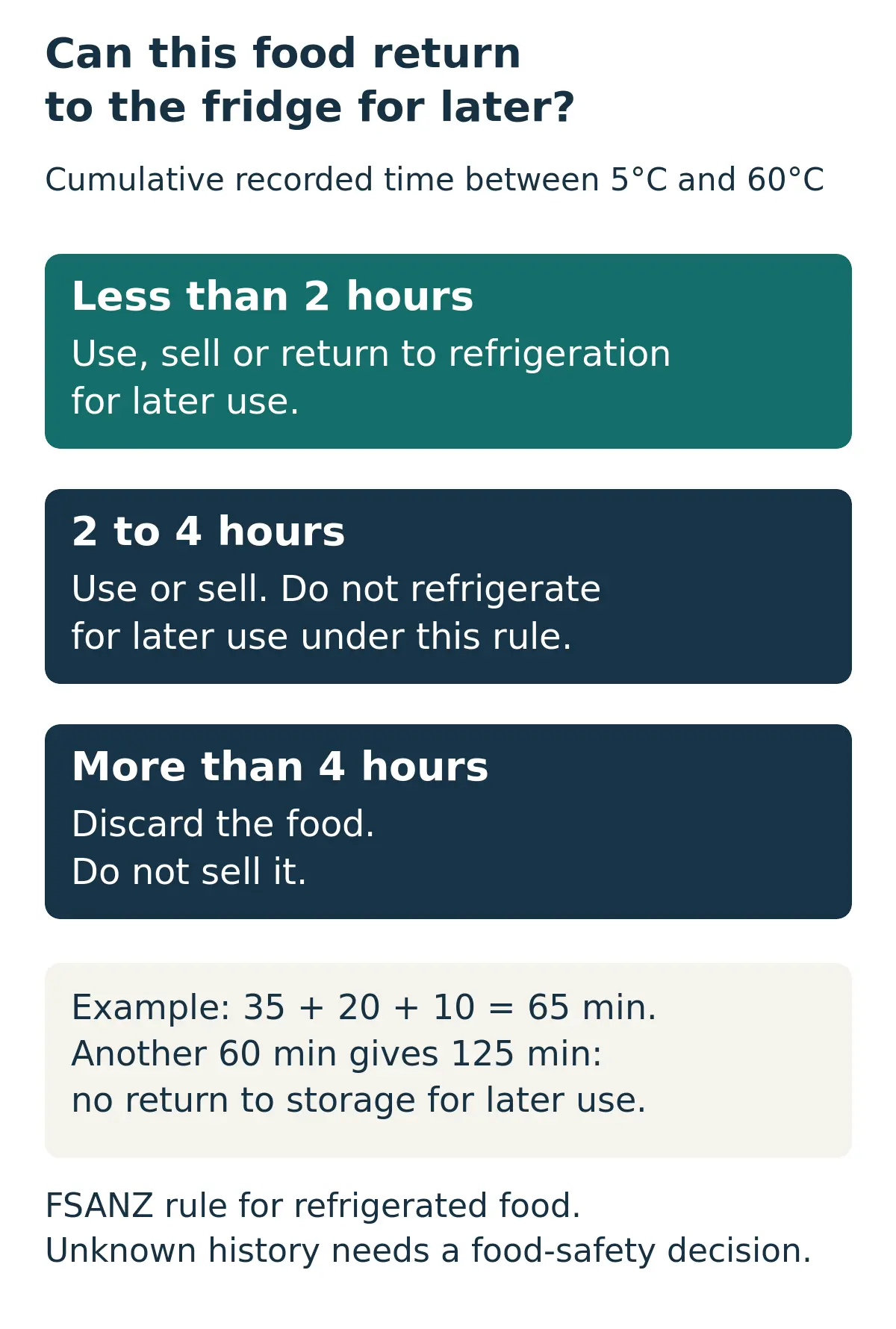
Use the actual history to assess a delay. If a batch has already accumulated 65 minutes under those conditions, another 60 minutes brings it to 125: it has crossed the return-to-later-storage boundary. Keep that accumulated history with the batch. If its history or the rule’s applicability is uncertain, refer the decision to the site’s food-control lead. Cooked potentially hazardous food has a separate two-stage cooling process.
Make acceptance and responsibilities explicit in the quote
Before transferring stock, retain the exact instructions, installer handover and agreed acceptance evidence for the cabinet’s intended location and load. KW’s refrigeration load-recovery guide owns the detailed equipment acceptance method. Equipment performance and food safety remain separate decisions.
If acceptance fails or is incomplete, use the extension/fallback plan while food retains a controlled destination. Release the backup only once the transfer and food checks are complete. If the new cabinet fails acceptance, keep food in the verified backup or complete the planned relocation.
For the equipment brief, send the model, postcode, measured site, storage job and backup plan through KW’s enquiry form. Compare the commercial fridges and freezers range against those requirements. Ask the quotation to separate supply, freight, indoor positioning, old-unit removal and installation.
Confirm the actual service scope in KW’s delivery policy, including whether indoor positioning and old-unit removal are quoted. Use the delivery-route guide before coordinating removal and arrival.
Manuals and source guidance checked 7 October 2026. Manufacturer instructions retain the named model, document revision and transport condition. The contractual and food-time calculations are openly illustrative; they are not customer cases or service commitments.