
Commercial fridge load recovery: a pass, hold or escalation test
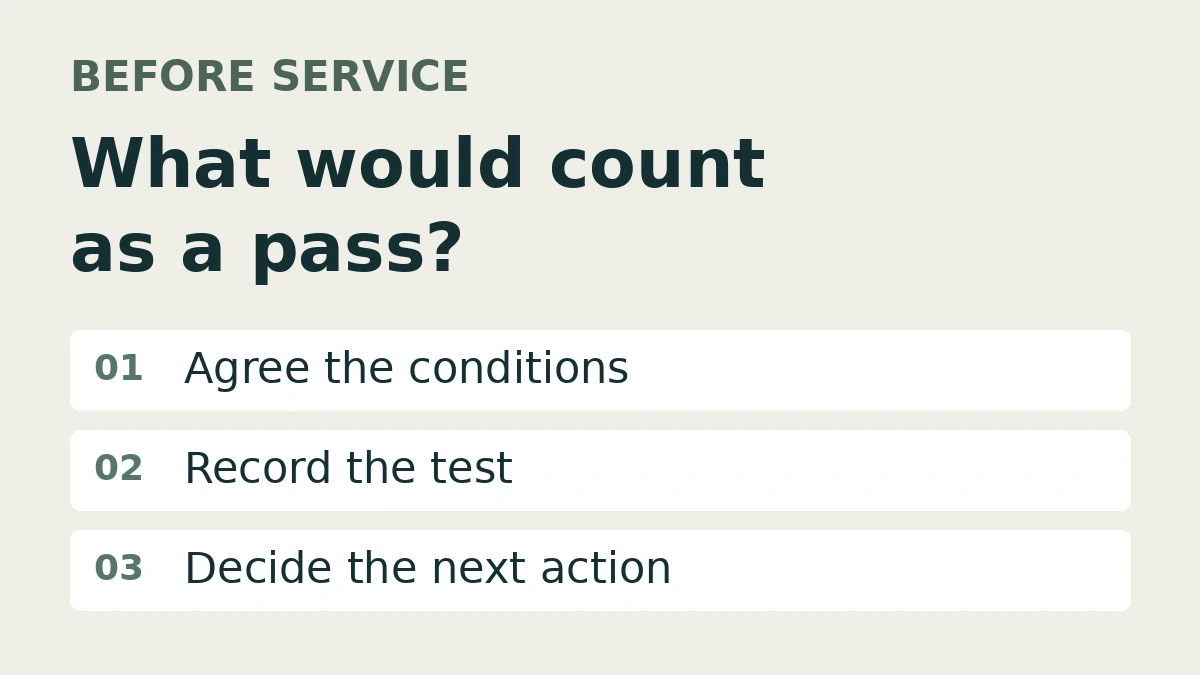
A commercial fridge passes a load-recovery acceptance test only when the test was agreed before it began, the actual load and door event were recorded, the equipment met that agreed criterion, and the separate food-safety decision was completed.
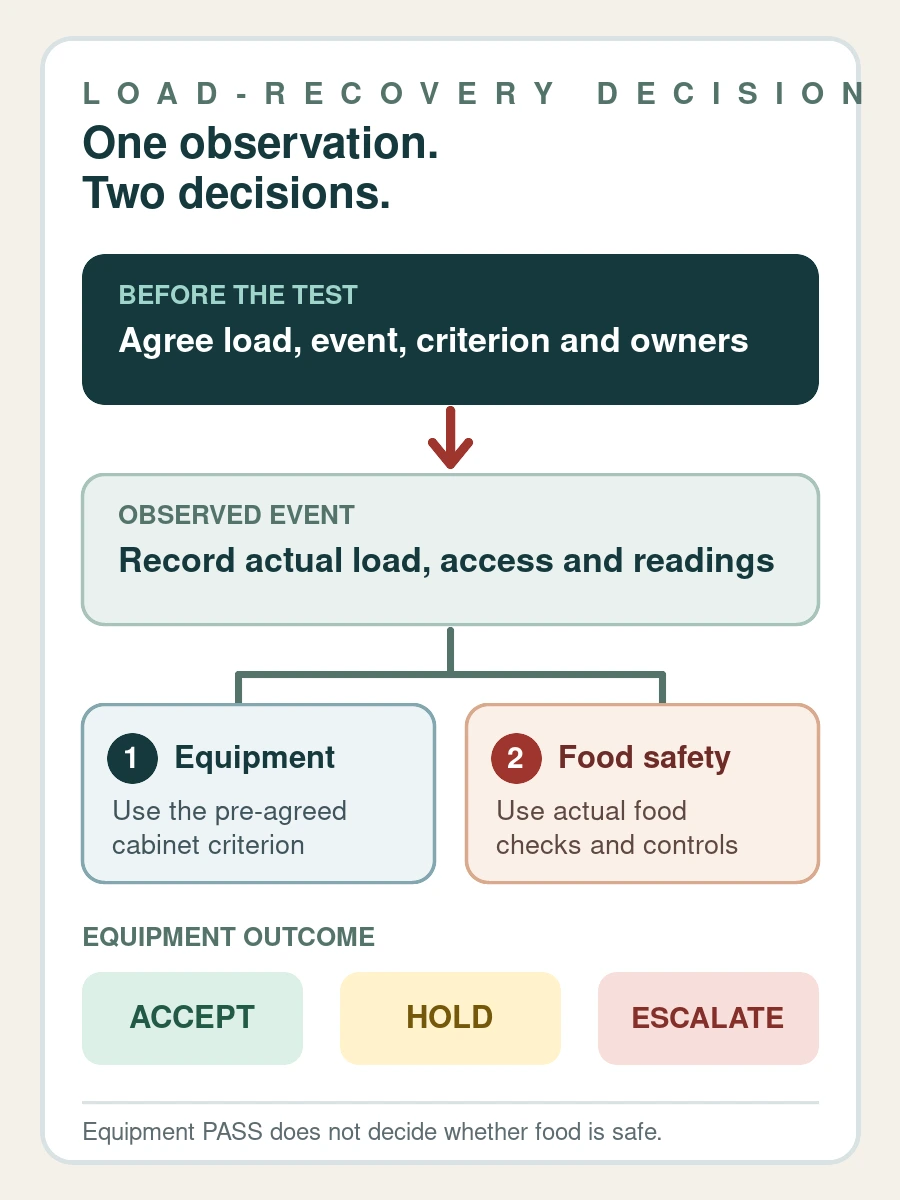
If the evidence is incomplete, hold acceptance and repeat the observation under controlled conditions. If a complete observation misses the agreed equipment criterion, preserve the record and escalate it to the supplier or service technician. An equipment pass does not, by itself, prove that food is safe.
Use four gates to decide whether the cabinet passes
Complete the gates in order. A cold display reading cannot make up for an unidentified cabinet, an undefined pass limit or a missing food check.
| Gate | Evidence required | PASS | HOLD or escalate | Decision owner |
|---|---|---|---|---|
| 1. Identity and prerequisites | Model, serial or asset ID, current manual revision, location, completed installation and start-up requirements. | The exact cabinet and applicable instructions are identified. | HOLD if identity, instructions or a prerequisite is missing. | Supplier or commissioning technician |
| 2. Test event | Representative load, starting condition, shelf arrangement, door event, instrument and measurement positions. | The event matches the use being accepted and can be repeated. | HOLD if the load or observation conditions cannot be reconstructed. | Operations with the supplier or technician |
| 3. Equipment result | Target, observation window and stability rule agreed before the test; time-stamped readings and interruptions. | The complete observation meets the agreed equipment criterion. | HOLD incomplete evidence. Escalate a complete test that misses the criterion. | Supplier or commissioning technician |
| 4. Food control | Actual food-temperature checks and the venue's corrective-action record where food is involved. | The food-safety owner accepts the food disposition under the venue's controls. | Apply the food-safety procedure independently of the equipment diagnosis. | Food-safety lead |
The decision belongs to the documented operating envelope: this cabinet, in this position, with this load and access pattern. A later relocation or substantially different loading arrangement needs its own review.
Set the criterion before starting the clock
Ask the supplier or commissioning technician to identify the applicable manual, permitted loading arrangement and recovery criterion for the proposed use. Record the target, observation window, stability requirement and who owns the assessment. If nobody can explain what would constitute a pass, leave the equipment decision open. A trace that eventually falls is not a substitute for a criterion chosen in advance.
Keep the food decision separate. FSANZ advises checking actual food temperature rather than relying only on equipment gauges. For cold potentially hazardous food, FSANZ's usual holding requirement is 5°C or colder, unless another safe temperature can be demonstrated. That boundary concerns food control; it is not a universal cabinet recovery deadline or a freezer set point.
Separate start-up instructions from load recovery
Check the exact instructions before treating a cold empty display as permission to load. As a document example, Bromic's January 2026 Version 3 upright display manual covers the UC0550GDL-NR, UC1250GDL-NR and UC1980GDL-NR refrigerators. Page 12 requires the refrigerator to run for at least 24 hours before loading, while also requiring air circulation and warning against overstocking. See the exact Bromic manual, pages 11–12.
The 24-hour instruction is a preloading requirement for those named refrigerators. It does not promise recovery from a representative load within 24 hours, and it does not apply automatically to another cabinet. Match the model identity and resolve any conflict between a specification and general manual wording with the supplier.
The commercial refrigeration climate-class evidence guide owns the separate question of rated operating conditions. Record the real location and ambient observation here without awarding the cabinet a new climate rating.
Copy this acceptance record before the test
Copy the table into the commissioning handover or print this section. Complete the “agree before” column before loading the cabinet, then preserve the observations and named decision owners. A blank cell is a HOLD, not permission to invent a favourable value afterwards.
| Record field | Agree before the test | Record during the test | Decision and owner |
|---|---|---|---|
| Cabinet identity | Exact model, asset or serial ID, manual revision and applicable loading instructions. | Location and ambient observation; prerequisites confirmed complete. | Identity accepted / HOLD — supplier or technician: ______ |
| Representative load | Product or agreed substitute, quantity, container format, starting condition and shelf arrangement. | Actual load placed and every material difference from the agreed arrangement. | Representative / HOLD — operations: ______ |
| Access event | Door-opening or restocking event, start and end rule, and any permitted interruptions. | Actual start/end times, unexpected openings, defrost event or alarm. | Usable event / repeat required — observer: ______ |
| Equipment measurements | Instrument identity and check status, measurement type, positions, intervals, target, window and stability rule. | Time-stamped readings with cabinet display and independent measurements labelled separately. | PASS / HOLD / ESCALATE — supplier or technician: ______ |
| Food checks | Food types and positions to check; applicable limits and corrective actions from the venue's controls. | Actual food readings, times, locations and corrective action taken. | Food disposition — food-safety lead: ______ |
| Accepted envelope | Cabinet, position, load arrangement and access pattern proposed for service. | Any unresolved variation or restriction discovered during the observation. | Accepted use or next action, owner and due date: ______ |
Do not substitute an arbitrary percentage of the cabinet's litre rating for a representative load. If a non-food load is proposed, have its suitability and limits agreed first. A water bottle or another substitute cannot establish what every food product experiences.
Keep service stock under verified temperature control while the test is unresolved. Do not deliberately warm saleable food, defeat an alarm or change controller parameters to manufacture a useful-looking result. Electrical and refrigeration investigation belongs with the appropriate service specialist.
Where compatible monitoring is available, its records may help identify temperature changes and access events; confirm the supported functions in the manufacturer's monitoring documentation. Equipment data does not remove the food checks appropriate to the operation.
Read the result without moving the goalposts
Accept the documented use
The equipment criterion was agreed before the test, the observation is complete, the result met that criterion and the food-safety owner recorded the separate food decision. Keep the conditions with the result. Acceptance applies to the documented arrangement and service pattern.
Hold because the evidence is incomplete
The load, measuring point, starting condition, pass criterion or owner is missing, or an interruption makes the observation inconclusive. Identify the missing item and agree a controlled repeat. “It got cold eventually” does not repair an incomplete record.
Escalate because a complete test missed the criterion
Preserve the readings and conditions for the supplier or service technician. Describe the observation without diagnosing a compressor, controller or refrigerant fault from the trace. Apply the food-safety procedure to affected stock without waiting for the equipment diagnosis.
This distinction prevents two costly mistakes. Missing evidence calls for a better observation. A failed, well-defined observation calls for investigation. Neither result, by itself, proves that the venue needs a larger replacement cabinet.
Attach the record to the commercial handover
Keep the agreed procedure, measurements, decision and permitted loading arrangement with the cabinet's operating record. Reassess when a change could take the cabinet outside that use, including relocation or a substantially different load or access pattern. The previous result remains evidence of the previous conditions.
If the intended use is still being specified, send the completed four-gate matrix and acceptance record to the supplier before comparing commercial fridges and freezers. Carry placement, access, monitoring and service-clearance questions into the venue's commercial kitchen design work. Exact product documents and qualified trades remain the owners of model, installation and service requirements.
Sources
- FSANZ: Thermometers — actual food measurement, equipment-gauge limits and thermometer requirements.
- FSANZ: Keeping food at the right temperature — Australian food-temperature control boundary.
- Bromic vertical display fridge and freezer manual, Version 3, January 2026 — exact named-model start-up and loading example.
- SKOPE-connect knowledge base — route to supported monitoring functions for compatible equipment.