
Split-Door or Open-Bay? The Commercial Fridge Decision That Quietly Costs You $8,000 a Year (FED-X XURC1410S2V vs Atosa MBF8006 Audit)
Split-Door or Open-Bay? The Fridge Decision That Quietly Costs You $8,000 a Year
A head chef in Parramatta once summed up his fridge situation in one sentence: “We lost $4,200 of ribeye last December because the compressor gave up at 11pm on a Thursday. The fridge was only three years old.” He didn’t buy the wrong brand. He bought the wrong architecture for his workflow, then ran it into the ground. That’s the real story behind most commercial fridge failures in Australia — not brand, not price, not build quality. Architecture mismatch.
Reading time: 14 minutes · For: multi-site operators, head chefs, procurement managers, compliance leads · Covers: FED-X XURC1410S2V, Atosa MBF8006, TCO modelling, GEMS 2024, FSANZ, installation reality, FAQ.
1. What You’re Actually Choosing Between
The FED-X XURC1410S2V and the Atosa MBF8006 sit in the same price bracket. Same tropical rating (43°C ambient). Same Dixell controllers. Same R290 refrigerant. On a spec-sheet comparison they look like near-twins.
They are not twins. They are opposites. The FED-X solves one problem beautifully and fails at the other. The Atosa does exactly the inverse. Most Australian buyers never see the difference until year two — by which point they’ve already paid the mismatch tax three or four times over.
FED-X XURC1410S2V — The Zoning Philosophy
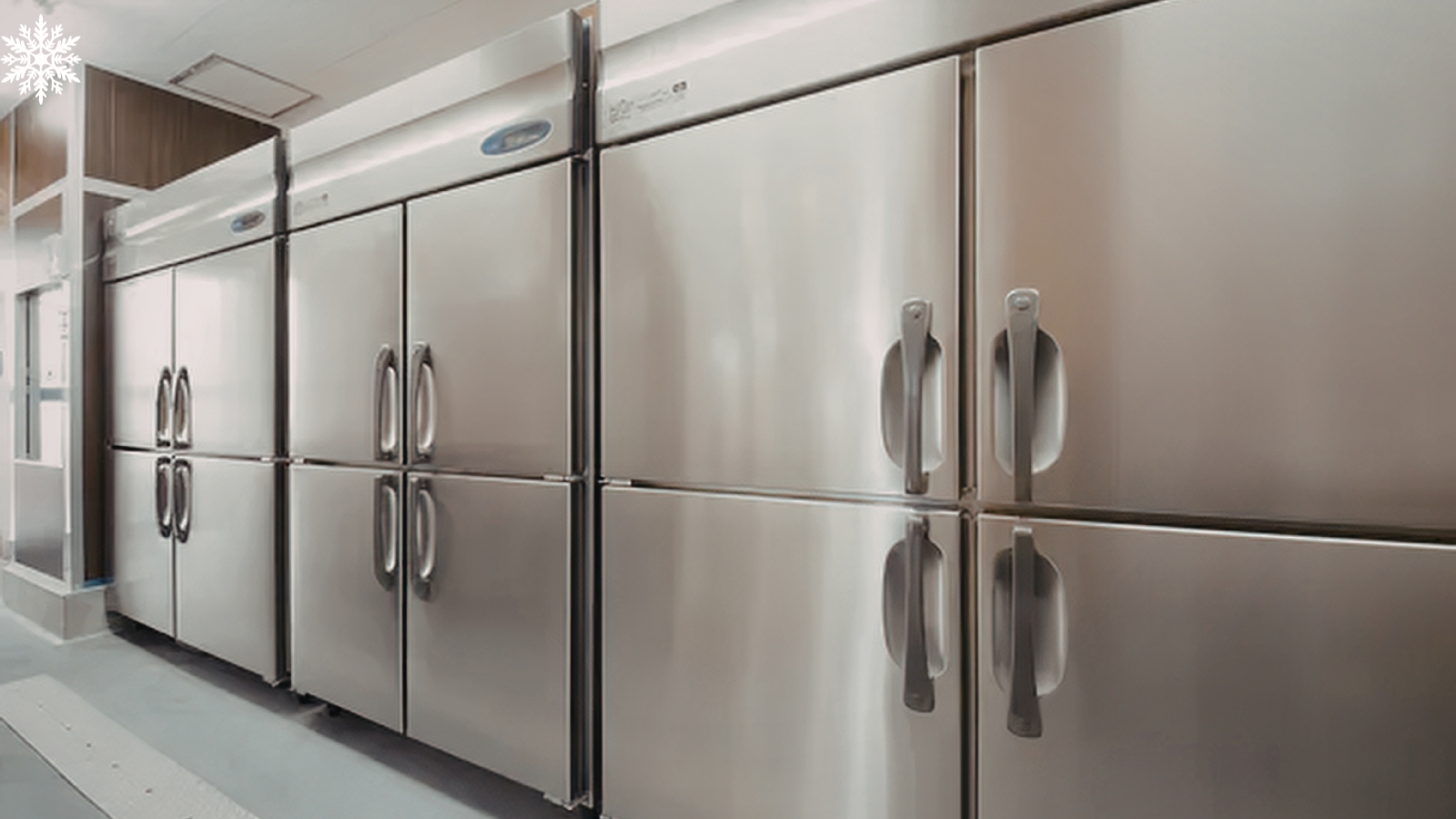
Read the spec sheet carefully and you’ll find one phrase most buyers skip: “1/2 split door system.” This is not a “four-door fridge.” It is a two-zone fridge wearing four half-doors. Open the top-left door to grab a 1/6 GN pan of diced onion, and the cold air pooled in the bottom-left chamber stays exactly where it is. The physical divider kills the convection column before it starts.
The architecture was developed in Europe for dense urban kitchens — tight footprints, high SKU counts, staff trained to grab one item at a time. It’s the philosophy behind Skope, Williams and Gram commercial units at two to three times the price.
Net capacity: 960L usable (1410L gross). Shelf load: 40kg per level. Manufacturer claim: up to 30% lower running cost vs. full-door equivalent. (Real-world savings depend on whether staff actually open single halves instead of both doors at once.)
Atosa MBF8006 — The Depth Philosophy
Atosa threw zoning away and went wide. One cold space, three full-height doors, 1968L of unbroken cabinet depth. No internal mullions. No half-height partitions. Whatever you need to store — a 60L stockpot, a full tray of sous-vide bags, a whole shoulder of pork — it goes in and stays in.
This architecture is the North American standard: pub kitchens, central production, hotel back-of-house. It’s optimised for throughput, not precision. Atosa’s rapid rise in Australia comes from matching that US-style workflow at a price-point well below Turbo Air or Traulsen.
Net capacity: 1968L. Shelf load: 70kg per level — nearly double the FED-X. Power draw: 570W nominal. Trade-off: every door opening disturbs roughly a third of the internal air column. In a café running 120+ openings per shift, that math gets expensive.
The question every buyer needs to answer honestly, before looking at anything else: when my staff open the fridge, are they grabbing one thing or loading one area? Precision grabbing wants zoning. Bulk loading wants depth. The worst decisions happen when a buyer chooses one and runs it like the other.
2. The Three-Layer Operational Tax
Most operators think “fridge cost” equals “electricity bill.” The electricity bill is roughly 10% of what a mismatched fridge actually costs you. The other 90% is hidden in three places no one reads on a spec sheet.
Layer 1 — The Air Displacement Tax
Cold air is dense. At 4°C it’s about 9% denser than 34°C kitchen air. The moment a door opens, gravity pulls that cold air out onto the floor and pulls warm ambient air in at the top. This is not a theoretical issue; you can literally see the vapour roll out when humidity is high.
How much cold air you lose per opening is governed by four things: door area, dwell time, the temperature gradient, and internal fan behaviour. The rough energy relationship:
Annual kWh = Nopenings/day × Qper opening × (1 / COP) × 365 / 1000
Annual Cost = Annual kWh × Tariff ($0.35–$0.42/kWh, AU commercial)
Where ρ is air density (~1.2 kg/m³), cp is specific heat (~1.005 kJ/kg·K), ΔT is the inside-outside temperature difference, fexchange is a dimensionless exchange factor (roughly 0.15 for a 5-second opening, 0.4 for 15 seconds). COP for an R290 commercial compressor in 43°C ambient sits around 1.8 — derated from the 2.0+ you’d see on a European test bench.
The split-door advantage in numbers: opening a FED-X half-door exchanges roughly half the air volume of an Atosa full-height door. Over a year of café-pattern use (120 openings per shift × 350 shifts), that translates to a measurable but modest electricity difference — on the order of $280 to $420 per year. That’s the Air Displacement Tax. Real, but the smallest of the three layers.
Layer 2 — Duty Cycle Degradation
This is where the real money goes. Compressors don’t die of old age. They die of cumulative duty cycles — the start-stop events that wear the start winding, degrade the oil, and stress the hermetic seals.
A well-specified commercial R290 compressor is engineered for 30,000 to 50,000 duty cycles. Under normal conditions — matched architecture, clean condenser, correct ambient, functional door gaskets — that’s seven to ten years of daily service. Under mismatched conditions, you can burn through the design envelope in three to four.
Two failure modes accelerate the burn:
Mode A — continuous overload. Install an Atosa MBF8006 in a high-frequency café where staff trigger 120+ openings per shift on full-height doors. The compressor never gets to rest. Instead of running on its designed 40–60% duty cycle, it sits at 80–100% during the lunch rush. Windings heat beyond rated temperature, internal oil breaks down, and the thermal overload protector trips with increasing frequency. Each overload trip counts double against cycle life.
Mode B — short cycling. Install a FED-X 1410 in a central production kitchen where staff leave doors open for 30–60 seconds while they wrestle a 60L cambro through the 700mm half-door aperture. The evaporator ices up from moisture ingress. Defrost cycles triple. Every defrost is a hot-cold hit on the compressor start circuit. Within 18 months the start capacitor fails; within 36 months the compressor itself.
When a compressor gives out mid-service, the bill lands in three pieces:
- Repair and labour: $800–$2,500 depending on fault and part availability. R290-certified technicians command a premium, and if the exact Embraco or Secop variant needs overseas supply, you’re looking at 3–6 weeks of downtime.
- Stock write-off: $1,200–$3,500 for a typical café fridge full of prepared stock. For fine-dining protein, much higher.
- Revenue loss: $2,000–$8,000 per day of closed service if this is your only large fridge.
Spread that exposure across a 7-year ownership horizon and adjust for probability, and you’re carrying a silent $400–$1,500 per year liability that never appears on any forecast.
Layer 3 — Yield Loss in the 5°C–60°C Danger Zone
This is the layer that kills margins quietly, because no one connects it to the fridge.
FSANZ Food Standards Code 3.2.2 requires potentially hazardous food (PHF) to be held at 5°C or below. Between 5°C and 60°C is the official danger zone where pathogen growth accelerates. FSANZ permits the 2-hour/4-hour rule: up to 2 hours in the danger zone and the food can still be returned to refrigeration; 2–4 hours and it must be used immediately; past 4 hours cumulatively, it must be discarded.
Here’s what no spec sheet tells you: items stored within 15cm of the door are exposed to partial ambient exchange every time that door opens. Their surface temperature fluctuates even when the core stays cold. Two things happen:
- Accumulated danger-zone time. Under an open-bay cabinet with 120 openings per shift, door-adjacent product can accumulate 60–90 minutes of danger-zone exposure across a single day. Still within the 2-hour window — but leave that product until tomorrow’s prep and you’ve crossed the line without noticing.
- Surface dehydration. Each open-close event strips moisture from exposed surfaces. Soft cheese glazes over. Baby greens go limp. Sashimi-grade fish develops a dry film that can’t be rescued. In a fine-dining kitchen, the head chef bins it silently. Monthly waste creeps from 2% to 5% of food cost.
A café doing $80,000 monthly revenue at 30% food cost ($24,000) loses an additional 3% — $720 per month, $8,640 per year — and nobody ever points at the fridge. The owner blames the prep cook, the prep cook blames the supplier, the supplier blames the weather. The fridge is the last suspect.
Three-layer total for a mismatched fridge (per year):
Layer 1 (energy delta): $280 – $420
Layer 2 (duty cycle exposure): $400 – $1,500
Layer 3 (danger-zone yield loss): $3,000 – $9,000
Total annual hidden tax: ~$3,700 to $10,900 — on a unit that retails for $4,500–$5,500. You’re paying the wrong-fridge penalty twice over, every single year.
3. Two Failure Patterns We See Every Month
These aren’t hypotheticals. KW’s service team logs these exact patterns during post-sale check-ins and compliance walkthroughs:
❌ Pattern 1 — FED-X 1410 in a central production kitchen
Why it was bought: “Energy efficiency.” The owner saw the 30% savings claim and the stainless-steel build quality and pulled the trigger.
How it fails: By week two the sous chef is swearing at the vertical mullion between zones. It blocks every standard stockpot, every bulk cambro, every 60L curry batch. Staff prop the left door open with a crate while they wrestle items in sideways. The evaporator ices up from moisture ingress. Defrost cycles go from once a day to three times a day. By month four, the electricity bill is higher than the old fridge it replaced — and the compressor is making a new clicking sound.
Root cause: The FED-X is engineered for precision-grab workflows. Force it into bulk-load service and you’ve inverted its design intent. The physics win. The buyer loses.
❌ Pattern 2 — Atosa 8006 in a specialty brunch café
Why it was bought: “We need capacity.” The owner looked at 1968L versus 960L usable and decided bigger was better.
How it fails: The menu runs 12 brunch items across eight fresh herbs, four dairy variants, and weekend oysters. Staff open a full-height door to find one microgreen. By month three, the owner notices the top shelf condenses visibly whenever the door stays open more than 10 seconds. Delicate greens start going slimy on Fridays. The FSANZ 4-hour clock gets triggered on oysters more than once in a bad week. The owner assumes a supplier issue and starts rotating suppliers. Nothing improves.
Root cause: Not a product defect — a workflow defect. The Atosa architecture assumes low-frequency, high-volume access patterns. Inflict 120 precision openings per day on it and you’ll disturb the thermal column every time.
Both owners thought they were buying a better fridge. They were buying the wrong tool for their specific job. When we audit a kitchen post-install, the single question that predicts satisfaction is not “what brand?” It’s “does the cabinet architecture match the service pattern?”
4. Hard Disqualifiers — Don’t Buy If You Hit One of These
Before you look at anything else — delivery date, discount, finance option — check these disqualifiers. If any apply, the machine in question is wrong for your site, regardless of how attractive the quote looks.
Do not buy the FED-X XURC1410S2V if:
- Your largest regular storage item won’t fit through a 700mm-wide half-door opening. (Measure before you order. Check cambros, stockpots, deli trays.)
- Any single shelf needs to hold more than 40kg. Typical culprits: ingredient boxes, catering platters, full dairy crates. The Atosa handles 70kg — the FED-X does not.
- Your staff have no FIFO rotation discipline. Zoned cabinets create more corners where forgotten stock goes to die.
- Your kitchen cannot provide manufacturer-specified ventilation clearance (typically ≥100mm at the rear and ≥300mm above the cabinet). A compromised clearance derates the 43°C ambient spec instantly.
- You’re planning to put it next to a gas range, dishwasher exhaust, or west-facing window. Localised heat plumes will push the actual ambient past 43°C during peak service.
Do not buy the Atosa MBF8006 if:
- Your service pattern exceeds ~120 door openings per shift on a single cabinet. At that point you’re destroying the compressor’s duty cycle budget.
- You need genuine temperature or humidity separation between stored categories — dairy at 2°C, proteins at 3°C, beverages at 5°C. A single-zone cabinet cannot do this.
- Your exhaust canopy can’t handle the heat plume from a top-mounted condenser under sustained 40°C+ ambient. Top-mount is a feature in tall kitchens and a liability in low-ceiling ones.
- You won’t register the unit with Atosa within 7 days of delivery. You forfeit the extended 2-year parts warranty if you miss this window. Many buyers register never, then get angry when year-three repairs cost full retail.
- Your site is in a long-term high-humidity zone (parts of North Queensland, Darwin, coastal Far North) and you don’t have air-conditioned back-of-house. Sustained ambient RH above 70% degrades the top-mounted condenser’s heat rejection faster than expected.
5. The Match Matrix — Five Scenarios
Map your operation against these rows. The correct answer is the row where every column fits your reality, not the row with the lowest sticker price.
| Your Workflow | Architecture You Need | KW Match + Alternatives |
|---|---|---|
|
High-frequency precision Brunch café, sushi counter, sandwich bar. 100+ openings per shift, many fresh-prep GN pans, cross-contamination matters. |
Split-door / half-door architecture. Local zone recovery. Climate Class 5 (40°C / 40% RH) tested. |
👉 FED-X XURC1410S2V Similar: Turbo Air split-door (+15–25%), Hoshizaki commercial (+40–60%). |
|
Bulk production Central kitchen, pub grub, catering. Large single items, heavy trays, deep storage, lower opening frequency. |
Full-height open bay. ≥60kg/shelf load. Top-mounted compressor. Tropicalised for 43°C. |
👉 Atosa MBF8006 Similar: Thermaster 3-door upright (≈same price), Williams HJ2-SA (+50%). |
|
Hotel room service / 24-hour operation Moderate frequency, long hours, mixed SKU types. Cannot afford a single failure event. |
Dual-circuit or redundant compressor. Local parts support. Extended warranty essential. | 👉 Step up to Skope or Williams dual-circuit units. The Atosa and FED-X single-compressor units are not the right answer for zero-downtime sites. |
|
Space-constrained prep No floor for uprights; high sandwich/salad turnover; staff working directly over cold-well pans. |
Underbench prep station. Forced air over GN pan wells. Bench height refrigerated work surface. | 👉 Thermaster SLB180 Sandwich Bar — not a replacement for upright storage, but a complement. |
|
Dual workflow You do bulk prep in the morning AND precision service in the afternoon. Trying to solve both with one fridge. |
Don’t compromise with one oversized unit. Two smaller specialised units will outlast and outperform. | 👉 FED-X 1410 (service line, precision) + an underbench or half-height Atosa (prep, bulk). 3-year TCO beats single-machine compromise by $8,000–$15,000. |
6. Installation Reality — The Stuff That Kills a Good Fridge Purchase
Half the service calls we receive in the first 12 months of a fridge’s life are not about the fridge. They’re about installation mistakes that were locked in before the unit was even powered on. Five things to check before the truck arrives:
Doorway clearance
The Atosa MBF8006 is 845mm deep. The FED-X XURC1410S2V is 830mm. Standard Australian internal doorways are 820mm clear opening. Measure every doorway on the delivery path before you order. A fridge that doesn’t fit through your kitchen door costs $200–$400 in re-delivery and sometimes requires a door frame to be removed. We’ve seen it. Twice this quarter.
Ceiling height for top-mount units
The Atosa is 2105mm tall. If your kitchen ceiling sits at 2400mm, the compressor has 295mm of space to reject heat upward. Manufacturer minimum is typically 300mm. In a tight ceiling, the cabinet will spend its life partially starving its own condenser — and that directly costs you duty cycle.
Dedicated 10A circuit
Both units are rated at 240V single-phase. Both draw enough peak current during compressor startup that they need their own dedicated 10A GPO — not a shared circuit with a dishwasher, microwave, or any other motor load. Sharing causes voltage drop during startup, which is the #1 preventable cause of compressor damage we diagnose. A 30-minute electrician visit to split the circuit costs $150–$300. A blown compressor from repeated voltage drops costs $1,500 minimum.
Levelling and castor brakes
Commercial fridges must be levelled within 3mm across their footprint. An out-of-level cabinet causes door seals to sag, condensate drainage to pool in the wrong corner, and compressor oil return to fail. Both units ship on heavy-duty castors with front-wheel brakes — use them. A fridge that rolls even 10mm during service breaks the seal alignment.
R290 and open flames
Both units use R290 (propane) refrigerant. Under AS/NZS 60335.2.89:2020, Australia permits charges up to 500g per cabinet — up from the old 150g cap. R290 is safe when the sealed system is intact; it becomes a hazard only during servicing or if the cabinet is physically punctured. Do not install either unit directly adjacent to an open-flame cooktop, salamander, or char-grill. Keep 1.5m of clearance from ignition sources, and ensure the area has general kitchen ventilation. Your refrigeration technician should be licensed under the ARCtick scheme.
7. Compliance Non-Negotiables (and What Happens If You Miss Them)
Four items must appear on any quote before you sign. If a supplier dodges any of them, walk away — and consider reporting them.
- GEMS Registration ID. Under the GEMS (Refrigerated Cabinets) Determination 2024 (F2024L01263), effective 5 October 2024, all refrigerated cabinets supplied in Australia must be registered with the GEMS Regulator before sale. What happens if missing: Unregistered supply is unlawful and carries civil penalties. As the buyer, you may find your unit ineligible for any applicable energy rebates, and an insurance claim following a product failure can be contested.
- EEI (Energy Efficiency Index) value and test climate class. Class 4 tests at 30°C/55% RH. Class 5 tests at 40°C/40% RH. What happens if missing: You have no way to legitimately compare running costs between two cabinets. “It’s energy efficient” with no EEI number is marketing, not specification. If your site hits 35°C+ regularly, Class 4 data is academic for you — insist on Class 5 figures.
- Declared refrigerant and GWP. R290 (GWP ~3 under AR4; near-zero under AR6) is compliant with Australia’s HFC phase-down scheduled 2018–2036. R134a (GWP 1,430) and R404A (GWP 3,922) are legacy refrigerants being progressively phased down. What happens if missing: You may be buying a stranded asset. A cabinet built on high-GWP refrigerant may see servicing restrictions within the ownership lifetime, and resale value drops accordingly.
- Local spare parts availability. Ask explicitly about door gaskets, controller boards, evaporator fans, condenser fans, and the compressor itself. Get the answer in writing. What happens if missing: “Parts available from overseas” means 3–6 weeks of downtime when something fails. For a café doing $3,000 per day, that’s $63,000–$126,000 of lost revenue from one failure. Parts on Australian shelves are not a luxury; they’re the difference between an inconvenience and a catastrophe.
8. Frequently Asked Questions
Can the FED-X XURC1410S2V handle a 45°C hot kitchen?
The unit is tropicalised to 43°C ambient. At 45°C sustained, it will continue running, but recovery times extend, duty cycle rises, and you’re outside the manufacturer’s design envelope. If your kitchen routinely exceeds 43°C, either improve ventilation (extraction, insulation, siting away from hot zones) or step up to an industrial-grade cabinet rated for Class 5 at 40°C/40% RH with derating headroom.
What actually happens if I miss the Atosa 7-day registration window?
You keep the standard 2-year parts and labour warranty but forfeit the additional 2-year parts extension that comes with online registration. Year 3 onwards, any parts failure is at full retail cost. Register the serial number on Atosa’s (SIMCO’s) Australian portal the same day you take delivery. Keep the confirmation email. Without it, the claim won’t process.
Is R290 really safe in a commercial kitchen?
Yes, within the design parameters. R290 is propane — flammable (A3 class) but contained in a sealed hermetic system with charge typically well under the 500g AS/NZS 60335.2.89:2020 limit. The documented risk is servicing without proper ventilation or physical puncture of the refrigerant lines. Use an ARCtick-licensed refrigeration technician, don’t store combustibles directly against the condenser, and keep open flames 1.5m clear. Millions of R290 commercial cabinets operate globally without incident.
How often should the condenser coil be cleaned?
For both units, minimum every 3 months in an Australian commercial kitchen. Monthly if you’re in a high-dust environment (flour-heavy bakery, charcoal grill exhaust, near a busy road). A clogged condenser is the single most common root cause of “my fridge isn’t holding temperature anymore” calls. Five minutes with a vacuum and a stiff brush prevents a $400 service call.
Can I put the unit on soft flooring or carpet?
No. Both units ship with heavy-duty castors that require a hard, level floor. Soft flooring deforms under concentrated load, the cabinet goes out of level, door seals fail, and drainage stops working correctly. Commercial kitchens in Australia almost universally use epoxy or tile flooring — if your site doesn’t, install a structural pad before the fridge arrives.
What’s the realistic lifespan of either unit?
Both are engineered for 7–10 years of commercial service under matched workflow and correct installation. Under mismatched workflow, documented failure points appear at 3–5 years. Under correct conditions with quarterly condenser cleaning and annual gasket inspection, 10+ years is achievable and common. The unit you buy matters less than how it’s used and maintained.