
Will Your Kitchen Equipment Fit? Measure the Delivery Route Before You Order
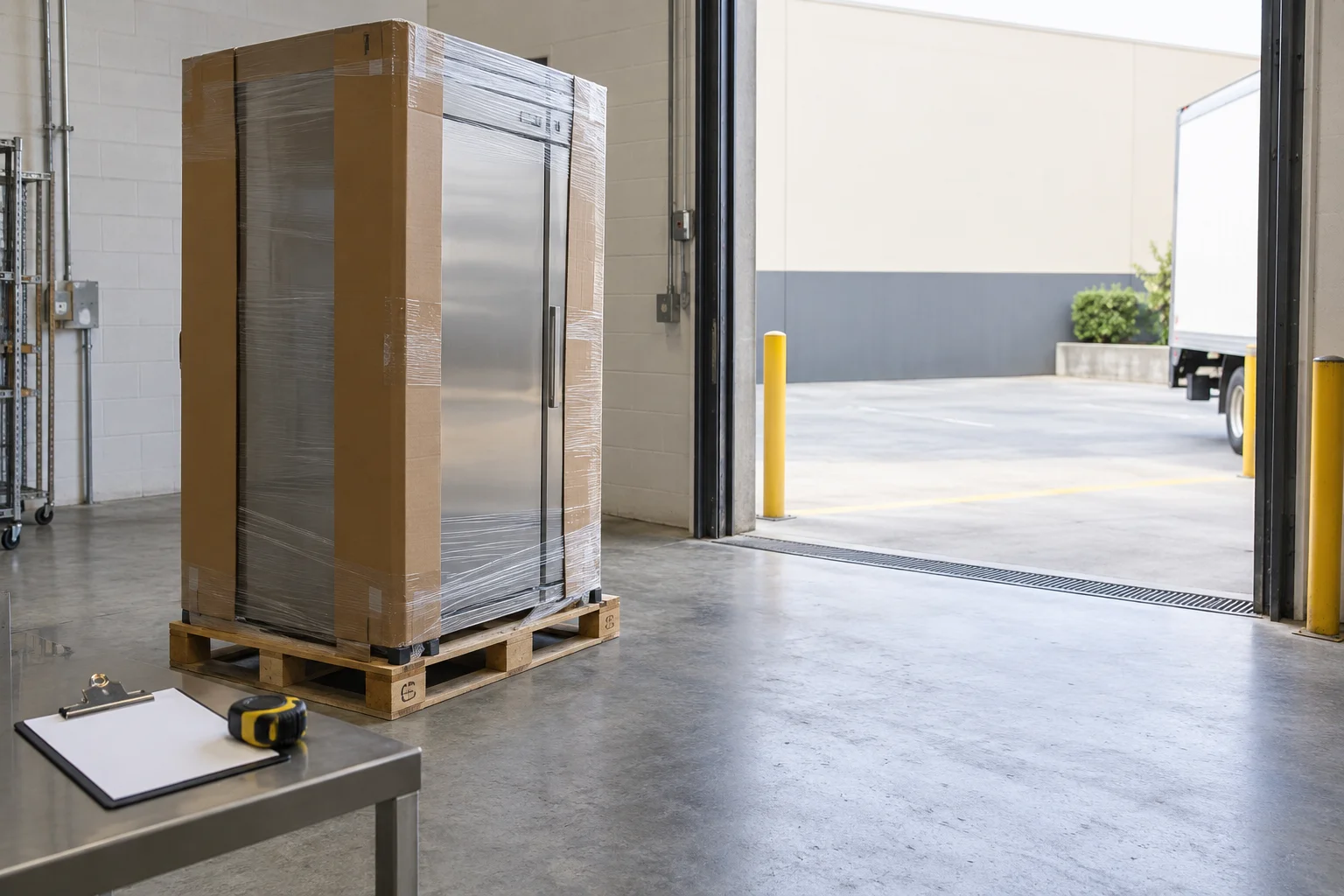
Measure the delivery route against the packed load, including the trolley or other equipment used to move it. The cabinet may fit its kitchen position while the delivery fails at a doorway, corner or goods lift.
The difference is measurable. In KW’s 15-listing snapshot, sourced from one supplier, Federal Hospitality Equipment, packaging increased the narrowest horizontal dimension by 20–80mm and height by 21–212mm. An extra 20mm can be enough to stop a delivery at a tight doorway.
Record the route from the agreed unloading point to the final position. The carrier or specialist mover then assesses the proposed method; your measurements are the evidence for that assessment.
What our packaging audit found
On 7 October 2026 we checked six labelled measurements—product width, depth and height, plus packing width, depth and height—on the official Federal Hospitality Equipment pages for 15 KW-listed Thermaster and FED-X refrigerated products. The supplier and KW records contain the same two horizontal measurements and height for each of the 15 body/packing pairs. Width and depth may be stored in different field orders, so compare the labelled physical sides.
The narrowest horizontal dimension increased by a median 40mm; median height increase was 101mm. We selected the 15 records whose recorded source was Federal Hospitality Equipment’s official product page; records sourced from internal PDFs, Bromic, Besttop or Simco (including Atosa and Snowman) were outside this pass. The sample mixes equipment formats and related variants from those two brands. Use the figures to understand the difference packaging can make, then obtain the dimensions for your own order.
Two exact examples show why the individual consignment matters:
| Source-checked model | Body W × D × H; packing W × D × H |
|---|---|
| Thermaster LG-1000BGBM | 1,253 × 740 × 2,039mm; 1,278 × 760 × 2,060mm |
| Thermaster TL900TN-6P | 900 × 700 × 800mm; 930 × 730 × 901mm |
Sources: Federal Hospitality Equipment’s LG-1000BGBM page and TL900TN-6P page. The figures are published packing specifications. Ask KW to confirm your order’s overall packed dimensions and gross weight, including the pallet or crate. KW’s delivery policy starts with equipment dimensions on the product page; for route planning, also obtain the packed dimensions. Supplier and KW listings may put width and depth in different orders, so match the labelled sides rather than comparing the first number alone.
For an illustrative 750mm-wide × 2,050mm-high clear doorway, the LG-1000BGBM body’s narrow face leaves 10mm across and 11mm above. Its published upright package exceeds both dimensions by 10mm. The packed cabinet cannot pass upright through that doorway. The bare body is only a possible alternative if the manufacturer and mover agree where and how to unpack and move it.
For a second hypothetical site, suppose equipment must pass through a low service hatch with a clear opening of 750 × 850mm. TL900TN-6P’s 700 × 800mm bare cross-section leaves 50mm each way. Its 730mm-wide package leaves 20mm horizontally, but the 901mm packing height is 51mm too tall. The hatch needs another route or an agreed unpacking method; checking width alone misses the obstruction.
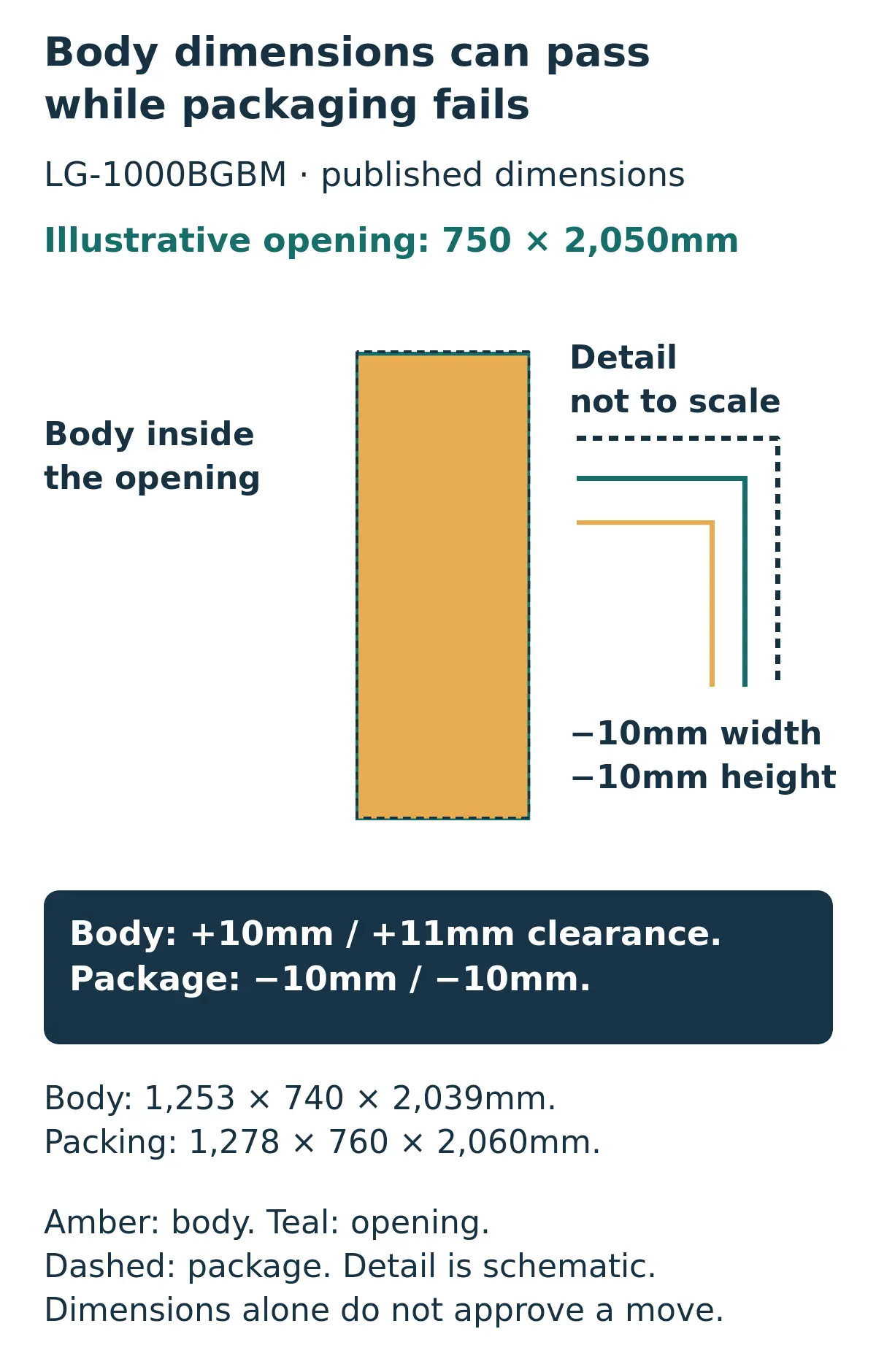
Mark each restricted point too small, possible—mover to confirm, or dimensions missing. Put an unknown shipping height in the last group. A bare cabinet that appears to fit belongs in the middle group until the unpacking and handling method are agreed.
Measure the usable opening and the approach
Measure the narrowest clear width and lowest clear height with each door in its achievable open position. Include handles, closers, stops, frames, handrails and fixed projections. Photograph the tape and label the conditions, such as “rear door at normal stop, between handle and opposite frame”. A nominal door size is not the available opening.
Record thresholds, steps, floor surfaces and changes in level separately. Ask the mover to check the trolley crossing and the floor separately from the doorway size.
Ask the mover for the complete moving dimensions. A pallet jack, trolley or protective arrangement can increase footprint and height. Keep unpacking, removal of doors/castors and changes of orientation unresolved until the manufacturer and mover confirm what is permitted, who does it and where. If unpacking is proposed, record who will do it, where, and how the cabinet will then be supported.
For turns, sketch the incoming corridor, outgoing corridor, corner, recesses and approach space from above. Photograph towards and away from the turn. Include the space needed to change direction, not just the two straight corridor widths.
A real package footprint can expose a turning conflict
LG-1000BGBM’s published package footprint is 760 × 1,278mm. For a simple turn-in-place calculation, treat the package as a rectangle rotating about its centre on a square landing. The greatest width it needs is its diagonal:
√(760² + 1,278²) ≈ 1,487mm.
An illustrative 1,450mm square cannot accommodate every angle of that centre rotation, despite being wider than either side of the package. A 1,500mm square clears the ideal rectangle geometrically, leaving only about 13mm total, or roughly 6mm per side if centred, at its maximum projection. That calculation covers the package alone; the mover also needs space for handling equipment, people and projections.
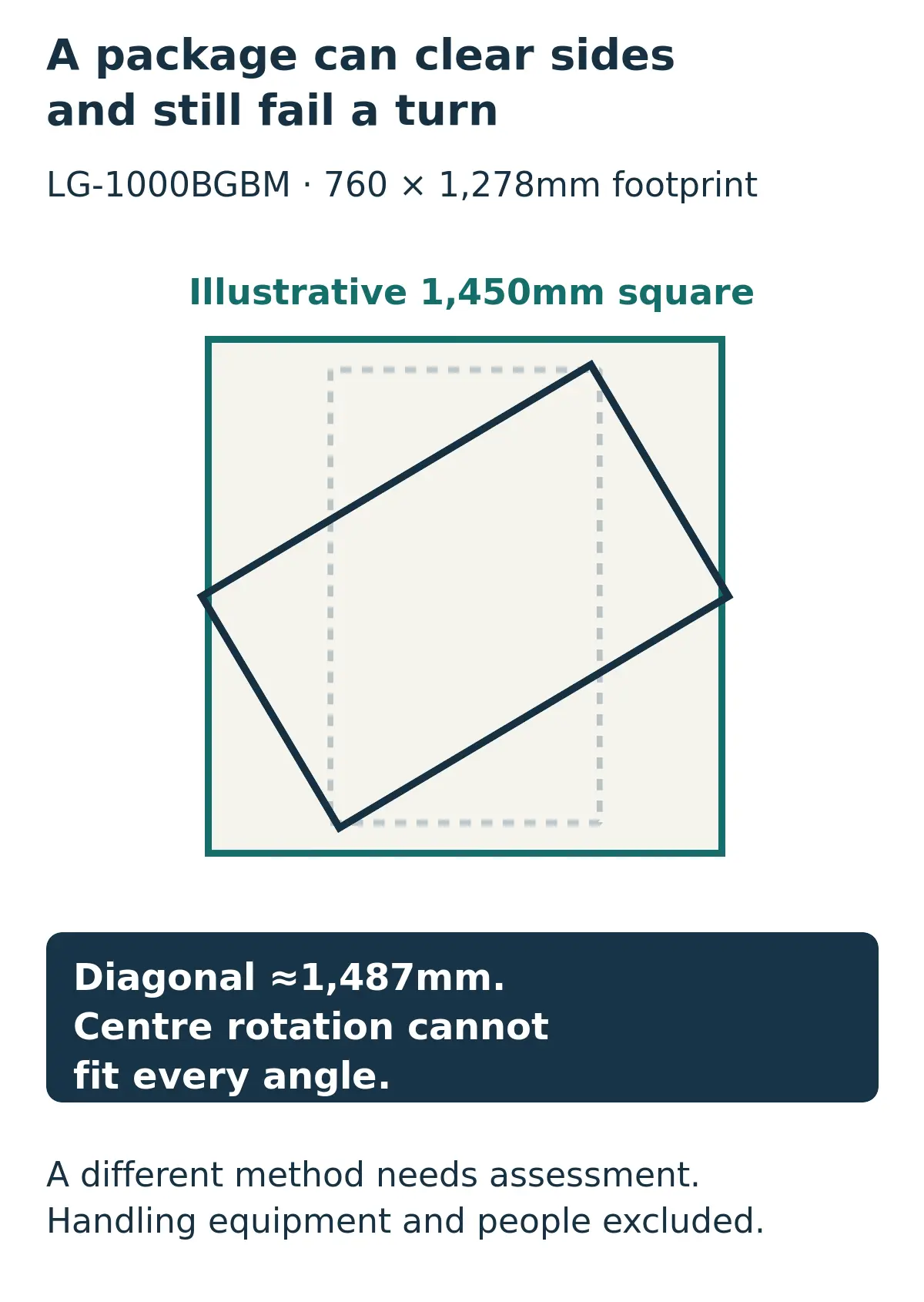
A mover may find another way to turn by changing position or using a different agreed method. The calculation gives them a specific tight point to assess. Do not choose an arbitrary tilt to force a fit; obtain the manufacturer’s transport instructions and the mover’s assessment. Building changes also need the building owner and relevant professionals.
Give lifts, stairs and docks their own record
For a goods lift, obtain the clear door opening, usable car width/depth/height, rated load and booking conditions. Photograph internal handrails and projections. The mover and building management must assess the combined load—equipment, handling device, people and other items—not the cabinet’s net weight alone.
Check the lift doorway before the car interior. In the LG-1000BGBM example, a 750mm clear lift door rejects its 760mm-wide upright package even if the car behind it is spacious. A load rating is a separate check: ask for the actual consignment’s gross weight and add the handling device, people and other items the proposed lift operation will carry.
For stairs, record each flight’s step count, rise/tread dimensions, clear width, landings, headroom, handrails and approach at both ends. Put each landing on the same labelled plan as the flights. A landing narrower than the 1,487mm turn-in-place calculation flags a question for the mover. On stairs, include headroom and the proposed handling equipment in the assessment. Photograph direction changes. Have the specialist mover and building owner assess the method and structural/loading questions before booking.
At docks and shared commercial buildings, record vehicle approach and height limits, unloading facilities, delivery windows, bookings, induction requirements and the authorised route. An alternative through another tenancy only exists once access is agreed.
Safe Work Australia’s hazardous manual tasks guidance addresses risks in lifting, pushing, pulling and carrying. Its model Code’s legal effect depends on jurisdiction. The responsible assessor needs the route and handling information as well as the weight.
Confirm where the delivery service ends
KW’s Delivery & Shipping policy describes standard delivery as kerbside or loading-dock delivery. The separately quoted Premium Delivery Service covers selected postcodes and depends on the equipment and site; it includes indoor placement, basic positioning and packaging removal. Old-equipment removal/disposal is an optional extra-cost service. Positioning is separate from installation and commissioning.
Confirm who unloads, who takes the load into the tenancy, who unpacks and who supplies any handling equipment. If one carrier stops at the dock and another party moves the cabinet internally, both need the measurements for their part of the route.
The policy states that undisclosed access restrictions may cause redelivery fees. If equipment cannot be landed because of access, return freight and a restocking fee apply. Resolve the restriction before dispatch and keep the agreed delivery point with the quote.
Arrange requested services rather than assuming them: tail-lift delivery depends on coverage and may cost extra; KW lists two-person delivery on request for items over 80kg. That service threshold does not prescribe a safe lifting team. Advise KW if there is no forklift or dock, or the proposal needs a crane/hi-ab.
Send one route brief, including the outgoing unit
Number each restricted point and keep its measurement, photograph and unanswered question together:
| Route point | Evidence and question to resolve |
|---|---|
| Vehicle/unloading | Approach limits, surface, facilities and site contact; can the booked vehicle and unloading method serve it? |
| Opening | Clear width/height, projections and threshold; will the agreed packed or unpacked load pass? |
| Turn | Labelled plan and both approaches; can the complete moving load manoeuvre? |
| Lift/stairs | Opening, dimensions, load/booking conditions or flights/landings; is the proposed method permitted? |
| Final position | Approach, working space and exact-model requirements; can the unit be positioned and installed? |
For replacement equipment, assess the outgoing unit too. It may differ in size, or the surrounding fit-out may have changed since installation. Sequence removal and arrival so neither unit blocks the other’s route. For refrigeration, reserve enough space in another refrigerator and verify its food-storage conditions before taking the old cabinet out of service. Use the refrigeration load-recovery guide to define the new cabinet’s equipment acceptance checks. For several suppliers, the fit-out quote comparison guide helps keep freight, positioning and installation responsibilities visible.
Send the exact model, postcode, unloading point, route record and restrictions through KW’s enquiry form, choosing Delivery enquiry. A labelled PDF can combine the photographs and sketch; the form accepts up to three PDF/JPG/PNG/WebP files, each at most 5MB and 10MB altogether. For a Premium quote, the delivery policy asks you to email sales@kwcommercial.com.au with the order number, site address and access details.
Resolve the tightest unconfirmed point before committing to the route. One favourable doorway result cannot cancel an unresolved turn, lift limit or unloading requirement.
Evidence checked 7 October 2026. The 15-row audit compares catalogue dimensions with official supplier pages. Site openings and landings are hypothetical; actual packing and the handling method must be confirmed for the order.