
A Hand Basin on the Plan Is Not Yet a Usable Hand-Washing Facility
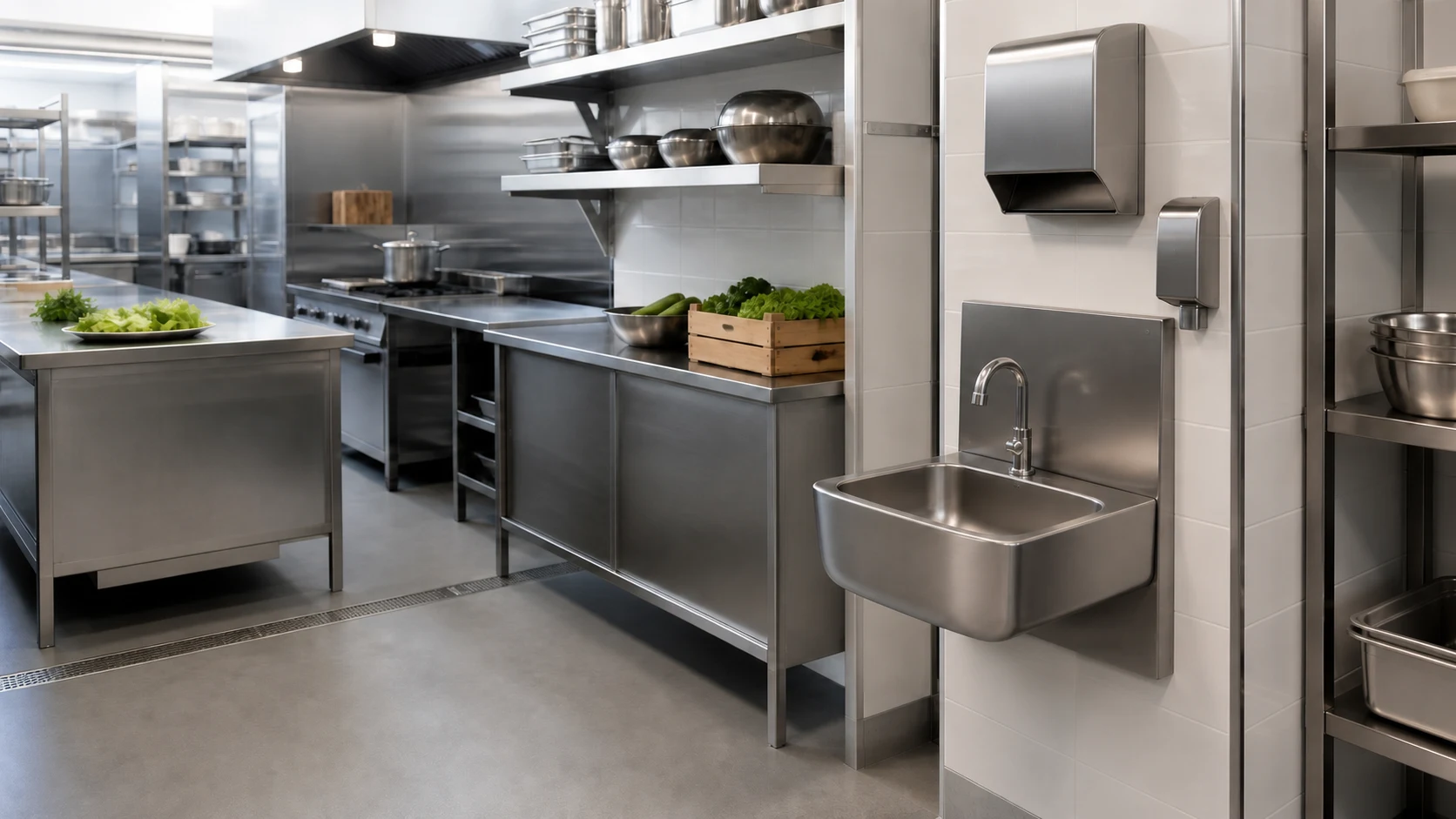
A commercial kitchen can have a hand basin on its equipment list and still leave staff without a practical place to wash their hands when the work requires it.
The problem may be obvious: the basin is behind an open door, blocked by a trolley or placed outside the area where unprotected food is handled. It may be less visible: there is no warm running water, the bowl does not allow hands and arms to be washed effectively, or the sink has quietly become another place to rinse utensils.
The first question is therefore not, “Which basin should we buy?” It is, “Where can hands contaminate food or a clean food-contact surface, and can the person working there reach a properly equipped hand-washing facility when they need it?”
Start with the work, not the basin count
Australian food-premises requirements do not begin with a universal instruction to install one basin per kitchen, per room or per employee. The FSANZ guidance for Standard 3.2.3 starts with the activities taking place.
Hand-washing facilities must be available within areas where food handlers work if their hands are likely to contaminate food. The guidance points to handling unprotected food and clean, sanitised food-contact surfaces as relevant examples. A warehouse worker moving sealed cartons presents a different hand-to-food risk from a cook handling raw ingredients or a person portioning ready-to-eat food.
That distinction changes how a fit-out should be considered. A single open kitchen may contain several different hand-contamination points even without walls between them: raw preparation, ready-to-eat assembly and a wash-up area receiving soiled utensils. Conversely, a room does not automatically need another basin merely because it has a different name on the floor plan.
Map the work first:
- Where is unprotected food handled?
- Where are clean or sanitised food-contact surfaces handled?
- Where do staff move after touching raw ingredients, dirty utensils, waste or other possible contaminants?
- How many people may need to wash their hands without waiting or leaving the relevant work area?
Those questions do not generate a basin count by themselves. They reveal where the hand-washing decision has to be resolved.
“Accessible” describes the route to the facility
A basin can be physically close and still be inconvenient to use.
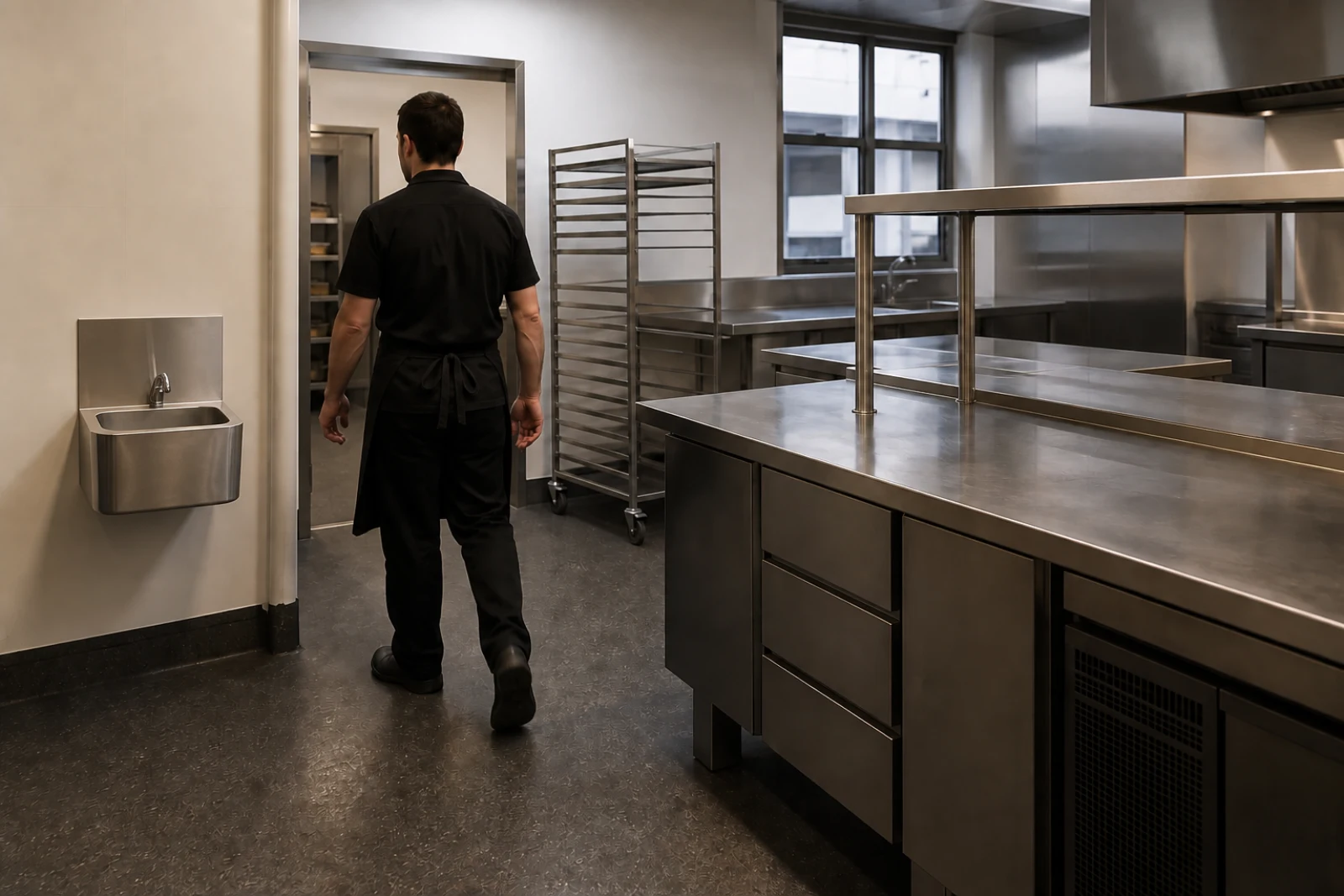
FSANZ explains that hand-washing facilities behind equipment, walls, partitions or doorways are unlikely to be easily accessible. A facility above or below a bench may also be too high or low for effective access. Its location should reflect the layout and the needs of the people working in the area.
This is a more useful test than measuring from the basin to the nearest bench and stopping there. Imagine a basin placed just inside a kitchen door. On an empty plan it looks close to the preparation line. During service, the door stands open across it and a mobile rack occupies the remaining approach. The basin exists, but the route that staff need has disappeared.
The national FSANZ guidance does not prescribe one maximum distance for every food premises. It says the appropriate distance can vary with the size of the area and the activities taking place. Some councils publish more specific fit-out rules. For example, the City of Stonnington's construction guidelines state that a hand basin should be within five metres of a food-preparation area and specify hands-free control expectations in that municipality.
That five-metre figure is evidence of a local requirement, not an Australia-wide shortcut. A business must check the rules applying to its own premises rather than importing a number from another council's guide.
There is also no single national basin count. FSANZ says additional basins depend on factors including the size, layout and use of the area and the number of food handlers. The practical objective is that staff are not discouraged from washing their hands because they must wait or travel too far.
The bowl is only one part of the facility
Once a location makes sense, the facility itself still has to support effective hand washing.
Under the FSANZ guidance, the normal requirements include a permanent fixture supplied with warm running potable water, subject to the provisions for temporary premises and specific exemptions. The water must run from a single outlet. Filling a bowl from separate hot and cold taps does not turn the resulting pooled water into warm running water.
The basin must also provide enough room for hands and arms to move under the running water. FSANZ does not prescribe one national litre capacity or one set of dimensions. A compact basin cannot be accepted from its external measurements alone; the usable space under the outlet matters.
The facility must be clearly designated for washing hands, arms and face. That can be reinforced by a recognisable hand basin, hand-wash-only signage and by keeping soap and drying facilities at that location. FSANZ's business guidance also requires soap or another suitable cleaner and an effective way for staff to dry their hands, with a used-towel container where appropriate.
This is why a prep sink, pot-wash sink or cleaner's sink should not casually become the hand basin when the dedicated facility is awkward to reach. The tasks are not interchangeable. FSANZ discusses limited arrangements in which one compartment of a double sink may be designated for hand washing, but their suitability depends on what else the business needs the sink to do and whether food-safety risk is controlled. That is not permission to label any spare bowl “hands only” after the rest of the fit-out has been fixed.
A control label does not settle the site decision
Hands-free, knee-operated, foot-operated, timed and sensor controls can all appear in commercial hand-basin ranges. They are product characteristics, not national approval labels.
FSANZ notes that hands-free or single-lever controls can reduce the likelihood of contamination transferring through a tap touched by dirty hands. It also says there is no prescribed duration for an automatic tap's water flow; water has to remain available long enough for thorough washing, which may require the control to be activated more than once.
Some local fit-out authorities require or prefer particular control methods. Other site decisions may turn on how warm water is supplied, whether a tempering arrangement is needed, what the unit includes and how it must be connected. Those questions belong to the current local requirements, the exact product documentation and appropriately licensed installation advice.
The same caution applies to mobile hand-washing stations. A fresh-water tank, waste tank or foot pump may make a unit relevant to a food truck, market or temporary site. None of those features, alone, proves that the unit provides the required water arrangement for long enough, manages wastewater appropriately or is accepted for that operation. Temporary premises can have different provisions, and the relevant authority must assess the actual setup.
“Commercial”, “hands-free” and “mobile” help describe equipment. They do not finish the facility assessment.
Choose hardware after the hand-washing path is clear
Product selection becomes much simpler once the work-area and facility questions have been answered.
At that point, the buyer can compare exact dimensions with the available space, check how the control operates, identify what tapware or water components are included, and confirm the connection and mounting requirements. Those are legitimate product questions. They should be answered by the exact product specification, not inferred from the category name or a similar-looking basin.
KW's commercial hand wash basin and station range is the appropriate next owner once the required facility job is defined. It should not be used to reverse the decision by picking a product first and assuming the floor plan will make it suitable.
Before ordering or relocating equipment, put the proposed facility back into the actual work path. Confirm the food-handling areas it serves, whether the approach remains open during service, how warm running potable water and drainage will be provided, whether hands and arms can be washed effectively, and where soap and drying will sit. Then take that proposal to the local council or environmental health officer and the relevant licensed design or plumbing specialist.
The useful evidence is not that a basin appears on the equipment schedule. It is that a food handler can reach and use the complete facility at the point the work creates the need.