
What Does “Automatic” Actually Mean on a Commercial Meat Slicer?
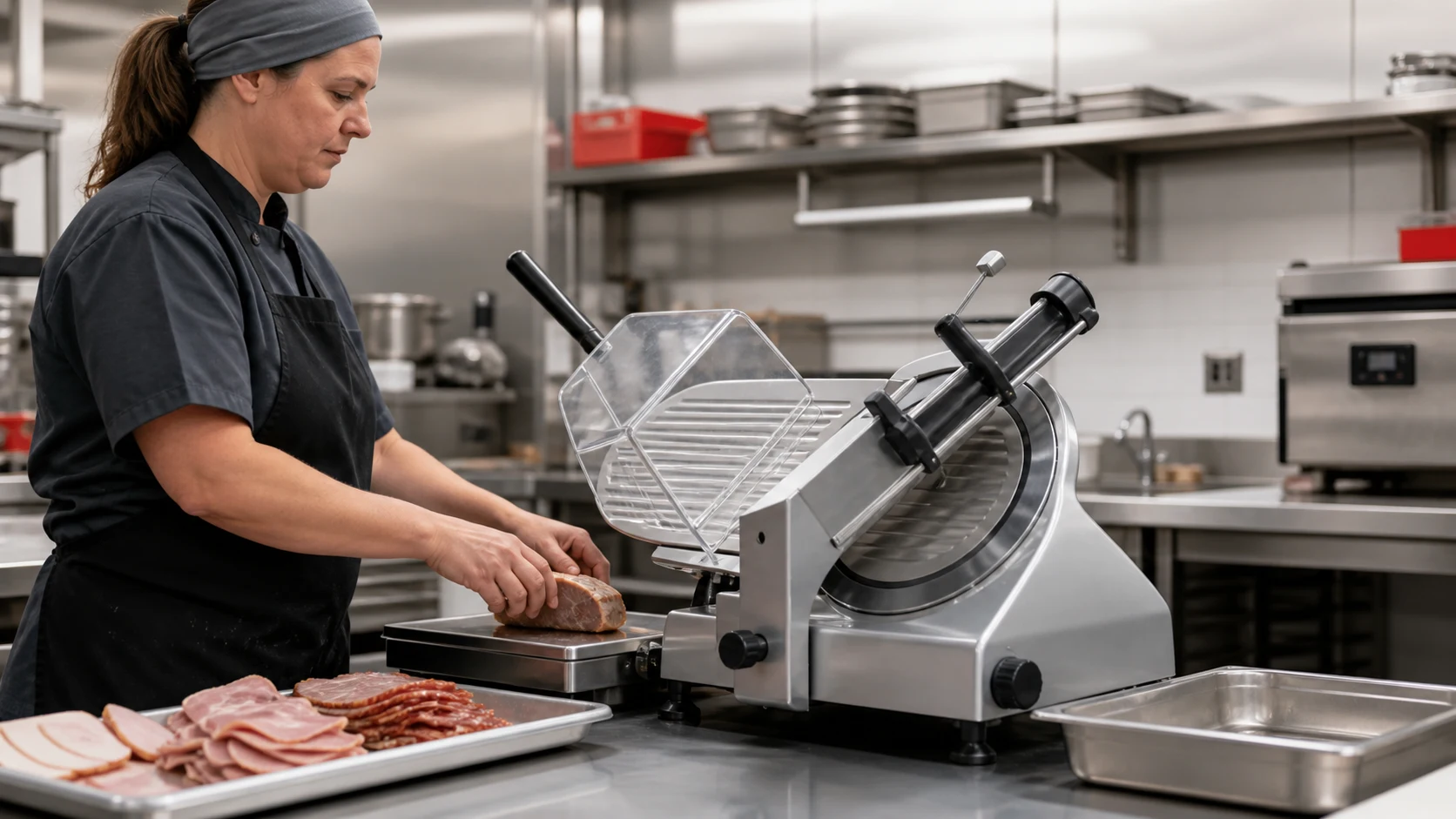
“Automatic” does not tell you that a meat slicer runs without an employee. It does not, by itself, tell you how many finished slices a kitchen will produce in an hour or how much labour the machine will save. It tells you that some function is automated — and the useful question is which one.
On one machine, automatic operation may mean that the carriage travels back and forth under power. On another, automation may extend to depositing or stacking slices. More integrated systems may add product fixation or weighing. Those machines can all carry an automatic label while removing very different parts of the operator’s work.
That makes “manual versus automatic” a poor final decision. It is a starting question that must be unpacked into the actual service workflow.
Put the whole slicing job back into view
The cutting stroke is only one part of using a commercial meat slicer. A practical workflow may include:
load product → secure product → set thickness → select and control the operating mode → move the feed or carriage → slice → collect slices → change product → clean → sanitise → reassemble
Not every machine uses exactly that sequence, and individual manuals may impose additional controls. The map matters because the word “automatic” can draw attention to the moving carriage while the work before and after it disappears from the comparison.
Workflow automation map
| Workflow stage | What an automation label may tell you | What the label does not establish |
|---|---|---|
| Load product | Usually nothing on its own | Who loads it, allowable product condition, maximum product size |
| Secure product | Some integrated systems may automate fixation | Whether a bench slicer still requires an operator to position and secure product |
| Set thickness | Nothing unless the exact controls say otherwise | Who selects or verifies the setting |
| Select/control mode | That an automatic mode exists | How it is started, stopped, changed or supervised |
| Feed/carriage movement | This is the automated function on some slicers | Loading, collection, changeover or cleaning |
| Slicing | The blade and feed may complete a powered cutting cycle | Real service output across an entire shift |
| Collect/deposit slices | Some models automate depositing, stacking or shingling | That every “automatic” slicer handles finished slices |
| Product change | Usually nothing | Time to stop, reload, reset or avoid cross-contamination |
| Clean and sanitise | Nothing on its own | Disassembly, cleaning method, chemical use or frequency |
| Reassemble and return to service | Nothing on its own | Checks required by the exact manual and workplace procedure |
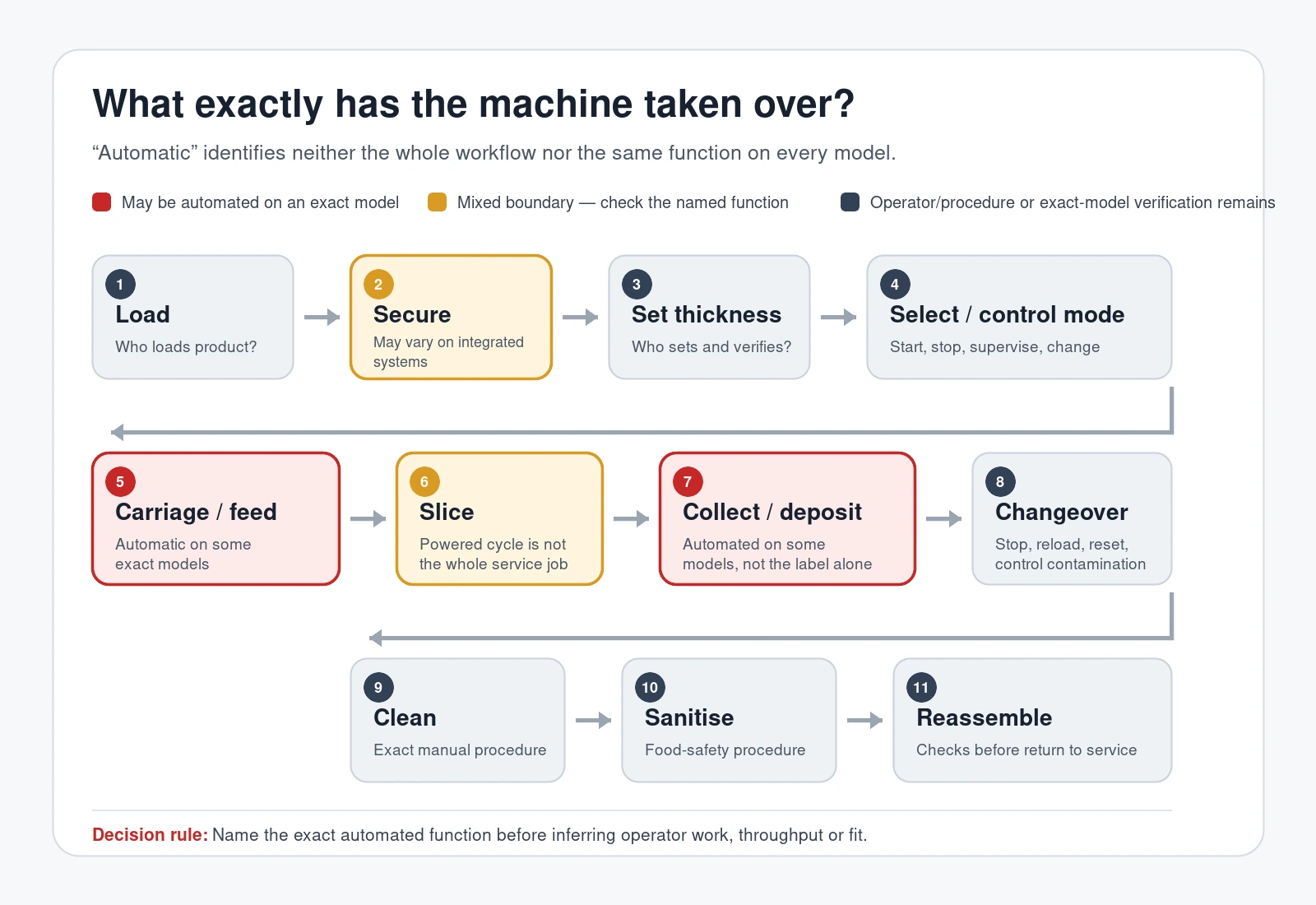
The table is not a category specification. It is a way to expose the missing questions. The exact model’s manual and technical documentation decide which cells change from operator work to machine function.
Two automatic slicers may automate different jobs
Official manufacturer documentation makes the terminology problem visible.
For the Globe S13A, the operator loads the product onto the carriage, secures it with the end weight and sets slice thickness. Its automatic mode then moves the carriage, with selectable speed and stroke settings. The manual also tells the operator not to load, unload or adjust the carriage during automatic operation. “Automatic” here describes a controlled part of the cutting cycle, not an unattended workflow. (Globe S13A owner’s manual)
Hobart’s HS9 documentation likewise describes an automatic carriage, including selectable speeds and stroke lengths. Loading, setup and cleaning remain separate parts of operating the machine. Those details belong to the HS9; they should not be transferred to another slicer simply because its product name also says automatic. (Hobart HS9 operator resources, HS9 specification sheet)
Bizerba’s range illustrates a wider automation boundary. Its VSP F documentation includes depositing functions such as stacking or shingling, while the A660 describes a more integrated process involving product fixation, slicing, depositing and weighing. These examples do not define what all Bizerba machines do. They show why two products carrying an automation label may replace different actions. (Bizerba VSP F, Bizerba A660)
The defensible comparison is therefore not “manual or automatic?” It is “which exact function does this model perform, under what controls, and what work remains around it?”
The operator work may move rather than disappear
A powered carriage can remove repeated hand movement during the cutting cycle. That is an observable mechanical distinction. It does not prove that the employee is free for another job throughout service.
Product still has to reach the machine in an allowable condition. Depending on the model, someone may need to load and secure it, select thickness and operating mode, monitor slice collection, change products, and stop the machine for cleaning. If sliced product accumulates faster than it can be collected, portioned, packaged or transferred, the downstream task can constrain the useful output. Frequent product changeovers can do the same.
This is why a labour-saving claim needs more than an automatic carriage. It needs a defined workload and evidence about the entire process: who performs each remaining action, how often changeover occurs, what happens to the slices after cutting, and whether the operator can safely perform another task while the documented operating procedure is followed.
Without that evidence, it is reasonable to say that a machine automates a specified motion. It is not reasonable to turn that motion directly into a staffing reduction, dollar saving or payback period.
A throughput number needs its test conditions
A published throughput figure may be useful exact-model evidence. It is not automatically comparable with a number from another machine.
Before using a slices-per-minute or similar figure, check what produced it:
- What product was being sliced, and in what condition?
- What thickness setting was used?
- Which carriage speed, feed arrangement or stroke length applied?
- Does the figure describe the cutting cycle only?
- Is depositing or stacking included?
- Are loading, collection and product changeover outside the measurement?
- Is the number a nominal machine setting or an observed service result?
If those conditions are absent, the number may describe the machine less completely than it appears to.
Blade diameter has a similar evidence limit. It can help identify a physical dimension and, alongside exact documentation, whether a product fits the machine’s stated envelope. Diameter alone does not prove full-cycle output. Feed design, stroke, controls, product condition, slice setting, changeover and downstream handling are not contained in that one number.
What a specification proves — and what it does not
| Field or label | A supportable inference | An inference to stop |
|---|---|---|
| Automatic | The exact documentation identifies at least one automated function | Unattended operation or a complete labour outcome |
| Carriage/feed description | How product is moved during the documented cutting cycle | Finished output across loading, collection and changeover |
| Speed or stroke settings | Available settings on that exact model | Direct equivalence to another manufacturer’s setting |
| Blade diameter | The stated blade dimension | Higher real-world production by itself |
| Slice thickness range | The model’s stated adjustment range under its instructions | Suitability for every meat, cheese or product condition |
| Nominal throughput | A model-specific figure under stated conditions | A like-for-like service result when conditions are missing |
| Removable or tilting components | A documented cleanability feature | A fixed cleaning time or reduced sanitising obligation |
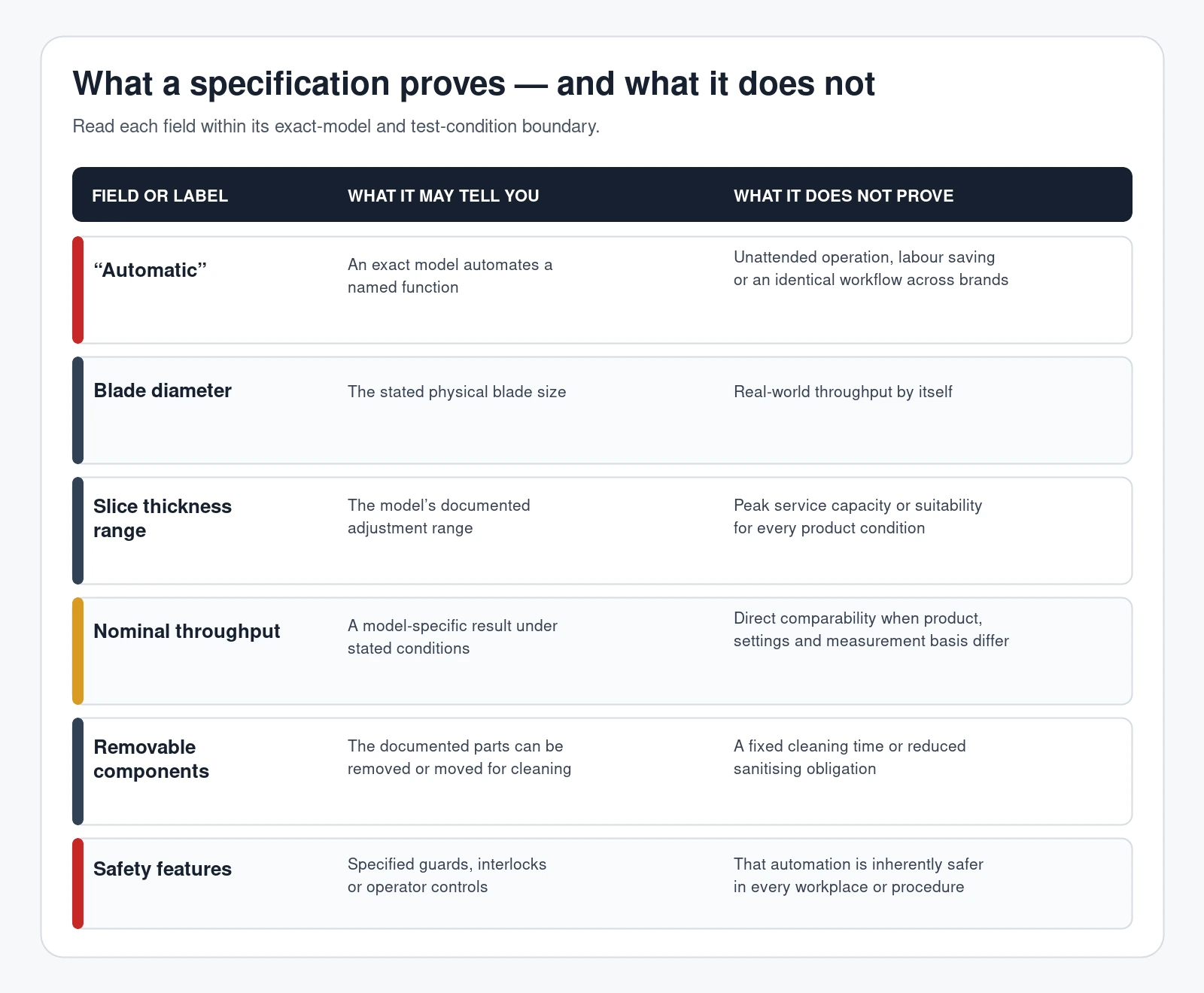
The strongest product evidence says both what the machine does and the conditions around the claim. Missing conditions are not an invitation to estimate them.
Automation is not a safety conclusion
Commercial slicers involve sharp blades and moving machinery. Whether a particular machine and work method control those risks depends on more than how its carriage moves.
WorkSafe Queensland’s guidance on meat-processing machines addresses guarding, controls, cleaning and electrical hazards, risk assessment and duties across the machine lifecycle. Its meat-slicer incident alert highlights controls such as guards, interlocks, food pushers, training and safe systems of work. Safe Work Australia likewise places machinery risks within the hierarchy of controls.
Those controls must be assessed for the exact machine and workplace. An automatic function can change the motion an operator performs, but the label does not prove that guards are suitable, procedures are followed, training is adequate or residual risk is lower. “Automatic is safer” is therefore not a safe purchasing shortcut.
The cleaning job remains after the cutting cycle
Automation during slicing does not remove food-contact cleaning and sanitising work. Cleanability must be examined separately through the exact machine instructions: which parts are designed to be removed or tilted, how the blade area is accessed safely, what must not be immersed or sprayed, and how the machine is returned to service.
FSANZ guidance distinguishes cleaning from sanitising: the surface must first be cleaned so the sanitising step can work effectively. Equipment instructions and chemical-manufacturer directions still apply.
Frequency should not be invented from the product category. FSANZ guidance allows cleaning and sanitising planning to reflect the equipment, its use and the food-safety needs of the business. A four-hourly interval may be appropriate for meat or salad slicers in a stated ready-to-eat-food context, but that is not a universal timetable for every slicer and every operation. The business plan, applicable food-safety requirements and exact equipment procedure must agree. (FSANZ Appendix 6)
The better comparison is not “automatic or easy to clean?” Ask whether the exact design reduces the work or risk of disassembly, whether the documented procedure fits the service pattern, and what remains compulsory regardless of the powered cutting mode.
Evidence to require before treating the label as a decision
For an exact model, look for documentation that answers the following:
- Which movement or function is automated: carriage, feed, depositing, stacking, product fixation, weighing, or another defined action?
- What must the operator load, secure, set, start, supervise, collect, change or stop?
- Which speed, stroke or mode settings apply, and what do they control?
- What product conditions and dimensions are permitted?
- If throughput is published, what product, thickness and operating conditions produced it?
- Which guards, interlocks and operating controls are documented?
- Which components are removed or moved for cleaning, and what cleaning and sanitising procedure is specified?
- What electrical, installation, inspection and service requirements apply to that exact model?
The Blog can explain why these questions matter. The current commercial meat slicer category and individual product pages own the current range, price, stock, warranty and model-level shopping information. The manufacturer’s current manual or specification must prove operational details; KW sales or service should handle unresolved workload, installation or maintenance questions.
That handoff is the useful end of the comparison: not a generic verdict that manual or automatic is better, but a clear account of what the proposed machine will actually do — and what it will still require from the people operating it.