
Three Mixer Heads Do Not Automatically Equal Three Drinks at Once

A commercial milkshake mixer’s head count tells you how many mixing positions are installed. It does not tell you how quickly a queue of finished drinks will leave the counter.
Three heads may provide three usable positions. But that conclusion still depends on the exact machine: whether the positions have independent motors and controls, whether the required cups and agitators are available, and whether the manufacturer documents simultaneous operation. Even when all of that is proved, head count has not measured ingredient loading, cup removal, serving, recipe changeover or hygiene work.
The useful buying question is therefore not “single, double or triple?” It is: how many positions can this exact machine make usable for the orders that arrive together?
Start with the queue, not the machine
A daily total can hide the decision that matters. Fifty drinks spread across a day create a different equipment job from six drinks arriving together, even though the total is lower.
Describe the busiest order pattern before comparing commercial milkshake mixers. How many drinks arrive in one group? Are they the same recipe, or do they require different ingredients and agitators? Can the cups be loaded before a position becomes free? Does one operator prepare, remove and serve every drink? Is a cleaning or allergen-control step required before a position can take the next recipe?
These questions do not create a universal capacity formula. They reveal whether another installed position could actually overlap with work already in progress.
Consider a three-drink order. If all three positions on an exact machine can operate independently, all required cups and agitators are present, and the recipes are suitable for simultaneous preparation, three positions may be usable together. If one drink needs a different process or a reset governed by the business’s food-safety procedure, the same machine can face a different service pattern. The head count has not changed. The work around it has.
This is why “drinks per day” and “number of heads” should not be joined by an invented rule. The missing evidence sits inside the peak queue.
What has actually been proved?
Product pages make head count easy to compare. The harder task is identifying how far the available evidence lets the comparison go.
Concurrency proof ladder
| Evidence level | What it can establish | What it still does not prove |
|---|---|---|
| Number of heads or spindles | Installed mixing positions on the exact model | That every position can operate independently or simultaneously |
| Separate motors | A stronger mechanical basis for independent positions | Independent control, compatible cups or a complete drink cycle |
| Independent controls or activation | The operator can control positions separately as documented | That every recipe can use every position at the same time |
| Supplied cups, agitators and documented simultaneous use | Strong exact-model evidence for concurrent mixing within the stated conditions | End-to-end drinks per hour, queue clearance or labour saving |
| A controlled peak-service test | Performance under the test’s recipe, operator and process conditions | A universal result for another venue, recipe or machine |
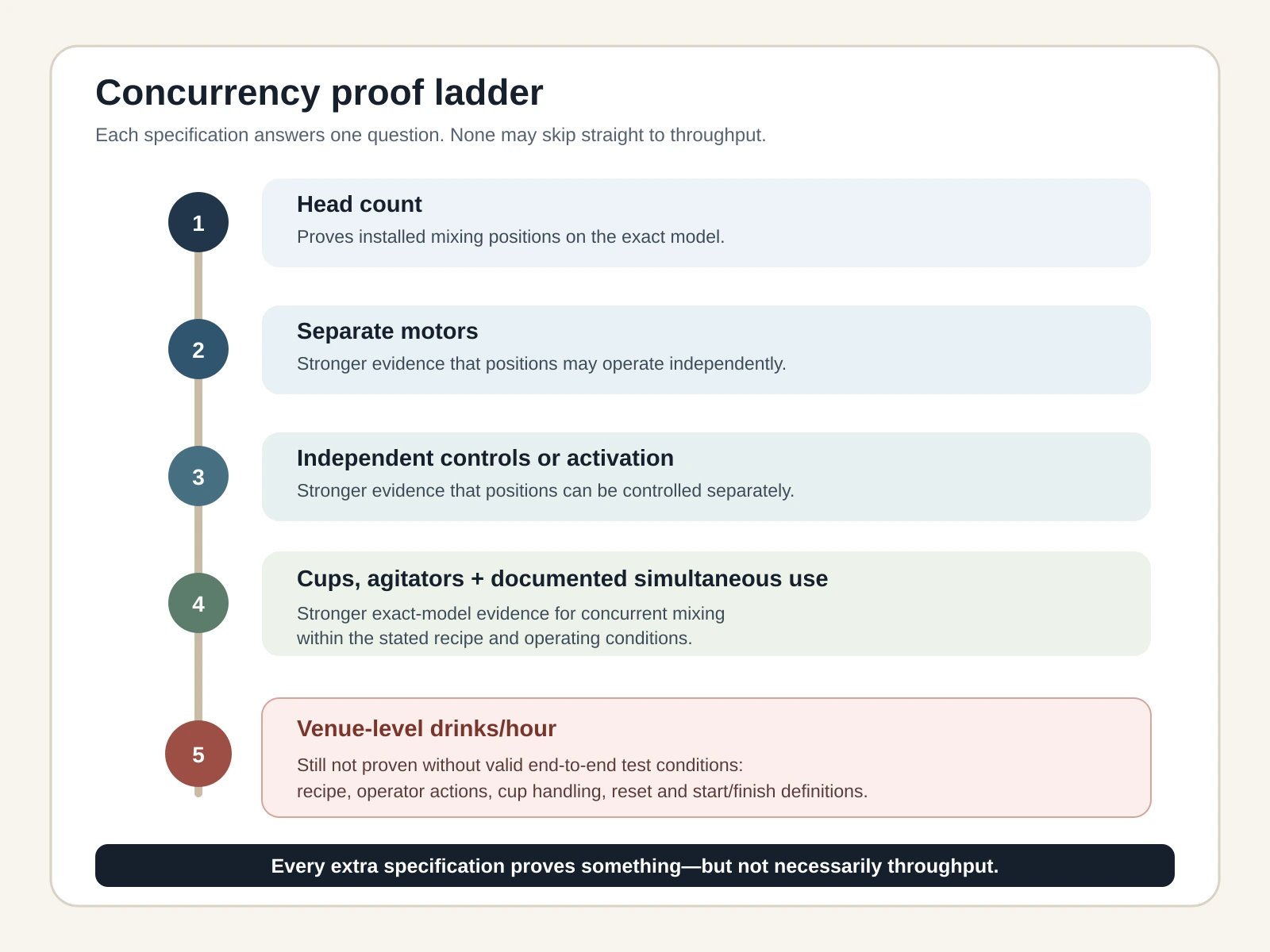
The stop point matters. A specification can move a claim up this ladder, but it cannot jump from “three heads” to “three times the output”.
Ceado provides a useful exact example. Its official M98 page describes the M98/2 as using two 300 W motors that operate independently and says two different recipes can be prepared simultaneously. That proves more than the label “double mixer”. It supports two independently operating positions and concurrent recipe preparation for that model. It still does not publish a complete venue-level drinks-per-hour result.
Hamilton Beach’s HMD200/HMD400 literature supplies another exact distinction. It describes the HMD200 with one motor, spindle and cup, and the HMD400 with three motors, spindles and cups. That is relevant evidence about the hardware supplied with those series. It does not measure the time required to load three cups, remove them, finish the drinks and prepare the next order.
Roband’s DM31 shows why activation language also needs care. Roband documents a single mixing position, two-speed control and a cup support that can hold the cup during mixing. “Hands free” in that context describes the supported cup while the mixer runs. It does not mean the machine loads ingredients, selects the control, removes the cup or serves the drink without an operator.
The examples are not a ranking. They demonstrate how exact documents can prove different levels of concurrency—and where the evidence stops.
Stress-test the order pattern
Once the exact machine’s positions are understood, apply them to the orders that cause pressure. Do not assign imaginary seconds. Test whether the work can overlap.
Peak order pattern stress test
| Order condition | Question that changes usable concurrency | Evidence needed before counting the position |
|---|---|---|
| Several drinks use the same recipe | Can the required cups be loaded and the documented positions run together? | Independent-operation evidence, cup/agitator availability and exact operating instructions |
| Drinks use different recipes | Are the recipes and agitators compatible with concurrent use on those positions? | Manufacturer recipe/agitator scope and the venue’s preparation method |
| One operator owns the whole order | Which loading, control, removal and serving actions can actually overlap? | Observed service process; do not infer labour capacity from hardware alone |
| A position needs cleaning or an allergen reset | When can that position safely accept the next drink? | Business food-safety/allergen procedure plus exact cleaning instructions |
| Cups or agitators are reused | Are enough compatible components ready for the next wave? | Included-component evidence and the venue’s utensil/reset process |
| A published speed or power figure looks higher | Was an end-to-end result tested under comparable conditions? | Manufacturer test conditions or a controlled site test—not RPM or watts alone |
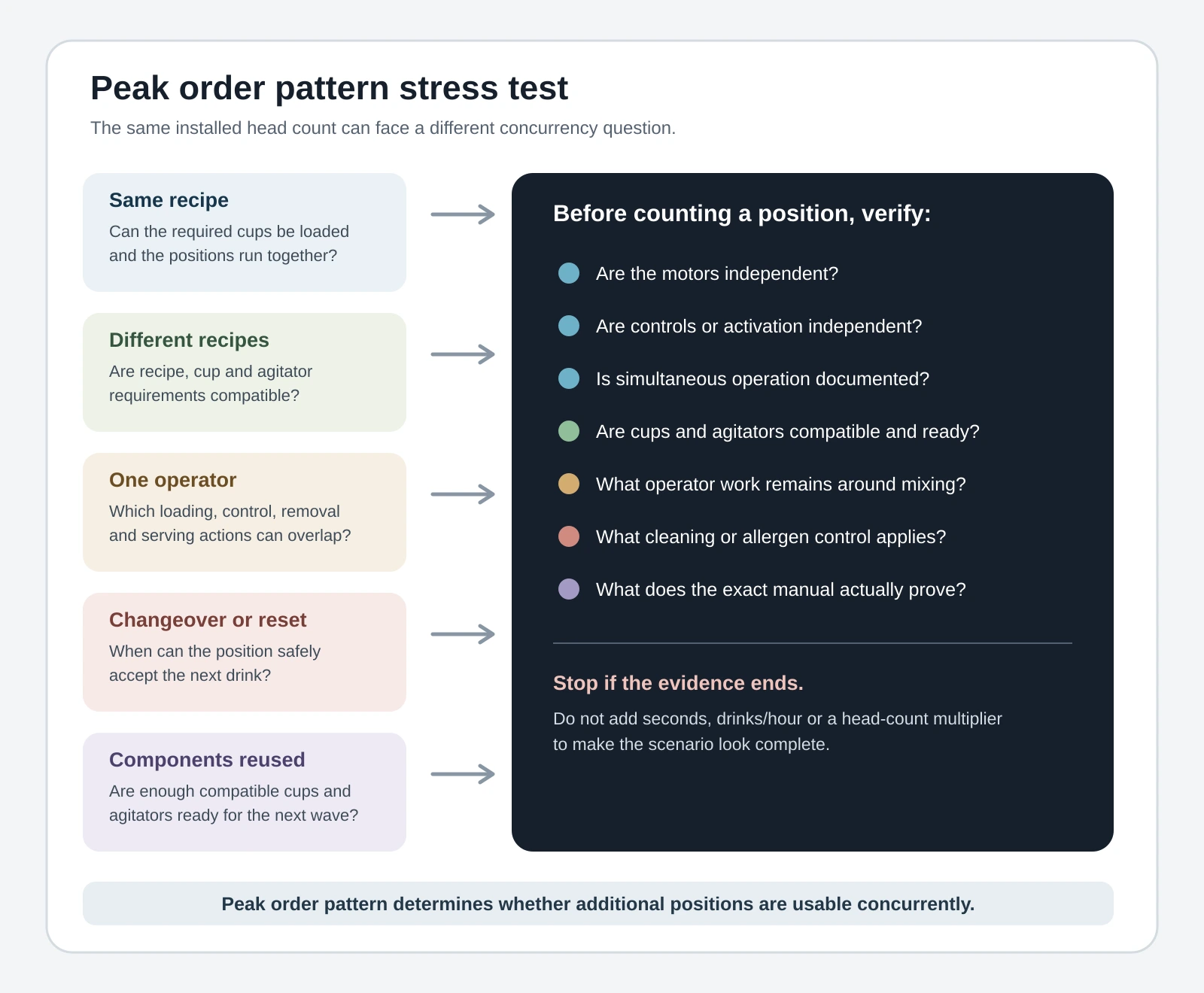
This is not a calculator. Its job is to prevent a multiplication error: heads × assumed cycle time = claimed capacity.
Two venues can reasonably reach different decisions about the same mixer. One may receive repeated groups of identical drinks and have the components and operator process to keep several positions occupied. Another may process frequent recipe changes or controlled allergen resets that prevent every position from returning immediately to the queue. Neither conclusion can be read from the head count alone.
The operator is part of realised concurrency
Manufacturer manuals show that mixing is only one part of the service cycle.
The Ceado M98 manual instructs the operator to place ingredients in the cup, hang the cup to engage the holder, start the motor, stop it, wait for a complete stop, remove the cup and serve. The Roband DM31 manual likewise describes selecting the speed, placing ingredients in the cup, positioning the cup, then removing it after mixing and waiting for the spindle to stop.
Those exact procedures should not be turned into a universal workflow for every mixer. They establish a narrower point: even where the cup can remain supported during mixing, an operator still performs work around the running position.
That work is relevant because parallel motors and parallel labour are not the same thing. A three-position machine may run several cups concurrently while one operator sequences the surrounding actions. Whether this clears a real queue depends on the order pattern and the observed process. The equipment specification does not supply that operational result.
This is also why an additional head cannot be promised as a labour saving. It may change which mixing work can overlap. It does not establish how many employees are required, what else they are doing, or how the complete service station is organised.
Hygiene can interrupt a position without changing its head count
Cleaning is not a generic appendix to the capacity decision. A position that cannot safely accept the next recipe is not currently usable concurrency.
Food Standards Australia New Zealand’s cleaning and sanitising guidance distinguishes cleaning from sanitising and states that items must be cleaned before they are sanitised. Food-contact surfaces need to be kept clean and sanitary. The exact work and frequency depend on the food, the equipment’s use and the business’s controls; a category article cannot impose one daily, weekly or between-drinks timetable.
Exact manuals may identify removable or dishwasher-suitable components for named models. That evidence can help a buyer understand the reset process, but it does not prove a fixed cleaning time. Nor does it decide the procedure required for a venue’s allergen management.
Where different recipes introduce an allergen-control question, stop the concurrency calculation. The business’s food-safety procedure and the exact manufacturer instructions must establish what can be reused, cleaned or separated before the next drink. The Blog should not guess that boundary to produce a neater output number.
RPM and watts do not clear the queue
Motor speed and electrical input are legitimate exact-model specifications. They are not substitutes for an end-to-end service test.
RPM describes rotational speed under the manufacturer’s stated conditions. Wattage describes electrical input or rated power as documented. Neither field tells you how a particular recipe behaves, how long an operator runs it, how quickly cups are changed or when the next order can begin.
Even manufacturer performance language needs its conditions. A statement about faster mixing may be relevant to the named product and test basis, but it should not be converted into a directly comparable drinks-per-hour figure for another machine. Without aligned recipes, quantities, controls, cup handling and start/finish definitions, the numbers are not measuring the same service job.
For the same reason:
- three heads do not prove three times the output;
- higher RPM does not prove faster queue clearance;
- higher wattage does not prove greater peak-service capacity; and
- simultaneous mixing does not prove a labour or profit outcome.
These are not reasons to ignore specifications. They are reasons to use each specification only for the question it can answer.
Evidence to obtain before treating heads as capacity
The Blog can define the decision boundary. The exact machine and venue must supply the final proof.
For a shortlisted commercial milkshake mixer, verify:
- the exact number of motors and mixing positions;
- whether each position has independent control or activation;
- whether simultaneous operation is documented;
- the supplied and compatible cups and agitators;
- the ingredients and recipes the manufacturer permits for those components;
- the operator steps for loading, starting, stopping and removing cups;
- the exact cleaning, dismantling and component-washing instructions;
- dimensions and electrical requirements; and
- any performance statement together with its test conditions.
Then compare that evidence with the actual peak order pattern, not a generic daily-volume band. Record how many drinks arrive together, which recipes cluster, which actions one operator performs and which hygiene controls interrupt reuse. If the evidence does not support an end-to-end rate, do not manufacture one.
The Commercial Milkshake Makers category owns current models, price, stock and product-level selection. Exact product pages and manufacturer manuals must prove the motors, controls, cups, electrical requirements and operating procedure. KW sales or service can help reconcile those facts with the venue’s peak-order pattern.
A multi-head mixer can create useful parallel mixing capacity. The defensible conclusion is not that more heads are automatically better. It is that every position must earn its place in the queue through exact machine evidence and a service pattern that can actually use it.