
When the Pizza Changes, Do Not Chase the Conveyor Oven Settings
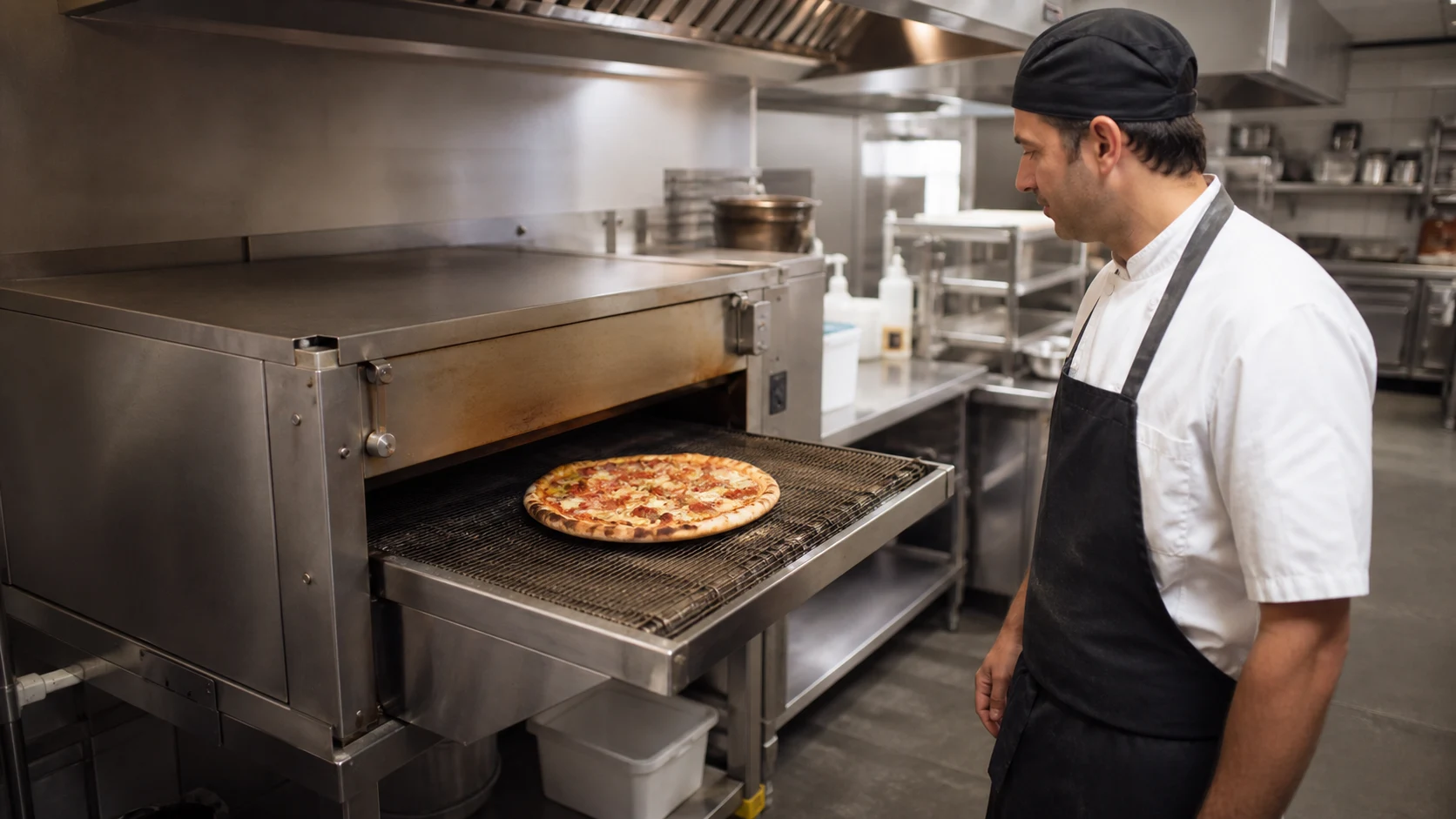
Yesterday the pizzas were leaving the conveyor oven as expected. Today they are pale, too dark, underdone through the centre or simply different from the product the kitchen had approved.
The immediate temptation is to add heat or slow the belt. That may change the next pizza, but it can also erase the conditions needed to understand what changed. A better first move is to restore the last known product and operating conditions: the same recipe and preparation, the same oven program or settings, and enough time for the exact oven to reach the state its manual requires.
Only then does an adjustment become a useful test rather than another unknown.
Begin with the last bake that worked
A conveyor oven can make repetition look simple: product goes in one end, travels through a heated chamber and comes out the other. When the result changes, however, “the oven is too cold” is only one possible explanation.
The relevant change may be visible on the controls. The conveyor time may have been altered, a preset may have been selected, or the temperature setting may differ from the recorded profile. It may also be on the pizza side. The product may be heavier, colder, prepared differently or placed on a different pan or screen.
That is not speculation added to make the diagnosis sound comprehensive. A Middleby Marshall operating manual describes its published times and temperatures as suggested guidance and says they vary with product weight, precooked state, starting temperature, handling and the type of pan used. The same manufacturer's troubleshooting path for overcooked or undercooked product checks conveyor speed, the temperature setting and the food-preparation process before directing the operator to authorised service.
This gives the kitchen a useful priority: recover the known conditions before deciding which setting deserves to move. If several things changed together, changing another one may produce an acceptable pizza without identifying why the previous result disappeared.
“Bake time” does not mean the whole wait for a finished pizza
On the cited Middleby and Lincoln conveyor-oven controls, the displayed bake time is tied to conveyor speed. It is measured from the moment the leading edge of the product enters the bake chamber until that same leading edge leaves it. A longer displayed time means the product moves more slowly through the chamber; a shorter time means it moves faster.
The pizza is not fully discharged when its leading edge reaches the exit. The additional period until the trailing edge has left the oven is described in the manuals as the time of delivery. Product length therefore affects how long it takes for the whole pizza to emerge even though the control's bake-time definition has not changed.
That distinction matters during a diagnosis. If staff time a pizza from first entry until it is completely clear of the belt, then compare that stopwatch result with a leading-edge bake-time display, they are comparing different intervals. The apparent discrepancy does not, on its own, show that the conveyor is running incorrectly.
Start with the terminology used by the exact manual. Confirm what the control displays and how the manufacturer says travel time should be measured. Do not borrow the meaning from another oven merely because both machines have a belt and a time display.
Temperature is part of the bake, not a verdict on the pizza
Temperature and bake time work together, but they are not freely interchangeable. A Middleby operating manual explains that increasing bake time may allow a lower temperature, and decreasing it may require a higher temperature, then immediately states that the relationship has limits. Taken too far, the product can become burnt outside and raw inside, or pale while still overbaked.
That is why “make it hotter” and “leave it in longer” are not equivalent corrections.
The same manual recommends making fine adjustments by holding either time or temperature constant while varying the other. This is a sound diagnostic principle within that documented operating context: one controlled change produces information; two simultaneous changes do not reveal which one affected the result.
There is another distinction to check in the exact manual. Some conveyor-oven controllers separately display the set temperature and the actual oven temperature. On those machines, entering a setpoint does not mean the oven has already reached it. The manufacturer's start-up procedure may also require the oven to reach that point and then remain there for a stated preheat period before production begins.
Not every commercial conveyor pizza oven exposes the same readings or uses the same start-up sequence. The useful question is therefore not simply, “What number is on the screen?” It is, “What does this model say that number represents, and was the documented operating state established before this pizza went through?”
Sometimes the changed variable is the pizza
If recorded time and temperature conditions are unchanged, the next useful comparison is the product that entered the chamber.
A suggested manufacturer setting is not a universal recipe. In Middleby's own guidance, product weight, precooked condition, starting temperature, handling and pan type can change the time and temperature required. Moretti Forni's published settings make the same point in another way: its recommendations vary by pizza style, dough-ball weight, baking support and exact oven model.
This is why copying a successful setting from another venue proves very little by itself. The other kitchen may be using a different oven, controller, airflow arrangement, product size, starting condition or baking support. Even where the displayed numbers match, the conditions that produced the finished pizza may not.
It also explains why one changed bake is not enough to diagnose an oven fault. If a chilled ingredient, prepared base, product weight or pan changed at the same time, the oven may be repeating its operating conditions while receiving a different baking job.
The evidence does not support turning this into an unlimited list of recipe variables. Nor does it establish a universal claim that placing more pizzas on every conveyor will reduce heat recovery by a predictable amount. If results change only under a particular loading pattern, record that pattern and check the exact model documentation or service evidence. Do not invent a category-wide recovery rule to fill the gap.
An acceptable bake is not a peak-capacity result
Once a kitchen has a pizza leaving the oven correctly, a different question often follows: how many can the oven produce during the busiest service period?
The approved setting is one input to that decision, not the answer.
Middleby service material separates bake time from time of delivery and calculates theoretical oven capacity using the dimensions of the bake chamber, product diameter and delivery time. The figures belong to the stated oven and product conditions. Change the product diameter, chamber geometry or bake time and the calculation changes.
This is why belt width alone is not pizzas per hour, and why a copied time-and-temperature pair cannot prove another venue's peak output. It does not establish how products occupy that belt, when the trailing edge is actually discharged, whether the exact oven has a single or split conveyor, or how the surrounding operation feeds and clears it.
Nor should a good result be stretched into a claim about labour saving, return on investment or operating cost. Those are business outcomes with additional inputs. They do not emerge from a control panel.
If capacity has become the real problem, keep the bake profile intact and open a separate model-and-product verification exercise. The exact manufacturer evidence—not a generic daily-volume band—must supply the chamber, belt, time-range and configuration facts. Current models belong in the commercial conveyor ovens category; the diagnostic article should not pretend to choose one before those facts are matched to the actual product and service pattern.
If the more fundamental question is whether a conveyor remains the right kind of pizza oven for the menu, that belongs in the broader commercial pizza oven selection decision, not in another round of setting changes.
Stop when the controls no longer explain the change
Adjustment stops being useful when the documented operating checks no longer explain the result.
Perhaps the recorded speed and temperature conditions have been restored, the known product preparation has been repeated and the exact start-up procedure has been followed, yet identical test products still cook differently. Perhaps conveyor travel is unstable, a control does not respond as the manual describes, or the symptom points towards heating, airflow, the conveyor drive or another internal component.
At that point, continuing to experiment with temperature and belt time can hide the pattern a technician needs to see. It may also move the operator beyond the work the manufacturer assigns to normal operation.
Keep the evidence instead: exact model and serial identity, the manual or program used, the recorded time and temperature conditions, the product and baking support, what changed, and whether the symptom repeats. Then follow the exact manufacturer's escalation path or contact authorised service.
The purpose of that stop is not procedural neatness. It preserves the distinction between an operating variable that can be tested and a fault that should not be chased through increasingly speculative adjustments. A changed pizza begins the diagnosis. It does not authorise an endless search for a more convincing number on the display.