
Pie Warmer Temperature in Australia: Food Safety, Settings and Buyer Checks
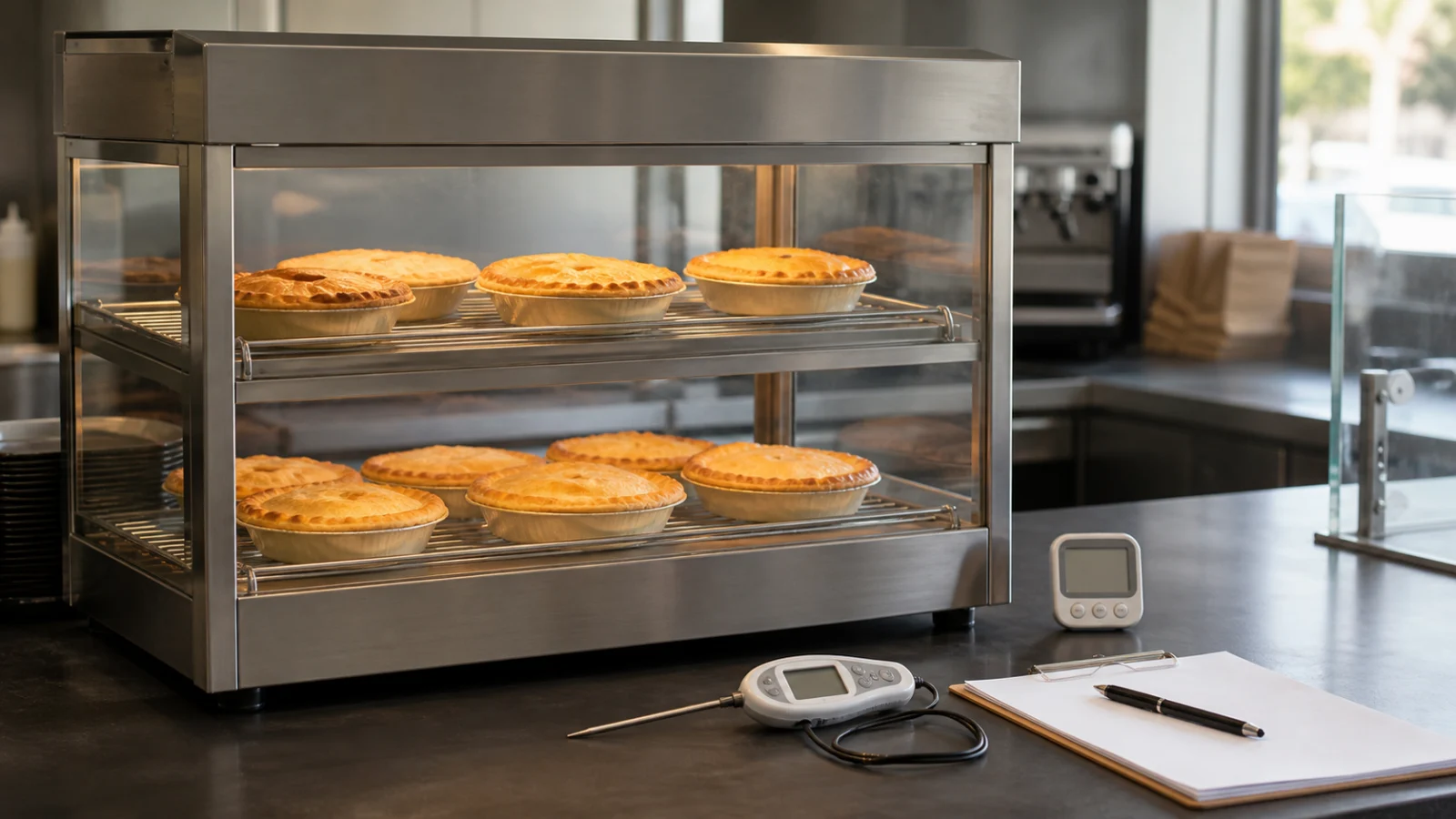
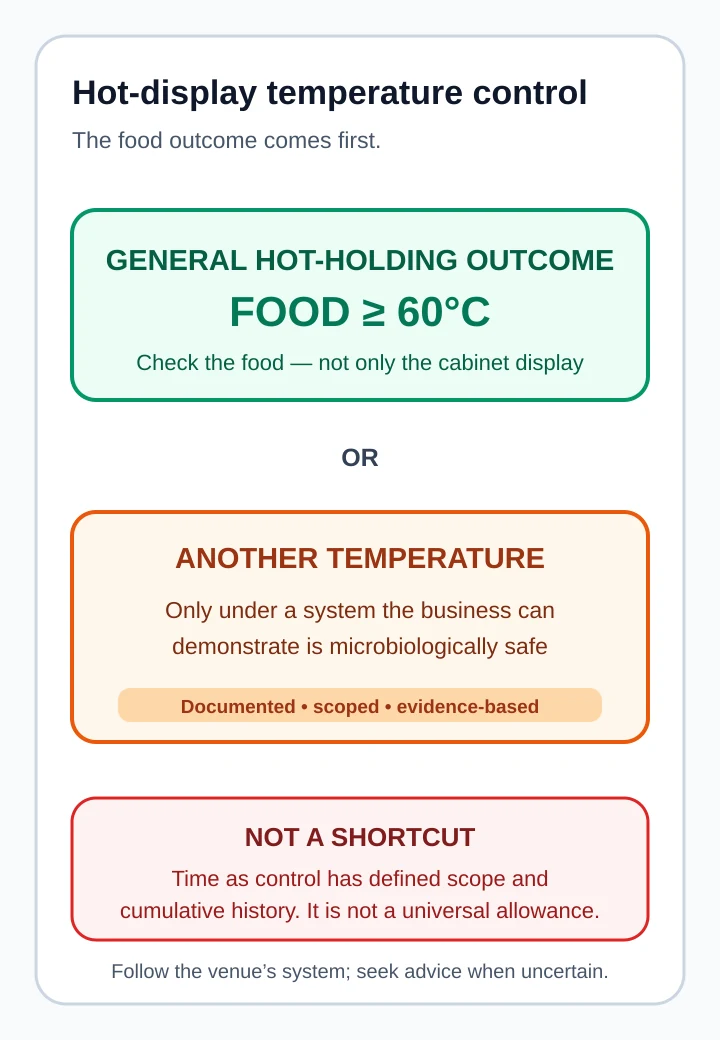
For potentially hazardous food, the temperature that matters is the temperature of the food itself. During hot display, the general Australian food-safety outcome is food at 60°C or hotter, unless the business can demonstrate that another temperature-control system is safe. That does not make 60°C a universal pie-warmer thermostat setting.
A cabinet-air reading, a thermostat setting, a built-in display and a probe reading from the food describe different things. Follow the food business’s documented controls and the exact appliance instructions, load food already heated for hot holding, and verify the food rather than treating the cabinet display as proof.
What temperature should a pie warmer be?
The direct answer has two parts:
- Food-safety outcome: potentially hazardous food on hot display should generally be maintained at 60°C or hotter. A business may use another temperature only when it can demonstrate that the alternative practice is safe.
- Equipment setting: use the exact model’s instructions and the venue’s verified operating procedure. There is no evidence-based thermostat number that can be prescribed for every pie warmer, load and service condition.
The first part comes from Australian food-safety requirements. The second is an equipment and operating decision. Confusing them creates a weak control: the dial can be set to one number while the food at a particular shelf position has a different temperature.
Food Standards Australia New Zealand (FSANZ) says potentially hazardous food generally needs to be kept at 5°C or colder or 60°C or hotter, including while it is stored, displayed or transported, unless a safe alternative system can be demonstrated. This guide focuses on hot holding in a pie warmer; it is not a complete food-safety program.
Which pies and pastries need temperature control?
The rule applies to potentially hazardous food: food that needs temperature control to minimise the growth of pathogenic microorganisms or prevent toxin formation. FSANZ examples include foods containing meat, egg or dairy, but a product name alone does not settle the classification. Ingredients, formulation, preparation and handling all matter.
That is why “all pies” and “all pastries” are both too broad. Establish which menu items are potentially hazardous through the business’s food-safety controls and supplier information. If the classification or an alternative holding method is uncertain, refer it to the venue’s food-safety supervisor or the relevant local enforcement authority rather than guessing from the cabinet type.
Four-temperature boundary map
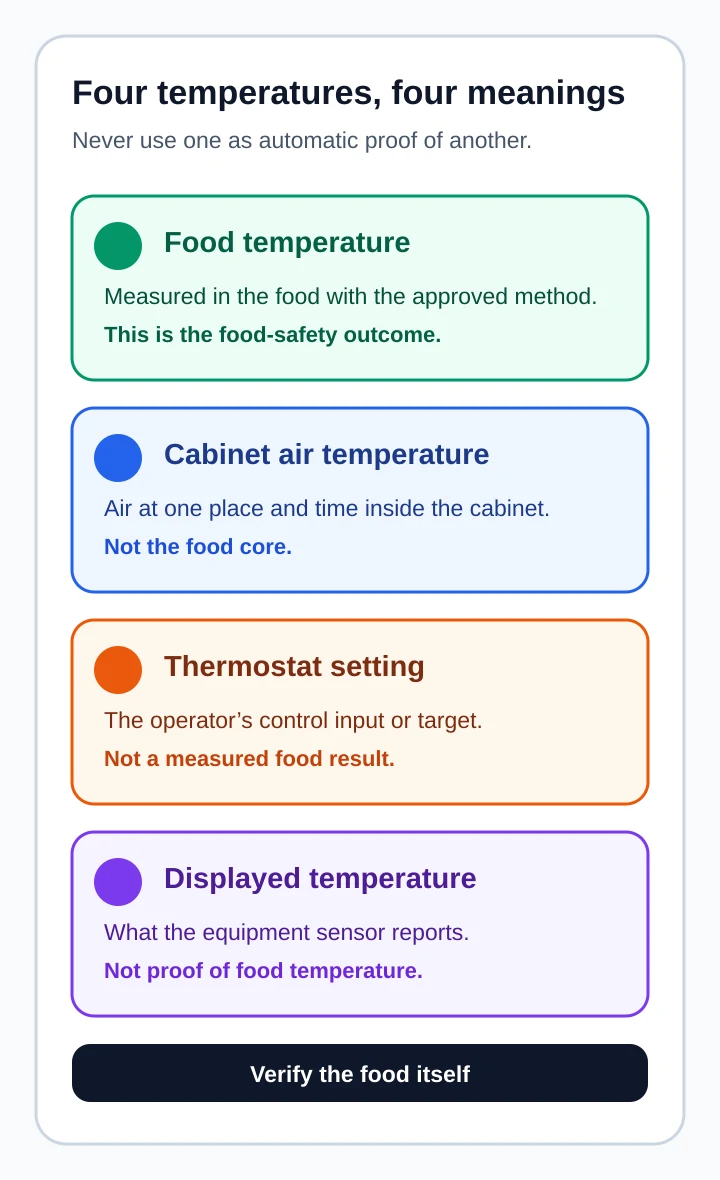
The four values below can influence the same service, but they are not interchangeable.
| Temperature | What it describes | How it is obtained | What it cannot prove by itself |
|---|---|---|---|
| Food temperature | The temperature of the product being held, checked at the relevant part of the food. | An appropriate food thermometer used according to the business’s procedure. | It does not show every product or shelf position unless the verification plan samples them. |
| Cabinet air temperature | The air temperature at a particular location and time inside the cabinet. | A cabinet sensor or a separate measuring instrument, depending on the equipment. | It does not establish the temperature at the thickest part of the food. |
| Thermostat setting | The operator’s control input or target for the appliance. | A dial, controller or other model-specific control. | It does not prove the actual cabinet air temperature or food temperature. |
| Displayed temperature | The value reported by the equipment’s sensor and display or gauge. | The built-in display, whose sensor meaning and location should be confirmed from exact documentation. | It does not automatically represent cabinet-wide conditions or the food itself. |
This separation is the practical answer to the setpoint question. The thermostat controls the machine; the display reports what its sensor detects; cabinet air transfers heat; and the food is the item subject to the food-safety outcome. A buyer should ask what the displayed value measures, while an operator should verify the food using the approved procedure.
Hot holding is not reheating
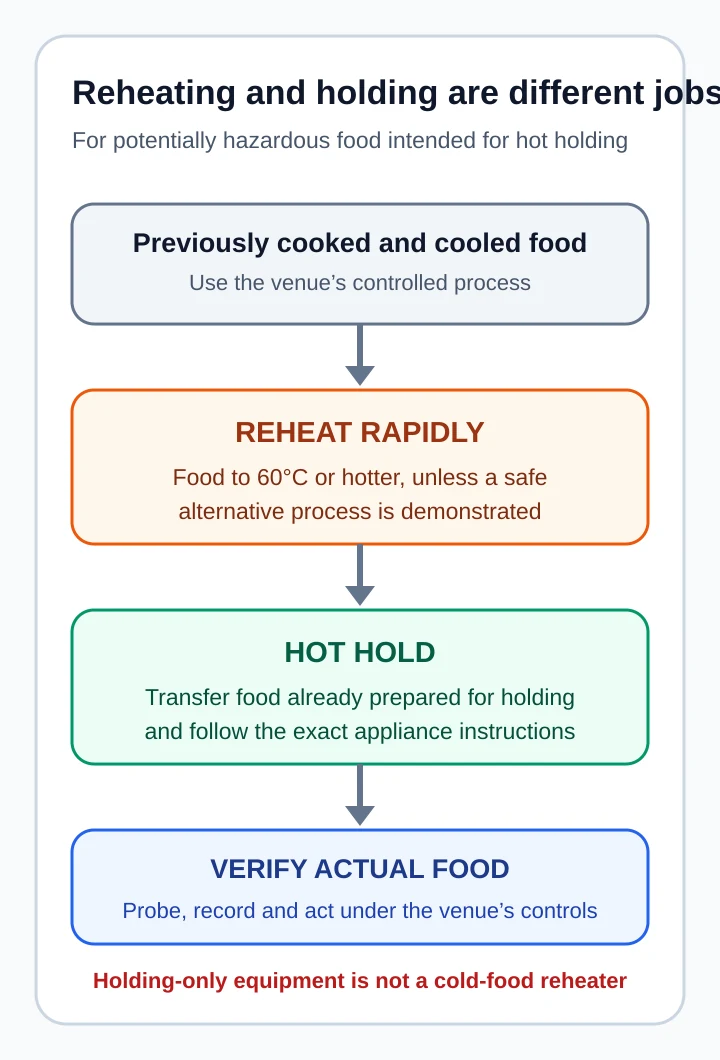
A pie warmer sold or documented as holding-only equipment should receive food that is already hot enough for the venue’s hot-holding process. It should not be treated as an appliance for slowly bringing cold food up to temperature.
Under Standard 3.2.2 and the accompanying FSANZ guidance, previously cooked and cooled potentially hazardous food intended for hot holding must be reheated rapidly to 60°C or hotter, unless the business demonstrates that another heating process is safe. FSANZ specifically warns that equipment designed only for hot holding, including many pie warmers, should not be used to heat cold food because the process may be too slow.
| Job | Purpose | Evidence needed | Stop condition |
|---|---|---|---|
| Reheating | Rapidly heat previously cooked and cooled potentially hazardous food for hot holding. | The venue’s controlled reheating process and equipment intended for that job. | Do not assume a holding-only warmer can perform the reheating step. |
| Hot holding | Maintain food that has already entered the holding process hot. | The exact appliance instructions, the venue’s food-safety controls and actual-food verification. | Stop relying on the cabinet when food readings are not controlled; follow the documented corrective action. |
If a product is promoted as having a cooking or reheating function, require exact manufacturer documentation for that model and function. A broad product description or a high maximum thermostat setting is not enough.
Hot-holding verification decision path
This sequence turns the temperature requirement into an operator check without pretending that one setting works everywhere.
- Classify the food. Confirm whether the item is potentially hazardous under the business’s food-safety controls. Do not decide from the word “pie” alone.
- Confirm the equipment job. Read the exact manual to establish whether the cabinet is for holding only. Keep cooking or reheating in the equipment and process approved for those jobs.
- Load food already prepared for hot holding. Follow the venue’s reheating and transfer process where previously cooked and cooled food is involved.
- Operate the warmer according to its instructions. Use the specified controls, loading arrangement and operating limits. Do not borrow a setting from another model.
- Measure the food. FSANZ advises checking the thickest part with an appropriate probe thermometer. Clean and sanitise the probe before and after use in accordance with the business’s procedure.
- Check representative items and positions. A reading from one product does not automatically describe another shelf, product size or point in service. The verification plan should reflect the menu, load and cabinet arrangement.
- Record and act. Keep the time-and-temperature evidence required by the business’s system. If the food outcome is not controlled, follow the documented corrective action and escalate equipment faults rather than repeatedly increasing the dial without diagnosis.
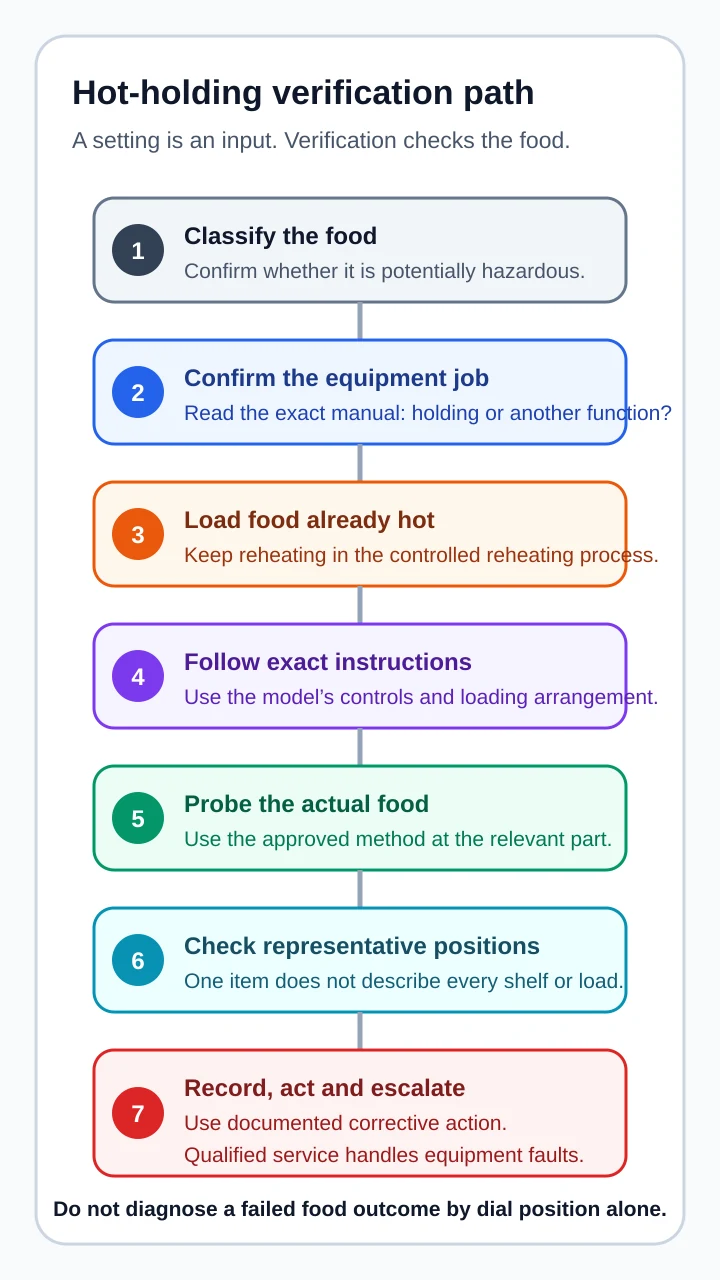
FSANZ says businesses should not rely only on fixed temperature gauges on equipment and should measure the actual food. That does not make a probe reading a repair diagnosis: if readings remain outside the controlled outcome, isolate the operational issue and refer calibration, thermostat, sensor or electrical work to a qualified service provider.
What if the business uses time as a control?
Time can form part of a safe alternative system, but it is not permission to choose any lower cabinet setting. The applicable method depends on the food and its complete temperature history, and the business must be able to demonstrate that its practice is safe. FSANZ’s 2-hour/4-hour guidance has a defined scope and treats time between 5°C and 60°C cumulatively. Use the venue’s documented system and seek regulator or food-safety advice where its application is uncertain.
Buyer evidence matrix: regulation, documentation and operational proof
A buyer needs two kinds of confidence: that the food-safety outcome can be controlled in the venue, and that the equipment’s documented characteristics fit the service. One does not replace the other.
| Decision field | Evidence to request before purchase | Operational check after installation | Do not infer |
|---|---|---|---|
| Food-temperature outcome | Venue food-safety requirements and the exact appliance’s intended function. | Actual-food readings under the venue’s approved loading and service procedure. | That the displayed temperature proves the food is at the same temperature. |
| Holding or reheating function | Exact current operating manual stating the intended use. | Confirm staff load food through the approved process. | That a wide thermostat range makes a holding-only cabinet a reheating appliance. |
| Thermostat and display | Control range, sensor meaning/location and operating instructions for the exact model. | Compare equipment indications with the venue’s actual-food verification. | Uniformity, recovery or food-core temperature from the dial or display alone. |
| Shelves and usable product fit | Exact shelf dimensions, spacing, arrangement, access and any stated capacity basis. | Confirm the intended product and loading pattern can be handled without obstructing the approved arrangement. | Capacity from cabinet width or a generic small/medium/large venue label. |
| Humidity or moisture feature | Exact documentation showing whether a system exists and how it is operated and cleaned. | Assess product quality within the venue’s food-safety and operating controls. | That humidity control guarantees freshness, prevents drying or suits every pastry. |
| Electrical and site fit | Exact rated electrical values, plug/connection requirements, footprint, clearances and installation instructions. | Confirm the installed location and supply match the approved requirements. | Power requirement, running cost or performance from cabinet size. |
| Cleaning and service | Exact cleaning instructions, removable components, service access and support pathway. | Integrate the manual into the venue’s cleaning and maintenance system. | A universal daily, monthly or fixed replacement cycle. |
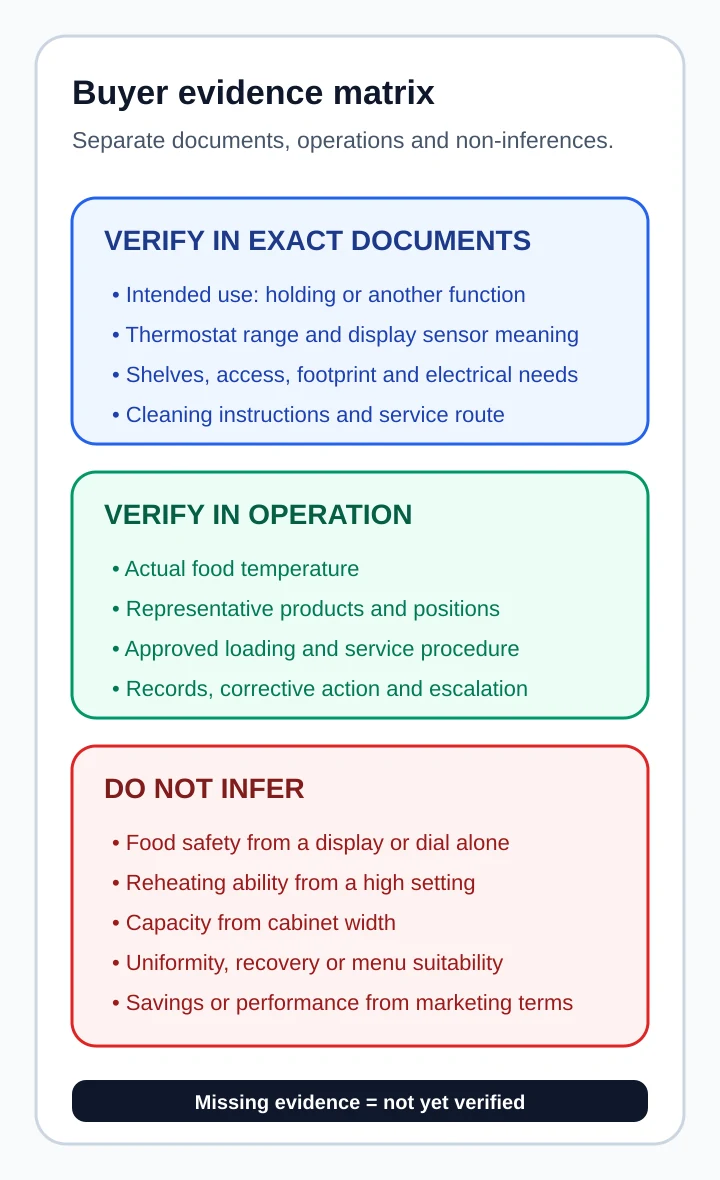
Use this matrix to compare evidence fields, not marketing adjectives. If an exact model lacks the document needed to answer a decision-critical question, record that field as not yet verified rather than filling it from a similar product.
Why thermostat range alone does not establish suitability
A published thermostat range describes the adjustment available on a particular model. By itself, it does not show:
- what the built-in sensor measures or where it is located;
- the temperature at the centre of the food;
- temperature consistency across shelves and loads;
- recovery after loading or door openings;
- whether the unit is intended to reheat food;
- whether a particular recipe will retain its desired quality; or
- how the equipment will perform in the intended operating conditions.
Those are different evidence questions. Exact documentation can answer some of them; actual operation and food-temperature checks answer others. Where performance evidence is absent, a wider range should not be treated as better or safer.
Questions to take to the supplier
- Can you provide the current operating manual and specification for the exact model?
- Is the appliance documented for hot holding only, or does the manufacturer expressly support another function?
- What does the displayed temperature measure, and where is its sensor located?
- What are the exact shelf dimensions, spacing, access arrangement and stated capacity basis?
- What are the rated electrical requirements, footprint, clearances and installation conditions?
- If a humidity or water system is fitted, what do the instructions require for operation and cleaning?
- What is the service route if the display and verified food readings do not align?
Answers should be traceable to the exact model. Similar appearance, a shared brand or a retailer’s category description does not establish identical controls or operating characteristics.
Move from temperature guidance to an exact equipment check
Start with the food outcome: identify the potentially hazardous products, the approved hot-holding process and how actual food temperature will be verified. Then compare models using the evidence matrix above.
Browse the commercial pie warmer range for the available equipment choices. Use each exact PDP and manufacturer document for current model facts, and ask KW to confirm any decision-critical field that remains unclear. The Category owns range selection; this guide’s job is to help you ask for the right evidence.