
The Dead-Stock Paradox: Why Your “Energy-Efficient” Chest Freezer Is Costing You $8,000 a Year (Thermaster BD598F vs Atosa JBF40FSGR vs FED-X XURF600G1V)
The Dead-Stock Paradox: Why Your “Energy-Efficient” Chest Freezer Is Costing You $8,000 a Year (Thermaster BD598F vs Atosa JBF40FSGR vs FED-X XURF600G1V)
A butcher in Wollongong replaced his tired chest freezer with a new one last winter, thinking he was saving money. Twelve months later his accountant flagged a 4% jump in food waste that no one could explain. When KW’s service team audited his walk-in, we found 38 kilograms of freezer-burnt lamb racks at the bottom of the chest — product that had been rotated below the visibility line in September and quietly forgotten. He didn’t have an electricity problem. He had an architecture problem. Chest freezers preserve temperature. Upright freezers preserve cash flow. Most operators never learn the difference until it has already cost them.
Reading time: 15 minutes · For: multi-site operators, head chefs, butchers, retail procurement, compliance leads · Covers: Thermaster BD598F, Atosa JBF40FSGR, FED-X XURF600G1V, dead-stock loss modelling, parasitic heater load, freezer burn, GEMS 2024 compliance, FAQ.
1. The Three Freezer Architectures — What You’re Actually Choosing Between
Walk into any Australian commercial refrigeration supplier and you’ll be shown three freezer shapes: a box that opens from the top, a tall cabinet with a solid door, and a tall cabinet with a glass door. The pricing looks broadly similar. The brochures describe all three with words like “reliable” and “energy efficient.” None of that helps you.
These are not three versions of the same appliance. They are three incompatible business tools dressed up to look alike. The correct choice depends almost entirely on one question: how fast does stock move through your operation?
Thermaster BD598F
THE THERMAL FORTRESS
The Thermaster BD598F is a 598L chest freezer with a heavy-duty stainless steel lifting lid. Cold air sits like a liquid at the bottom — open the lid and almost nothing escapes. With only 280W of drawn power, it is the lowest-energy freezer in this comparison by a wide margin.
Temperature range: -22°C to -18°C. Ambient rating: 32°C / 75% RH (sub-tropical — not full tropical). Internal dimensions: 1462 × 524 × 739mm. Defrost: manual. Price band: around $2,200 including GST.
Atosa JBF40FSGR
THE ROTATION ENGINE
The Atosa JBF40FSGR is a slimline 488L single-door upright. Its only 654mm wide — engineered to slide into tight back-of-house corridors. Top-mounted compressor. Four GN-compatible shelves. Eye-level visibility from front to back. This is the architecture that forces disciplined stock rotation.
Temperature range: -22°C to -18°C. Ambient rating: 40°C / 40% RH — true tropical. Power: 540W nominal. External dimensions: 654 × 800 × 2065mm. Defrost: automatic. Price band: around $2,700–$3,200.
FED-X XURF600G1V
THE MERCHANDISING TOOL
The FED-X XURF600G1V is a 600L full-glass-door upright freezer. Fan-forced cooling, R290 refrigerant, LED internal lighting, and — critically — a heated door frame that runs continuously to prevent condensation on the glass. This cabinet was built to sell frozen product to customers, not to store it cheaply.
Temperature range: -15°C to -18°C. Ambient rating: 38°C / 40% RH. Power: 450W (includes anti-sweat heater load). Defrost: automatic. Price band: around $3,000+.
Notice what’s not in these three product descriptions: the word “better.” None of these is better. They are answers to different questions. Before you buy any of them, you need to know which question you are actually asking.
2. The Three-Layer Operational Tax — Where the Money Really Goes
Most operators evaluate freezers on one axis: running cost. A GEMS 2024 EEI calculation gives you an energy number. The sticker price gives you a capital number. Everything else — the cost of freezer burn, the cost of staff time wasted digging, the cost of the same ingredient being reordered three times because no one could see it was already there — sits in a blind spot. That blind spot is where the real money goes.
Layer 1 — Energy and Parasitic Load
All three units consume electricity. The Thermaster BD598F at 280W nominal, the Atosa JBF40FSGR at 540W, the FED-X XURF600G1V at 450W. But nominal power is not continuous power — compressors cycle. Under Australian commercial conditions and an average duty cycle of 50%, the approximate annual consumption looks like this:
Thermaster BD598F: 280 × 0.5 × 24 × 365 / 1000 ≈ 1,226 kWh/year
Atosa JBF40FSGR: 540 × 0.5 × 24 × 365 / 1000 ≈ 2,365 kWh/year
FED-X XURF600G1V: 450 × 0.5 × 24 × 365 / 1000 ≈ 1,971 kWh/year
At $0.35/kWh commercial tariff:
Thermaster: ~$429/year
Atosa: ~$828/year
FED-X: ~$690/year
At first glance the Thermaster is an obvious winner — roughly $400 cheaper per year to run than the Atosa. The FED-X sits in the middle. This is the number your accountant will quote back to you.
The FED-X’s 450W draw deserves closer attention. Its solid-door sibling, the XURC600G1V fridge, draws about 310W for the same 600L cabinet. The ~140W difference is the anti-sweat heater load — a glass-frame heating element that runs 24 hours a day to keep the glass clear of condensation in Australian humidity. You pay for that heater every single hour, whether or not a customer is looking at the product. If your freezer is in a back-of-house prep area no customer ever sees, that 140W of continuous heating has zero commercial return. It is pure parasitic load.
Layer 2 — Freezer Burn and Dead-Stock Waste
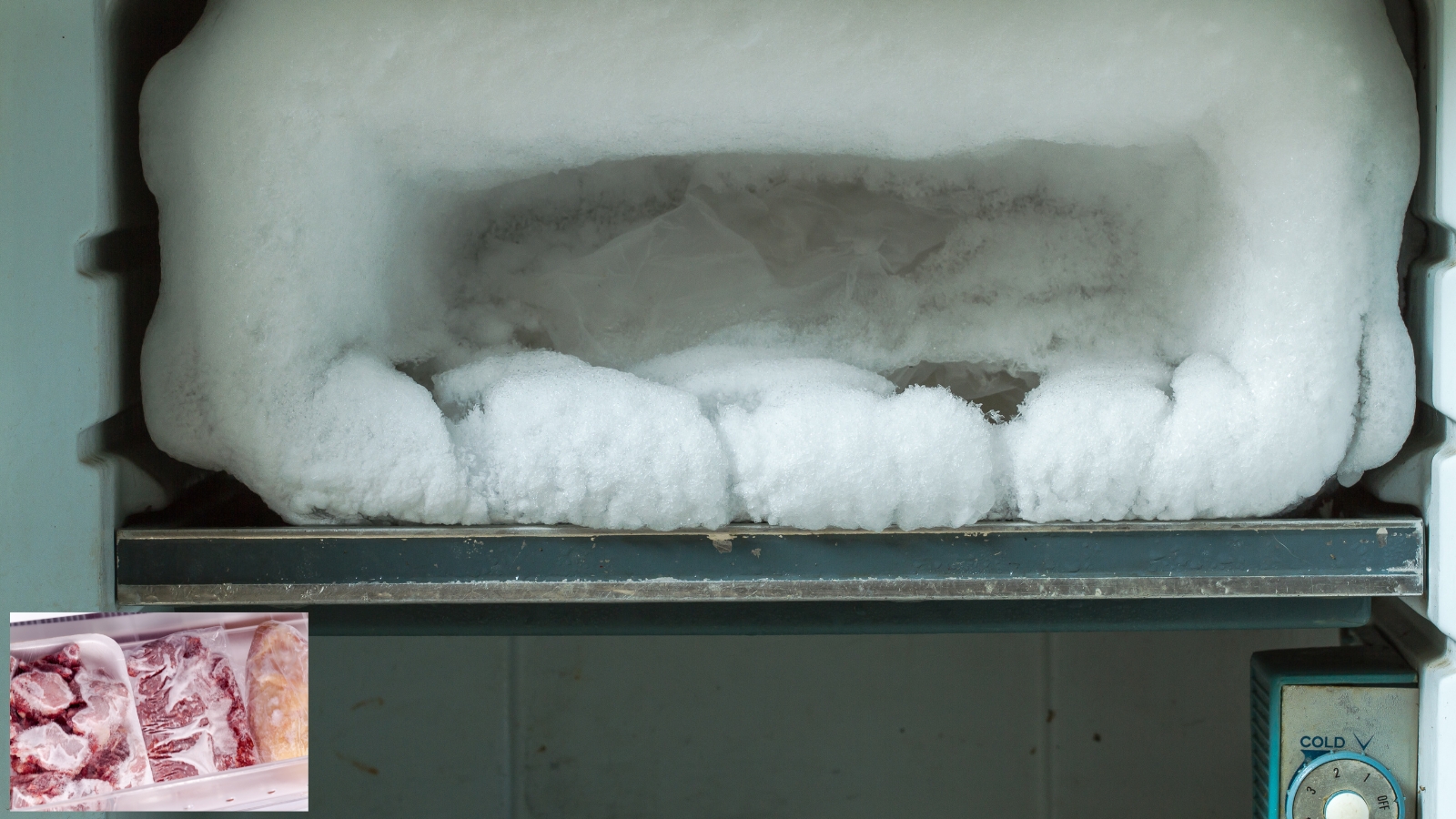
This is the layer that destroys chest-freezer economics in fast kitchens. Freezer burn is surface dehydration: at -18°C, water molecules sublimate directly from the surface of frozen food into the cabinet atmosphere. The product loses moisture, the surface turns pale and leathery, protein texture degrades, flavour oxidises. Once it sets in, the product cannot be sold to a paying customer — it gets binned.
Freezer burn accelerates with long storage times, temperature fluctuation, and poor packaging. In a chest freezer where the bottom layer may sit undisturbed for 60, 90, or even 180 days, freezer burn is not a risk — it is a certainty. And nobody notices until someone finally digs to the bottom.
Work through the arithmetic. A typical back-of-house chest freezer in a meat-heavy kitchen holds $2,500–$4,000 of inventory at any given time. The bottom 25–35% of that stock — roughly $700–$1,400 of product — is in the “rarely touched” zone. Under a 7–14 day rotation kitchen where staff grab from the top and reorder rather than dig, the annualised freezer-burn write-off sits between $3,000 and $8,000 per year.
An upright freezer eliminates this layer almost entirely. Eye-level visibility means the chef walks past the oldest product every single time they open the door. It is hard to forget a bag of prawns when it is literally at face height every morning. The architecture enforces the rotation discipline that staff training alone rarely achieves.
Layer 3 — Labour Search Time and Duplicate Ordering
Every time a chef has to dig through two or three layers of frozen product to find a specific bag of something, the lid stays open longer. That drives up the compressor duty cycle. It also burns staff time — typically 2 to 5 minutes per search, multiplied across a 12-month horizon.
If three kitchen staff each spend an extra 5 minutes per shift searching a chest freezer, that’s 15 minutes per day, 90 hours per year. At $28/hour loaded labour cost, that’s $2,520 per year of pure labour drag that never shows up on any report.
The related loss is duplicate ordering. When inventory is invisible, staff assume the kitchen is out and add it to the next supplier order. Over a year, duplicate ordering from freezer opacity typically adds 2–4% to food purchase costs. In a mid-size kitchen spending $20,000/month on frozen product, that’s $4,800–$9,600 per year in over-buying.
Total annual operational tax for the wrong freezer architecture:
- Energy (if chosen wrong for use case): ±$400
- Parasitic anti-sweat load (glass-door back-of-house): ~$430
- Freezer burn + dead stock (chest-freezer fast kitchen): $3,000–$8,000
- Labour search time: $1,500–$2,500
- Duplicate ordering from invisible inventory: $2,000–$5,000
Realistic range: $6,000–$16,000 per year — on a freezer that cost $2,200–$3,200. You can buy the wrong freezer twice over in the first year alone and still save money compared to continuing to run it.
3. Three Failure Patterns We See Every Month
These are the patterns KW’s service team documents on real post-sale audits. Not hypotheticals:
❌ Pattern 1 — Chest freezer in a high-rotation café
Why it was bought: “Lowest running cost. Energy efficient. Classic commercial workhorse.”
How it fails: The café uses frozen berries, pastry dough, ice, and par-cooked proteins across a 7-day cycle. Two staff work the line during brunch. Neither will ever dig below the top basket. Every 30 days the owner discovers three bags of frozen croissant dough at the bottom that have been written off. By month six, the frozen waste line on the P&L has quietly grown by $400/month.
Root cause: Chest-freezer architecture assumes low access frequency and long storage times. Inflict a 7-day rotation workflow on it and you’ve guaranteed bottom-layer spoilage. The cabinet is working perfectly. The workflow is the wrong tool’s job.
❌ Pattern 2 — Glass-door freezer in a back-of-house prep area
Why it was bought: “Looks premium. Staff can see what’s inside without opening.” Spoiler: nobody looks — it’s in a hallway.
How it fails: The owner’s electricity bill for the unit runs roughly 30% above what an equivalent solid-door upright would cost — because the anti-sweat heater never turns off. Across a three-year ownership cycle this single cabinet adds roughly $1,200 to utility costs with zero commercial return. The glass accumulates fingerprints no one cleans and the LED lighting is usually off to “save energy” (it does not affect the heater load).
Root cause: Glass-door freezers are retail merchandising tools. In a customer-facing location they drive impulse sales that easily repay the anti-sweat premium. In a back-of-house prep hallway they are pure parasitic cost.
❌ Pattern 3 — Upright freezer in a rural pub with unstable power
Why it was bought: Replaced an old chest freezer because the new pub owner wanted “something modern.”
How it fails: The site loses power 4–6 times per year during storms. The old chest freezer used to hold safe temperature for several hours through each outage. The new upright loses cold much faster because opening the door during an outage (to check what’s still frozen) dumps the entire air column. By year two, the owner has written off two full freezer loads of stock from extended outages.
Root cause: Upright architecture trades thermal stability for access speed. In a site with frequent power disruption, that trade goes the wrong way. The chest freezer was the correct tool — just not for the food-rotation pattern the owner imagined.
4. Hard Disqualifiers — Don’t Buy If You Hit One of These
Before delivery date, discount, or finance option — check these first. Each is a hard “don’t buy” that overrides every other consideration.
Do not buy the Thermaster BD598F (chest) if:
- Your stock rotation is faster than 21 days on frozen product. The bottom layer will freezer-burn faster than your staff will rotate it.
- Your kitchen runs sustained ambient above 32°C. The BD598F is sub-tropical rated (32°C / 75% RH) — for a tropical site specify a Class 5 tropical chest freezer instead.
- Your team has no disciplined FIFO protocol with dated labels and basket-level tracking. Without it, a chest becomes an archaeological dig.
- You need auto-defrost for operational simplicity. The BD598F is manual defrost — budget for the quarterly downtime.
- You need a tropicalised unit for a front-of-house takeaway zone. The BD598F was built for back-of-house bulk, not customer-facing placement.
Do not buy the Atosa JBF40FSGR (upright solid) if:
- Your site loses mains power more than 4 times per year. An upright freezer offers less thermal inertia than a chest during extended outages.
- You need 600L+ usable volume in one unit. The JBF40FSGR gives you 430–488L depending on which spec figure you follow — for heavier stock programs, size up or buy two.
- You won’t register the unit with Atosa within 7 days of delivery. You forfeit the additional 2-year parts extension — same rule as the Atosa fridge range.
- Your ceiling is under 2200mm — the top-mounted compressor needs at least 300mm clearance above the 2065mm cabinet height to reject heat properly.
- You plan to store bulk boxed product (25kg+ single items). The shelf architecture suits GN pans and bagged product, not irregular bulk.
Do not buy the FED-X XURF600G1V (glass door) if:
- The unit will not be in a customer-facing position. You are paying the anti-sweat heater premium for no commercial return.
- Your site ambient exceeds 38°C. The FED-X XURF600G1V is not full tropical — for kitchens near cooklines or in full afternoon sun, step up to a Bromic or Skope glass-door unit with higher ambient rating.
- You require high-throughput stock rotation with heavy traffic. Glass doors are impact-sensitive and door-frame heaters struggle with very high open-close frequency.
- Your kitchen humidity is sustained above 60% (poorly-ventilated basement prep areas). The anti-sweat heater will run harder and condensation can still form on the glass interior.
- You’re trying to justify it as a “premium upgrade” to a solid-door freezer that does the same storage job. It isn’t. It’s a different tool for a different job.
5. The Freezer Architecture Scoring Matrix
No single freezer wins on every axis. Use this matrix to see which architecture best serves the factors that actually matter for your operation. Weight each factor by how much it affects your P&L, then multiply through.
| Performance Factor | Weight | Chest (BD598F) |
Upright Solid (JBF40FSGR) |
Glass Door (XURF600G1V) |
|---|---|---|---|---|
| Thermal stability / power-outage resilience | Up to 30% | 10 | 7 | 6 |
| Inventory visibility / FIFO enforcement | Up to 25% | 4 | 9 | 10 |
| Access speed during service | Up to 20% | 5 | 9 | 9 |
| Energy efficiency (running cost) | Up to 15% | 9 | 7 | 5 |
| Spoilage risk in fast-rotation workflows | Up to 10% | 4 | 8 | 7 |
The matrix headline: Chest freezers win the physics. Upright freezers win the business. Glass-door freezers win the merchandising — and nothing else. The “best” score depends entirely on which factor you weight highest.
If you operate a rural venue where thermal stability and outage survival are critical, weight column 1 heavily and the chest wins. If you run a high-rotation urban café where FIFO and service speed drive the P&L, weight columns 2–3 heavily and the upright wins. If you sell product directly to customers from the cabinet (impulse takeaway ice cream, frozen dumplings, grab-and-go desserts), weight column 2 and the glass door’s merchandising value pays for its electricity premium.
6. The Decision Matrix — Match Your Operation to the Right Architecture
This matrix converts the scoring system into specific operational scenarios. Find your row. The right answer is the row that matches every column for your situation, not the row with the lowest sticker price.
| Your Operation | Architecture Required | KW Match + Alternatives |
|---|---|---|
|
Strategic reserve / bulk storage Remote site, 30+ day rotation, bulk meats, disaster reserve, butcher cold room, catering overflow. Power grid unreliable. |
Chest freezer with high thermal inertia. Manual defrost acceptable if well-maintained. ≥32°C ambient rating for sub-tropical sites. |
👉 Thermaster BD598F Similar: Bromic CF0500FTSS (tropical class), Polar Heavy-Duty chest range. |
|
Fast back-of-house rotation Café, brunch kitchen, restaurant back-of-house, 7–14 day turnover, multiple staff accessing throughout shift, FIFO enforcement critical. |
Slimline upright solid-door, tropical (40°C) rating, auto defrost, visible shelving, top-mount compressor, tight footprint. |
👉 Atosa JBF40FSGR Similar: Turbo Air slimline upright (+15–20%), Skope ReFlex UF7.UPF (+40%). |
|
Customer-facing merchandising Takeaway ice cream, frozen dumpling retail, convenience shop impulse zone, supermarket snap-freeze. |
Glass door freezer with anti-sweat heater, adaptive humidity control, LED interior, 38°C+ ambient rating. |
👉 FED-X XURF600G1V Similar: Bromic GD1500LF (premium tier, higher ambient), Skope BM1500 (dual-pane adaptive heater). |
|
Hotel / 24-hour operation Continuous access, mixed-use stock, cannot afford freezer failure event. |
Dual circuit or redundant compressor upright. Extended warranty mandatory. | 👉 Step up to Skope or Williams dual-circuit units. The single-compressor units in this comparison are not the right answer for zero-downtime sites. |
|
Dual workflow You need BOTH strategic bulk reserve AND fast-rotation kitchen access. |
Two units, not one compromise. Separate the architecture by use case. | 👉 Thermaster BD598F (bulk reserve) + Atosa JBF40FSGR (daily rotation). Combined annual savings vs single-freezer compromise: $4,000–$10,000 in avoided spoilage. |
7. Installation Reality — What Nobody Tells You Until After Delivery
Half of the “freezer not performing correctly” service calls KW sees are caused by installation mistakes that were locked in before the unit was even switched on. Six things to verify before delivery:
Chest freezer footprint vs. floor plan
The Thermaster BD598F is 1603mm wide and 733mm deep — it needs a clear floor rectangle with at least 100mm ventilation on the back and 150mm on either side. In a tight Australian kitchen that single footprint often eats up more floor than operators realise. Measure twice. Draw it on paper.
Upright freezer ceiling clearance
The Atosa JBF40FSGR is 2065mm tall with a top-mounted compressor requiring at least 300mm overhead clearance for heat rejection. If your ceiling is 2300mm you’re cutting it close. At 2200mm you’re compromising the thermal envelope. Measure ceiling height (including any beams, pipes, or ductwork) before ordering.
Doorway clearance on delivery path
The Thermaster BD598F in its packaging is 1680 × 880mm — it will not fit through a standard 820mm kitchen doorway without tilting. The Atosa upright at 654mm wide fits easily but 2065mm tall means you may need to tilt it to clear lower door headers. Walk the delivery path with a tape measure before the truck is scheduled.
Dedicated 10A circuit
All three units require their own dedicated 10A GPO — not shared with a microwave, dishwasher, or other high-start-current load. Shared circuits cause voltage drop during compressor start-up, which is the single most preventable cause of compressor damage in commercial freezers. A 30-minute electrician visit to separate the circuit costs $150–$300. A compressor failure from repeated voltage dips costs $1,500+.
Levelling
Chest freezers must be levelled within about 3mm across the lid opening, or the self-closing seal won’t compress evenly. Uprights must be levelled so the door swings true and the internal drainage operates. Use the adjustable castor legs on the Atosa; for the chest, shim under the base if the site floor isn’t flat.
Compliance — GEMS 2024 and EEI
All refrigerated cabinets supplied in Australia must be registered under the GEMS (Refrigerated Cabinets) Determination 2024 (F2024L01263), effective 5 October 2024. Ask for the GEMS Registration ID and declared EEI on every quote. Reference documentation: KW’s GEMS 2024 compliance guide and installation clearance checklist.
8. Compliance Non-Negotiables for Commercial Freezers
Four items must be on the quote before you sign. If a supplier hedges on any of them, walk away:
- GEMS Registration ID. Under F2024L01263, all commercial refrigerated cabinets supplied in Australia must be registered with the GEMS Regulator. Unregistered supply is unlawful. If missing: civil penalties for the supplier, insurance complications for you if a failure occurs, and ineligibility for any applicable energy rebates.
- EEI value and test climate class. Under GEMS 2024, commercial freezers use the Energy Efficiency Index to express minimum performance. Ask for the EEI and which climate class it was tested at (Class 3, 4, or 5). For Australian back-of-house, demand Class 5 data (40°C / 40% RH). If missing: you have no legitimate way to compare running costs between cabinets.
- Refrigerant declaration and charge weight. R290 (propane, GWP ~3) is the direction Australian policy is heading under the 2018–2036 HFC phase-down. AS/NZS 60335.2.89:2020 permits up to 500g R290 in self-contained cabinets. Legacy refrigerants (R134a, R404A) are being phased down — buying today is acquiring a partially stranded asset. If missing: servicing restrictions within the ownership lifetime, and reduced resale value.
- Local parts availability in writing. Ask explicitly about compressor, door gasket, controller board, evaporator fan, and condenser fan availability from Australian stock. If missing: a failure event can become 3–6 weeks of downtime waiting for overseas parts. For a butcher or ice-cream retailer, that can be catastrophic.
9. Frequently Asked Questions
Is a chest freezer more energy efficient than an upright freezer?
Thermally, yes. Cold air is denser than ambient air and sinks to the bottom of a chest freezer, so opening the lid loses minimal cold air. An upright freezer loses a significant portion of its cold air column every time the door opens because cold air falls out at floor level. Financially, however, the answer often flips. A chest freezer that saves $200–$400 per year in electricity can easily lose $3,000–$8,000 per year in dead-stock spoilage if your kitchen turns over stock every 7–14 days. The energy-efficient unit can be the most expensive unit to own.
Why do busy restaurant kitchens prefer upright freezers over chest freezers?
Upright freezers enforce FIFO rotation because chefs can see every shelf at eye level. Chest freezers hide the bottom layer. In a fast kitchen, staff will not dig through three layers of frozen product to find the oldest bag of prawns — they grab whatever is on top and reorder the missing item. Within 60–90 days, the bottom layer becomes freezer-burnt inventory that gets discarded. The Atosa JBF40FSGR and similar slimline uprights are engineered specifically for this 7–14 day turnover pattern.
Why are glass door freezers expensive to run?
Glass door freezers operate at -18°C or lower. In Australian commercial environments (typical kitchen humidity 40–70%), condensation would form on the outside of the glass within minutes. To prevent this, the door frame and glass edge contain anti-sweat heating elements that run continuously. The FED-X XURF600G1V draws 450W nominal, compared to approximately 310W for its solid-door fridge equivalent — that difference is largely the anti-sweat load. If your use case doesn’t require customer-facing display, you’re paying the visibility premium for zero return.
What is freezer burn and how does it happen in commercial storage?
Freezer burn is surface dehydration. Even at -18°C, water molecules sublimate from the surface of frozen food into the slightly drier air of the freezer cabinet. The surface becomes pale, dry, leathery. Protein texture degrades and flavour oxidises. Professional kitchens discard freezer-burnt product because it can’t be served. The risk accelerates with improper packaging, temperature fluctuation, and long storage times. In chest freezers where bottom-layer inventory may sit for 60+ days, freezer-burn waste is the single largest hidden cost.
What ambient temperature rating do I need for an Australian commercial freezer?
For back-of-house in a hot Australian kitchen, specify at least 40°C ambient rating (Climate Class 5 under ISO 23953-2:2015). The Atosa JBF40FSGR is rated for 40°C. The FED-X XURF600G1V is rated for 38°C — suitable for ventilated kitchens but not for spaces adjacent to cooklines or in full afternoon sun. The Thermaster BD598F is rated for 32°C/75%RH (sub-tropical) — appropriate for cellars, cool storerooms, or air-conditioned back-of-house, but not for a hot service kitchen.
How long can a commercial freezer hold temperature during a power outage?
This depends on cabinet type, insulation thickness, ambient temperature, and whether the door stays closed. Chest freezers have the highest thermal inertia because cold air can’t escape unless the lid is lifted. Upright freezers lose stable temperature faster because cold air falls out every time the door is opened. No manufacturer in Australia publishes a specific recovery-time figure because the variables are site-dependent. For outage-prone sites, chest freezers with high insulation and manual defrost are the preferred architecture. If you open the door during an outage, you cut the holding time significantly.
What does GEMS 2024 require for commercial freezers in Australia?
The GEMS (Refrigerated Cabinets) Determination 2024 (F2024L01263), effective 5 October 2024, requires all refrigerated and freezer cabinets supplied in Australia to be registered with the GEMS Regulator and to meet Minimum Energy Performance Standards expressed through the Energy Efficiency Index (EEI). When purchasing any commercial freezer, always ask the supplier for the GEMS Registration ID, the declared EEI, and the test climate class. Unregistered supply is unlawful and carries civil penalties.