
What an R290 label proves — and what it does not

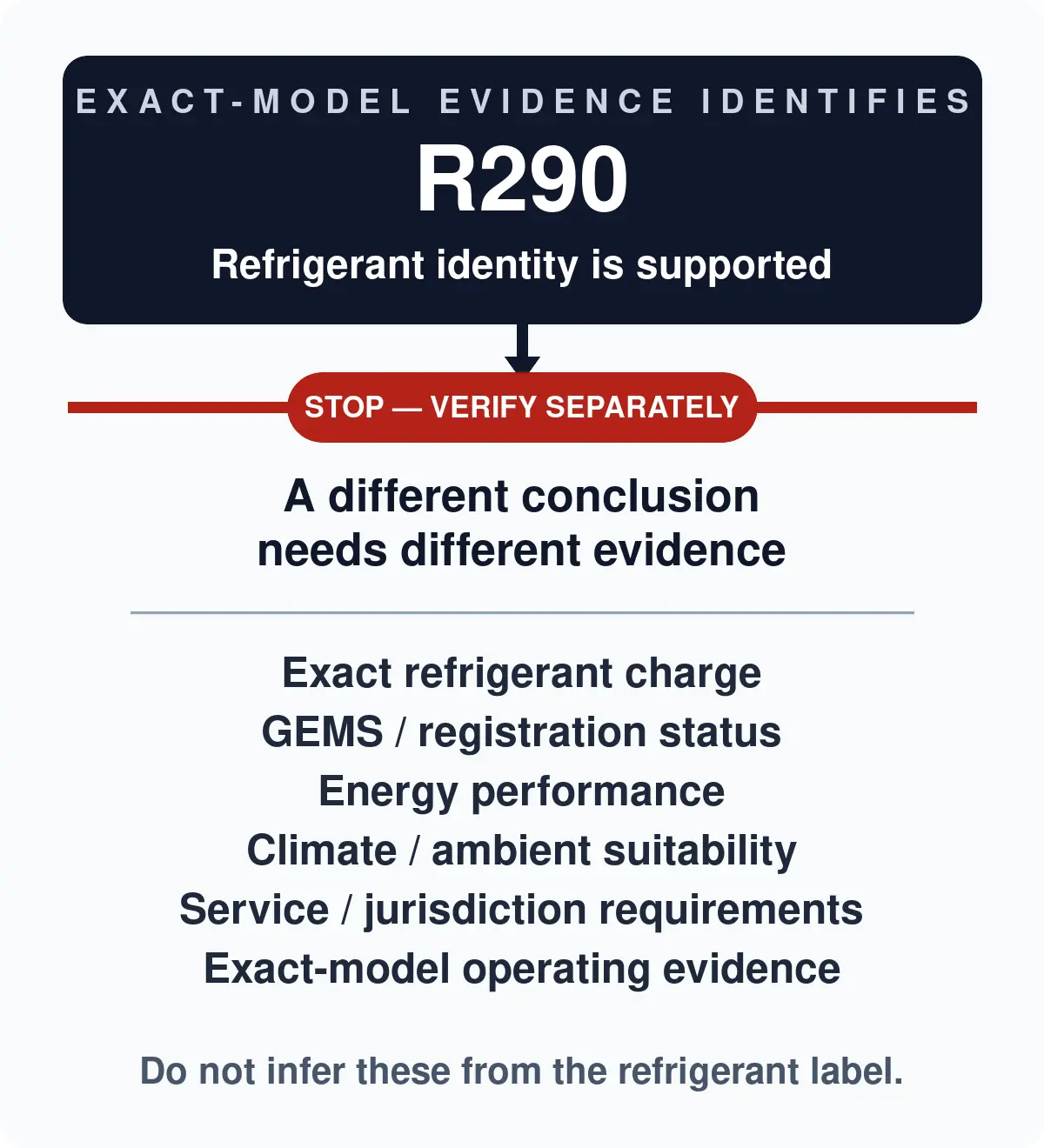
An R290 label answers one question: which refrigerant the evidence says the cabinet uses. It does not, by itself, answer how much refrigerant is in the system, whether the cabinet falls within a particular GEMS class, how much energy it uses, whether it suits a hot kitchen, who may service it or whether it will cost less to run.
Those are separate decisions. Each needs evidence that matches the exact cabinet, the exact question and, where work or site rules are involved, the applicable Australian jurisdiction.
That distinction matters before product selection. A true refrigerant statement can still be the wrong proof for the conclusion a buyer is about to make.
Start with the conclusion you are trying to support
“It uses R290” is a product fact when an exact-model source supports it. “It is efficient”, “it is suitable for this room” and “our contractor can service it” are different claims. Repeating the refrigerant name does not close the evidence gap between them.
Before relying on an R290 claim, finish this sentence:
I am concluding [what?] because [which exact source?] states [which fact?] for [which model, test scope, site or jurisdiction?].
If the source proves only the refrigerant identity, stop there. Do not promote that fact into a different proof family.
This is the central buying judgement: the most useful document is not the one with the strongest environmental or efficiency language. It is the document that answers the decision currently in front of you.
First prove the refrigerant identity
The Australian Government’s refrigerant reference identifies R290 as propane and gives it an A3 safety classification. The same reference lists the non-HFC natural-refrigerant group containing R290 as having a global warming potential below 5. Those statements establish a refrigerant identity, a safety classification and a defined environmental metric. They do not describe a cabinet’s energy use or operating performance.
For an exact cabinet, look for its design refrigerant in the model-specific evidence. The Department of Climate Change, Energy, the Environment and Water says the design refrigerant can be found on equipment compliance plates and in manufacturer manuals. A current manufacturer datasheet may support the same identity when its model code and configuration match the offered unit.
Do not substitute a range name, a sibling model or a retailer’s category description for that match. If the quotation, nameplate, manual and datasheet point to different model identities, the next step is clarification from the supplier or manufacturer—not choosing the most convenient document.
The DCCEEW refrigerant classification reference and its rules on charging refrigeration and air-conditioning equipment explain the national refrigerant context. The exact equipment documents still own the exact cabinet fact.
Refrigerant identity and refrigerant charge are different facts
Knowing that a cabinet uses R290 does not tell you the refrigerant charge. The charge belongs to the exact system and must be taken from applicable exact-model evidence, such as its charge marking or manufacturer documentation.
That is why a single charge number should not be carried from a standard summary, another product or a different installation into a buying decision. Product construction, circuit configuration, the applicable standard and the conditions attached to a limit all matter. This article does not calculate a permitted charge or turn one threshold into an Australian rule for every commercial cabinet.
For a buyer, the safe boundary is straightforward:
- confirm the complete model identity;
- obtain the exact charge evidence if the charge is relevant to the decision;
- keep any product-standard or site condition attached to the source;
- hand a mismatch, conversion or sealed-system question to the manufacturer and the appropriately qualified service owner.
Do not use an R290 label as permission to charge, discharge, vent, open or convert a refrigeration system. The label is evidence about the design refrigerant only to the extent the exact source supports it; it is not a service instruction.
R290 does not decide GEMS scope or registration
Australia’s current Greenhouse and Energy Minimum Standards (Refrigerated Cabinets) Determination 2024 applies to defined classes of refrigerated cabinets. Official Energy Rating guidance identifies covered refrigerated display, drinks, storage, ice-cream freezer and scooping cabinet classes. It also identifies exclusions, including icemakers, built-in cabinets, roll-in cabinets and pass-through cabinets.
The scope test is therefore about the cabinet’s defined product class and any applicable exclusion—not the refrigerant name. An R290 cabinet may require a GEMS scope and registration check, but “R290” is not proof that the model is covered, registered or compliant.
If the cabinet is within the applicable class, use the complete model identity to find and reconcile the official registration record. Do not treat a marketing badge, an incomplete model family or the existence of another registered cabinet as the record for the offered unit.
The detailed owner for cabinet classification, registration and EEI interpretation is KW’s GEMS and EEI guide for refrigerated cabinets, together with the current Energy Rating refrigerated-cabinet guidance and the in-force Determination. This R290 page owns the handoff: it explains why refrigerant identity cannot replace those sources.
Energy evidence has to carry its own weight
R290 is not an energy result. It does not state the cabinet’s Energy Efficiency Index, energy consumption, voluntary star information or likely electricity bill.
An energy comparison needs published data for the exact models and a comparison that preserves the relevant context. Cabinet class, storage or display job, temperature conditions, capacity and test conditions can change what a number means. A lower figure copied from a different product class or test context is not automatically a better result for the same operational job.
Running cost needs still more information: the applicable energy figure, an operating assumption, the buyer’s tariff and a defensible comparison baseline. Payback would also require the relevant purchase-cost difference. Without those inputs, an R290 label cannot establish lower bills, a saving percentage, ROI or payback.
This is where the legacy version of this page overreached. Its modelled energy and commercial outcomes did not prove an R290 effect. The useful reader question remains—“what evidence would support an energy decision?”—but the unsupported answer does not.
For a real comparison, ask for the exact registered or manufacturer-published energy evidence and keep its conditions attached. Then compare cabinets that can perform the same required job. If that evidence is absent, the correct result is not an estimate; it is an unresolved energy claim.
Climate class and site suitability need separate evidence
Refrigerant type does not establish climate class, maximum ambient temperature, clearance, ventilation, electrical fit or suitability for a particular kitchen.
Those questions belong to the cabinet’s exact documentation and the actual site. A model’s climate or ambient evidence may help define its operating boundary, while the room still presents its own heat load, airflow, access, services and installation conditions. Neither side can be reconstructed from “R290”.
The same restraint applies to room-volume or charge-related controls. A figure published by one regulator for a stated context does not become a nationwide placement formula for every self-contained commercial cabinet. Product type, system design, source scope and jurisdiction must remain visible.
When ambient conditions are the unresolved decision, move to KW’s commercial refrigeration climate-class guide. When the problem is the kitchen environment rather than the refrigerant label, use the hot-kitchen refrigeration decision guide. The exact manual and a project-specific site assessment still control the final model and installation decision.
Service permission depends on the work and the jurisdiction
The federal refrigerant-handling licence position is only one layer of the service question. DCCEEW states that the Commonwealth ozone framework does not require a refrigerant handling licence for natural refrigerants such as hydrocarbons. The same guidance says that state and territory requirements, work health and safety duties and other authorisation or licensing rules still need to be considered.
That means neither of these shortcuts is safe:
- “R290 needs no licence anywhere”; or
- “one state’s hydrocarbon licence is the national rule”.
Queensland, for example, has a named gas work licence category for hydrocarbon refrigerant work. That is evidence about Queensland’s framework and the work described by that authority. It does not determine permission in New South Wales, Victoria, Western Australia or another jurisdiction.
WorkSafe Victoria publishes guidance for flammable refrigerants within the Victorian safety context. Its charge, room and control information should remain attached to that context; it is not a national cabinet-selection formula.
For a particular job, identify the jurisdiction and describe the work before asking who may perform it. Inspection, electrical work, installation, refrigerant recovery, opening a sealed circuit and changing a design refrigerant are not interchangeable tasks. Use the current regulator’s work-scope language and engage an appropriately trained and qualified person rather than interpreting a licence title from a product label.
The DCCEEW safety guidance provides the federal boundary. The relevant state or territory authority and the exact manufacturer instructions own the next decision.
Make each conclusion name its proof
The R290 proof separation can now be applied without turning it into a generic buying checklist.
If the conclusion is “this cabinet uses R290”, match the complete model to its plate, manual or exact manufacturer datasheet.
If the conclusion is “this is the exact charge”, require the exact model and circuit evidence. Do not infer the quantity from the word R290.
If the conclusion is “this model is within GEMS scope and registered”, establish the cabinet class, check exclusions and reconcile the exact official registration record.
If the conclusion is “this model has a particular energy result”, use its applicable published energy and test evidence. Do not substitute the refrigerant identity.
If the conclusion is “this model suits this kitchen”, reconcile exact climate, ambient, clearance, electrical and location requirements with the real site.
If the conclusion is “this person may perform this work”, identify the work and jurisdiction, then verify the applicable authority and competency requirements.
If the conclusion is “this choice will save money”, require a comparable operational baseline and complete commercial inputs. Without them, stop before making the claim.
Each successful proof leads to a different owner. Current products, pricing, stock, warranty, freight and exact specifications belong to the relevant commercial refrigeration Category and product pages. Exact charge and service conditions belong to the matching manufacturer evidence. Site and work authority belong to the applicable project and jurisdiction owners.
The R290 label has done its job once it reliably identifies the refrigerant. Everything after that must be proved separately.