
Commercial Chargrill Buying Guide: Build the Requirement Before You Compare Models
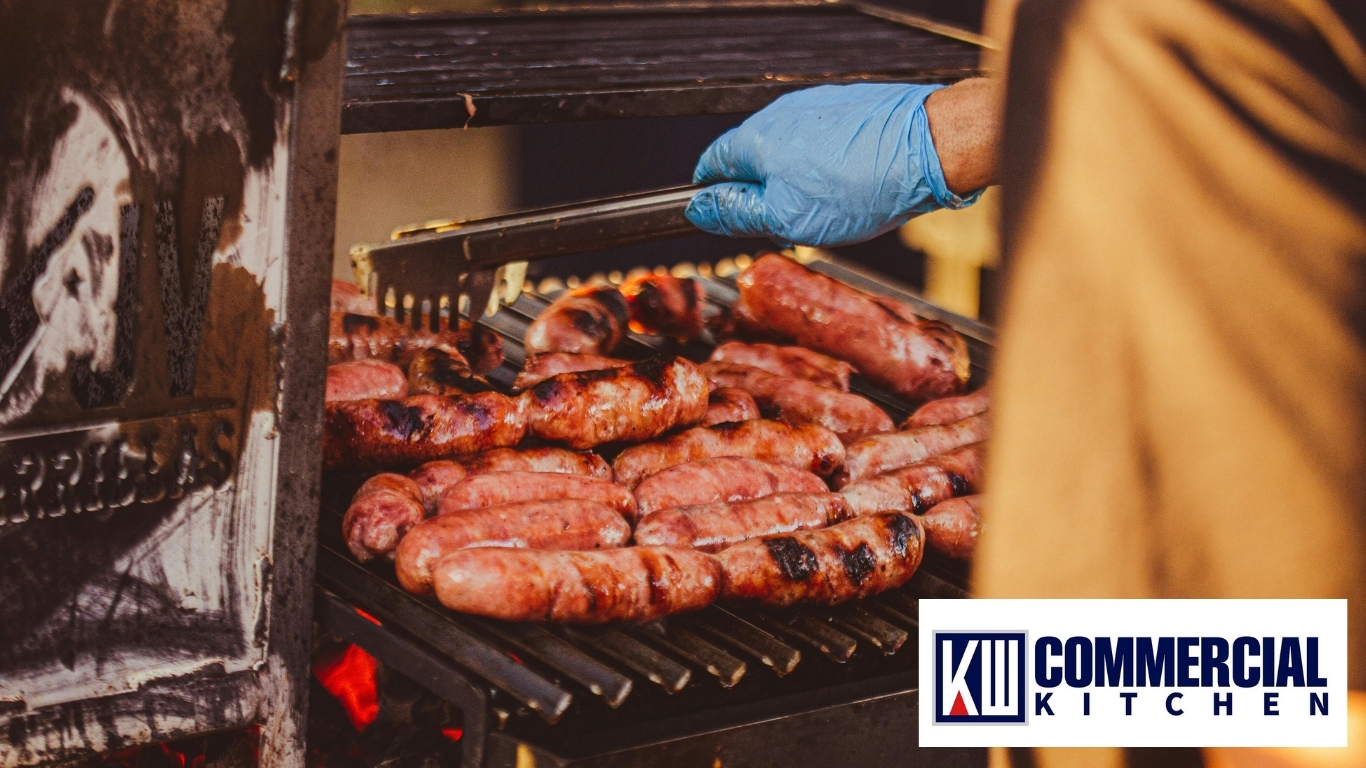
Do not choose a commercial chargrill by fuel type or headline width alone. Build one requirement from the food you will cook, the busiest service load, the usable cooking surface, the site's utilities and ventilation, and the clean-down and service work the model creates. Then make every supplier quote answer that same requirement.
This changes the question from “Is gas or electric better?” to “Which documented machine fits this menu, this peak and this site?” It also exposes missing evidence before a deposit, delivery or trade booking turns it into a project delay.
First confirm that chargrilling is the cooking method you need
A chargrill requirement starts with the contact between food and the cooking system: grate, radiant, direct-contact element or another manufacturer-defined arrangement. A smooth solid plate belongs to a different comparison. If your menu depends on eggs, pancakes, chopped items or broad full-surface contact, compare a chargrill with a griddle before you specify fuel, width or brand.
For the chargrill decision, record the menu items that genuinely need this cooking method. Include their prepared dimensions, whether they can share a zone, and which products cannot be cooked together under your operating controls. This is more useful than a list of every item that might occasionally touch the grill.
Build the menu-and-peak-load record
Nominal appliance width is not the same as usable cooking capacity. Controls, zone divisions, edge conditions and the food footprint all affect what can be cooked at once. Record the peak you need to support, then ask the supplier or chef trial to demonstrate it on the exact configuration. Do not convert a burner count or kilowatt figure into portions per hour without a governed test.
| Record before comparing models | Evidence to attach | Decision it changes |
|---|---|---|
| Menu items and prepared dimensions | Actual portion footprint, not a generic menu label | Grate or element arrangement and usable surface |
| Maximum items cooking simultaneously | Peak-service docket or production plan | Required working area and number of independent zones |
| Different heat or separation needs | Chef-defined batches and operating controls | Zone layout and whether one surface can carry the menu |
| Recovery expectation after loading | Exact-model demonstration or trial conditions | Whether the documented configuration meets the service pattern |
| Available line position | Measured width, depth, height, access and adjacent surfaces | Physical fit, stand/base choice and specialist review |
The editorial judgement here is deliberate: capture the load before choosing the fuel. Fuel affects the equipment and site evidence, but it does not replace the load evidence.
Use exact-model evidence, not category assumptions
Two current manufacturer documents show why “48-inch gas” and “900 mm electric” are only starting labels. The comparison below is not a recommendation and does not declare a winner. It shows the fields that materially differ and therefore belong in a quote.
| Evidence field | American Range ARRB-48 | Blue Seal E596D-LS |
|---|---|---|
| Documented format | Countertop radiant charbroiler | Electric chargrill on leg stand |
| Documented dimensions | 1219 × 762 × 356 mm | 900 × 812 × 1085 mm |
| Energy input | 120,000 BTU/h (35 kW); eight individually controlled burners | 13.4 kW; separate left and right heat zones |
| Connection evidence | Natural gas or propane must be specified; 3/4-inch gas inlet documented | 400–415 V, 3P+N+E, 22.5 A documented |
| Cooking and clean-down components | Reversible cast-iron grates, removable radiants and removable grease pan | Direct-contact elements and manual water-filled cooking well with drain |
Sources: the American Range ARRB specification and the Moffat E596D-LS manufacturer page. Confirm the current revision, ordering code and Australian supply configuration before purchase. A model-family brochure does not prove the delivered unit's gas type, electrical connection, base, accessories or local acceptance.
Treat utilities, ventilation and installation as one site decision
Fuel is not a shortcut to site suitability. The exact gas type and input, or the exact voltage, phase, current and connection method, must meet verified site capacity and the manufacturer's instructions. Gas work and fixed electrical work sit with the applicable licensed trades; an operator's role is to provide accurate site and equipment evidence, not to size or certify the connection.
Ventilation also depends on more than the appliance label. FSANZ guidance for Standard 3.2.3 says food premises need sufficient natural or mechanical ventilation to remove fumes, smoke, steam and vapours. It identifies the nature and volume of operations, system capacity, maintenance, equipment position and layout as factors in adequacy. Use the commercial-kitchen exhaust screening guide to decide which project evidence and specialist owner must resolve that question; this chargrill guide does not size or approve the exhaust system.
For a gas example, Energy Safe Victoria's commercial-kitchen checklist covers certification, manufacturer instructions, clearances, isolation, hose assemblies, ventilation and applicable interlocks. That checklist is Victorian guidance for licensed gasfitters, not an Australia-wide approval from this article. Confirm the applicable rules, authority and trade requirements for your project location.
Send the exact model document, measured line position and proposed operating load to the project owner early. If exhaust, make-up air, fire systems, combustible-surface protection, access or services remain unresolved, the equipment decision remains unresolved. Coordinate the equipment with the kitchen project before treating a product quote as installation-ready.
Compare the clean-down and service path before you compare convenience claims
“Easy to clean” is not a specification. Ask what staff remove, where grease or water goes, which surfaces remain hot or inaccessible, what must cool before handling, and which steps belong only to the manufacturer's procedure or a service technician.
- Obtain the exact cleaning and operating instructions for the proposed model.
- Identify removable grates, radiants, grease channels, pans, wells, drains and any required water connection or manual fill.
- Check whether the line position gives safe access for the documented routine.
- Record daily and periodic tasks without inventing intervals that are absent from the manual.
- Confirm who services gas, electrical, control and drainage components and how the unit can be isolated and accessed.
The ARRB document and E596D-LS page describe different component paths. They do not prove that one is universally faster, safer or cheaper to maintain. The useful comparison is the exact work your team and service provider must perform in your layout.
Make suppliers quote the same chargrill requirement
A comparable chargrill request should carry one frozen set of inputs:
- menu items, prepared dimensions and simultaneous peak load;
- required surface or element arrangement and independent-zone needs;
- measured equipment position, access and adjacent surfaces;
- verified available gas or electrical service, without assuming it is adequate;
- ventilation, fire-system and authority questions assigned to named owners;
- exact model, gas/electrical configuration, base or stand, accessories and current document revisions; and
- clean-down, drain, isolation, service-access and demonstration requirements.
Where a supplier proposes an alternative, require them to mark every changed assumption. That protects the decision from a cheaper quote that silently changes width, zones, stand, connection, accessories or the work expected from another trade.
Once the requirement is stable, browse current commercial chargrills and request a quote against the same requirement sheet. Current price, stock, freight, warranty and available configurations belong to those live commercial owners and must be confirmed there.