
How Much Should You Budget for a Commercial Coffee Setup in Australia?
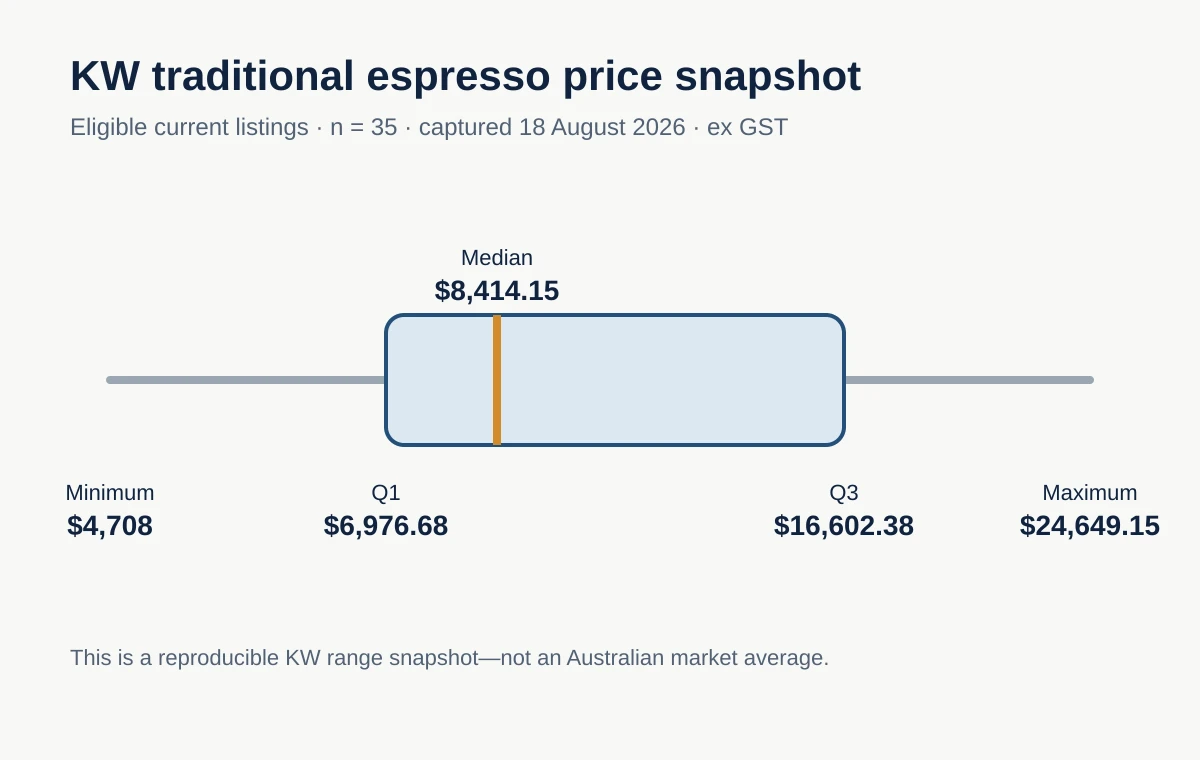
Start with three separate budget lines: a traditional commercial espresso machine, one suitable commercial grinder, and a location- and scope-specific installation service. In KW Commercial Kitchen’s eligible traditional espresso listings captured on 18 August 2026, 35 machines ranged from $4,708 to $24,649.15 ex GST, with a median of $8,414.15 ex GST. That is a reproducible snapshot of KW’s range—not an Australian market average and not a complete café-opening budget.
Prices and availability change. This guide explains the decision structure; recheck the current product page and confirm the complete scope in a quote before purchasing.
What does a commercial espresso machine cost in KW’s current range?
The useful answer is a distribution, not one headline number. After removing draft products and separating two fully automatic machines from the traditional espresso-machine corpus, the eligible 35-machine snapshot produced the following figures.
| Measure | Current ex-GST price | How to use it |
|---|---|---|
| Minimum | $4,708.00 | Lowest observed eligible listing, not a universal entry price |
| First quartile | $6,976.68 | 25% of the captured cohort priced at or below this point |
| Median | $8,414.15 | Middle listing in the captured cohort |
| Third quartile | $16,602.38 | 75% of the captured cohort priced at or below this point |
| Maximum | $24,649.15 | Highest observed eligible listing, not a recommendation |
The cohort is deliberately narrow. It includes current non-draft listings in KW’s Commercial Espresso Machines category that use the traditional espresso-machine architecture. It does not claim to represent every brand, dealer or machine available in Australia.
Why the original 37-machine total needed a taxonomy check
The raw category returned 37 current non-draft listings, but two were fully automatic Egro/Rancilio machines. Those machines belong to a different buying architecture from the article’s core formula. A fully automatic platform may handle coffee preparation differently from a traditional espresso bar built around a separate machine and grinder.
Adding a separate grinder to every one of the 37 rows would therefore create a double-count risk. This guide uses 35 traditional espresso listings for the machine distribution and treats the two fully automatic listings as a separate decision path. If you are comparing bean-to-cup or superautomatic equipment, request a configuration-specific quote rather than applying the traditional setup formula.
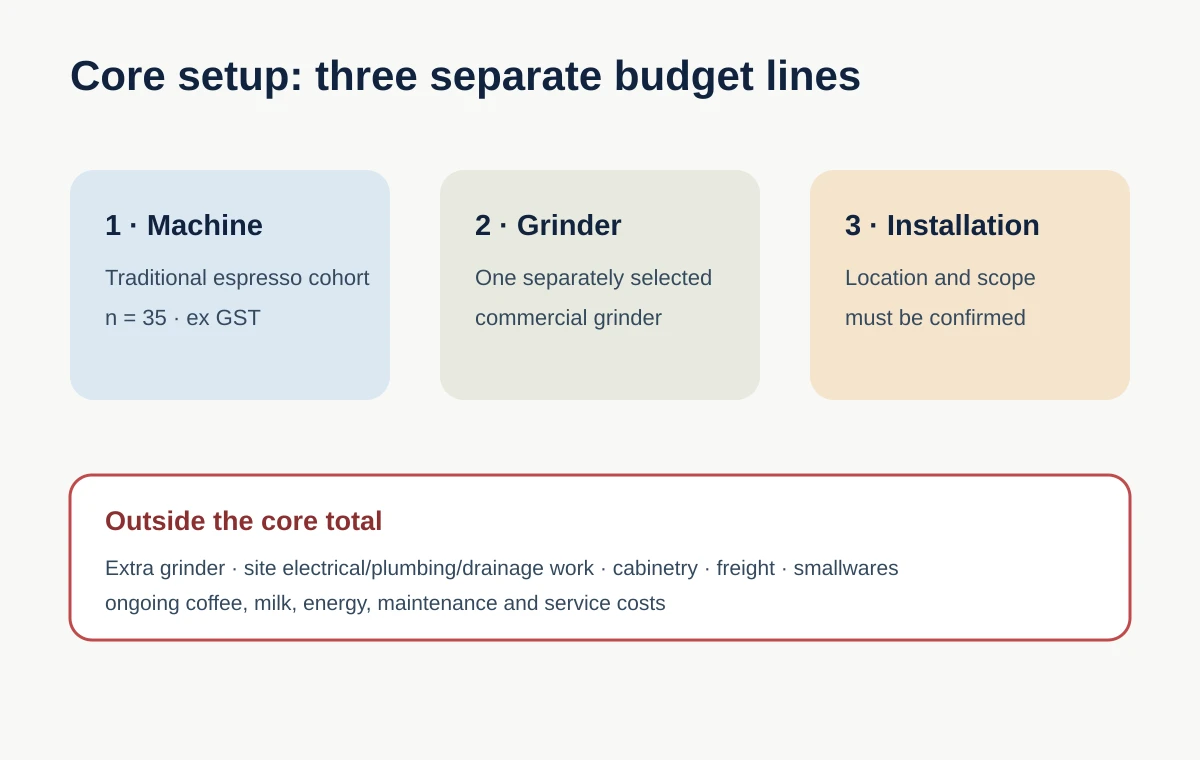
Keep the three core budget lines separate
1. Traditional commercial espresso machine
The machine is the largest equipment line in the captured KW range, but price alone does not prove output, service speed or venue suitability. Use the distribution to set an initial purchasing envelope, then compare exact configurations and site requirements.
2. One commercial coffee grinder
A traditional espresso setup normally needs a separately selected grinder. Keep that line outside the machine distribution so the numbers remain auditable. The correct grinder decision depends on the coffee program and workflow; this article does not convert grinder wattage, burr description or price into an unsupported throughput promise.
A venue may choose more than one grinder—for example, to separate coffees—but a second grinder is outside this guide’s core setup boundary. It should appear as an explicit additional line, not be hidden inside a universal total.
3. Defined installation service
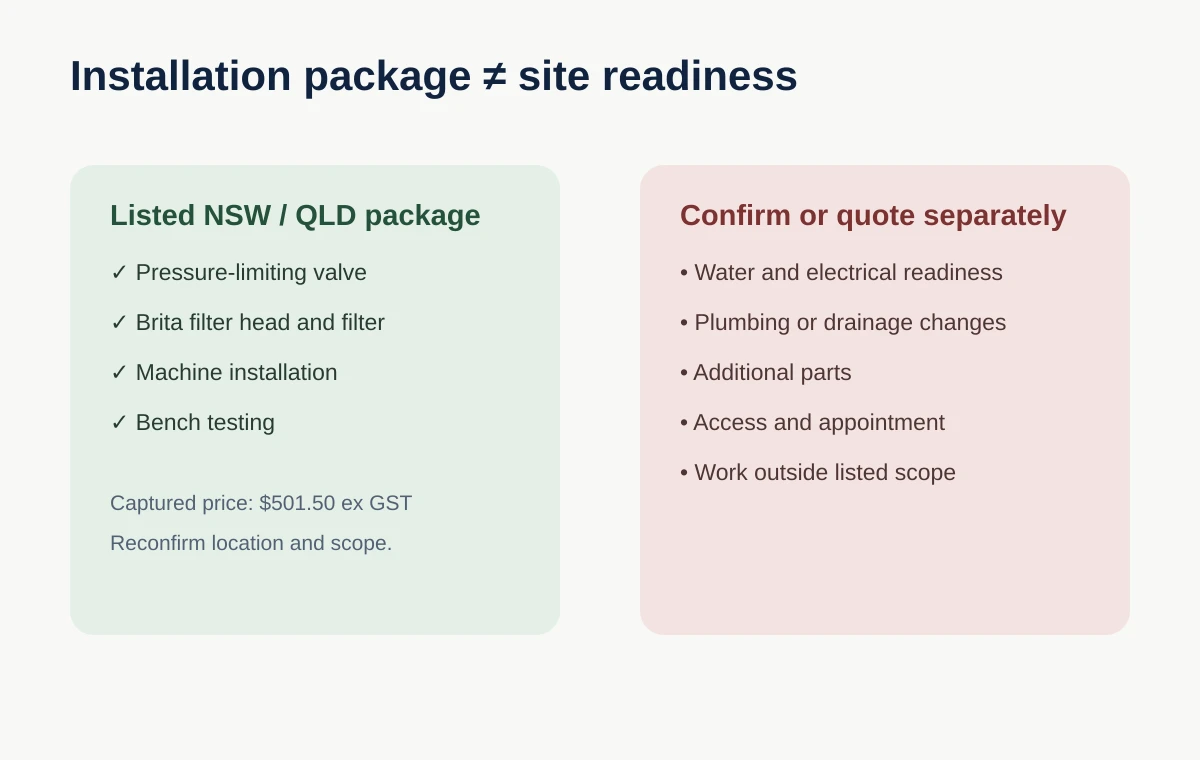
KW currently lists location-specific NSW and Queensland installation packages at $501.50 ex GST in the captured records. Each of those records lists a pressure-limiting valve, Brita filter head and filter, machine installation and bench testing. The service record also says the buyer must confirm the address, machine model, water and electrical readiness, access, scope exclusions and appointment availability.
That price does not prove what remedial plumbing, drainage, electrical work or additional parts will cost. Work outside the listed package may require a separate quotation. Victoria also has a listed service line, but every location and inclusion must be reconfirmed rather than converted into an Australia-wide installation promise.
What can make one machine configuration different from another?
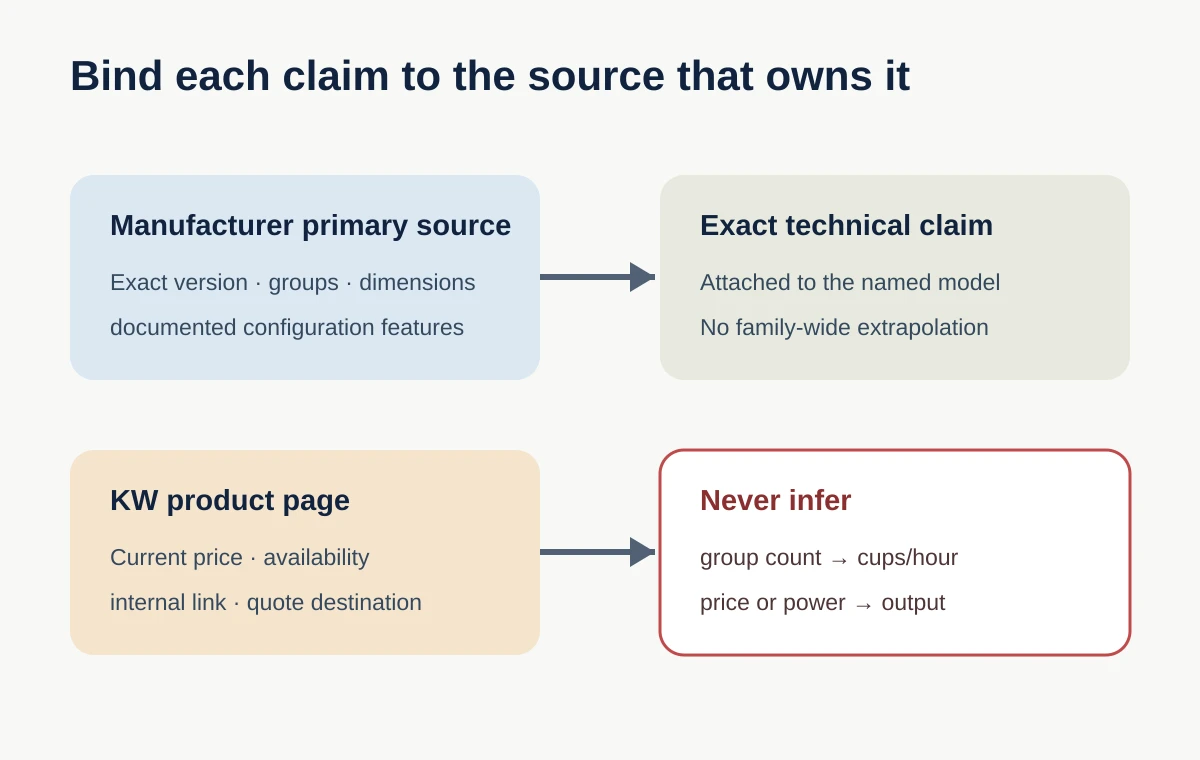
Configuration differences matter, but they must stay attached to the exact documented model or family. Rancilio’s current Classe 5 information describes different versions and group configurations, including traditional espresso variants. Bezzera’s B2016 manufacturer brochure likewise documents 1-, 2- and 3-group versions. Those facts can help a buyer identify what needs comparing.
They do not justify a shortcut such as “two groups equals a particular number of coffees per hour” or “three groups suits a venue with a particular number of covers”. No cups/hour figure may be inferred from group count, price or power. Real service capacity also depends on the exact machine, recipe, grinder, operator, milk workflow, recovery behaviour and service pattern. This guide therefore uses group count as a configuration descriptor—not a throughput calculator.
| Comparison question | Evidence allowed here | What remains unproven |
|---|---|---|
| Which version or group configuration is offered? | Exact manufacturer page or brochure | Your venue’s required output |
| What is the current KW price? | Current exact PDP and frozen corpus | Future price or whole-market average |
| Is a model currently listed as available? | Current PDP status | Lead time at the date you need it |
| Will it fit the site? | Exact dimensions and utility data where documented | Site suitability until measured and confirmed |
| How many drinks can it deliver? | Only exact, attributable performance evidence | Any output inferred from group count, price or power |
What is outside this core setup budget?
This is not a complete café fit-out estimate. Keep the following items visible as separate decisions:
- additional grinder or alternative-coffee equipment;
- water, drainage or electrical rectification outside the defined service package;
- bench cut-outs, cabinetry, joinery and other building works;
- freight, access handling or site-specific delivery requirements;
- smallwares, knock boxes, tampers, milk equipment and cleaning supplies;
- ongoing coffee, milk, energy, maintenance and servicing costs;
- training, warranties or service coverage not stated for the exact purchase.
Leaving these lines outside the headline figure is not an omission. It prevents a scoped equipment snapshot from being mistaken for a guaranteed installed project total.
Prepare these details before comparing or requesting a quote
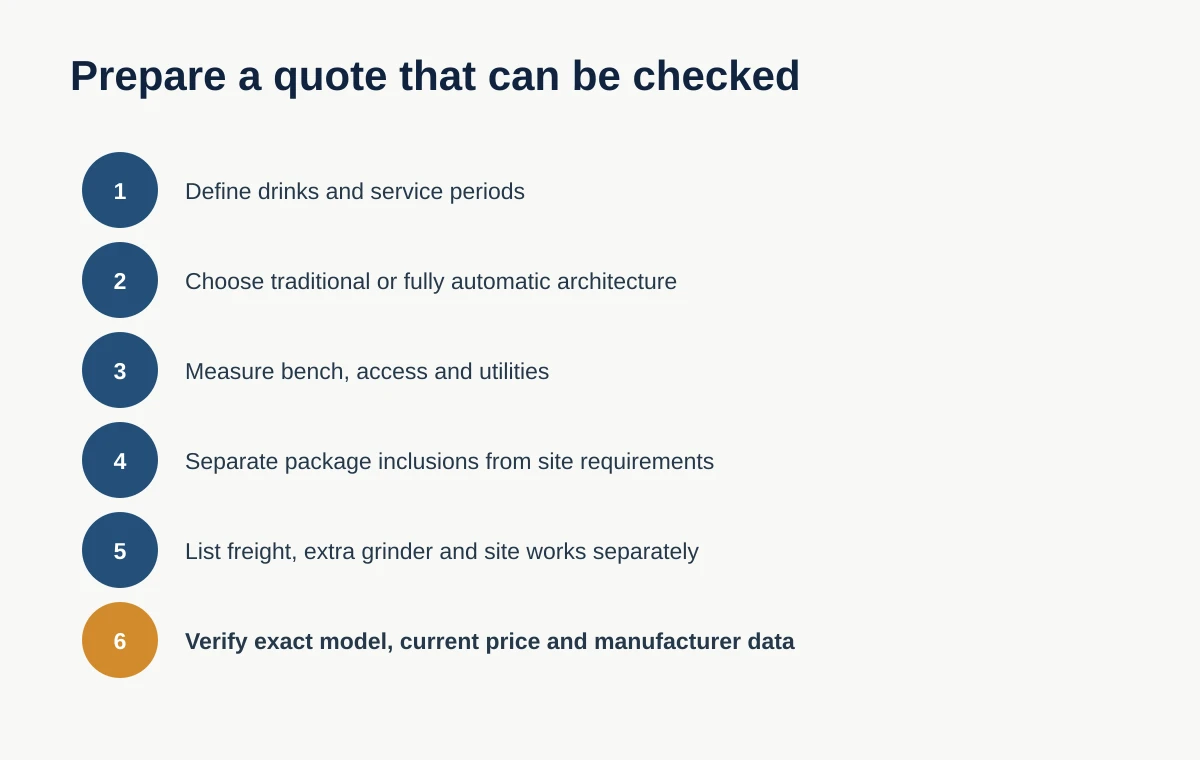
- Define the coffee program. Record the drinks, sizes and service periods the bar must support without converting them into an invented machine output.
- Choose the architecture. Decide whether you are assessing a traditional espresso bar with a separate grinder or a fully automatic path. Do not combine their budgets.
- Measure the site. Capture usable bench space, access and the exact utility information a supplier or licensed trade asks for.
- Separate included from required. A component supplied in an installation package does not prove every site has the same requirement.
- List exclusions. Put freight, extra grinders, cabinetry and remedial trades into their own quote lines.
- Verify exact models. Compare current price and availability on the PDP, then confirm technical specifications against manufacturer documentation.
Where should you go next?
Use this snapshot to set an initial budget envelope, then browse commercial coffee machines and the commercial espresso machine range. For installation, review the location-specific NSW package or Queensland package and confirm your address, machine, site readiness and exclusions.
For configuration questions, use the Rancilio Classe 5 manufacturer page and Bezzera B2016 manufacturer brochure as model-bound evidence. Then request a quote for the exact machine, grinder and installation scope rather than relying on a universal total.
Frequently asked questions
How much does a commercial coffee machine cost in Australia?
There is no single defensible whole-market figure in this guide. Across 35 eligible traditional commercial espresso listings in KW’s range on 18 August 2026, current prices ran from $4,708 to $24,649.15 ex GST, with a median of $8,414.15 ex GST. Recheck the range and price before purchase.
Does the machine price include a grinder?
Not in this article’s traditional espresso setup formula. The grinder is a separate line. Fully automatic machines were separated because applying the same grinder assumption could double count part of that architecture.
Is installation included in the machine price?
No. The captured NSW and Queensland package records are separate location-specific service lines. They have stated inclusions and require site details to be confirmed.
Is this the full cost of opening a café?
No. It excludes the wider fit-out, freight, remedial trades, cabinetry, extra equipment, ingredients, labour and ongoing operating costs.
Does a three-group machine always produce more coffees per hour?
This guide does not make that inference. Group count is a configuration descriptor; a defensible output statement needs exact-model evidence and the relevant operating assumptions.