
The $15,000 Oil Trap: Commercial Deep Fryer Profit & Sizing Guide
The $15,000 Oil Trap: Commercial Deep Fryer Profit & Sizing Guide (Australia 2026)
Stop treating your fryer like a metal box that makes hot oil. It is a financial engine. Here is how to calculate exactly how much profit it is leaking.
Let’s rip the band-aid off right away. I audit commercial kitchens across Australia every week, and the conversation is always identical. A venue owner will spend three days hunting online, comparing spec sheets they barely understand, all just to save $800 on a commercial deep fryer from a no-name brand.
They think they won. They didn’t.
Here is the brutal engineering truth: The invoice you pay for the machine is barely 10% of its lifetime operational cost. The remaining 90%? That is the cooking oil you are going to pour into it over the next three years. When you buy a cheap, flat-bottom iron box without proper thermal controls or a deep “Cold Zone,” you are literally installing a vampire on your cookline. It will drink $55 drums of premium canola oil for breakfast.
🩸 The KW Oil Profit Bleed Calculator
Let’s run the real numbers on a standard, busy Australian café using a cheap 20L twin-basket fryer versus a Tier-1 engineered machine.
(If you run a 3-vat Fish & Chip shop, you are burning $10,000+ in pure cash every single year.)
Think it stops there? It doesn’t. Under the State EPA (Environmental Protection Authority) guidelines, waste cooking oil is a heavily regulated industrial waste stream. You can’t just pour it down the drain. The faster your cheap machine ruins the oil, the more frequently you have to pay licensed contractors to pump your grease trap and haul away your waste drums. You are paying for the oil when it comes in, and paying again to get it taken out.
1. The “Peak Hour Law”: Sizing Your Fryer Without Guessing
The second fastest way to bankrupt your kitchen is sizing your equipment based on a quiet Tuesday afternoon. You look around, see two tables eating, and think, “Yeah, an 8-litre benchtop will do the job.”
Rule #1 of Kitchen Engineering: Always size your fryer based on your absolute busiest hour of the week.
If your fryer cannot handle the Friday night UberEats rush between 6:30 PM and 7:30 PM, your entire kitchen bottlenecks. The docket rail fills up, the chefs start screaming, and your customers jump on Google to leave a 1-star review for waiting 40 minutes for a side of chips. In our Commercial Deep Fryers Buyers Guide, we mapped out the exact mathematics to avoid this.
The Golden Sizing Formula
In the commercial catering industry, there is a hard, mathematical benchmark for frying output that you cannot argue with:
1 Litre of Oil ≈ 10 to 15 Serves (Portions) Per Hour
If your pub expects to push out 150 sides of chips during the Grand Final halftime, a 10L single pan will collapse. You need a Twin Pan 20L+ system to maintain the thermal mass.
| The Sizing Mistake | The Operational Reality | The Financial Penalty |
|---|---|---|
| Undersized (Too small for the rush) |
Thermal mass is obliterated. Oil drops below 150°C. A 3-minute cook time turns into an 8-minute greasy nightmare. | Lost Revenue & Reputation: The pass grinds to a halt. Delivery drivers cancel. Customers leave and never come back. |
| Oversized (Too big for your menu) |
You are firing up 30L of gas-guzzling oil all day just to fry 6 pieces of calamari at 2:00 PM. | Energy Bleed: Massive waste of gas/electricity, as documented in our Energy Efficiency Audit. Plus, hot oil degrades simply from sitting at high temperatures. |
| No “Cold Zone” (Buying cheap flat-bottoms) |
Crumb and batter fall directly onto the red-hot element and carbonize instantly, turning the oil bitter. | Dead Oil: Oil turns black in 48 hours. Your consumable costs skyrocket by up to 50% overnight. |
2. The Physics of a “Soggy Chip” & The Menu Killer
Have you ever tasted a chip that looked pale, felt heavy, and went limp within 3 minutes of hitting the serving bowl? That is not a bad potato. That is a Thermal Crash.
When a chef dumps 2kg of frozen chips (-18°C) into a cheap fryer, the oil temperature instantly plummets from 180°C down to 140°C. Because the machine lacks the raw BTU (gas power) or high-density electric elements, it struggles. It takes 6 to 8 excruciating minutes to fight its way back to 180°C.
🚨 The “Drinking Oil” Phenomenon
When food sits in low-temperature oil (under 160°C), the pores of the potato fail to seal. Instead of flashing the moisture out, the food literally acts like a sponge and drinks the oil. Not only does this cost you 20% more in oil consumption per basket, but cooking in temperature-abused oil spikes the formation of polar compounds—a direct violation of the Food Standards Australia New Zealand (FSANZ) guidelines.
The fix? High Recovery Rates. Tier-1 fryers hit the food with intense, sustained heat, sealing the exterior instantly. We proved exactly how this works with hard data in our Gas Fryer Recovery Time Audit.
The Menu Killer: Why Frying Chicken Ruins Your Chips
Now, let’s talk about the food itself. I see cafe owners try to fry battered flathead, chicken schnitzels, and potato chips in the exact same vat to save space. This is operational suicide.
Different foods destroy oil differently. When you fry chicken, animal fat and blood leach into your plant-based cooking oil. This instantly alters the chemical composition, dropping the smoke point dramatically. When you fry battered fish, massive amounts of wet flour drop into the oil and burn. If you mix these proteins with your chips, your chips will taste like burnt fish, and your oil will die twice as fast. If your menu is complex, you absolutely must read our Fryer Engineering Audit and invest in a Split Vat (Twin Pan) system for physical isolation.
3. The “Cold Zone” Lie: Why Your Oil Turns Black by Thursday
Look inside your vat. If your oil is smoking, spitting, and tasting bitter before the weekend even hits, stop blaming the oil brand. Blame the cheap metal box you’re frying in.
The Carbonization Trap
When a chef drops battered flathead or crumbed calamari into a cheap flat-bottom fryer, the loose batter sinks. It hits the roaring 180°C heating element or the screaming-hot steel floor. It doesn’t just cook—it incinerates. We call this Carbonization.
Those microscopic burnt carbon particles act like a cancer. They circulate through the vat, break down the chemical structure of the oil, destroy the smoke point, and turn your $55 drum of premium oil into toxic black sludge in 48 hours.
The W-Zone Fix: Deep Tube Fryers.
Tier-1
The W-Zone Fix: Deep Tube Fryers.
Commercial machines (like Anets or Blue Seal) don’t use flat bottoms. They use a Tube Burner System with a massive “Deep V” Cold Zone at the base. The oil above the tubes is a violent 180°C. But the oil below the tubes sits dead quiet at around 100°C. When batter falls off, it sinks into this cold zone. It never burns. It just sits there peacefully until you drain it. This single geometric feature instantly extends your oil life by up to 50%. See the engineering for yourself in our Commercial Deep Fryers Catalog.
4. The “Tradie Tax”: The Hidden Ransom of Installation
Before you point at a fryer and say “I want that one,” let’s talk about the ransom you are about to pay the Australian tradesmen to install it. Gas vs. Electric isn’t just about utility bills—it’s about your kitchen’s infrastructure.
- 🔥 The Gas Trap (Canopy Compliance) Gas fryers are absolute workhorses, and bulk gas is cheap. But Australian law dictates you cannot run a commercial gas fryer without a compliant commercial exhaust canopy and interlock system. If you take over a small café that doesn’t have a canopy, installing one just to run a $2,000 gas fryer will cost you $15,000 to $25,000 in sheet metal and tradie fees.
- ⚡ The Electric Trap (3-Phase Upgrades) Electric fryers are 100% thermally efficient because the element sits directly in the oil. But any heavy-duty electric fryer (15kW and up) requires 3-Phase Power. If you are in an older building with only single-phase power, an electrician will charge you anywhere from $3,000 to $8,000 just to upgrade your switchboard and pull the heavy cables. Know your power limits before you buy.
5. The KW Decision Shortcut: Stop Guessing. Buy This.
Stop scrolling through specification sheets trying to play engineer. Find your business type below and buy exactly what the physics of your kitchen dictates.
🐟 The Fish & Chip Shop
The Threat: Relentless volume. You are dumping kilos of frozen, water-heavy product into the oil non-stop.
The Weapon: High-BTU Gas Tube Fryer (20L to 30L+). You need raw, violent fire power to prevent thermal crashes. Don’t play around with small vats. Read our Gas Fryer 2025 Guide for the heavy hitters.
🐟 The Fish & Chip Shop
The Threat: Relentless volume. You are dumping kilos of frozen, water-heavy product into the oil non-stop.
The Weapon: High-BTU Gas Tube Fryer (like Anets or FastFri 20L+). You need raw, violent fire power to prevent thermal crashes. Don’t play around with small vats. Read our Gas Fryer 2025 Guide for the heavy hitters.
☕ The Café / Coffee Shop
The Threat: Zero floor space, no gas canopy, and you only fry side-portions of chips for lunch service.
The Weapon: Benchtop Electric Fryer (like Woodson, Benchstar, or Apuro). Plug-and-play (10A or 15A). It fits on a stainless bench, transfers 100% of its energy directly into the oil, and requires zero ducting.
🍻 The Pub / Gastropub
The Threat: Menu chaos. Frying heavily battered seafood, chicken schnitzels, and vegan chips at the exact same time.
The Weapon: Twin Pan Fryer (like Cookrite or Anvil Split Vat). Two independently controlled oil tanks. It physically isolates the proteins, stops your vegan chips from tasting like calamari, and saves you from buying two full-sized machines.
☕ The Café / Coffee Shop
The Threat: Zero floor space, no gas canopy, and you only fry side-portions of chips for lunch service.
The Weapon: Benchtop Electric Fryer (8L to 12L). Plug-and-play (10A or 15A). It fits on a stainless bench, transfers 100% of its energy directly into the oil, and requires zero ducting.
🍻 The Pub / Gastropub
The Threat: Menu chaos. Frying heavily battered seafood, chicken schnitzels, and vegan chips at the exact same time.
The Weapon: Twin Pan Fryer (Split Vat). Two independently controlled oil tanks. It physically isolates the proteins, stops your vegan chips from tasting like calamari, and saves you from buying two full-sized machines.
6. The Chemistry of Filtration & The CFO’s Final Move
So you bought a heavy-duty tube fryer. Great. Now, how do you stop your staff from ruining the oil anyway?
Let’s get one thing straight: taking a wire skimmer and scooping the big burnt chunks out of your vat is not filtering. That’s just fishing.
True oil filtration is chemical rehabilitation. As oil breaks down, it creates invisible Free Fatty Acids (FFAs) and polar compounds. These are what make the oil smoke and taste bitter. When you use a proper built-in filtration machine combined with filter powder (like Magnesol), you aren’t just catching crumbs—you are chemically scrubbing the FFAs out of the liquid, washing black oil back to a golden amber. Dive into the chemistry in our Commercial Fryer Oil Filters Guide.
The Ultimate Arbitrage: Let the Oil Pay the Rent
Stop paying cash for depreciating kitchen equipment. Here is how the smart money plays the game:
- 👉 A premium Anets or Henny Penny with built-in filtration costs more upfront. But between the Deep Cold Zone and the daily micron filtering, it will save you roughly $150 a week in wasted oil.
- 👉 The SilverChef Rent-Try-Buy weekly payment for that exact same premium fryer is roughly $60 to $80 a week.
The math is undeniable. The machine literally pays its own rent, and you pocket $70 of positive cash flow every week. Oh, and those rental payments? 100% tax-deductible as operating expenses.
Read our CFO Guide: SilverChef vs. Shift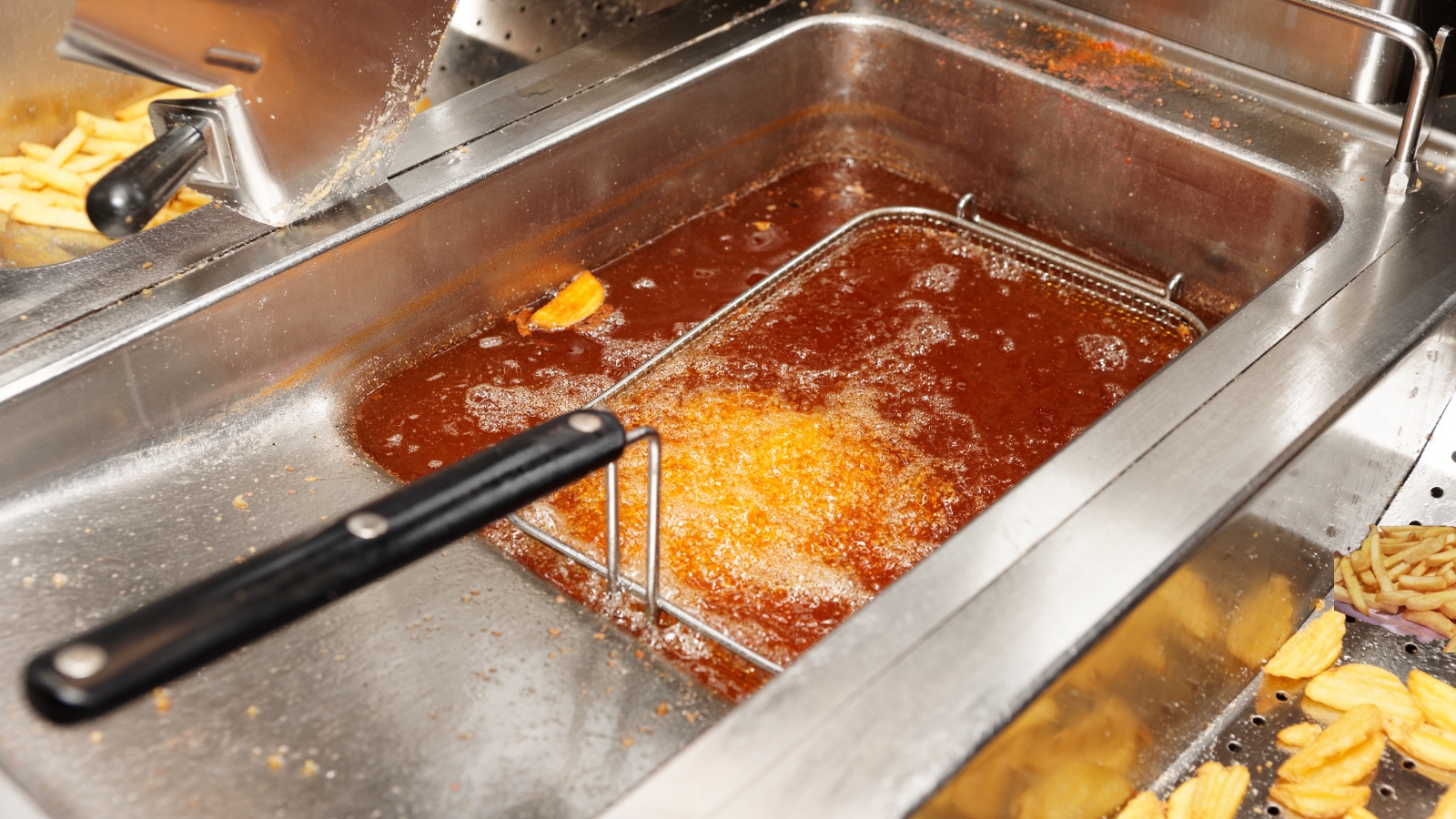
7. The Deep Fryer FAQ: What Sales Reps Won’t Tell You
These are the real questions venue owners ask us when they are panicking on the phone at 8:00 PM on a Friday. Read this before you call a tradie.
“Why is my commercial fryer smoking at normal temperatures?”
If your oil is smoking at 170°C, the chemical smoke point has been physically destroyed. This is caused by a massive build-up of Free Fatty Acids (FFAs) from carbonized food, water, and salt. You cannot “save” smoking oil. It is dead. Drain it immediately before it taints the taste of your food and violates health codes.
“Should I turn the thermostat down to 140°C during quiet times to save gas and oil?”
Absolutely not. This is a rookie mistake. If an order comes in and you drop chips into 140°C oil, the pores won’t seal. The food will drink the oil, becoming a soggy, greasy mess. If you want to save gas during quiet hours, invest in a Twin Pan fryer and simply turn one vat completely off.
“How often should I actually change my fryer oil?”
You do not change oil based on the calendar; you change it based on chemical degradation. If you buy a Tier-1 fryer with a deep cold zone, filter the oil daily with powder, and avoid frying heavily salted foods directly over the vat, premium oil can easily last 7 to 10 days. If you buy a cheap flat-bottom fryer and skip filtering, it dies in 3 days. Period.
Stop Guessing. Let Eva Calculate Your Profit Leak.
Don’t play guessing games with your cash flow. Tell our Tier-0 AI engineering system, Eva, what type of venue you run and how many kilograms of chips you drop a day.
She will instantly calculate exactly how much oil money you are burning, select the exact fryer geometry you need, and generate a SilverChef breakdown so you can upgrade without spending your own cash.