
Commercial Ice-Maker GEMS in Australia: Scope, Registration and Buyer Evidence Guide
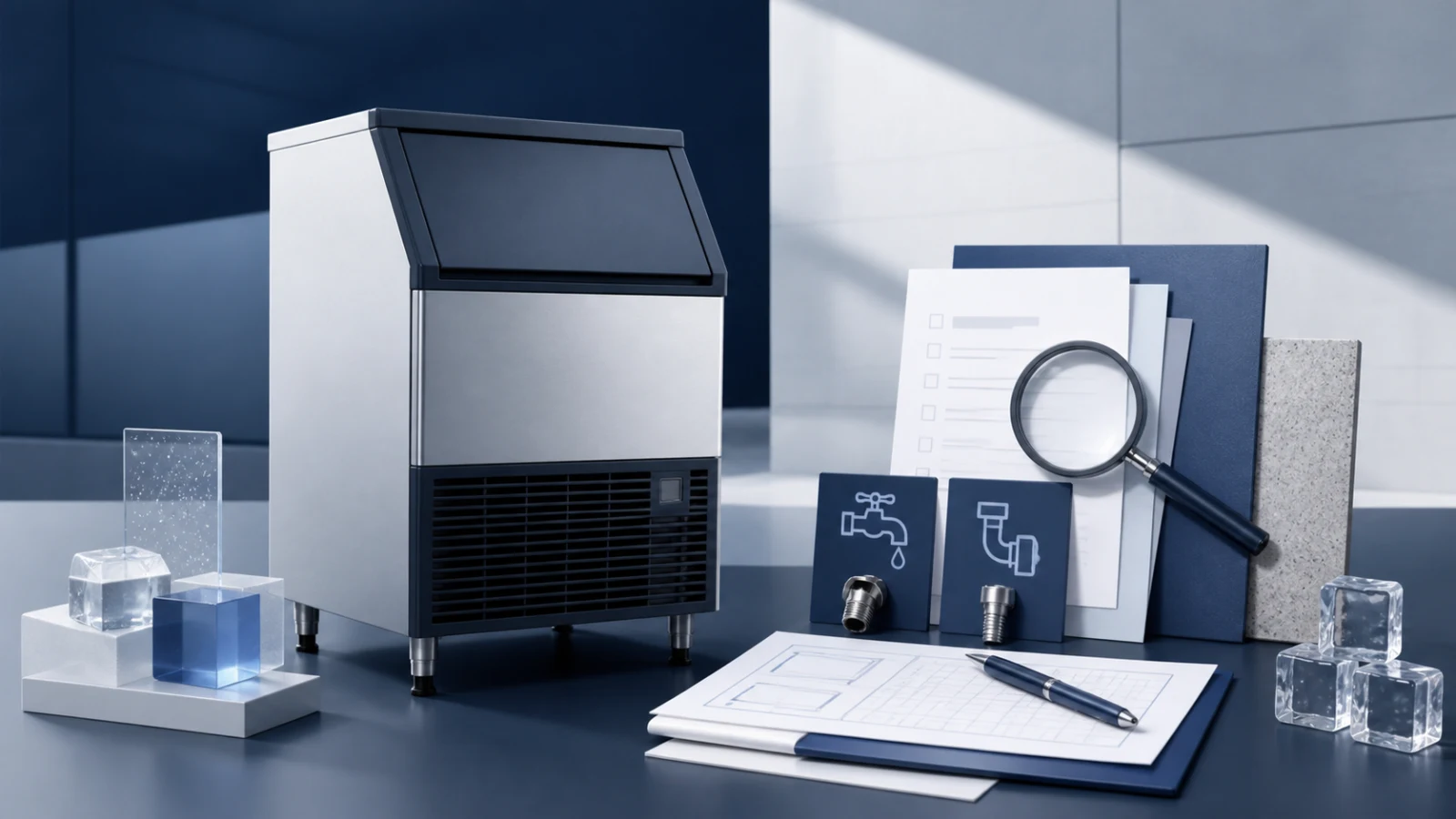
Australia’s commercial ice-maker GEMS requirements commenced on 3 March 2026. The instrument itself was registered one year earlier, on 3 March 2025. Those dates describe different events: the first identifies when the Determination was registered; the second is when its requirements came into effect.
For a covered commercial ice-maker, the current GEMS registration number must be clearly visible when the product is advertised for sale or supply—including online, in print and in store—and when it is physically displayed for sale or supply. Commercial ice-makers do not require an Energy Rating Label. For this equipment class, the number with the AIM prefix is the evidence a buyer should look for and verify.
This guide helps Australian commercial-kitchen buyers decide whether a machine is within the Determination’s scope, follow the AIM evidence from an advertisement to the official register, and separate registration evidence from venue-fit decisions. It does not certify a model, decide whether grandfathering applies, replace legal advice or prescribe site services.
What changed on 3 March 2026?
The Greenhouse and Energy Minimum Standards (Commercial Ice-makers) Determination 2025 was registered on 3 March 2025. Its commercial ice-maker requirements commenced on 3 March 2026, after the statutory 12-month period.
From commencement, a covered model generally cannot be supplied or offered for supply unless it is registered and complies with the applicable GEMS level requirements, subject to the Act and any valid grandfathering provision. The Determination sets class-and-capacity energy limits; it does not make a seller’s general statement of “compliant” sufficient evidence for an exact model.
Equipment imported or manufactured in Australia before 3 March 2026 may be eligible for statutory grandfathering. Eligibility is fact-specific under the Act. A buyer should request the exact evidence supporting any such position rather than treating the product’s age, stock location or a seller’s description as a decision.
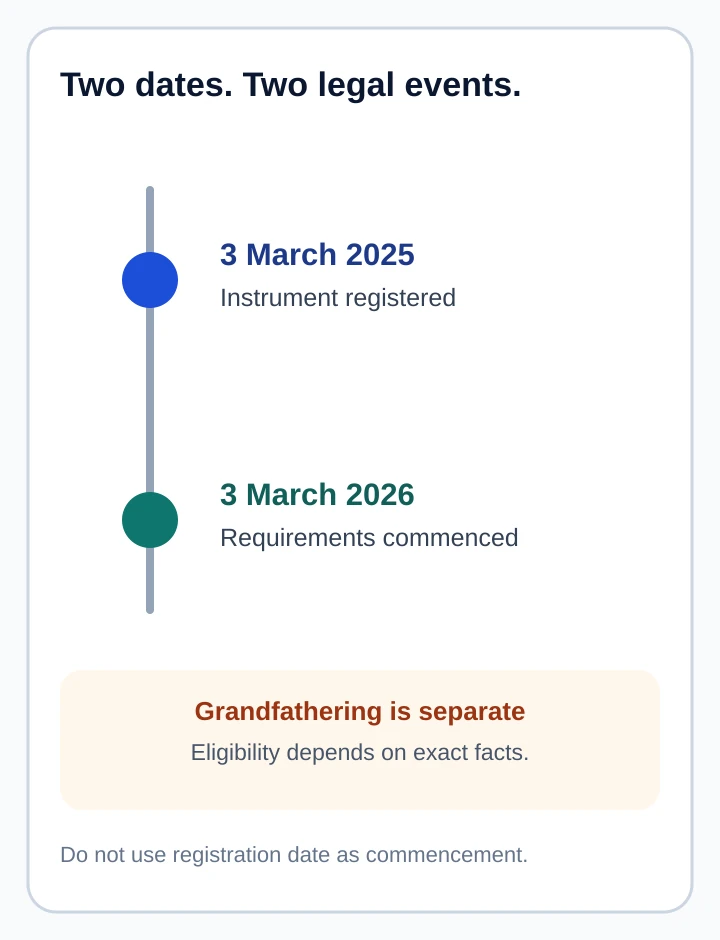
Scope decision tree: is the machine within the commercial ice-maker Determination?
Use the following sequence as a screening path. Classification still depends on the exact equipment and the Determination; this decision tree does not create a new legal test.
- Is it an automatic, factory-made assembly? The covered definition concerns an assembly that combines, or is intended to combine, a condensing unit and an ice-making section as an integrated unit, with means to make and harvest ice. It may or may not include ice storage or dispensing.
- Does it have the required service connections? Covered products provide both a water-supply connection and a drainage connection. The existence of these connections helps identify scope; it does not settle how a particular site should be plumbed.
- Is its tested ice-making capacity within the covered ceiling? The class extends up to and including 1,000 kg per 24 hours at the specified regulatory rating point: 32°C ambient air, 21°C inlet potable water, 230V and 50Hz. This is a test boundary, not a promise of output in a buyer’s venue.
- Do not invent a lower threshold. Energy Rating states that the covered commercial class has no lower ice-making-capacity limit. A small or benchtop machine cannot be classified as domestic from size alone.
- Check the domestic exclusion with exact evidence. Domestic ice-makers are excluded, but the label “domestic”, a small footprint or a retailer category is not enough to classify an uncertain product. Ask the supplier to identify the exact scope basis.
- If the product appears covered, move to registration evidence. Record the exact model designation shown in the offer, locate the AIM registration number and verify the record in the official database before relying on a compliance statement.
If any branch is unclear, stop the scope conclusion at “not yet verified”. Do not turn missing evidence into a domestic classification or a compliance claim.
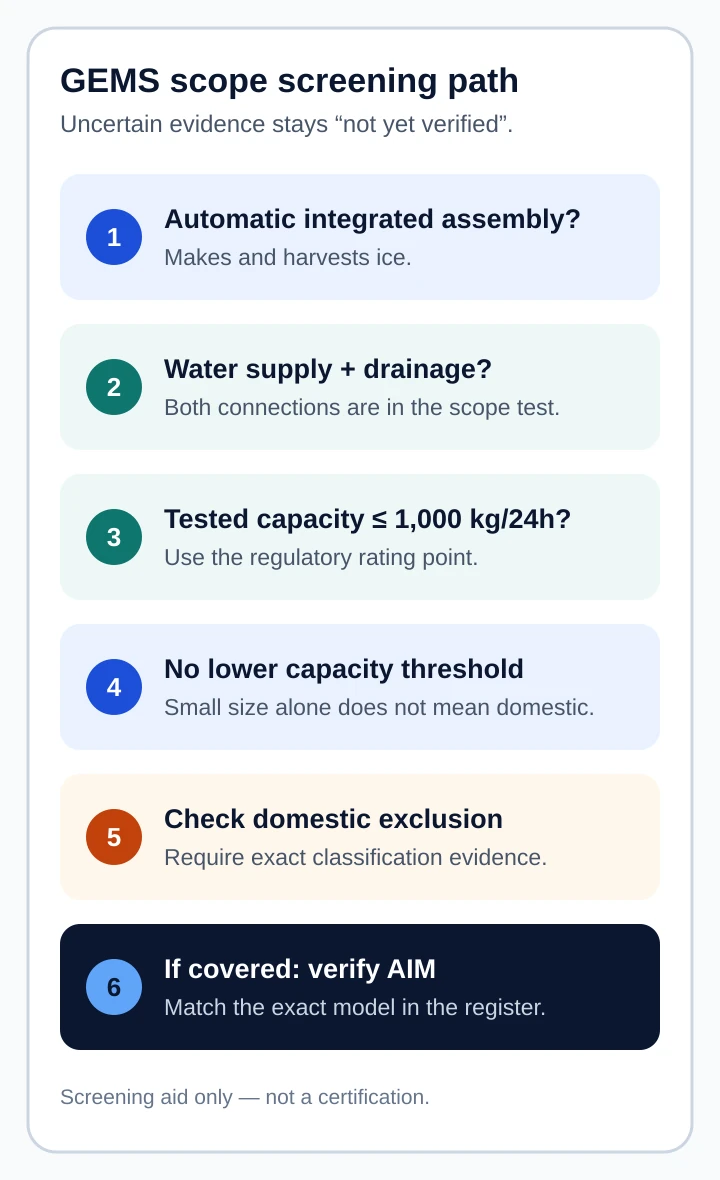
The AIM evidence chain: from advertisement to official record
The registration-number rule is designed to make a covered offer traceable. Follow the evidence in order.
- Start with the advertisement or display. For a covered product advertised for sale or supply online, in print or in store, the current GEMS registration number must be clearly visible. It must also be clearly visible when the product is displayed for sale or supply.
- Identify the AIM number. Commercial ice-maker registration numbers use the
AIMprefix. Energy Rating permits the full wording or the shortenedGRN-AIMform. That format explains what to recognise; it is not an example registration for a real model. - Capture the exact model identity in the offer. Record the brand, complete model designation and any family description shown. Do not assume that similar model names share one registration.
- Search the Energy Rating Registration Database. Match the offer to the exact registered model or the expressly covered family scope. The database is the authoritative place to inspect registration status and the performance fields made available for that record.
- Reconcile differences before purchase. If the model string, family coverage or AIM number does not align, ask the supplier to resolve the mismatch. A brand-level statement, product image or retailer badge is not a substitute for the exact record.
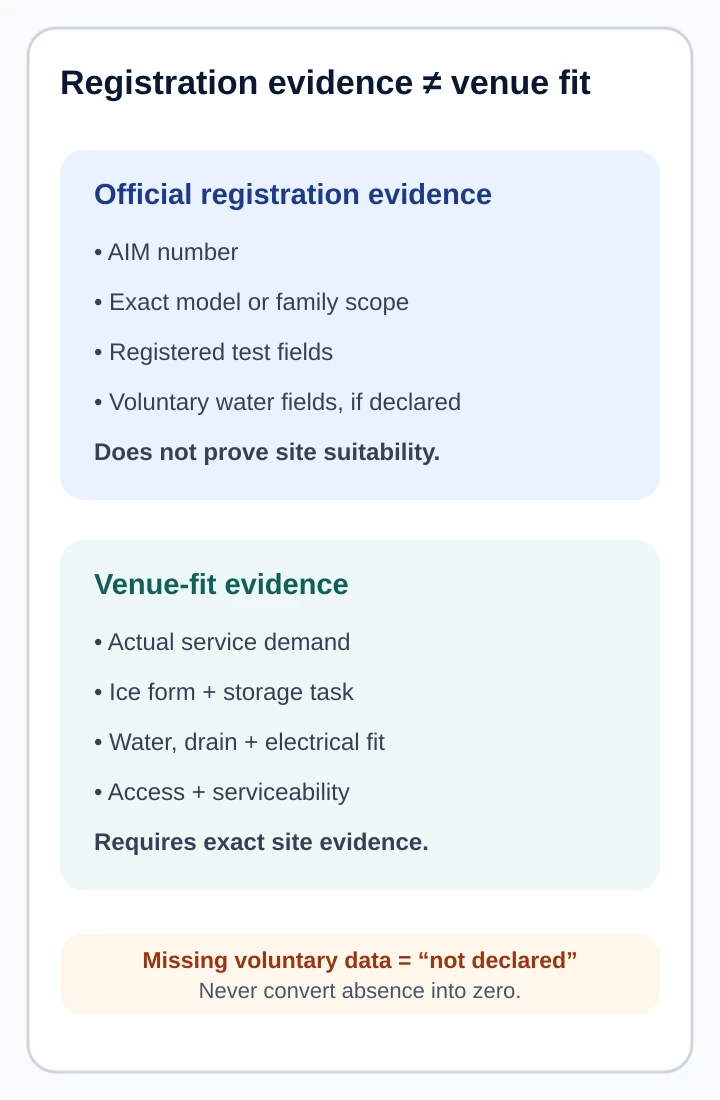
- Keep registration and suitability separate. A matching registration record addresses the GEMS evidence question within its scope. It does not prove that the machine can meet a venue’s peak demand, fit the available services, produce the preferred ice form or suit the intended storage and workflow.
Models can share a family registration only when the Determination’s conditions are met, including the same tested capacity, energy consumption and product class and coverage by a single test report. Similar naming is not evidence that those conditions have been satisfied.
What an Energy Rating Label does—and does not—tell you here
Commercial ice-makers do not require an Energy Rating Label. Its absence is therefore not, by itself, a defect for this product class. The relevant visible identifier is the current GEMS registration number for a covered product.
Do not confuse that rule with the separate GEMS obligations for other equipment classes. This guide concerns commercial ice-makers under their own Determination; it does not transfer labelling, scope or efficiency rules from refrigerated cabinets or domestic appliances.
Buyer comparison matrix: compare evidence of registration separately from venue fit
| Decision field | Evidence to request | What can be compared | What must not be inferred |
|---|---|---|---|
| GEMS registration | Visible AIM number plus the matching official registration record | Exact registered model or expressly covered family scope and available registered fields | That a brand claim covers every model, or that registration proves venue suitability |
| Tested ice-making capacity | Registered data and exact manufacturer evidence with test conditions | Values only when their conditions and product configuration align | That regulatory rating-point capacity equals output at the buyer’s site |
| Water data | Registered potable-water and, where relevant, condenser-water fields plus exact technical evidence | Voluntarily declared fields where present and measured on a comparable basis | That a blank voluntary field means zero water use |
| Ice form and storage configuration | Exact model documentation and the venue’s service brief | Documented configurations against the intended handling and storage task | Universal melting, quality, price or use-case superiority |
| Venue demand | A documented demand brief covering actual service pattern and peak conditions | Candidate equipment against the same buyer-defined demand scenario | A fixed kilograms-per-day range based only on venue type or customers served |
| Water, drainage and electrical fit | Exact installation manual, site survey and appropriate trade confirmation | Documented model requirements against verified site conditions | A universal drainage layout, pump choice, water treatment or installation prescription |
| Serviceability and maintenance | Exact manual, warranty/service terms and local support evidence | Documented access needs and service arrangements for the exact model | A universal cleaning, service or filter-replacement interval |
| Operating cost or payback | Comparable test data plus stated electricity, water, demand and operating assumptions | Only a reproducible calculation using the same assumptions | Unverified daily or monthly costs, savings or payback claims |
This matrix deliberately leaves some cells dependent on exact evidence. Registration makes a model traceable; it does not replace a site brief or an exact-manual review.
Build the venue brief without using unsupported shortcuts
After the scope and AIM checks, define the job the machine must perform. Record the required ice form, the timing and variability of demand, storage and dispensing arrangement, available space, ventilation context, water supply, drainage, electrical service and access for operation and servicing. These are buyer inputs to verify—not universal recommendations supplied by the GEMS registration.
Self-contained and modular configurations can lead to different storage, space and service decisions, but the configuration name alone does not determine fit. Use the exact model documents and site evidence. Plumbing, drainage, electrical and water-treatment decisions should remain with the exact manual and the appropriate qualified parties.
Avoid capacity shortcuts based only on venue type or a fixed ice-per-customer assumption. The regulatory capacity rating is measured at specified test conditions; a venue plan must address its own demand and operating environment without relabelling the registered value as guaranteed site output.
Buyer evidence checklist before accepting a quote
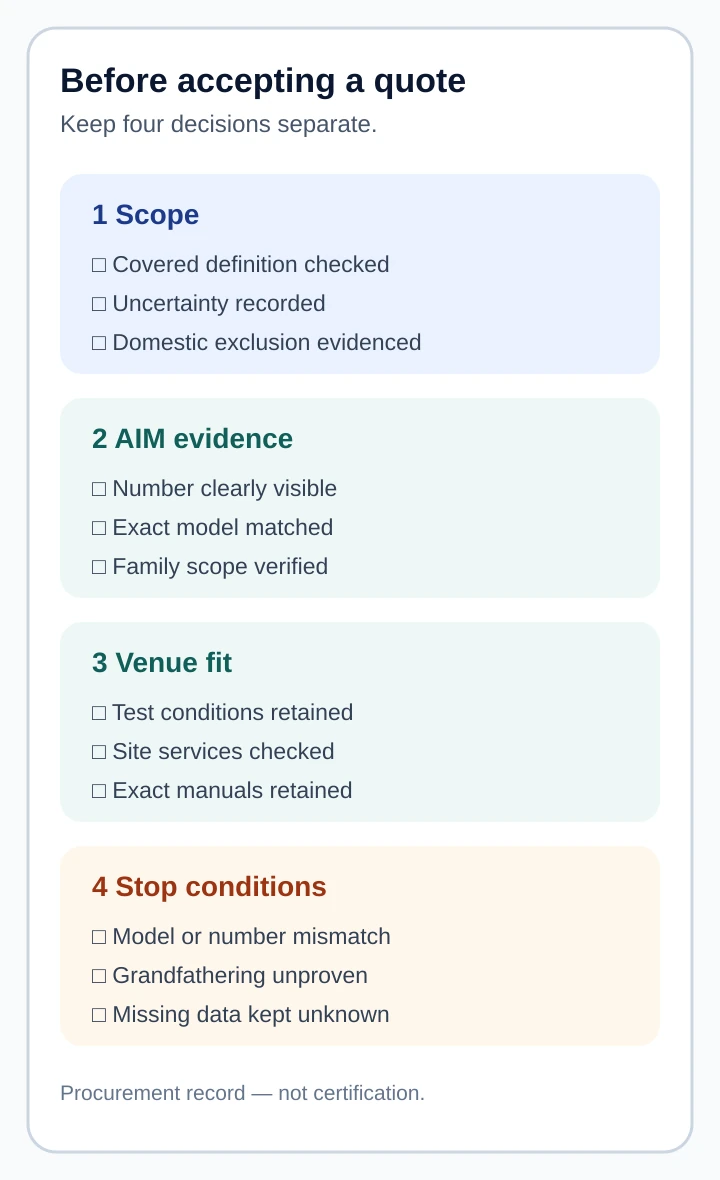
- Record whether the exact equipment appears to meet the covered commercial ice-maker definition and where classification remains uncertain.
- Confirm that the advertisement or display shows a current AIM registration number clearly.
- Match the complete model designation and AIM number to the official Registration Database.
- If a family registration is relied on, verify that the offered model is expressly within that registered family rather than assuming from its name.
- Treat any grandfathering statement as a separate evidence request; do not decide eligibility from the listing alone.
- Retain the exact model documents used for capacity, utilities, storage, installation and service comparisons.
- Record the rating or test conditions beside every performance value being compared.
- Mark voluntary water fields as “not declared” when absent; never convert absence into zero use.
- Keep GEMS registration, venue capacity, site-service fit and operating-cost analysis as separate decisions.
- Escalate model, number or evidence mismatches before accepting a compliance statement or quote.
A completed checklist is a procurement record, not a certification. It makes unresolved evidence visible before a buyer commits to an exact model.
What to do next
Start with the scope decision tree, then follow the AIM number through to the exact official registration record. Only after those checks should you compare the machine against the venue brief and exact site evidence.
You can then review the Commercial Ice Maker category as a product-discovery step. Category listings and product pages do not replace the official registration check: verify the exact model and its evidence before relying on any compliance, capacity, installation or operating-cost claim.