
Why Your Commercial Ice Machine Is Falling Behind — and What to Check First
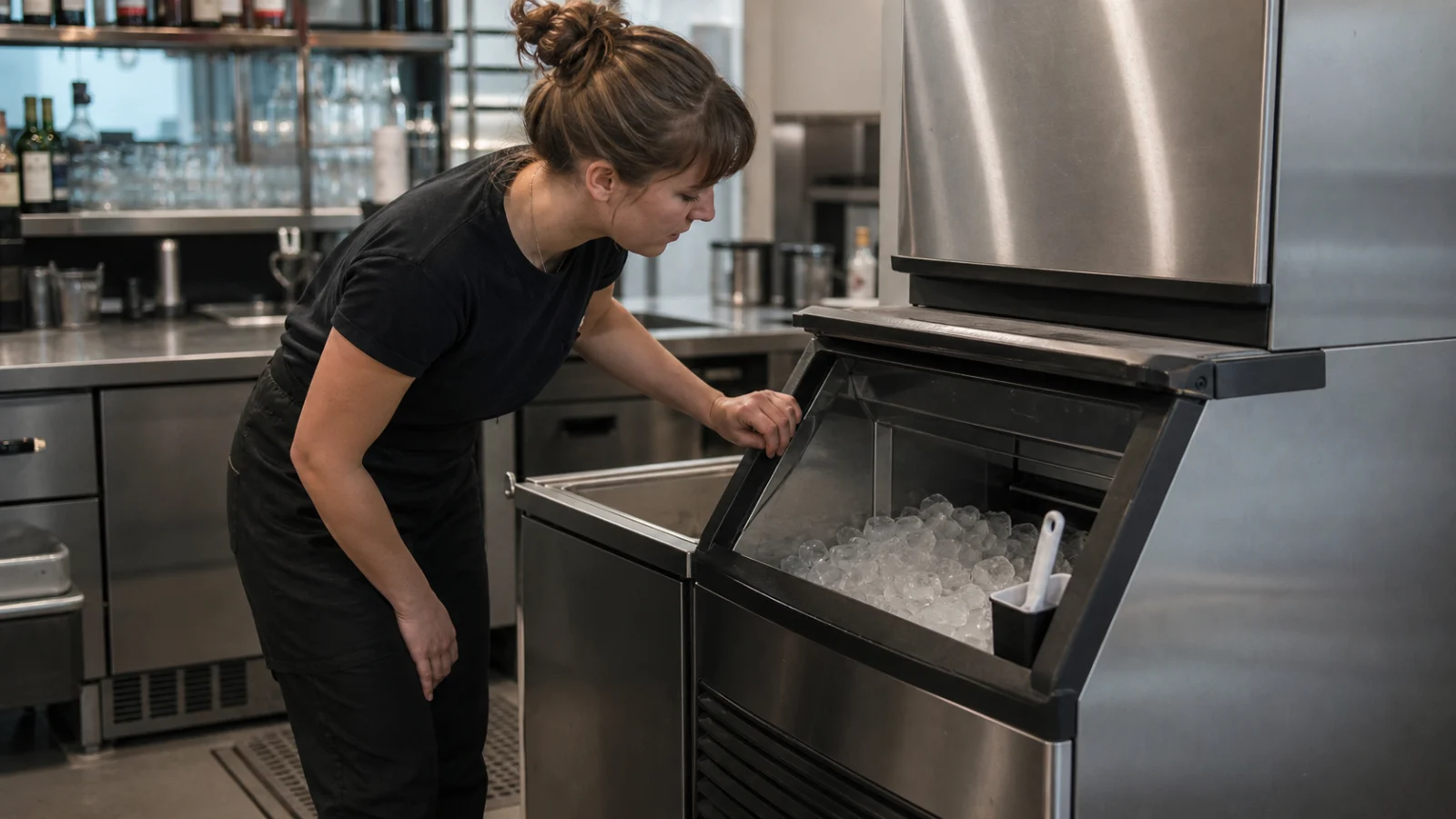
If your commercial ice machine is falling behind, do not assume immediately that the machine has failed—or that replacing it with a larger unit will solve the problem. “Not enough ice” can mean the machine has stopped completely, it is producing less than its own normal output, it only runs short during peak service, its ice has changed from what that machine normally makes, or staff have ice in the bin but cannot access or dispense it quickly enough. These are routing signals, not diagnoses.
Start by recording the exact model, what changed, when the shortage occurs, any displayed error code, the bin level and recent changes around the machine or venue. Then follow only the operator checks and maintenance permitted by the manual for that exact machine. A cleaning, reset or chemical procedure allowed for one model must not be carried across to another brand or machine.
The evidence determines the next step. A persistent error, unsafe electrical condition or suspected internal refrigeration fault belongs with an appropriately competent service provider. Lower output across the whole day may justify checking permitted airflow, water and maintenance factors before service. A shortage limited to a rush may point to a mismatch between production, storage and peak demand, but it does not prove the machine is undersized or fault-free. Ice that is smaller, thinner or less complete than this machine normally produces should be recorded as a change, not judged against one universal “correct” cube. If the bin contains enough ice, the constraint may instead sit in storage access, dispensing or service workflow.
The purpose of this guide is to help you separate those paths safely: machine fault, operating condition, production-and-storage fit, or workflow. It will not teach you to open the refrigeration circuit or diagnose internal components. Where water quality, scale, pressure or filter history is relevant, it will identify that as a conditional branch—not present filtration as a universal cure for low ice production.
What Does “Not Enough Ice” Actually Mean?
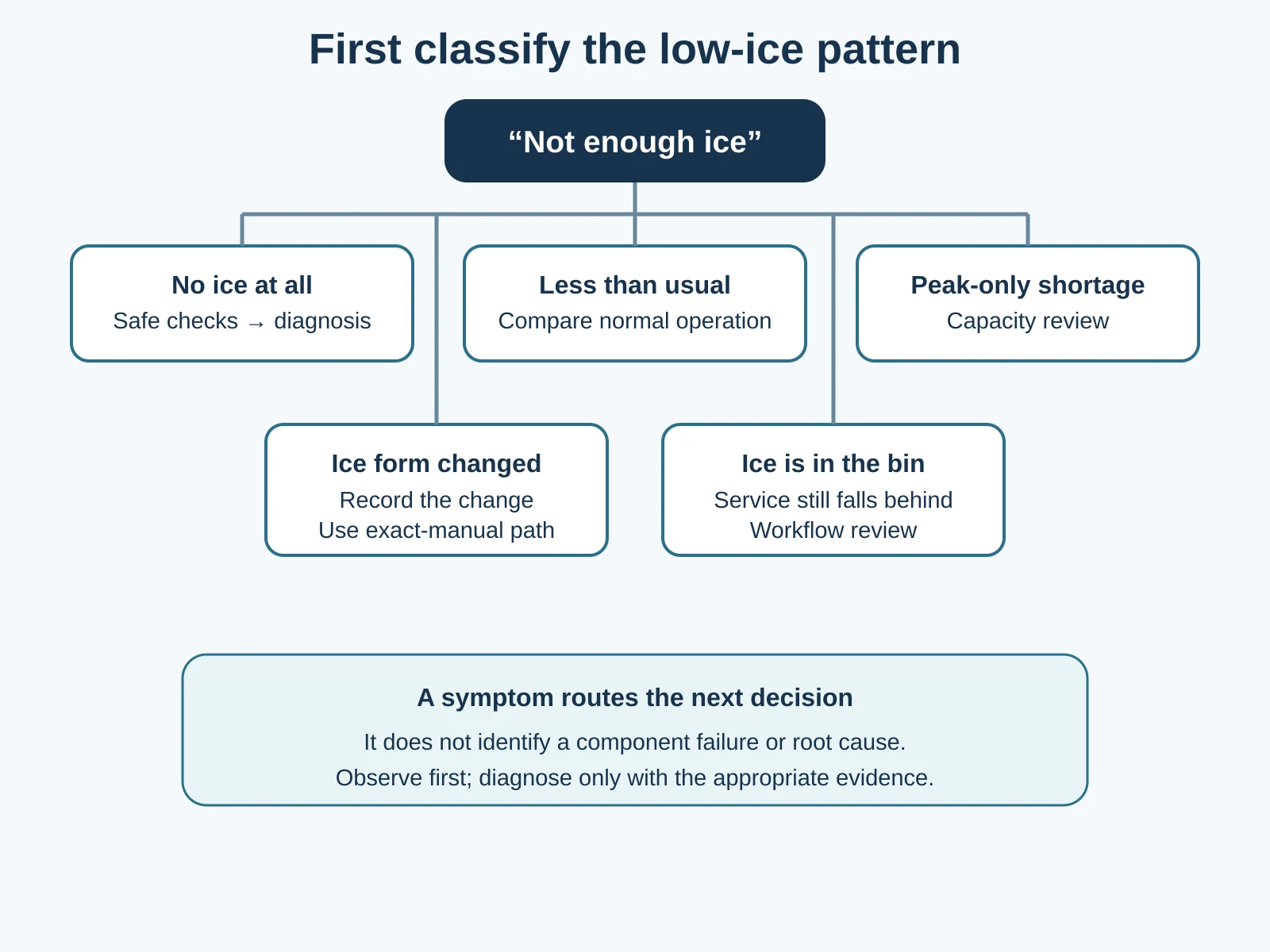
Before asking why an ice machine is falling behind, define what “not enough ice” looks like in the venue. The same complaint can describe a complete stop, a noticeable change from the machine’s usual production, a shortage that appears only during the busiest part of service, a change in the ice itself, or a delay between stored ice and the staff who need it. Those situations lead to different questions. At this stage, none of them proves a cause or determines whether the next action is maintenance, service, resizing or a workflow change.
| What you are seeing | What it tells you — for now | Where to go next |
|---|---|---|
| No ice at all | Treat this differently from a machine that is still producing, but too slowly. | Check the basic operating state and then follow only the operator checks permitted by the exact model manual. |
| The machine is still making ice, but noticeably less than it used to | Something may have changed in the way the machine is operating or in the conditions around its normal operation. The observation does not identify what changed. | Compare what is happening now with the machine’s established normal behaviour. |
| Ice only runs short during peak service | The pattern may involve production capacity, storage capacity or peak demand rather than one obvious machine problem. | Compare when ice is made, how much usable ice is stored and when the venue needs it. |
| The ice looks smaller, thinner or less complete than normal for this machine | A change from this machine’s usual ice form is useful evidence, but it does not identify the cause. | Record when the change began and follow the exact model manual for the next permitted observation. |
| There is ice in the bin, but staff still cannot keep up | The constraint may sit outside ice production itself. | Check how ice is stored, reached, transferred or dispensed at the point of service before blaming production. |
The reference point matters. Different machines are designed to make different forms of ice, so a cube should not be judged against a universal idea of what “correct” ice looks like. What matters here is a change from the normal output of that machine: less ice than it normally makes, a different form than it normally produces, or a different pattern of availability than the venue normally experiences.
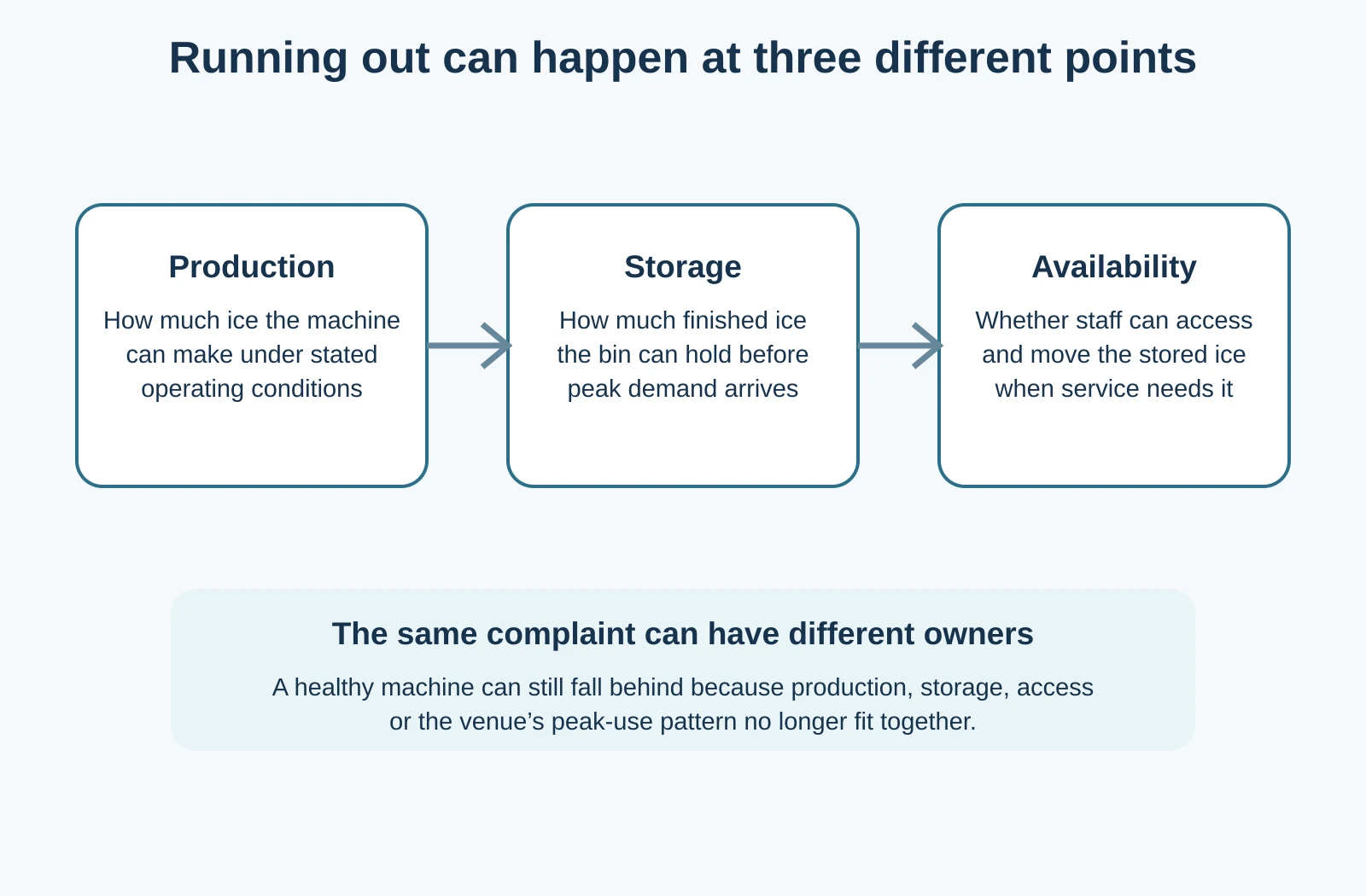
It is also useful to separate three ideas that are often collapsed into one complaint. Production capacity is the machine’s ability to make ice over time. Storage capacity is the amount of finished ice the bin can hold before production pauses. Ice availability at the point of service is the usable ice staff can reach when they need it. A venue can run short at the bar while the machine is still producing. A storage bin can contain ice while access or dispensing slows service. Conversely, a well-organised service station cannot compensate for ice that is not being produced or stored in time.
This classification does not solve the problem; it prevents the wrong problem from being investigated. “No ice” should not be merged with “less than usual”. An all-day change should not be treated as identical to a shortage confined to peak demand. A change in ice form should not be confused with the normal geometry of another machine. And ice present in storage should not automatically be counted as ice available to staff at the moment of service.
Once you know which pattern you are dealing with, the next step is to check the operating conditions that can change ice production before assuming the machine itself has failed.
Safe Checks Before Calling for Service
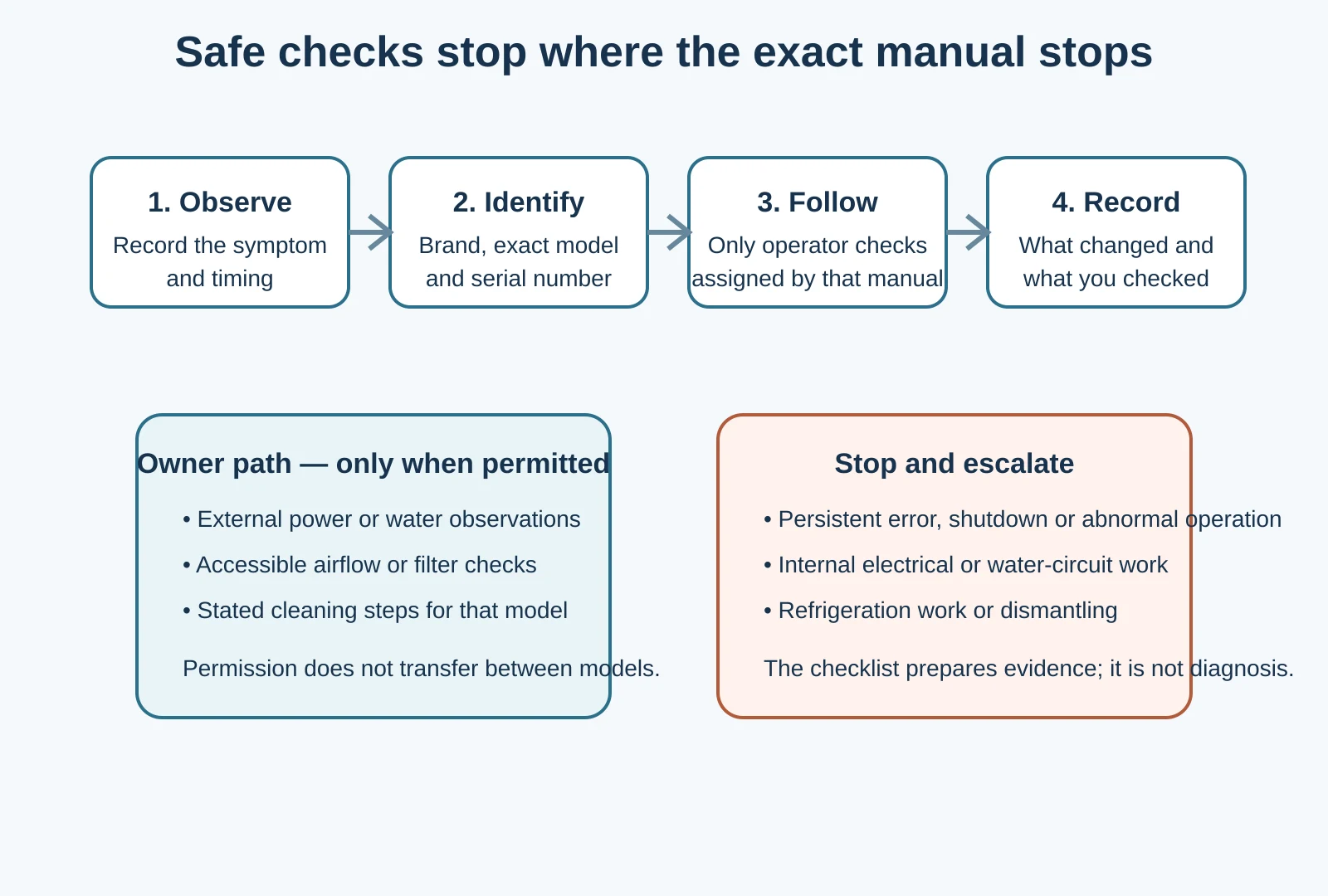
The purpose of a safe check is not to find or fix an internal fault. It is to describe the problem accurately, confirm the basic operating state and complete only the actions that the operator manual permits for that exact machine. This gives a service provider better evidence while keeping the operator out of electrical, refrigeration and internal component work.
Start With the Exact Model and the Symptom
Find the machine’s brand and exact model from its identification plate or approved equipment record. Do not rely on appearance: machines from the same brand can have different controls, filters, cleaning procedures and service boundaries. Match the manual to that identity before acting.
Record the symptom in observable terms. Is there no ice, less than the machine normally makes, a change in its normal ice form, a shortage limited to peak service, or ice in storage that staff cannot access quickly enough? Note when the change began, whether an error code or indicator is displayed and whether anything around the venue changed recently. A water interruption, relocation, different filter, warmer work area or changed trading volume is useful context, but it is not proof of the cause.
Check Power and Water Supply — Only as the Manual Allows
The Hoshizaki instruction manual covering the KM-40C-HC family includes power supply, water supply and air-filter condition among its checks before service. That supports checking the visible operating state for a covered machine; it does not authorise opening an electrical enclosure, testing voltage, dismantling a water valve or applying the same sequence to another model.
Use the exact manual to decide what the operator may confirm. This may be limited to whether the machine has its normal power indication and whether the permitted water-supply control is in its expected position. If the manual does not assign an action to the operator, record the observation and stop there. Do not improvise an internal test because the external check was inconclusive.
Check Airflow and Accessible Filters
Airflow checks should begin outside the machine. Record whether stored items, packaging, a new partition or a recent relocation has changed the clear space around the ventilation openings. Do not remove fixed panels to inspect an internal condenser.
Filter cleaning is also model-specific. The relevant Hoshizaki manual includes its air filter in operator checks. The current Moffat page for the Scotsman ECM 47 AS OX identifies a removable, washable front condenser air filter and links the model’s Installation Operation Manual. That manual separates permitted user cleaning from work assigned to an authorised service agent, including water-circuit cleaning. These examples show why the instruction must be: if the exact manual identifies a user-removable filter and tells the operator how to clean it, follow that procedure. They do not prove that every commercial ice machine has a customer-serviceable condenser filter.
Check the Operating Environment
Record the conditions around the machine without turning the observation into a diagnosis. Note whether ventilation openings are obstructed, whether the machine has been relocated, whether nearby equipment or room use has changed, and whether the incoming-water conditions appear different following plumbing or filter work. The purpose is to create a before-and-after account that can be compared with the machine’s normal operation.
Bromic’s official manual register maps an operator manual to the IM0170HSC-HE. That manual specifies an operating room-temperature range, inlet-water range, ventilation requirements and side clearances, and lists water and airflow conditions among the factors relevant to reduced ice capacity. It supports recording those site conditions for the covered machine. It does not provide clean authority for an IM0170 quantitative high-temperature production curve, and it does not prove that a machine operating inside its stated location limits will deliver unchanged output.
Stop When the Manual Stops
Do not enter the compressor or condenser compartment, interfere with controls or safety devices, open the refrigeration circuit, test internal electrical components, adjust sensors, bypass a fault or add refrigerant. The exact operator manual—not familiarity with another machine—sets the end of the venue-level check.
Record persistent error indications and anything unsafe or unusual, then leave internal diagnosis to an appropriately competent service provider. Refrigerant and electrical requirements depend on the equipment, refrigerant and jurisdiction; the operator does not need to resolve that legal classification before deciding not to perform internal repair work.
If the permitted checks do not explain the change, the next question is whether the machine now needs technical diagnosis—or whether it is working normally but no longer matches the venue’s demand.
Cleaning, Airflow and Planned Maintenance
Cleaning and airflow matter here only because the exact machine’s evidence may identify a blocked air path, dirty accessible filter, scale or overdue maintenance as relevant to reduced output. They are not a generic diagnosis. Keep the model’s specified air intake, discharge path and service clearances unobstructed; required clearances, airflow direction and permitted cleaning vary by model and cooling configuration.
Safe Checks an Operator Can Make
Identify the exact model first. Without removing fixed panels, record visible obstructions around its specified intake and discharge, recent relocation, unusual heat around the unit and the condition of any filter the exact manual assigns to the operator. Follow only that manual’s isolation and cleaning steps. If it does not authorise the action, record the condition and stop.
Cleaning Actions That Depend on the Exact Model
Filter access, cleaning media, descaling, sanitation and water-system procedures are not interchangeable between ice machines. Some manuals permit limited external or removable-filter cleaning; others reserve water-system work for trained service personnel. Do not transfer a chemical, interval, numeric clearance or dismantling sequence from a Blizzard manual—or any other brand—to an unidentified machine.
What Should Be Left to a Qualified Technician
Refrigerant pressures, superheat, subcooling, compressor amperage, electrical relays and contactors, hot-gas or harvest diagnosis, sensor calibration and internal pump servicing are technician work. Their appearance in a service program does not turn them into operator troubleshooting instructions.
Example: Blizzard Professional Maintenance Program
Federal Hospitality Equipment currently displays a six-month professional maintenance program on the supplier pages for several listed Blizzard models, including the SN-068F supplier page. This proves the supplier program shown on those pages; it does not establish a universal interval for every commercial ice machine, and its technical checklist must not be assumed to fit every Blizzard architecture.
FHE’s current terms separately contain maintenance-related warranty conditions, while the older Blizzard manuals currently attached to the reviewed supplier pages separately list maintenance work and exclusions. A current attachment does not prove that the PDF is the manufacturer’s latest revision. These sources also do not prove that missing one six-month service automatically voids the complete warranty. Confirm the applicable written warranty and latest exact-model requirements before purchase or service.
When Should You Stop Checking and Call for Technical Diagnosis?
Stop the venue-level check when you have completed the actions permitted by the exact model manual and the fault, shutdown or unexplained change remains. Escalation means the machine now needs technical diagnosis. It does not tell you which part has failed, whether a repair will be minor or substantial, or whether the machine should be replaced.
A Persistent Error or Shutdown Is a Service Signal
An error code or shutdown is useful because it gives the service provider a model-linked starting point. Record the exact code or indicator as displayed, when it appeared and what the machine was doing at the time. Do not translate the code into a component diagnosis unless the exact manual explicitly does so for the operator.
The Hoshizaki instruction manual covering the KM-40C-HC family directs the operator through specified before-service checks and then refers a persistent problem or error indication to a Hoshizaki service agent. That sequence supports escalation after the permitted checks. It does not support guessing that a named internal component has failed.
Follow only the reset instruction, if any, provided for the exact model and condition. Do not repeat it beyond the manual’s direction or treat repeated attempts as a substitute for escalation. If the manual sends a persistent indication to service, stop there rather than borrowing a reset sequence from another machine.
Internal Electrical, Water-Circuit or Refrigeration Work Is Not an Owner Check
The operator boundary is reached before internal testing or repair begins. Do not open electrical or refrigeration compartments, probe internal wiring, adjust controls or safety devices, dismantle valves or pumps, bypass a fault, open the refrigeration circuit or add refrigerant. These actions move beyond observing the machine’s operating state.
The relevant Hoshizaki manual warns against putting hands into the machine compartment and against disassembly or repair by the user. For the Scotsman ECM 47 AS OX, the Installation Operation Manual linked from the current Moffat product page distinguishes user cleaning from water-circuit cleaning assigned to an authorised service agent. Those are source-backed examples for the covered machines, not a universal maintenance schedule for every ice maker.
Where the exact manual is silent, use the conservative boundary: record the symptom, do not dismantle the internal system, and provide the evidence to an appropriately competent service provider. Refrigerant and electrical licensing can depend on the equipment, refrigerant and jurisdiction; the venue does not need to settle those classifications by attempting the work itself.
Record What Changed Before the Technician Arrives
A useful handoff is factual and chronological. Give the service provider the brand and exact model, the displayed code, the pattern of ice loss, when it began and the owner-level checks completed under the manual. Include photographs of a changed ice form or display indication where useful.
Also record recent changes without labelling them as causes: a water interruption, filter change, relocation, altered ventilation area, unusual room conditions, changed operating hours or a different pattern of peak demand. Note whether the machine later resumed normal operation and whether the same indication returned. This evidence helps technical diagnosis without encouraging the venue to name a failed component.
A Service Call Still Does Not Prove the Machine Is Undersized
A machine can require diagnosis for an unresolved fault while the separate question of production and storage fit remains open. Equally, a service assessment may find that the machine is operating as specified even though the venue still runs short during busy periods. Neither outcome should be assumed before the evidence is available.
Keep the decisions separate. Technical diagnosis asks whether the machine has an operating fault and what action is appropriate. Capacity analysis asks whether production, stored ice and peak demand still match the way the venue operates. Replacement is a later commercial decision that may need both sets of evidence; a service call alone does not answer it.
If the machine is technically healthy but the venue still runs short of ice during busy periods, the next problem to investigate is not repair—it is whether production, storage and peak demand still match the way the venue now operates.
What If the Ice Machine Is Working but Still Cannot Keep Up?
A machine can appear to operate normally and still leave a venue short of usable ice. That does not prove a mechanical fault, and it does not prove the machine is undersized. It opens a different investigation: whether production, storage, peak demand and access to finished ice still match the way the venue operates.
Separate Ice Production From Ice Storage
Ice production is the amount a machine can make over a stated period under stated conditions. Storage is the amount of finished ice the bin can hold at one time. They interact, but they are not interchangeable.
A bin’s storage capacity does not tell you how quickly the machine can refill it. A high published daily production figure does not guarantee that the bin will be full at the exact time a lunch, dinner or bar rush begins. Production may pause when the bin reaches its control point, then resume after staff remove ice. The useful question is therefore not simply “How much does the machine make?” It is also “How much ice is available before the peak, and how quickly is it being used and replenished?”
This article does not calculate venue demand. It establishes whether a production-and-storage comparison is the next appropriate step.
Published 24-Hour Output Depends on Test Conditions
A kg/24h figure only has meaning when the exact model and test conditions travel with it. Two current Australian manufacturer examples show why.
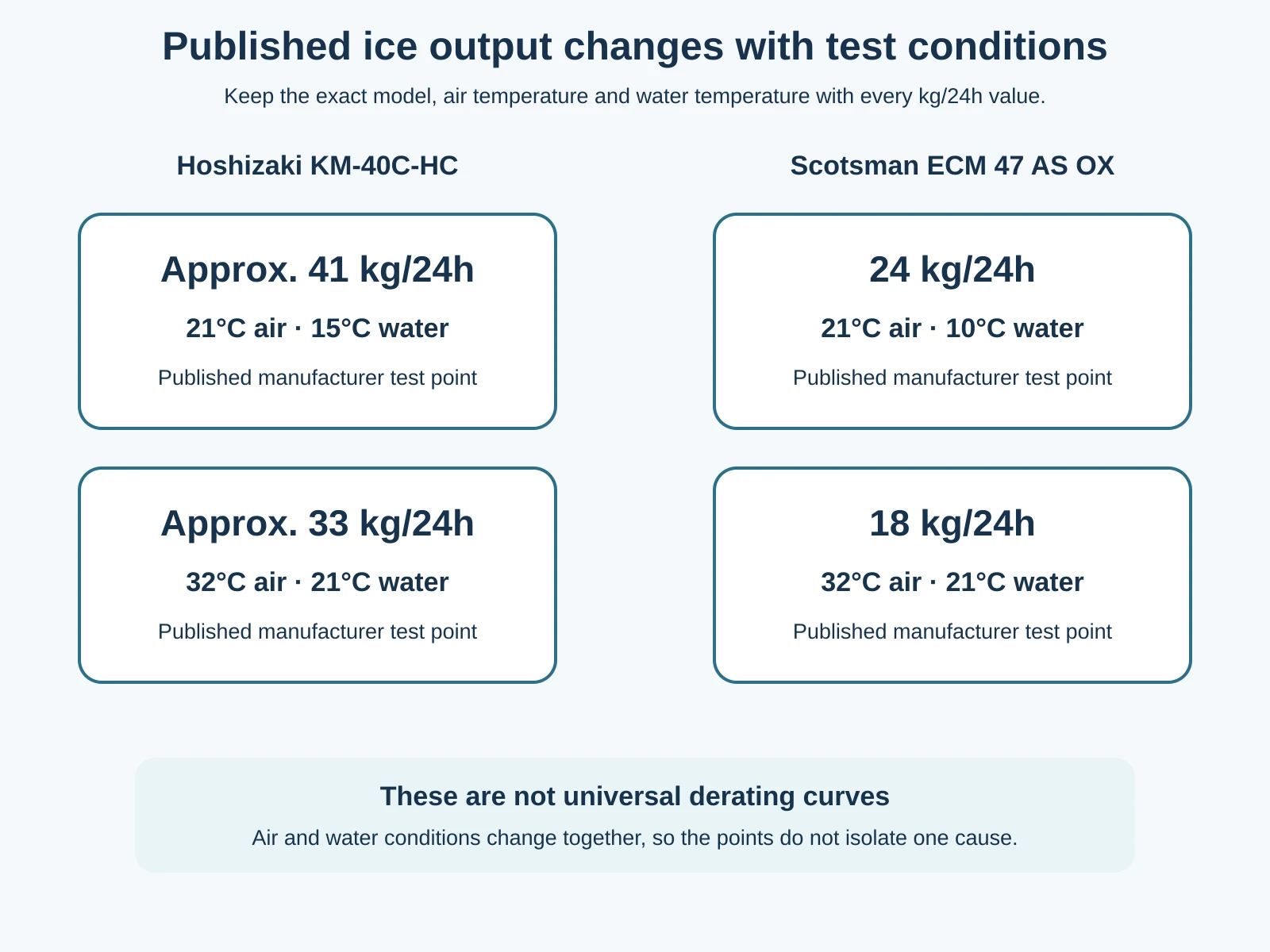
Why a Single “kg per 24 Hours” Number Is Not Enough
| Model example | Published condition | Published production | What the figure can tell you |
|---|---|---|---|
| Hoshizaki KM-40C-HC | 21°C air / 15°C water | approximately 41 kg/24h | Output published for this exact model under this stated combined condition. |
| Hoshizaki KM-40C-HC | 32°C air / 21°C water | approximately 33 kg/24h | Output published for the same model under a different combined condition. |
| Scotsman ECM 47 AS OX | 21°C air / 10°C water | 24 kg/24h | A model-specific published reference point under the stated condition. |
| Scotsman ECM 47 AS OX | 32°C air / 21°C water | 18 kg/24h | A second published point under a different combined air-and-water condition. |
For the Hoshizaki KM-40C-HC, approximately 41 kg/24h at 21°C air/15°C water and approximately 33 kg/24h at 32°C air/21°C water are two combined test conditions. The difference cannot be assigned to ambient temperature alone. For the Scotsman ECM 47 AS OX, 24 kg/24h at 21°C air/10°C water and 18 kg/24h at 32°C air/21°C water are also exact-model test points, not a universal derating curve for Scotsman or commercial ice machines generally.
These figures show why the conditions must travel with the capacity figure. They do not predict how much every ice machine will lose as a kitchen gets hotter, and they do not establish the output of a different model. The Bromic IM0170HSC-HE quantitative curve remains excluded because the graph labels in its linked manual do not provide clean exact-model lineage for that use.
Peak Demand Can Expose a Capacity Mismatch
If a machine operates normally through much of the day, shows no persistent fault, continues to make its normal ice form and only falls behind during a recurring service peak, it is reasonable to raise a capacity question. The pattern may indicate that production and stored ice are not keeping pace with demand at that time. It does not prove undersizing: operating conditions, maintenance state and other factors may still need to be considered.
Record the bin level before the peak, when the shortage begins, whether production continues and how service demand differs from quieter periods. This creates a venue-specific pattern without turning the chapter into a demand calculator.
Check Whether the Bottleneck Is at the Point of Service
Ice can exist in the bin without being available quickly enough where staff use it. Restricted access, transfer steps, dispensing speed or the position of stored ice may create a service bottleneck even when production continues.
That distinction matters commercially. Buying a higher-production machine may not solve a delay caused by access or dispensing. Equally, improving workflow cannot create ice that was not produced and stored in time. Locate the constraint before choosing an equipment response.
When to Move From Troubleshooting to Capacity Planning
Move to capacity planning when technical faults have been investigated, the machine appears to be operating normally, and shortages repeatedly align with peak demand or insufficient usable storage. The next task is to compare documented demand, exact-model production under relevant conditions and storage—not to keep guessing at faults.
That detailed calculation belongs to the Commercial Ice Maker Sizing Guide. This article does not repeat its demand factors, safety margins or sizing method; it identifies when that separate analysis becomes relevant.
If the machine needs repair, or if it is technically healthy but no longer fits the venue’s demand, the final decision is different in each case. That is when it becomes useful to compare repair, continued operation and replacement using the actual costs and operating risks of the venue.
Repair, Keep or Replace? A Practical Decision Framework
Once the problem is clearer, the decision is not automatically “repair or replace”. Keeping the machine in service may be appropriate when it is operating normally and the real constraint sits elsewhere. Repair may be appropriate when a defined fault can be addressed and the machine still suits the venue. Replacement becomes an evaluation—not a default—when the combined evidence around repair scope, history, downtime and capacity fit makes that pathway worth comparing.
Start With a Written Repair Assessment
Ask for a written diagnosis and repair quotation before comparing options. The assessment should identify the work being proposed, the parts or service scope included, applicable exclusions and the expected pathway to return the machine to operation. A component name by itself does not decide the outcome. It affects the repair scope, parts availability, expected downtime and quotation, but it does not establish that replacement is the better decision.
Keep uncertainty visible. If diagnosis requires further testing, distinguish the confirmed scope from work that may be discovered later. Do not convert a preliminary possibility into a final repair cost, and do not compare an incomplete assessment with a fully specified replacement pathway.
Check Warranty Status Before Comparing Costs
Confirm the purchase date, warranty terms, covered components, labour conditions and required service channel for the exact machine. A valid warranty pathway may change who should inspect the unit, what evidence is required and which costs are covered. Follow the warranty process before authorising work that could affect coverage.
Warranty status does not answer the capacity question. It establishes the correct service pathway for a fault. A machine can receive warranty service and still need a separate capacity review if the venue has outgrown its production or storage arrangement.
Look at the Machine’s Fault History, Not Just This Repair
Review service reports, invoices and recorded symptoms. Ask whether the same or a related fault has occurred before, what work was completed and whether the machine returned to normal operation afterwards. Treat the history as evidence, not as an automatic rule based on age or a fixed number of service calls.
One repair does not make a correctly sized machine a replacement candidate. Conversely, repeated related faults may change the uncertainty, expected disruption and value of another repair, but they still need to be considered alongside the written assessment, warranty and capacity fit.
Evidence to Compare Before Deciding
| Question | Evidence to collect | Decision value |
|---|---|---|
| Is the machine under warranty? | Warranty terms, purchase date and required service pathway | Establishes whether warranty or an authorised service process should come first. |
| What is actually being repaired? | Written diagnosis, scope and repair quotation | Defines the known current repair rather than a guessed fault. |
| Has the same or a related fault happened before? | Service history, invoices and prior symptoms | Shows whether the current event appears isolated or repeated. |
| Would a successful repair restore adequate capacity? | Normal production pattern, storage and peak-demand history | Tests whether repairing the fault would also resolve the ice shortage. |
| What is the impact of downtime? | Expected repair lead time, bought-in ice and actual service disruption | Shows the venue-specific consequence of waiting without inventing a loss figure. |
| What would replacement actually cost? | Equipment quotation plus applicable delivery, installation, commissioning and site work | Enables a like-for-like comparison with the repair pathway. |
Ask Whether a Successful Repair Would Still Leave a Capacity Problem
A machine can be repairable and still be the wrong production or storage fit for the venue. Before approving a repair solely to address “not enough ice”, ask what successful repair is expected to restore. If it returns the machine to its normal operation but documented peak demand still exceeds usable production and storage, the fault and capacity mismatch are separate problems.
Preserve the reverse conclusion as well. A machine that remains appropriately matched to the venue should not be treated as a replacement candidate merely because it needs one defined repair. Capacity fit is an input to the decision, not a shortcut around technical evidence.
Compare Downtime With the Full Cost of Replacement
Use the venue’s actual circumstances. Record the expected repair lead time, whether temporary bought-in ice is available, which services may be restricted and what disruption staff would need to manage. Do not assign a standard dollar loss or assume another venue’s interruption applies here.
Compare like with like. A repair quotation should not be set against a bare machine price on a product page. A replacement comparison may need equipment, delivery, installation, commissioning and applicable site work, but include only the items relevant to this venue and quotation. Replacement can also have its own lead time and operational disruption.
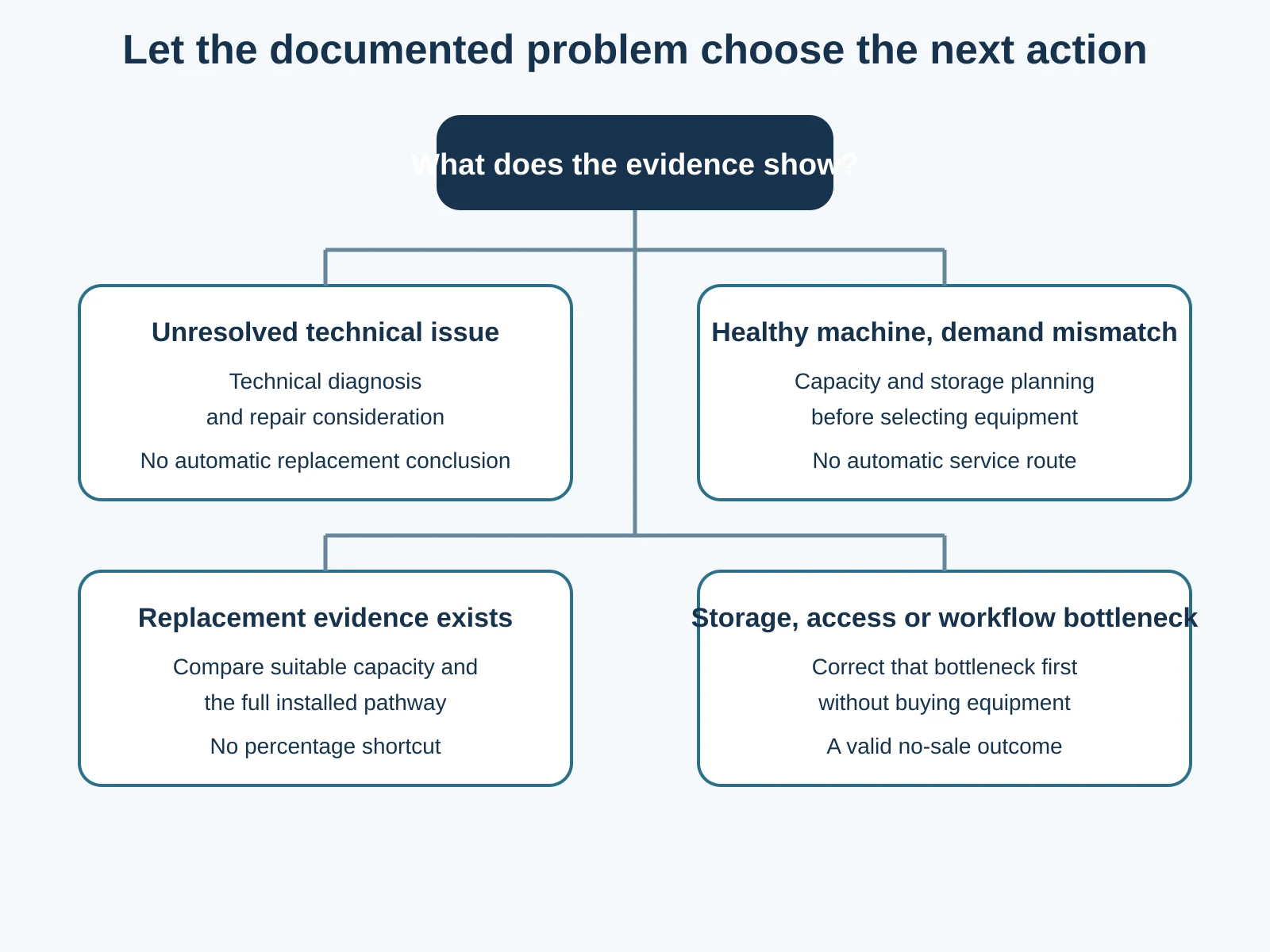
Choose the Option That Solves the Actual Problem
Use the combined evidence to choose the next path:
- A defined technical fault in an otherwise suitable machine supports investigating repair through the appropriate service pathway.
- A technically healthy machine with a documented production or storage mismatch supports capacity planning rather than repeated fault-finding.
- An unfavourable combination of repair scope, fault history, downtime exposure and capacity fit supports evaluating a fully specified replacement pathway.
- No technical or capacity problem points back to the actual storage-access, dispensing or workflow constraint.
These are decision routes, not automatic verdicts. The final choice should be traceable to the venue’s written service evidence, operating history, demand pattern and comparable quotations.
What to Have Ready Before You Contact a Technician or Equipment Supplier
The next conversation will be more useful if it begins with the machine’s identity and the venue’s observations rather than a guessed diagnosis. The same evidence can also prevent a technical fault, capacity mismatch or workflow constraint from being sent down the wrong path.
If the Machine Appears to Need Technical Diagnosis
For a persistent fault, shutdown, error indication or unresolved abnormal operation, contact the appropriate service pathway for the exact machine. Provide the model details, the indication as displayed, what the machine is doing and the checks completed under its manual. Do not name a failed component unless a qualified assessment has already identified it.
If the machine is under warranty, check the applicable warranty process before authorising work. A service assessment should establish the fault and proposed scope; it should not begin with an assumption that the machine must be replaced.
If the Machine Works but No Longer Keeps Up
If the machine appears to operate normally but repeatedly falls behind during peak demand, move into capacity planning rather than fault diagnosis. Record production, usable storage, bin level before the peak, when the shortage begins and how demand has changed. The Commercial Ice Maker Sizing Guide owns the detailed demand and storage comparison.
If that evidence shows the existing machine may no longer suit the venue, compare suitable replacement capacity through the commercial ice makers range. Compare the complete installed pathway, not simply a larger published output or a bare machine price.
If production and storage are adequate but staff cannot reach or dispense ice quickly enough, address that access, storage or workflow bottleneck first. A replacement machine is not the default answer to a point-of-service constraint.
Bring the Evidence, Not a Guess
| Have this ready | Why it matters |
|---|---|
| Brand, exact model and serial number if available | Identifies the machine and the correct documentation or service pathway. |
| Error code or indicator, if shown | Gives service personnel a factual starting point. |
| What the machine is doing now | Distinguishes no ice, reduced output, changed ice form, a peak-only shortage or another observed pattern. |
| When the shortage happens | Helps separate an all-day production issue from a peak-demand problem. |
| Recent site or operating changes | Adds context without assuming those changes caused the problem. |
| Checks completed from the exact model manual | Avoids repeating owner-level checks and preserves the operator boundary. |
| Previous service history or written repair assessment | Supports the repair, keep or replace decision. |
| For a capacity concern: current production, storage and peak-use pattern | Shows whether sizing deserves a separate review. |
If the machine has an unresolved technical fault, the next step is technical diagnosis. If it is operating normally but repeatedly falls behind peak demand, the next step is capacity planning before choosing a replacement. If the constraint sits in storage access or workflow, fix that bottleneck first.
If you are comparing commercial ice machines, contact KW with the existing model, observed shortage pattern, storage requirement and venue demand. That gives the discussion a factual starting point before you shortlist a replacement.
Commercial Ice Machine Troubleshooting FAQs
How much does commercial ice machine repair cost in Australia?
There is no reliable single Australia-wide repair figure that should be used to decide whether to repair or replace a commercial ice machine. The cost depends on the actual diagnosis, the work and parts included, applicable labour and service arrangements, warranty coverage and the venue’s location.
Use a written repair quotation that identifies the proposed scope and exclusions. Compare it with the applicable full replacement pathway, which may include equipment, delivery, installation, commissioning and relevant site work—not only a bare online machine price. Consider the venue’s actual repair lead time and disruption as separate decision inputs. No fixed percentage turns that evidence into an automatic replacement rule.
Does no error code mean my commercial ice machine is working normally?
No. The absence of an error code does not prove that the ice machine is operating normally. An error code is one diagnostic signal, not a machine-health certificate; having no code also does not prove that a hidden component has failed.
If output, normal ice form or operation has changed, follow the permitted checks in the manual for the exact model. Record the abnormal behaviour and use the manual’s escalation path if it persists rather than treating the display as the complete diagnosis.
Can I descale or chemically clean a commercial ice machine myself?
Only if the operator manual for the exact model assigns that specific descaling or chemical-cleaning procedure to the operator. Permissions differ between manufacturers and models: a manual may allow an operator to clean a removable air filter or storage bin while reserving water-circuit cleaning or chemical treatment for an authorised service pathway.
Follow the stated isolation, chemical and rinsing instructions without transferring a procedure from another machine. General food-hygiene requirements establish the need for clean, sanitary equipment; they do not authorise dismantling, internal water-circuit work or a particular descaling method.
Can a water filter fix low ice production?
Not necessarily. A water filter is not a universal fix for low ice production, and low output by itself does not prove that filtration is the problem.
Water treatment becomes relevant when the documented issue involves water quality, excessive minerals or scale, filter history, a relevant water-flow condition, or a filtration requirement stated for the exact machine. Check the model’s requirements and applicable local water information before selecting treatment. If water quality or scale is part of the documented issue, review the filtration or water-treatment requirements for that machine rather than assuming a filter change will restore output.