
Commercial kebab machine capacity: plan the whole service chain
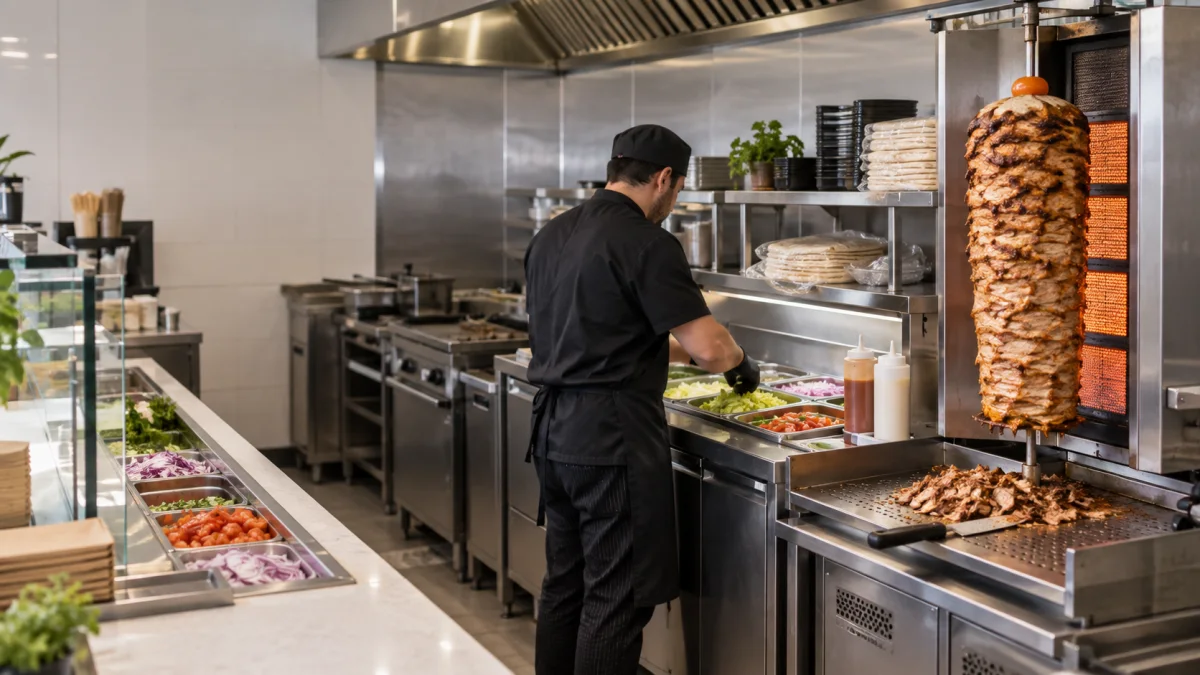
A kebab machine's listed cone rating describes one machine attribute. It does not answer when carvable meat will be available, how quickly the station can move sliced meat through its controls, or what happens to the last batch.
Those are the questions that decide whether the station can absorb a rush. Record them as six separate rows before asking a supplier to shortlist a machine. The gaps in the record are the useful result: they show what must be tested instead of being hidden inside a guessed portions-per-hour figure.
Start the log before the first order
Choose one real busy interval from the venue's own trading pattern. Record when the planned cone enters the operating process, when the first saleable slice becomes available under the venue's controls, when orders begin to bunch and when the queue clears. Keep the menu's portion specification and order mix beside the timing record.
Then assign one observer to each handoff that could interrupt service: carving, any separate cook step, hot holding, assembly and batch change. The aim is not to manufacture a benchmark. It is to preserve the conditions around what the venue actually observes: batch identity, staffing, service window and food-control route.
This distinction matters with a rotisserie because service is drawn from the product progressively. A starting load does not become saleable output all at once. The purchasing brief therefore needs the pace and controls around the exposed, carved product, not only the maximum load named for a machine.
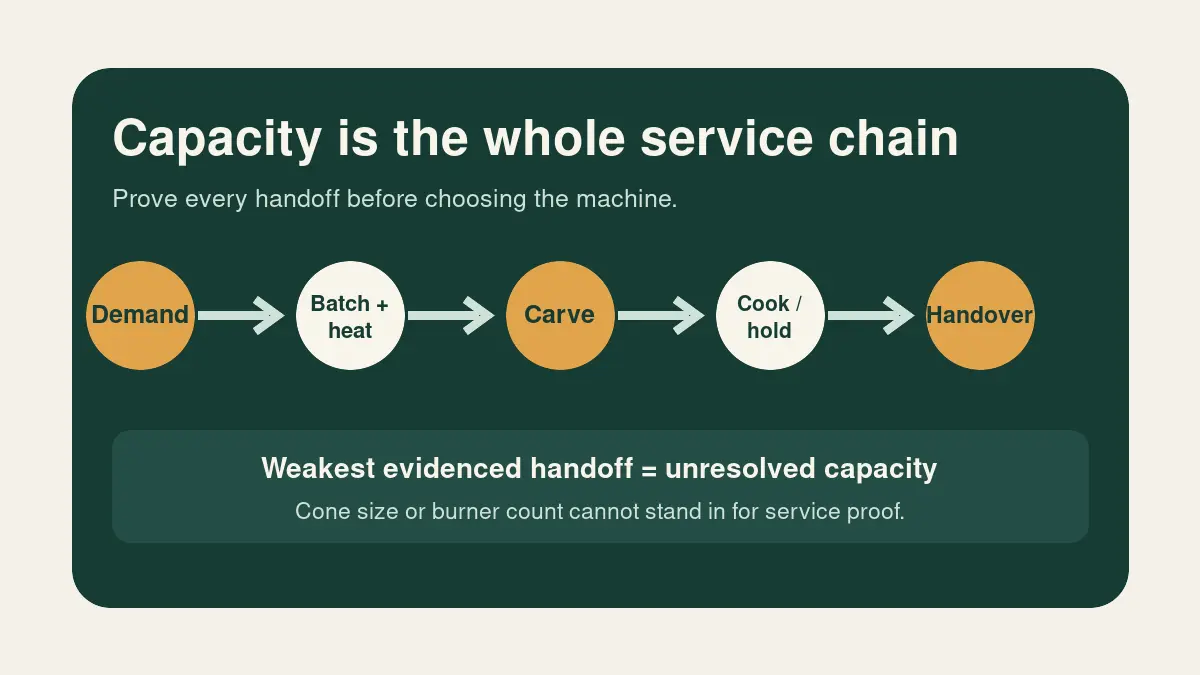
Complete the six-row peak-service capacity matrix
Use the same busy interval for every row. A figure without its owner and test condition stays unresolved.
| Row | Evidence to keep | What remains unresolved | Owner |
|---|---|---|---|
| 1. Demand | Orders and required serves inside the chosen interval, portion specification and menu mix. | Whether the interval represents the venue's difficult queue rather than a daily average. | Venue operations |
| 2. Cone and batch | Batch identity, planned start and change point, preparation state and the rule for any remainder. | Whether the plan covers the rush and the final batch without inventing a cone-to-serve conversion. | Operations and food-safety owner |
| 3. Active heating | Exact machine configuration, permitted load and operating method from current model evidence; actual site services. | Any model, installation, utility or clearance fact missing from a current exact document. | Supplier and qualified trades |
| 4. Carving | Observed carving intervals, staffing, tool method and separation between raw and cooked contact. | Whether the carver can stay at the machine while the order line is active. | Operations and food-safety owner |
| 5. Cook, hold and assemble | The venue's controlled route for sliced meat, monitoring points, holding space and assembly pace. | Whether a downstream step has less usable capacity than carving. | Food-safety owner and operations |
| 6. Last batch | Cut-off time, disposition of cooked and uncooked product, cleaning window and named close-down owner. | Whether the peak plan creates an unsafe or wasteful remainder at close. | Food-safety owner |
Read the matrix for three rotisserie failure patterns
The rush begins before the first controlled output is ready. Rows 1 and 2 may show enough planned food for the interval while the opening queue still waits for saleable sliced meat. That is a timing problem to test with the venue's real start-up process. A larger cone does not, by itself, resolve it.
The carver leaves the machine to finish orders. Rows 4 and 5 expose whether one person is expected to carve, run a separate cook or hold step and assemble at the same time. In that case, a machine specification can remain unchanged while staffing or station layout sets the pace.
The final cone solves lunch and creates a close-down problem. Read rows 2 and 6 together. If the batch plan can only cover the late interval by leaving an uncontrolled remainder, the answer may be a different batch rule or service cut-off rather than a larger machine.
These patterns are diagnoses, not model recommendations. Mark each one as observed, passed under a stated test, or still due. Do not replace a missing observation with a nominal kg/h value.
Attach food-safety controls to the affected rows
FSANZ identifies doner kebab as potentially hazardous food and links the risk to hygiene and temperature control. Its Safe Food Australia Appendix 4 guidance recommends thawing before cooking, reaching 75°C during cooking, holding cooked slices at 60°C or above and applying a second cook to sliced meat.
The same guidance recommends separating raw and cooked utensils or hands, holding potentially hazardous sauces and salads at 5°C or below, and using smaller batches to reduce leftovers. It does not recommend returning uncooked meat left on the spit at the end of the day to the cooler for cooking the next day.
Put these controls beside the matrix rows they affect: preparation and remainder decisions in row 2, carving hygiene in row 4, cook and hold monitoring in row 5, and final disposition in row 6. The venue's applicable food-safety program, local authority and qualified adviser still own the validated procedure. The matrix records their decision; it does not rewrite it to make a preferred machine fit.
Send one evidence pack to the equipment and layout owners
For the supplier, attach the completed matrix and list every model fact still due: permitted load, operating configuration, physical envelope, services, clearances, cleaning access and servicing evidence. Obtain the current manual for the exact model before installation or operation. A family document is not permission to transfer one model's details to another.
For the site team, carry the carving position, controlled cook or holding step, assembly space, separation points, monitoring access and cleaning route into the venue's commercial kitchen design work. Qualified trades retain ventilation, utility and installation decisions.
When those owners have answered the unresolved cells, compare the result with the current commercial kebab machine range. The Category owns current product choice and exact product documents own specifications. This article owns the evidence register that should reach them first.
Sources and local authority check
- FSANZ Safe Food Australia, Appendix 4 — national guidance used for the doner-kebab handling and temperature-control discussion.
- NSW Food Authority: doner kebabs — state guidance showing why venue procedures and local enforcement still matter.
- FSANZ directory of food regulatory agencies — use this to identify the relevant authority outside NSW.