
Plan Commercial Kitchen Storage from the Inventory, Not the Cabinets
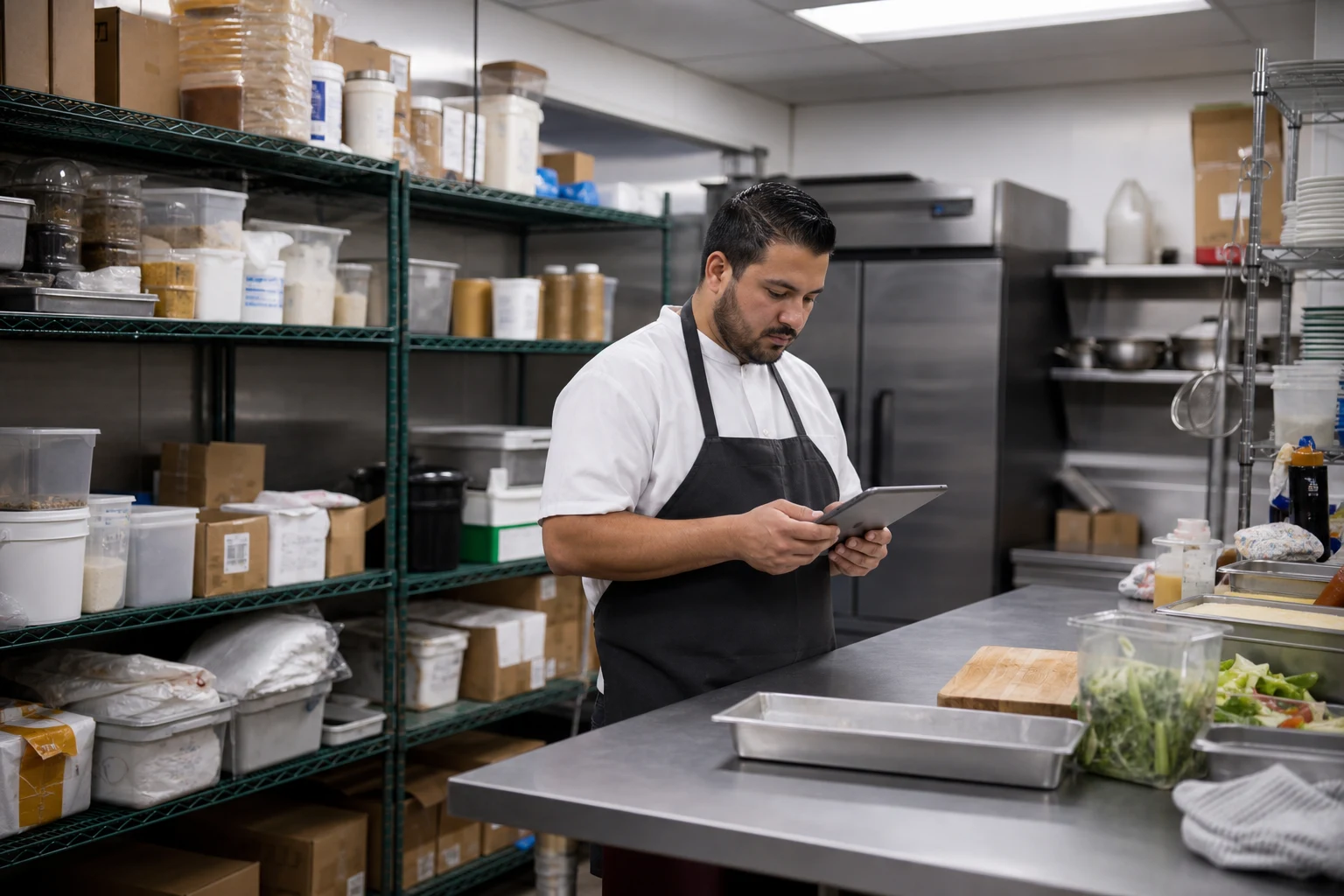
A total stock figure does not tell you how many shelves, containers, fridges or freezers a commercial kitchen needs. The same inventory can create several storage jobs when its condition, contamination relationship, quantity or place in the operating flow changes.
Start by building a storage-load map. Its purpose is not to produce a shopping list. It is to describe what the operation must hold, under which evidenced conditions, at the busiest relevant moment and where the next design or product decision belongs.
Describe inventory as it will actually be handled
An operating inventory is more useful than a list of product names. It follows what the business intends to receive, keep, open, prepare, hold and move into service. Those actions matter because an inventory line may not remain one storage problem throughout its time in the kitchen.
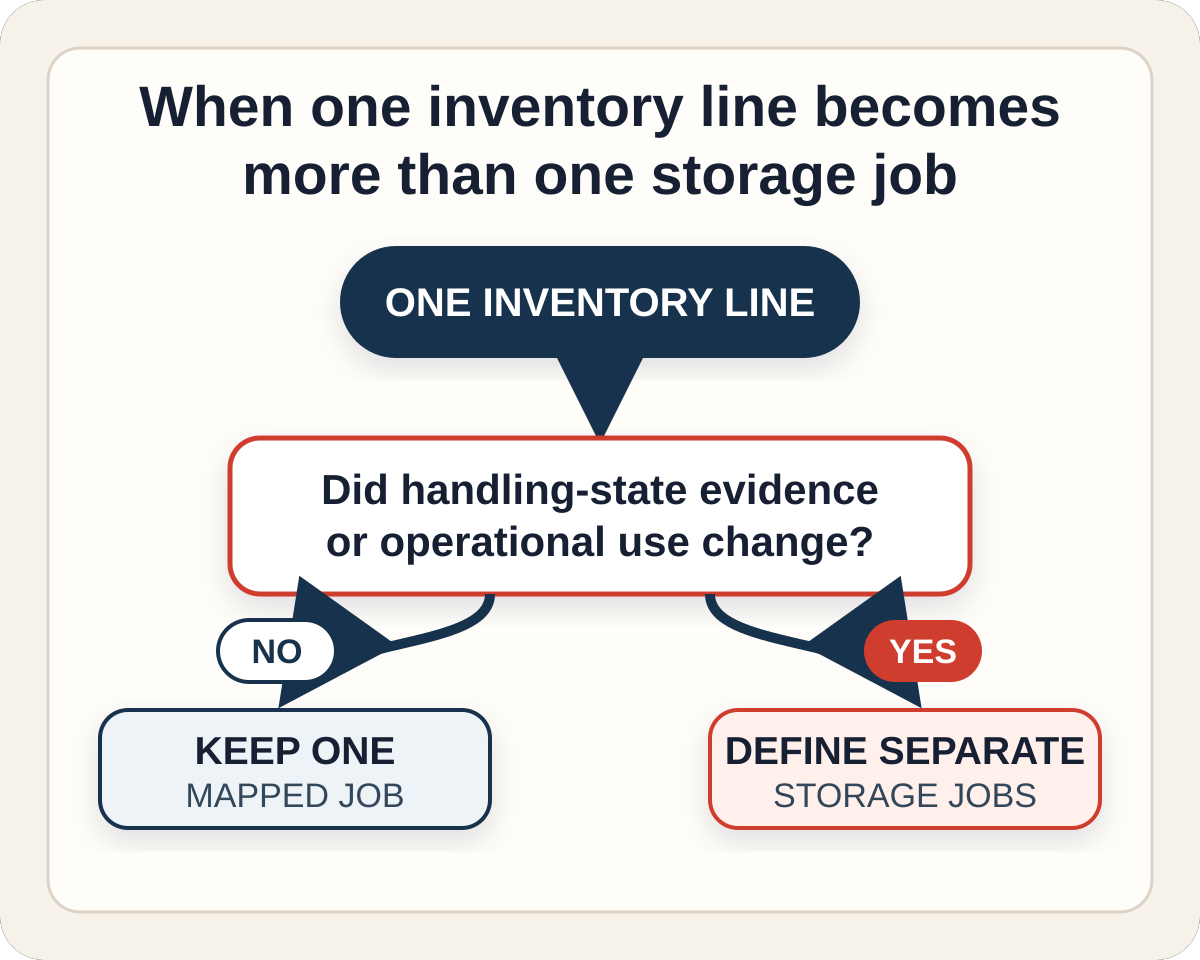
Consider an unnamed ingredient that arrives in sealed packaging. Its exact manufacturer instructions may specify one condition while sealed and another after opening. If the operation later prepares or portions it, the evidence and food-safety controls applying at that stage may need to be checked again. This does not prove that every ingredient changes condition. It shows why the handling state has to be recorded before the storage job can be defined.
Keeping those states on one line can hide the real load. The unopened stock, opened stock and prepared quantity may be held at different times, in different amounts or under different supported conditions. The map should separate them only where the evidence or operation creates a genuine distinction.
This is also where the map avoids becoming a product taxonomy. “Ingredient”, “packaging” or “prepared food” identifies what something is; it does not, by itself, establish how or where it should be stored.
Let evidence establish the holding condition
The Australia New Zealand Food Standards Code does not turn food names into a universal cabinet plan. Standard 3.2.2 requires stored food to be protected from likely contamination and kept under environmental conditions that do not adversely affect its safety or suitability. It also requires potentially hazardous food to be under temperature control and food intended to be stored frozen to remain frozen during storage.1
Those are storage outcomes, not a shortcut for assigning equipment. FSANZ’s Safe Food Australia guidance explains that appropriate conditions depend on the food’s characteristics and packaging, and that manufacturer storage instructions should guide the decision where they are provided.2
Terms such as ambient, chilled, frozen or protected dry storage may eventually describe different jobs in the plan. They should be the result of checking the relevant item, handling state and evidence—not headings under which stock is assigned by habit. Even a familiar product type may have instructions or controls that change once it is opened or prepared.
When the exact condition is unresolved, mark it as unresolved. Choosing a fridge, freezer, bin or shelf first does not settle the evidence question; it only gives an undefined job a piece of equipment.
Do not collapse protection, temperature and space into one answer
Three questions often get treated as if they were interchangeable: Is the food protected from contamination? Is it under the required temperature condition? Is there enough suitable space for the activity and equipment? Passing one does not prove the other two.
Official guidance gives practical contamination-protection examples, including suitable food-grade containment, managing relationships between raw and ready-to-eat food, and separating food from chemicals. These examples help explain the outcome. They are not an exhaustive national floorplan or a fixed placement rule.
Standard 3.2.3 addresses the premises and equipment side of the problem. Clause 3 requires premises design and construction to be appropriate for the activities carried out and to provide adequate space for those activities and the fixtures, fittings and equipment used. Clause 12 requires fixtures, fittings and equipment to be adequate for producing safe and suitable food and fit for their intended use.3
Neither clause supplies a storage-area percentage or proves that an exact cabinet is suitable. Safe Food Australia explains that space needs depend on the complexity of the operation, including the volume and type of food, staffing and activities such as receiving, preparing, dispatching, cleaning and sanitising.4 Available space is therefore a project constraint to be reconciled with the work, not the answer to the storage question.
Clause 15 of Standard 3.2.3 has a narrower job. It concerns storage for items likely to contaminate food, including chemicals, clothing and personal belongings. It must not be expanded into a generic rule for the capacity of all food storage.
Map the load at the moment it must fit
An average inventory number can make a difficult storage job look smaller than it is. The operational question is what quantity must be accommodated at the relevant high-load moment: after a delivery, before a busy service, while prepared stock is being held, or when replenishment intervals are longest.
That peak relevant load is a project-planning input, not a legislated multiplier. The operator can supply delivery pack sizes, delivery cadence, the maximum planned on-hand quantity and the way stock turns through the business. The article cannot convert those facts into a universal number of days’ stock or a prescribed turnover rate.
Turnover still matters because two operations holding the same product may carry very different quantities between deliveries. It also exposes whether bulk stock and working stock exist at the same time. The map should record that operating reality rather than assuming a fixed replenishment pattern for a venue type.
For food requiring refrigeration or cooling, Safe Food Australia explains that adequate refrigerated space is needed for the volume involved. Its storage guidance also recommends stock rotation and avoiding overstocking a refrigerator beyond its ability to maintain the required temperature and allow chilled air to circulate.5
This is why nominal litres cannot be turned directly into a cabinet count. A product’s published capacity, internal configuration, dimensions and intended use must eventually be checked against the defined job using exact-model evidence. Until that happens, total litres are not proof that the load fits under its required conditions.
Follow the load through the operation
A storage job also has a place in the operating sequence. Inventory arrives, moves into bulk holding, may enter preparation, may wait in a controlled state and may need replenishment into service. Recording those movements helps distinguish jobs that a single total-stock figure conceals.
For example, bulk holding and point-of-use holding may support different moments in the same operation even when the underlying item is related. That does not establish that every kitchen needs both, or prescribe where either must be placed. It identifies a workflow question for the site-specific design process.
Point of use should therefore be recorded as a relationship: where the item enters the operation, where it waits, where it is prepared or used, and what replenishment has to occur. It should not be promoted into a nationwide placement, clearance or approval rule.
If the mapped jobs do not fit the available premises, the map has revealed a project conflict. The response may involve the operating brief, procurement frequency, menu or production decisions, or the site design. It does not authorise tighter storage or additional equipment by assumption.
Finish with storage jobs, then hand each decision to its owner
A defined storage job brings together the relevant handling state, evidenced holding condition, contamination relationship, peak quantity and turnover pattern, and its place in the operating flow. It also shows what remains unknown. That is enough to improve the next brief without pretending the Blog has designed the room or selected the equipment.
The exact fit of those jobs within a premises belongs with Kitchen Design or the appointed project designer, with certified or regulated design remaining with the appropriately qualified owner. Once a job is sufficiently defined, the relevant Category can help identify the product family. Exact dimensions, configuration, capacity, intended use and installation requirements belong with the PDP and current manufacturer documentation for the exact model.
Questions about the food-safety control for an exact food or business belong with the current authority, local enforcement body or a qualified food-safety owner. FSANZ explains that state and territory agencies and local councils enforce and interpret the Code in Australia; that jurisdictional boundary prevents one local approach from being treated as a nationwide approval pathway.6 Refrigeration, electrical or other specialist installation questions belong with the exact manual and the relevant licensed or specialist owner.
A storage product cannot repair an undefined storage job. If the evidence, peak load, workflow or site fit is still missing, return that gap to its owner. Product selection becomes meaningful only after the operating inventory has been translated into the different jobs the kitchen actually needs to support.
Official sources checked 27 August 2026. Food-safety interpretation, premises design, approval and specialist installation remain specific to the business, project and jurisdiction.