
Before You Compare Commercial Kitchen Fit-Out Quotes, Make Sure They Price the Same Project

Do not compare the totals yet. If one commercial kitchen quote supplies equipment while another also carries site, services, installation or handover responsibilities, the numbers do not describe the same project.
Missing scope is not zero cost. It is unallocated responsibility. The lower total becomes meaningful only after the operating brief, site and jurisdiction context, equipment schedule and responsibility scope have been brought onto the same basis.
First decide what each number is pricing
“Commercial kitchen fit-out quote” can sit on documents that price very different objects. One may be an equipment supply proposal. Another may include building work or services coordination. A third may extend to delivery, positioning, installation, regulated connections or particular handover work. The heading on the document does not prove which of those objects it contains.
The first comparison is therefore not between totals. It is between the work each total claims to cover. Australian Government guidance for preparing quotes says a written quote should contain a clear description of the work or service, itemised and total costs, and any agreed variations or revisions.1 That is useful clarity guidance; it does not decide the legal meaning or completeness of a particular fit-out contract.
Imagine that Quote A supplies the scheduled appliances to the site, while Quote B supplies them and also includes delivery coordination, positioning and some installation work. Quote A may have the lower total, but the difference has not yet demonstrated a saving. It has demonstrated that the two suppliers may be pricing different responsibilities.
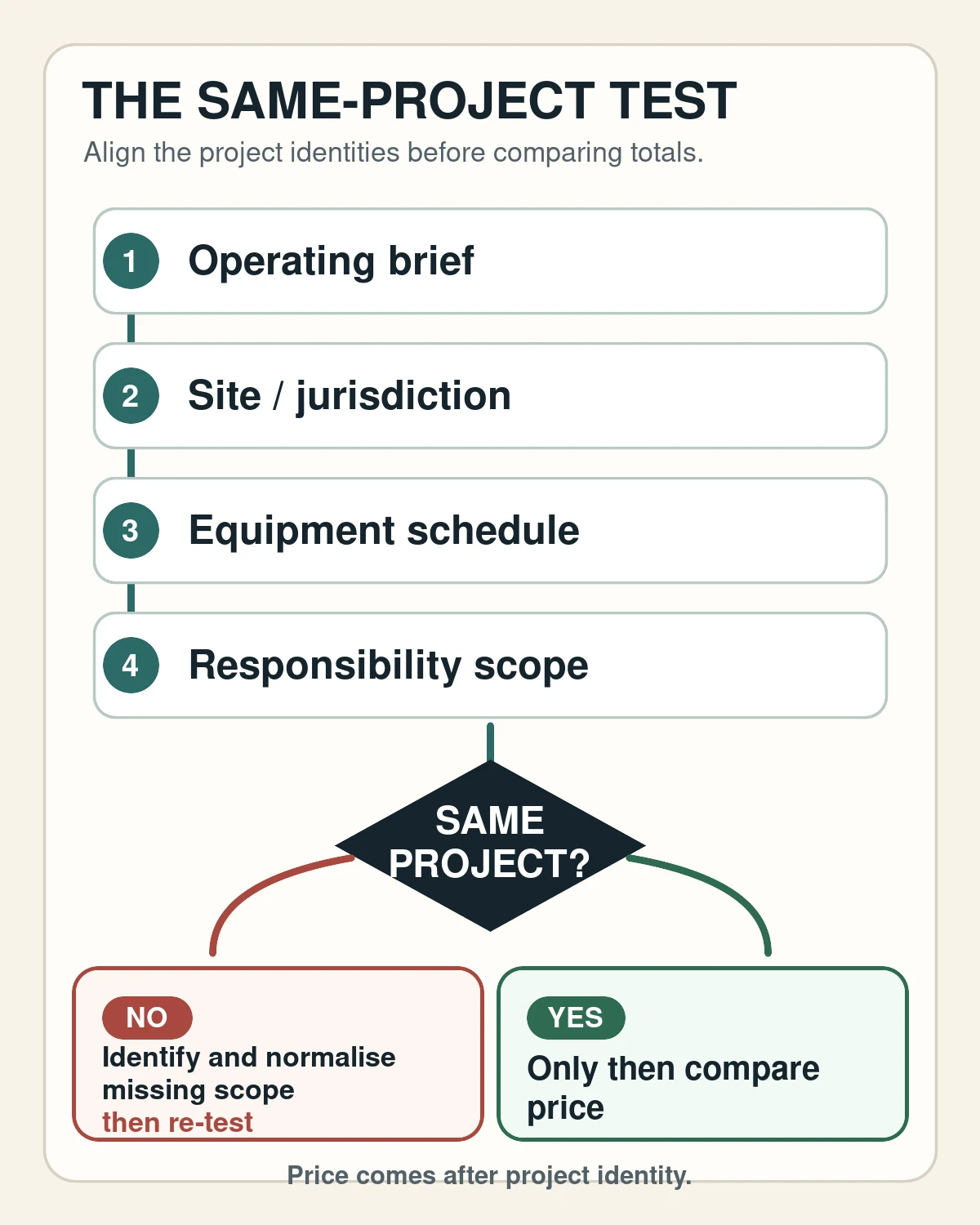
This is the purpose of The Same-Project Test: establish whether both documents describe the same operation, the same site assumptions, the same equipment and the same responsibility split. Price comes after those identities, not before them.
The operation has to be the same
A commercial kitchen is not defined by the venue label alone. A café with light reheating, a high-volume takeaway operation and a production kitchen may all occupy a similar floor area while placing very different demands on storage, preparation, cooking, washing, waste handling and service flow.
FSANZ Standard 3.2.3 guidance does not prescribe one universal list of premises and equipment specifications. It says food operations vary in size and complexity, and that what is appropriate depends on the operation, food-safety risks and the outcomes the Standard intends.2
That makes the operating brief a comparison control, not introductory paperwork. If one quote assumes a compact menu and modest throughput while another has allowed for broader production, higher peak demand or a different cleaning flow, their equipment and services scopes may diverge even when both documents say “restaurant kitchen”.
The operator does not need to design the premises to make the brief useful. The useful contribution is to state what the kitchen must do: the food processes, service pattern, peak output, storage and cleaning activities that materially affect the project. Designers, authorities and trades remain responsible for turning that brief into project-specific design and regulated work.
The site and jurisdiction assumptions have to be the same
The same operation and equipment schedule can meet two very different sites. An existing food premises may have usable services and known base-building interfaces. A cold shell, an older tenancy or a site being converted from another use may leave more building and services work unresolved. Access, delivery conditions, landlord responsibilities and the condition of existing infrastructure can also change which party is expected to carry a task.
Location matters for another reason: approval and compliance pathways are jurisdiction and project specific. For example, the NSW Food Authority tells NSW retail food businesses to check with their local council about additional planning and environmental approvals, and separately discusses premises-construction requirements.3 That proves why the site and jurisdiction must be known. It is not a nationwide approval recipe and does not determine the pathway for a project outside NSW.
For quote comparison, the practical question is whether both parties received and priced the same site context. If one assumes existing power, gas, water, drainage or ventilation can be used and another assumes upgrades or new work, the totals are not yet comparable. Nor can an operator settle the difference by choosing the assumption they prefer. The condition and adequacy of project services belong with the relevant designer, engineer, certifier, authority, builder or licensed trade.
The equipment identity must be real, not approximate
“Oven”, “dishwasher” or “refrigeration” is not an equipment schedule. Quote comparison needs enough identity to show that quantities, exact models where selected, options and relevant manufacturer inputs are aligned.
Two models in the same product family can differ in dimensions, utilities, accessories, installation conditions or service arrangements. Those differences can affect the surrounding project scope. They cannot be safely filled in from a category description, a sibling model or a supplier’s assumption. If an exact product fact matters to the comparison, it should come from the exact current manufacturer document.
KW’s Shop by Business pages make the same boundary visible: published packages are reference configurations, while final quotes are tailored to the menu, footprint, electrical, gas, drainage, ventilation, installation and delivery requirements.4 A reference equipment package can help form a brief. It is not evidence that the whole fit-out has been priced.
The equipment identity is complete enough for comparison when both quotes can be read against the same scheduled items and options, with unknown products still marked as unknown. Replacing an unresolved model with a convenient estimate may make the documents look aligned while hiding a real services or installation difference.
Responsibility is where apparent savings can hide
Once the operation, site and equipment are aligned, the remaining question is who owns the work around them. Depending on the project, that may include design and approval tasks, building fabric, electrical or gas work, water and drainage, exhaust and fire interfaces, equipment supply, freight and access, delivery and positioning, installation, regulated connections, and model-specific commissioning or handover.
This is not a universal list of inclusions. Not every project or appliance needs every item, and the same party will not own every responsibility. The point is to identify which responsibilities the actual documents include, which they exclude and which remain unresolved.
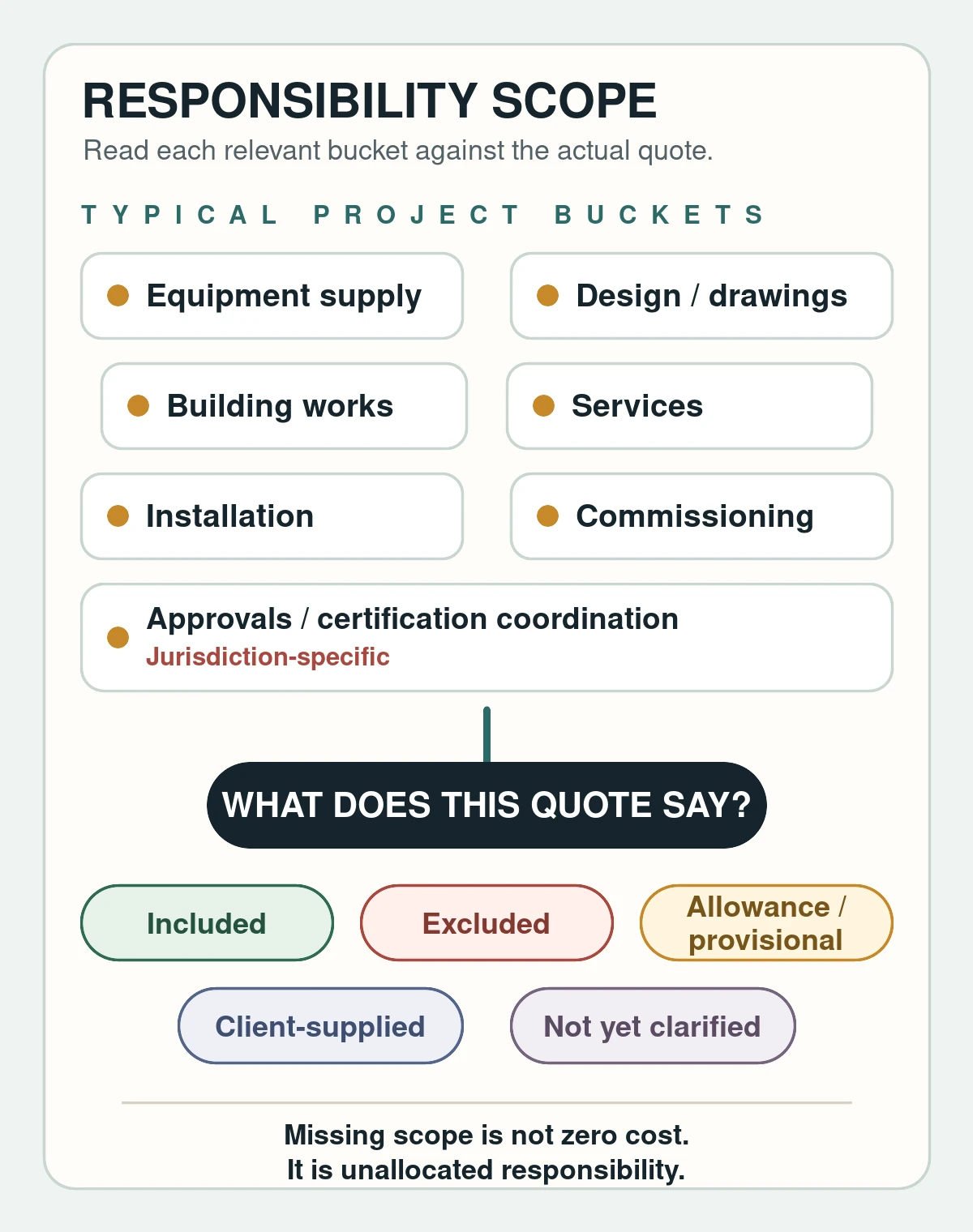
An exclusion is not automatically a defect in the quote. It may be a deliberate boundary around work that another party will perform. But it cannot be treated as zero simply because it sits outside the displayed total. Until its owner and basis are known, it remains unallocated project scope.
The same treatment applies when a document uses an allowance or the term “provisional sum”. This article does not assign those terms a universal legal effect. For comparison purposes, the reader needs to know what the document says the amount covers, what remains uncertain and who is expected to resolve it. Any question about contractual meaning, adjustment rights or acceptance risk belongs with an appropriately qualified commercial or legal adviser.
“Client supplied” also changes responsibility rather than making it disappear. Supply, delivery timing, site storage, compatibility, positioning and installation may sit with different parties. The quoted total cannot be compared fairly until both documents use the same assumption about those interfaces.
Installation and commissioning need the same restraint. Do not assume installation is included because equipment appears in the quote, and do not assume every product requires the same commissioning process. Read the document, check the exact manufacturer evidence where relevant, and identify the supplier, service agent or licensed trade responsible for the work.
Only now can the prices be compared
The Same-Project Test is satisfied only when the operating identity, site and jurisdiction identity, equipment identity and responsibility identity describe the same intended project. It is an editorial comparison method, not a statutory or contractual test.
Normalising the scope does not require every supplier to use the same document format or commercial model. It requires the differences to become visible. A supply-only proposal can still be useful, provided the reader does not compare its total with a broader fit-out proposal as though both include the same work.
After normalisation, the lower total may prove commercially preferable. Before normalisation, it proves only that the displayed number is lower. Quality, fitness for purpose, delivery conditions, risk allocation and the ability to complete the required work may still matter to the project decision, but this article does not rank suppliers or tell the reader which quote to accept.
If the remaining scope cannot be resolved, keep the prices separate and name the uncertainty. Do not convert a venue label, floor area or equipment subtotal into an average project cost. The honest answer may be that the quotes are not yet comparable.
Hand unresolved scope to the correct owner
The operator owns the operating brief and the commercial decision. KW’s Kitchen Design service can help turn a venue brief and floorplan into practical equipment planning and an equipment quote. KW describes that work as design guidance and a compliance pre-check, not certified design, council approval or construction sign-off.5
Project-specific design and building-services questions belong with the appropriately qualified designer, architect or engineer. The applicable approval pathway belongs with the appointed certifier or building surveyor, council or other relevant authority for the jurisdiction. Building scope and interfaces belong with the appointed builder, shopfitter and contract team. Regulated connections belong with appropriately licensed trades. Exact-model requirements belong with current manufacturer evidence and the relevant supplier or service agent. Contract interpretation belongs with an appropriately qualified adviser.
The next useful action is not to find a national fit-out rate. It is to send the same operating brief, site information, equipment schedule and responsibility questions to the parties pricing the work. When those inputs describe the same project, the totals can finally be asked to compete.
Official and first-party sources checked 27 August 2026. Approval, design, installation and contract requirements remain project and jurisdiction specific.