
Before You Quote a Commercial Coolroom, Build This Project Evidence Pack
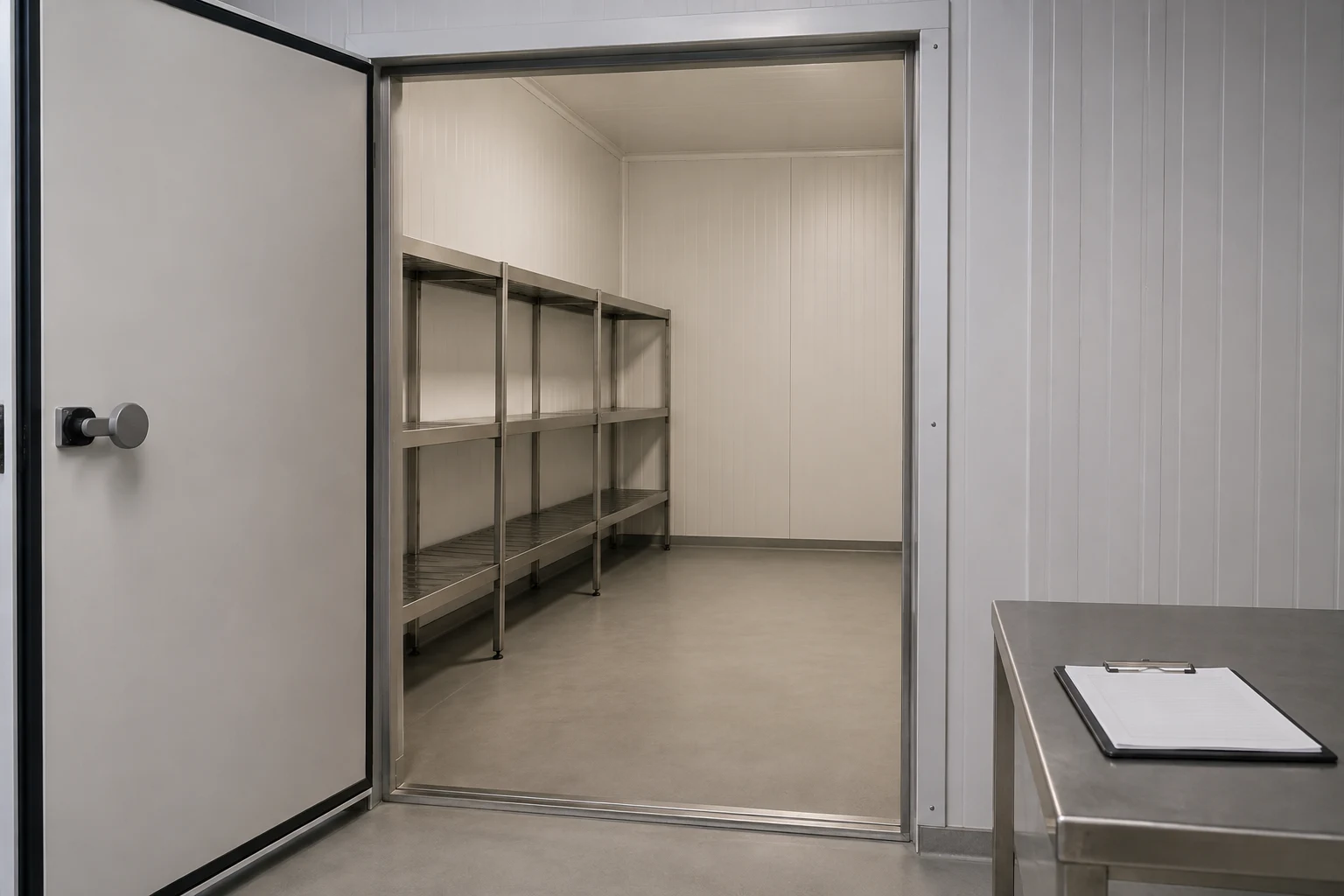
A commercial coolroom project is ready to quote when its operating demand, room and access envelope, refrigeration and services questions, food controls, and decision owners are recorded without hidden assumptions. A room dimension by itself is not a project brief. Neither is a refrigeration unit selected before the load, site and responsibilities are understood.
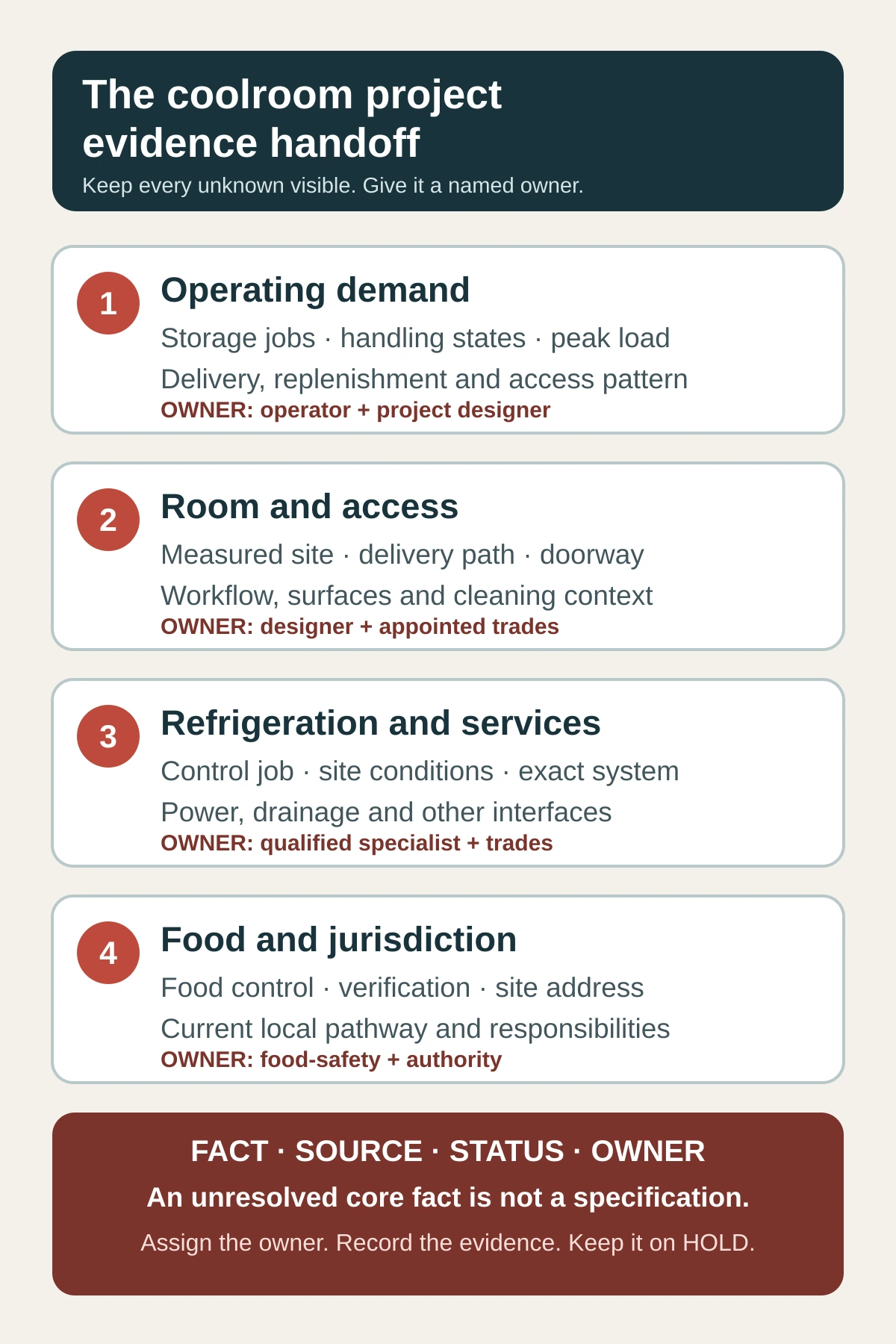
The useful output is an evidence pack with four fields against every important input: what is known, the source, what remains unknown and who must resolve it. If a fact is missing, mark it HOLD and assign an owner. An unresolved core fact is not a specification; do not turn it into a guessed capacity, service requirement or approval.
This guide helps an Australian food-business owner or project lead prepare that handoff. It does not design, certify or install a coolroom, and it does not replace exact manufacturer documents, qualified refrigeration advice, licensed trades or local authority requirements.
Start with the operating job, not the room
The first question is not “How many square metres can we fit?” It is “What must this room reliably hold and support at the demanding operating moment?”
Begin with the storage jobs already defined from the operating inventory. For each relevant line, record the handling state, required holding condition, maximum planned on-hand quantity, delivery pack and cadence, replenishment pattern and how often staff need access. The separate commercial kitchen storage-load map explains that upstream step.
Keep uncertainty visible. A weekly delivery total is not automatically the peak quantity inside the room. The number of cartons is not usable volume. A nominal room volume is not proof that the intended load fits with the necessary access and operating conditions. These are different observations and should remain different until the appointed owners reconcile them.
One practical editorial judgement follows: define the demanding operating state before measuring products around an empty room. Otherwise an early room or plant choice can quietly become the assumption that every later owner is asked to defend.
Record the room, door and movement envelope separately
The project team needs measured site facts, not just an intended internal room size. Record the proposed location, available footprint and height, nearby walls and equipment, access from unloading point to installation position, and any physical restrictions that could affect delivery or assembly. Mark who measured each value and when.
Then record the movement job. Which side of the doorway is receiving, preparation or service? What must pass through the opening? How will staff enter, turn, load, retrieve and leave during the busiest relevant period? Where could an open door interfere with a work path? These are workflow inputs for the designer and refrigeration/project team, not universal layout answers.
Surfaces, thresholds, drainage, cleaning access and moisture management also need named owners. The operator can describe cleaning practices, spills, traffic and site conditions. The appropriate designer, builder, refrigeration contractor, plumber or authority decides what those facts require for this project. This article supplies no generic floor, drain, threshold or construction specification.
The coolroom shelving guide owns shelving material and condition questions. The cool room shelving Category owns current product-family browsing. Neither should be used to reverse-engineer the room before the operating and site jobs are known.
Give refrigeration and services their own evidence lane
Refrigeration evidence begins with the job to be controlled and the conditions around the proposed system. Record the intended use, applicable food-control requirement, site ambient conditions, adjacent heat sources, access pattern and any unusual operating period the appointed refrigeration owner should assess.
Keep room performance, food temperature and equipment identity separate. The equipment schedule should identify the exact proposed plant and configuration when one is selected. Current manufacturer documents then own its stated operating envelope, electrical and installation requirements. The appropriately qualified refrigeration contractor owns the system and site assessment.
Refrigerant identity is another evidence family, not a shortcut to performance or approval. The AIRAH Flammable Refrigerants Safety Guide places risk assessment and site checks for relevant refrigeration systems with the installer/specialist boundary. If a proposed system uses a flammable refrigerant, give the qualified owner the exact system and site information; do not infer the safety outcome from a refrigerant name or a generic product family. For the broader evidence boundary, use KW's R290 proof-separation guide.
Power, controls, condensate, drainage, ventilation, heat rejection, plant location, penetrations and structural support should appear in the issue register even when their answers are not yet known. Their purpose at this stage is to prevent an unpriced or unowned interface. The correct entry may be UNKNOWN — qualified owner to determine, not an invented number.
Food control is not the same as the room setting
Food Standards Australia New Zealand says potentially hazardous refrigerated food should generally be kept at 5°C or colder unless the business can demonstrate another safe control. That is a food-control boundary. It is not a universal coolroom air setpoint, refrigeration design value or proof that every location inside a room will produce the same result.
The same verified FSANZ source scope covers thermometer verification. The operating pack should state how the business will verify food temperature under its applicable food-safety process. A proposed controller display, setpoint or air reading does not by itself establish the temperature of the food.
Record which food or process requires control, the evidence for that requirement, how it will be verified and who owns any alternative control. If the exact food, process or safe control is unresolved, refer it to the business's food-safety owner or relevant authority. Do not ask the refrigeration quote to silently answer a food-law question.
Local premises and approval requirements also need a jurisdiction field. The City of Port Phillip's 2025–2026 food-business guide is useful here only as one verified example that a local food-premises plan process can request project information. It is not a national checklist. Record the venue address and the relevant council, certifier or other authority; then obtain the current requirements for that place and project.
Use one register to stop ownership gaps
The pack can be compact, but every row needs a responsible destination.
| Evidence family | Record before quote | Owner of the unresolved decision | Stop condition |
|---|---|---|---|
| Operating demand | Storage jobs, handling states, peak relevant load, delivery and access pattern | Operator with project designer | Load or workflow is assumed rather than recorded |
| Room and access | Measured site, delivery path, proposed envelope, door and movement relationships | Project designer, builder and appointed specialists | Fit or access depends on an unverified dimension |
| Refrigeration and services | Control job, site conditions, exact proposed system when known, service interfaces | Qualified refrigeration contractor and relevant licensed trades | Capacity, plant or service requirement is guessed |
| Food control | Applicable food-temperature requirement and verification method | Food-safety owner or relevant authority | Room air or equipment label is used as food proof |
| Jurisdiction and responsibility | Site address, current local pathway, inclusions, exclusions and named handoffs | Relevant authority, certifier, project owner and contract owner | Approval or responsibility is described as “by others” without an owner |
A missing number is obvious. A missing owner is more dangerous because the assumption can travel through several quotes without being challenged. Make every exclusion specific: name the item, the party expected to resolve it, the evidence they need and the point at which the project cannot advance.
Compare quotes only after they describe the same evidence state
Two prices are not comparable if one includes site assessment, system controls or trade interfaces that the other leaves undefined. Before comparing totals, place each quote against the same evidence register and classify every line as included, excluded, provisional, owner-supplied or unresolved.
Do not reward a quote for supplying confident numbers where the project evidence is missing. Ask which recorded input supports the number, whether the exact system/configuration is identified, and who retains responsibility for the interface. If the answer relies on an assumed load, unmeasured access path or unspecified service, return that row to HOLD.
For a broader fit-out scope comparison, continue with the same-project quote test. That article owns quote normalisation across a fit-out; this page owns the coolroom evidence supplied into it.
Take an owner-complete pack into the commercial handoff
The pack is ready for review when the operator-supplied facts are sourced, specialist decisions are assigned, local requirements are identified and no core assumption is hiding inside a product or quote description. “Ready” does not mean every specialist has finished design. It means the unknowns are visible and have owners.
KW's Kitchen Design team can use the operating brief and site context for practical equipment planning. Once the refrigeration and shelving jobs are sufficiently defined, the governed commercial refrigeration range, cool room shelving Category and exact product/manufacturer evidence can support the commercial decision. Current price, stock, freight, warranty, exact specifications and final suitability remain with those owners.
The project evidence pack has done its job when each participant is answering the same room, load, site and responsibility question. If a core fact is still unknown, keep the project on hold at that dependency and send the question to its rightful owner—do not make the uncertainty disappear inside the quote.