
Map the route to finished mince before comparing kg/h
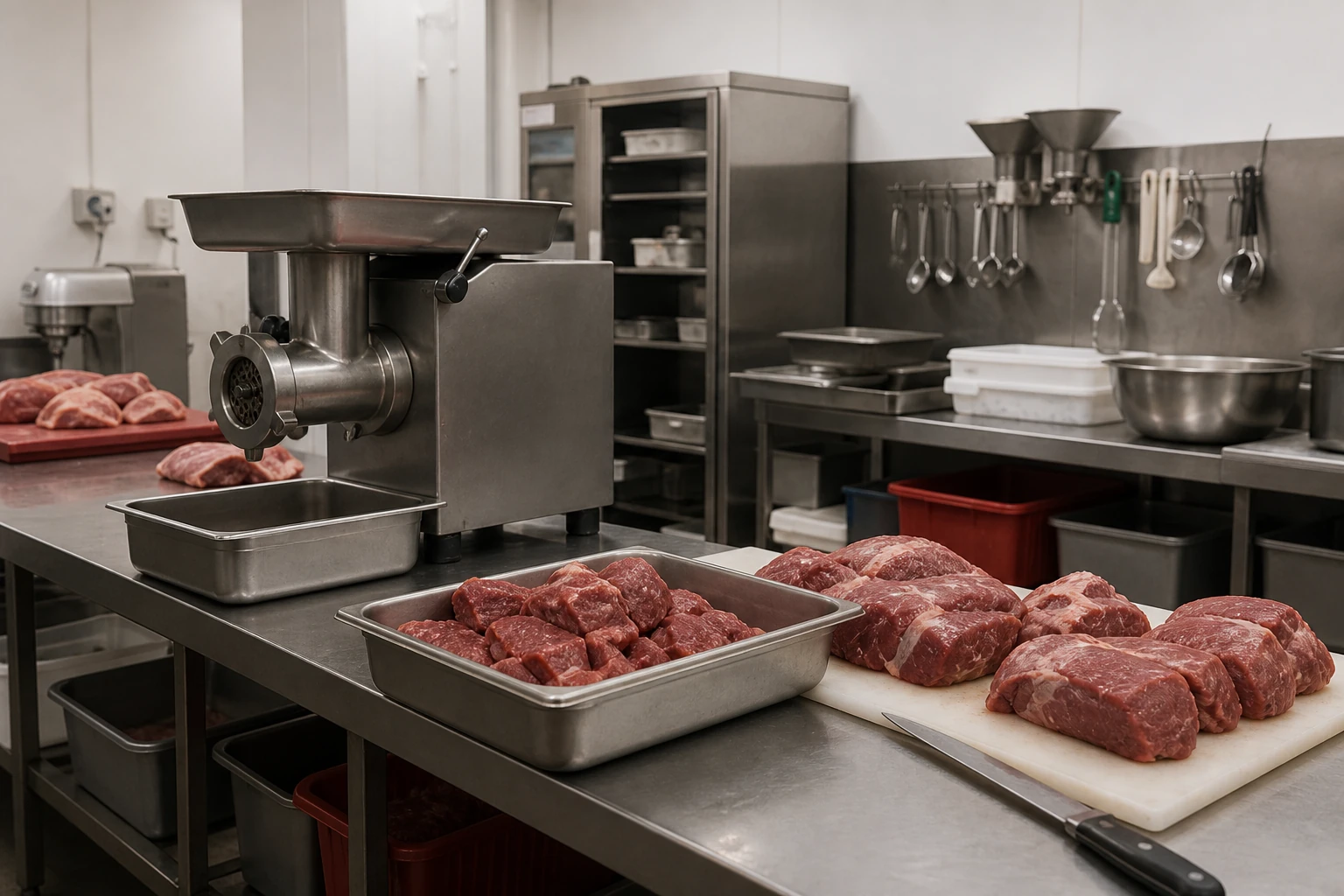
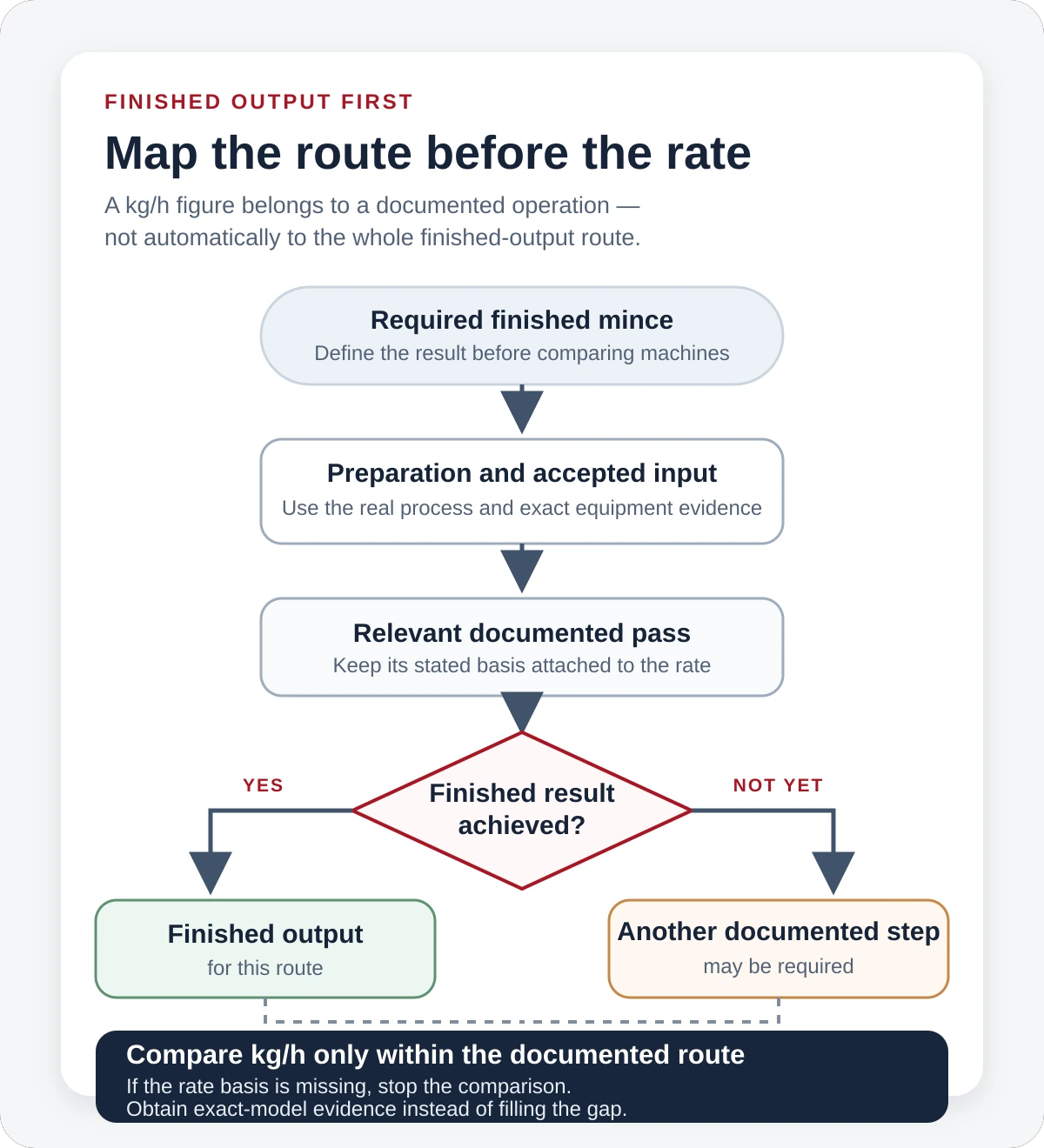
A finished-output requirement is not the same thing as one nominal mincing pass. Before comparing a commercial meat mincer’s stated kg/h, establish the preparation, pass or passes, handling and changeover work needed to produce the mince you actually require.
Only then can you ask whether a published rate describes a relevant stage in that route. If the source does not identify the model, product, pass, plate or other stated conditions behind the number, it cannot support a finished-output prediction.
A capacity figure belongs to a stated operation
Published capacity is useful evidence when its denominator is visible. It becomes misleading when a rate for one operation is treated as the output of an entire production route.
An exact Hobart 4732 specification illustrates the distinction. For that named machine, the manufacturer states 35–40 pounds per minute for fresh meat on first cutting and 25–30 pounds of beef per minute on second cutting, both through the stated 1/8-inch plate. Those are not universal commercial-mincer rates or a universal second-pass penalty. They are evidence that even one manufacturer can define different rates for different operations on one exact system.
Hobart’s current chopper and grinder information likewise separates first- and second-grind capacities for named equipment. It does not say that every batch needs two passes; it shows why pass identity cannot disappear from a rate comparison.
The same boundary applies to a maximum or nominal rate. A rate without its stated application basis is incomplete evidence; it cannot be transferred into another machine or process by assumption.
Begin with the mince you need to finish
Do not begin the route with a motor rating, head-size label or product shortlist. Begin with the required finished result and the time window in which it must be ready for its next operation.
The useful description is operational: what is coming in, what reduction is required, whether the result after one pass is the finished result, and what must happen before that mince is available for mixing, forming, filling, cooking, packing or another downstream step.
This does not require a universal plate recipe. A plate or cutting system belongs to an exact reduction step. The required result, the accepted input and the manufacturer’s instructions determine whether it is relevant. A coarse-to-fine sequence cannot be assumed for every food, machine or process simply because it appears plausible.
The point is to name the work before comparing machines. “Produce mince” is too broad. “Prepare the incoming product, complete the required mincing stage or stages, then transfer the finished result to the next controlled operation” exposes the route that the capacity number must fit.
Put each required pass inside the route
Once the finished result is clear, trace backwards to the incoming product. Is it already in a form the exact machine accepts, or is trimming, portioning, thawing or another preparation stage still required? The answer must come from the real process and the exact equipment evidence; it cannot be inferred from the word “commercial”.
Next identify the mincing operation. One pass may be the complete required reduction. Another process may require a documented second or repeat pass. Treat that additional pass as another work event, not as an invisible continuation of the first rate.
Then account for the route around the cutting set:
- preparation needed before the stated pass;
- loading and feeding within the exact operating instructions;
- collection and transfer after the pass;
- any required repeat processing;
- movement into the next production stage; and
- product, batch or allergen changeover and clean-down where the operation requires them.
These events are not a calculator. They identify what the nominal rate does not measure unless the source expressly says otherwise. Their duration depends on the process, equipment, people and controls in the actual operation.
Operator and handling work can sit outside the rated pass
A mincer’s cutting rate does not automatically include preparation, loading, collection, inspection, rework, transfer or changeover. Some of that work may be operator-dependent; some may belong to adjacent equipment or the wider production plan.
This is why the same nominal figure can carry different meaning in two processing routes. In one route, the stated pass may deliver the required reduction directly into the next stage. In another, the same stated pass may sit between additional preparation and repeat processing. The number has not changed, but the amount of route work needed to produce finished mince has.
That distinction does not prove where a bottleneck will occur. It prevents the bottleneck from being assumed away. Actual finished throughput requires observed or project-specific evidence for the whole route, not an invented multiplier applied to the mincer’s published rate.
Food-temperature control also needs its own boundary. Food Standards Australia New Zealand says potentially hazardous food should generally be kept at 5°C or colder or 60°C or hotter, unless safety at another temperature can be demonstrated, and time outside temperature control should be kept as short as possible. That is food-safety guidance. It does not prove that colder meat universally increases mincer rate, improves texture or makes a machine suitable.
Cleaning and sanitising are similarly real operating obligations, but the machine procedure belongs to its exact manual. For route planning, a required clean-down or product changeover can be recorded as a separate event without inventing a universal duration or publishing one generic disassembly method.
Read the evidence behind kg/h before comparing it
The useful capacity question is not simply “which number is larger?” It is “what work does this number describe?”
For each model under consideration, identify whether the published evidence states:
- the complete model identity;
- the product or product form used;
- whether the rate refers to a first, second or other named operation;
- the plate or cutting system where relevant; and
- any stated application or operating conditions attached to the rate.
If two numbers are not published on a comparable basis, ranking them does not repair the missing evidence. A larger stated kg/h may describe a different pass, product or condition. A lower stated figure may be the only one whose denominator is clear. Neither observation proves which machine will deliver more finished mince in the reader’s operation.
The supported editorial judgement is therefore narrow: compare the rate whose stated basis corresponds to a required stage in the actual route. If the basis is missing, stop the comparison and obtain exact-model evidence rather than filling the gap with venue type, head size, motor power or a guessed efficiency factor.
Do not turn one specification into finished-throughput proof
Head size, motor wattage, phase, drive description and included plates can all be exact product facts. None of them, alone, establishes the rate of finished output through a multi-stage production route.
The same restraint applies to broad product labels. A machine being described as heavy duty or commercial does not establish continuous duty, accepted inputs, bone capability, maintenance intervals, service requirements or suitability for a particular production load. Those conclusions require exact current documentation and, where the decision is project-specific, evidence from the real operation.
This page therefore stops before calculating actual throughput, recommending a model or assigning a daily-kilogram band to a machine size. It also makes no claim that in-house mincing will reduce labour, lower cost, improve quality or deliver a payback. Those outcomes were asserted in the legacy articles without governed evidence and do not survive the upgrade.
The practical consequence is not that nominal capacity is useless. It is that the number should be used for the operation it actually describes.
Hand the next decision to the evidence owner
Once the finished-output route is defined, the commercial decision can move to the correct owner.
Use the current Meat Mincers Category to inspect the current range and shortlist equipment for further verification. Use the exact PDP, manufacturer datasheet and manual for current kg/h, plates, power, dimensions, accepted product, duty, operating procedure, warranty and other model-specific facts.
If the exact documentation does not describe the required input, pass or operating condition, ask the supplier or manufacturer to resolve that gap. Guarding, electrical work, internal repair and machine-specific service belong to the exact instructions and appropriately qualified owner, not to a general Blog article.
The Blog’s job ends at the evidence handoff: define the finished mince, map the processing route, identify the relevant pass, read the exact rate basis and record what proof is still missing. A product choice begins only after those are describing the same job.