
Butcher Shop Equipment Australia: Plan the Workflow First
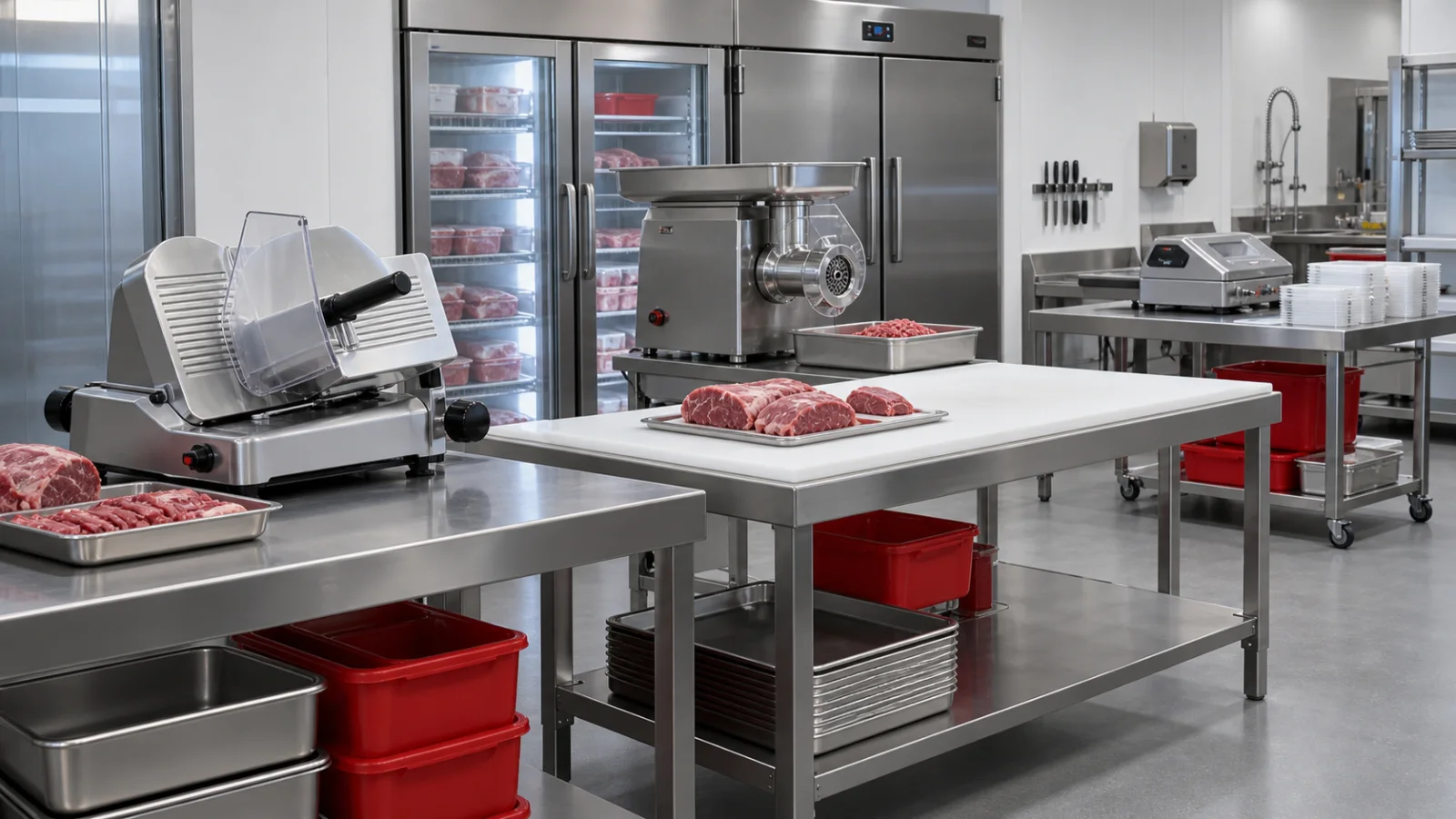
Do not begin a butcher shop equipment plan with a “must-have” machine list. Begin with the product route: what arrives, where it waits, what work changes it, how it is packed or displayed, and what must be cleaned before the next product or batch.
The equipment belongs only where that route needs capacity, separation, control or a safer mechanical task. This is the difference between buying a machine that looks appropriate and building a workstation that can actually support the shop’s products, people and food-safety controls.
Run one product through the shop before naming equipment
Choose one real product family that matters to the business. Trace it from delivery to sale without jumping over the time spent waiting, moving, changing containers or cleaning. Then repeat the exercise for a materially different product: for example, something that is minced rather than portioned, or a ready-to-eat line that must remain separated from raw meat.
This is the One Product Trip. It prevents a common planning error: treating the processing machine as the whole system. A slicer, mincer, bandsaw or filler may perform its named task, yet the route can still fail at receiving space, refrigerated holding, transfer, packing, display, changeover or clean-down.
Record the route before looking at brands. The first version does not need perfect timings. It needs honest unknowns, because an unknown site service or cleaning method is a reason to hold a shortlist rather than fill the gap with a sales adjective.
The route record exposes what a shopping list hides
Build one row for every meaningful step. A small shop may have several tasks at one controlled workstation; a larger operation may separate them. The table does not prescribe a layout. It shows the evidence the layout and equipment decision still need.
| Route step | Record from the real operation | Equipment question | Hold the shortlist when |
|---|---|---|---|
| Receive | Product form, delivery unit, arrival frequency and transfer path | Can the load move into controlled storage without an improvised holding step? | Access, weighing, trolley or immediate cold-hold needs are unknown |
| Cold hold | Maximum quantity held at one time, product groups and required separation | Which storage and monitoring arrangement covers the actual peak inventory? | Capacity is based on average stock or cabinet litres alone |
| Primary work | Cut, portion or preparation task; batch size; productive window; operator handoff | Is mechanical equipment needed, and what exact input/output does it have to handle? | The task is described only as “heavy duty” or “commercial” |
| Secondary work | Mincing, filling, tenderising, marinating or other product-specific step | Is this a separate station, another pass, or not part of this product route? | A machine’s nominal rate is being used as whole-route throughput |
| Pack or display | Pack format, label/traceability need, display quantity and replenishment pattern | What packing, weighing, sealing or refrigerated display function is actually required? | The sales display is expected to absorb back-of-house storage demand |
| Change and clean | Product/batch change, raw/RTE boundary, disassembly owner, wash and drying route | Can food-contact parts be accessed and the station reset under the exact instructions? | Cleaning requires defeating a guard, unsafe access or an undocumented method |
The most useful number may not be the largest kg/h or cabinet volume. It may be the maximum quantity held at once, the narrowest processing window, or the changeover that stops two product routes sharing a station safely.
Cold capacity has to follow the peak route
FSANZ temperature-control guidance says potentially hazardous food generally needs to be kept at 5°C or colder or 60°C or hotter during receiving, storage, display and transport, unless the business can demonstrate a safe alternative system. During preparation or processing, time outside temperature control should be kept as short as possible.
That creates an equipment-planning boundary, not a generic cabinet recommendation. Record the maximum product likely to be waiting before processing, between stages, after packing and in the display. Include delivery overlap and replenishment stock. Average daily volume can miss the moment when all of those loads coexist.
In NSW, the retail meat premises standard says chiller and freezer capacity must be adequate for the total quantity likely to be held at one time, and it addresses temperature monitoring and separation of ready-to-eat from raw meat. That is NSW evidence, not an Australia-wide premises approval. Confirm the applicable state or territory requirements and the project’s food-safety controls with the relevant authority.
The supported buying judgement is simple: size cold storage and display from the peak route and its separation needs. Do not let a front display’s nominal volume stand in for back-of-house holding, or a cabinet’s temperature claim stand in for the shop’s loading and recovery evidence.
Turn the route into a capacity floor before reading kg/h
Once the route is recorded, convert the required finished quantity and its usable processing window into a screening rate: required finished-output rate = quantity due in the window ÷ usable processing minutes × 60. Use the finished product due at the next step, not raw delivery weight. Do not quietly count setup, changeover or clean-down as productive minutes unless the observed workflow shows that work fits inside the same window.
This number is a floor for the complete station, not proof that a machine with a higher published kg/h figure will keep up. Compare a manufacturer capacity only when its input, output, passes, accessory or plate, and operating conditions match the route being screened. Loading, trimming, collection, inspection, packing and transfer still need their own observed time.
Keep three route numbers separate: finished quantity required, usable window, and verified station output from a timed trial or an evidenced current workflow. Treat the machine rating as a fourth number with its own conditions. When those conditions or the station output are unknown, the calculation exposes an evidence gap; it does not authorise an optimistic shortlist.
A processing machine can be fast while its station is slow
Machine capacity normally describes a stated operation under stated conditions. It does not automatically include trimming, loading, repeat passes, collection, inspection, packing, transfer or clean-down.
For mincing, the governed commercial meat mincer capacity guide shows how to map the finished-output route before comparing kg/h. Apply the same discipline to other machine families: identify the exact input, the exact task and the usable product leaving that task. If the specification does not describe those conditions, it cannot close the route by assumption.
This also changes where you look for the bottleneck. If packing can handle fewer completed batches than the processing station can present, more machine capacity may only create waiting product. If every product change creates a long controlled clean-down, the number of changeovers may matter more than a headline rate. Measure the complete station in the real workflow before treating one specification as production output.
Test whether two product routes can share one station
Sharing a machine or bench is not proved by the fact that both products fit through it. Put the two Product Trips side by side and test the collision between them. A shared station remains a shortlist option only when the sequence, separation and reset can all be evidenced without creating an uncontrolled wait elsewhere.
| Collision test | Evidence to record | Shared station remains possible when | Hold or separate the route when |
|---|---|---|---|
| Timing | Each product's arrival, processing and packing window; queue that forms while the station is occupied | The sequence fits the real productive window and downstream work can absorb it | One route creates waiting product, missed replenishment or an unmeasured peak overlap |
| Product boundary | Raw and ready-to-eat status, allergen or recipe separation, containers and transfer path | The business's food-safety controls define a supported order and separation method | The proposed sequence relies on informal memory or an unverified contamination assumption |
| Reset | Exact disassembly owner, cleaning, sanitising, drying, inspection and reassembly steps | The current manual and workplace controls support the reset within the available window | The reset time is unknown, needs unsafe access, defeats a guard or has no drying/reassembly space |
| Utilities and space | Power, water, drainage, ventilation where applicable, access and washed-part landing space | The site evidence supports both operating and clean-down states | A second task is being added without checking its service, access or clean-down footprint |
This is a planning gate, not a declaration that shared use is safe. When any row remains unknown, keep both the shared-station option and the duplicate-equipment option open. The exact machine information, food-safety controls and workplace risk process decide which path can be supported.
Guarding and clean-down are purchase evidence
WorkSafe Queensland’s meat-processing machine guidance identifies access to moving blades and difficult-to-clean surfaces as hazards. Its evidence prompts include fixed or interlocked guarding, accessible emergency stops, suitable controls and safe access for maintenance, cleaning and sanitising. Each machine is different, so the exact manufacturer information and workplace risk process remain necessary.
Ask for the operating and cleaning manual before purchase, not after installation. Confirm which parts the operator may remove, how energy is isolated, whether guards and interlocks remain effective, how food-contact surfaces are reached, where washed parts go, and what space is needed to dry and reassemble them. Internal repair, electrical work and guard changes belong to the qualified owner; this guide does not turn them into operator tasks.
FSANZ distinguishes cleaning from sanitising: cleaning removes dirt, grease and food waste, while sanitising destroys microorganisms. The article cannot supply one generic chemical or disassembly schedule for every butcher machine. The correct procedure must reconcile the food-safety program, chemical instructions, exact equipment manual and workplace safety controls.
Let each product trip decide which equipment families belong
A family name is useful only after the task exists in the route.
- Refrigerated storage and display belong where peak holding, separation and sales presentation require distinct controlled space.
- Bandsaws and cutting equipment belong only where the incoming product, required cut and guarded operating method support that task.
- Slicers belong where the product, slice result, batch pattern and cleaning/changeover route are defined; a slicer is not automatically the safe or efficient answer to every portioning job.
- Mincers, tenderisers and fillers belong where the finished product requires those documented operations. Treat every pass, transfer and changeover as part of the station.
- Scales, packing and sealing equipment belong to the actual pack, label, traceability and transaction job. Do not infer trade suitability or packaging performance from a generic product label.
- Benches, sinks, hand-wash facilities, trolleys and storage are not background accessories when they control transfer, separation, clean-down or safe access.
There is no universal small-butcher bundle in that list. Two shops can sell similar products and still need different stations because delivery form, batch timing, cooked/raw separation, display replenishment, site services or staffing are different.
Send a route brief, not a wish list
Before requesting a quote, send the product trips, peak quantities, batch windows, product-change boundaries, proposed station sequence, access measurements, available utilities and the food-safety or authority inputs already confirmed. Mark every unknown. For each shortlisted model, request the current specification and manual covering dimensions, operating envelope, utilities, accepted input, capacity conditions, guarding, cleaning access, service requirements and warranty.
In NSW, retail meat premises are licensed by the NSW Food Authority. Elsewhere, confirm the relevant state, territory and local requirements rather than transferring the NSW rule nationally.
Use KW’s current butcher shop equipment range only after the route brief is ready. The Category and exact product pages own current products, price, stock and published model facts; the manufacturer documents and project specialists close the remaining technical and site questions.
The outcome should be an evidence-marked shortlist: each station has a reason to exist, each model fact has an owner, and every unresolved safety, food, utility or fit question remains a hold—not a guess hidden inside “essential equipment”.