
Commercial Rice Production Planning: Turn Peak Demand Into a Batch Schedule
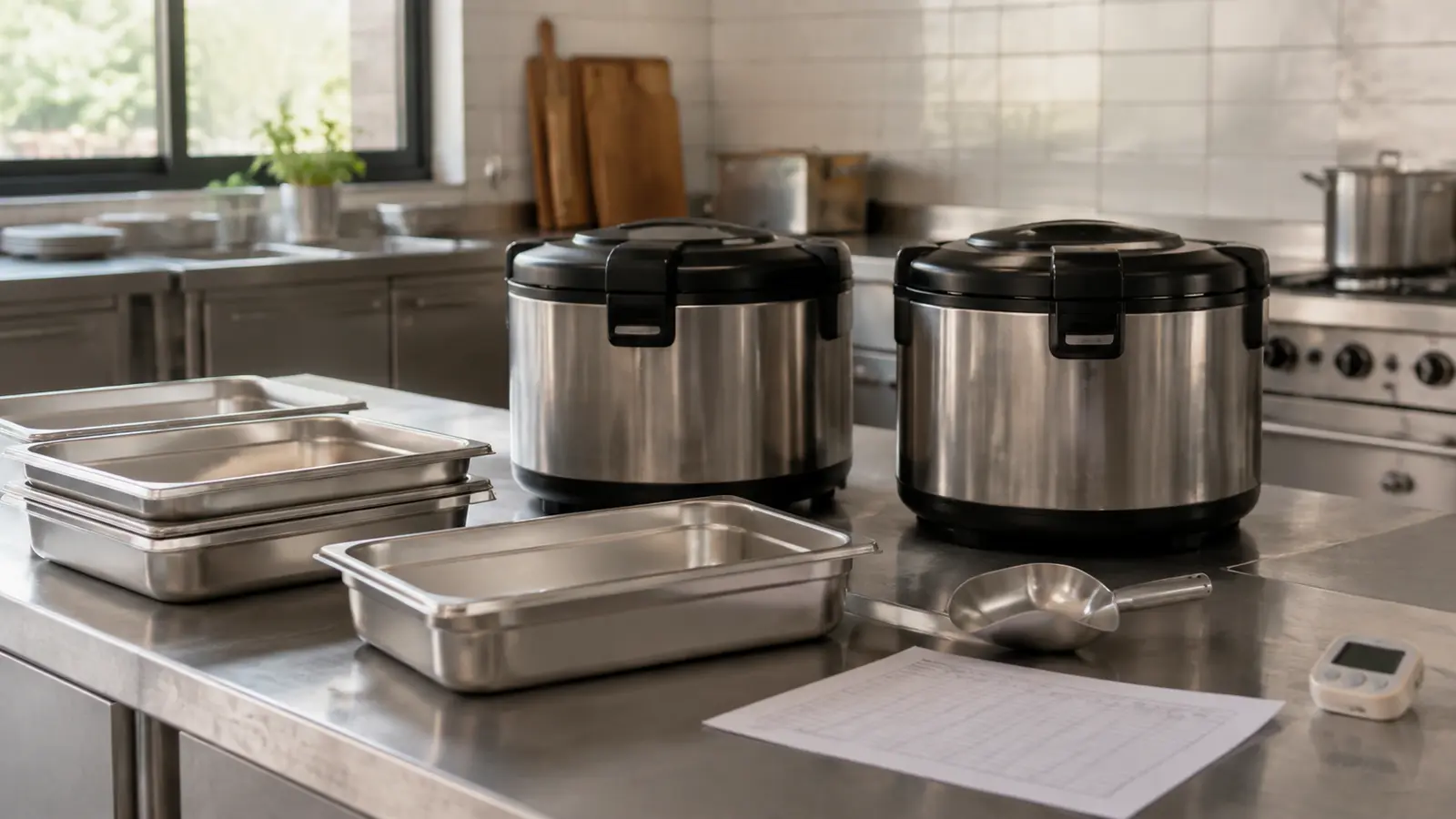
Rice service fails on a clock, not at the end-of-day total. The useful capacity question is whether the next acceptable batch can reach the pass before the current one runs out. Answer it from the busiest service interval, the portion actually served, a tested service-ready batch yield and the full replenishment cycle—not from daily covers or a dry-cup label.
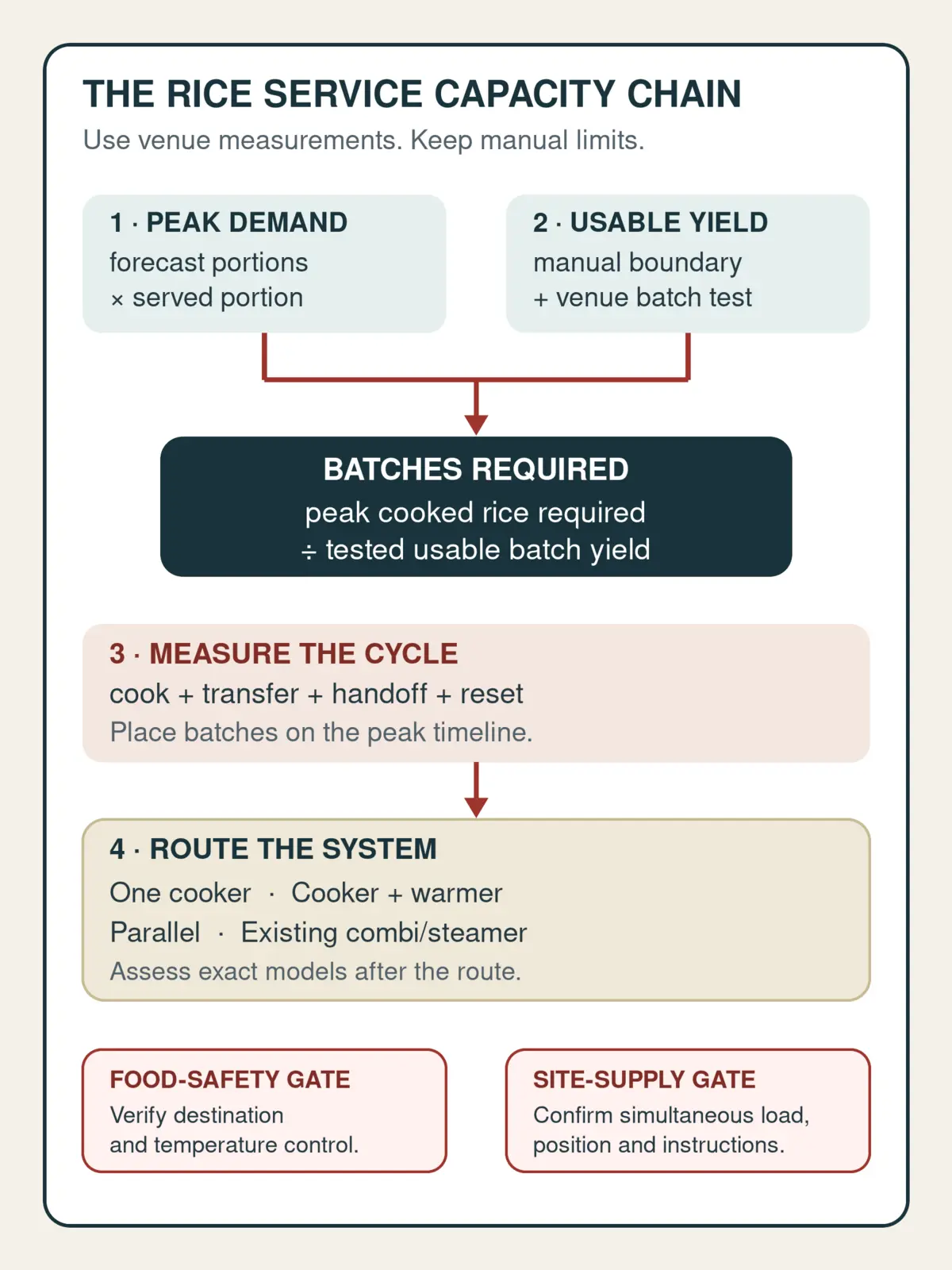
That sequence exposes the real constraint: not “How large is the cooker?” but “Can the next acceptable batch arrive before the current service-ready batch runs out?” The result is a production brief for one cooker, a cooker and warmer, parallel cookers, or an already-owned combi/steamer process. It is not an exact-model recommendation.
Lock four measurements before you compare equipment
Record the venue's own values. A generic conversion from dry rice to servings is too fragile because rice type, recipe, wash/soak method, water, batch load, portion tool and the venue's texture standard can all change usable output.
- Peak cooked-rice demand by interval. Break the busiest service into intervals that match how the kitchen actually replenishes the pass. Record portions forecast in each interval, not just the whole sitting.
- Measured served portion. Weigh or otherwise consistently measure the cooked amount that leaves the pass for this menu. Do not borrow a universal serving size.
- Tested service-ready batch yield. Measure the cooked rice the venue accepts for service after normal handling losses. Keep the exact manufacturer's load limit as a hard boundary.
- Measured replenishment cycle. Time the repeatable sequence from starting a batch through cooking, safe transfer, portioning handoff and the reset needed before the next batch can begin.
The key editorial judgement is simple: a nameplate capacity is a boundary, not proof of service-ready output. The manual can say what an exact unit permits; only a controlled test with the venue's rice and workflow shows what that batch contributes to service.
Run one controlled batch test and keep its identity
Use the exact equipment and current manufacturer instructions. Record the model, manual revision, rice type, dry load, water/process, start and finish observations, cooked output accepted for service, transfer/reset time and the food-control path after cooking.
Change one input at a time if a second test is needed. Otherwise a larger yield, shorter cycle or different texture cannot be attributed to a particular change. Reject any test that exceeded the manual, produced unacceptable rice, relied on an unrecorded intervention or cannot be repeated by the operating team.
The batch record should survive the purchase decision. If a shortlisted model uses a different rating convention or process, rerun the test rather than translating its label into a promised number.
Turn the measurements into a replenishment schedule
For each peak interval:
cooked rice required = forecast portions × measured served portionbatches required = cooked rice required ÷ tested service-ready batch yield, rounded upreplenishment cycle = measured cook time + safe transfer time + reset time
Then place the batches on a timeline. Start with the first moment rice must be available and work backwards by the measured cycle. Mark which batch feeds which service interval and what happens to any planned balance.
Do not smooth the busiest interval into an hourly average. If most orders land in a short rush, the average hides the point where the pass empties before the next batch arrives. The production route is governed by the interval that cannot be replenished in time.
Route the production system before the SKU
Use the completed timeline to decide which class of system deserves an exact-model review.
| Route to test | When it may fit the measured job | Evidence still required |
|---|---|---|
| One cooker | One tested batch covers the relevant service demand, or the measured cycle replenishes before acceptable rice runs out. | Exact manual, service-ready batch test, complete cycle, bench position and site supply. |
| Cooker plus warmer | Cooking and holding are operationally separate and the documented holding plan keeps each batch within the business's food-safety and quality limits. | Exact cooker and warmer instructions, transfer method, temperature verification, batch identity and discard/cool disposition. |
| Parallel cookers | The peak interval requires overlapping batches, or resilience is a defined operating requirement. | Simultaneous site load, circuit/connection assessment, bench and ventilation requirements, labour and safe transfer sequence. |
| Existing combi or steamer process | The venue already has a manufacturer-supported rice process whose tested batch and cadence meet the same requirement. | Exact program/manual, compatible vessels, tested yield, competing equipment load and specialist/site confirmation where required. |
These are routing conditions, not promises. If a combi or steamer remains in contention, the commercial combi-oven decision guide keeps that equipment family's own operating and evidence questions visible. For any cooker route, use the commercial-kitchen power guide to frame the site evidence before a licensed electrician assesses installed supply and simultaneous load. Exact manufacturer documents still own capacity, connection, clearances, operating instructions and permitted use.
Food safety changes the schedule; it does not fill missing capacity data
Food Standards Australia New Zealand lists cooked rice as potentially hazardous food. It says potentially hazardous food should generally be kept at 5°C or colder or 60°C or hotter unless the business can demonstrate another safe control. Use the business's applicable food-safety program and a suitable probe thermometer; an equipment lamp or warm mode is not evidence of food temperature. If hot holding is part of the route, apply the separate food-outcome hot-holding control rather than treating a warmer setting as proof.
If cooked rice will be cooled, FSANZ requires the food to cool from 60°C to 21°C within two hours, then from 21°C to 5°C within a further four hours, unless the business can demonstrate another safe process. If it will be reheated for hot holding, heat it rapidly to 60°C or hotter before transfer; equipment designed only to hold hot food is not the reheating step.
The separate 2-hour/4-hour guide applies to ready-to-eat potentially hazardous food brought out of refrigeration, and its time between 5°C and 60°C is cumulative. Do not use that guide as a substitute for the two-stage cooling rule. The NSW Food Authority identifies improperly refrigerated cooked rice as a food vehicle previously associated with Bacillus cereus toxin; that does not mean all rice contains the pathogen, but it explains why the schedule needs a verified disposition for every batch.
For each planned batch, write one destination: immediate service, verified hot holding, compliant cooling for later use, or disposal under the business's control. If that destination is unknown, the production schedule is not complete.
Give the shortlist your timetable, not a capacity wish
Before requesting a shortlist, record:
- peak portions by replenishment interval and the measured served portion;
- exact rice/process identity and tested service-ready yield;
- full cook, transfer and reset cycle;
- first-available time and every required batch start/finish point;
- the verified food-control destination of each batch;
- available bench footprint, access and cleaning needs;
- site supply and the owner who will confirm simultaneous electrical load;
- which functions must remain available if one unit is offline.
Send the timetable—not a request for “something bigger”—into the commercial rice cookers and warmers range. It lets each exact model be tested against a known batch size, start time and hand-off deadline. If the unresolved constraint is bench sequence, utilities or interaction with the rest of the line, take the same record to KW's Kitchen Design team.
The shortest useful shortlist is the one in which every route can meet the same service clock and food-control path. A larger label cannot rescue an unknown portion, untested yield or batch that arrives after the pass is empty.