
Commercial Rotisserie Capacity: Plan Cooking and Hot Holding
A rotisserie has to keep up with the rush. The hot counter has to make room for what comes out. Those are two different capacity questions, and they rarely resolve to the same number.
Plan commercial rotisserie capacity from the greatest number of chickens cooking at once, then calculate the greatest number waiting for sale. The worked lunch service below needs 54 cooking positions and 26 holding positions—even though its largest batch is 24. These are illustrative planning quantities, not a machine recommendation.
First, find out what the bird count means
A catalogue capacity belongs to a loading arrangement. Fri-Jado’s TDR 7/8 capacity guidance gives up to 28 chickens in baskets or 40 on meat forks, based on 1.2 kg chickens. The loading format changes the count; neither count establishes your cooking time or hourly sales capacity.
Rotisol’s 1175.8SMiG technical sheet uses a model-specific 32/40 poultry rating. Before comparing machines, ask the supplier to translate the rating into your bird sizes, accessories and cooking process. These manufacturer examples explain the question; they do not identify the right KW purchase.
One lunch service. Two different peaks.
Imagine a service from 11:30 to 13:30, with four releases: batch A has 12 chickens, B has 24, C has 18 and D has 12. This is a constructed stock-accounting example. The event times do not establish cooking durations or prove that any particular equipment can run the schedule.
The cooking peak happens before the queue
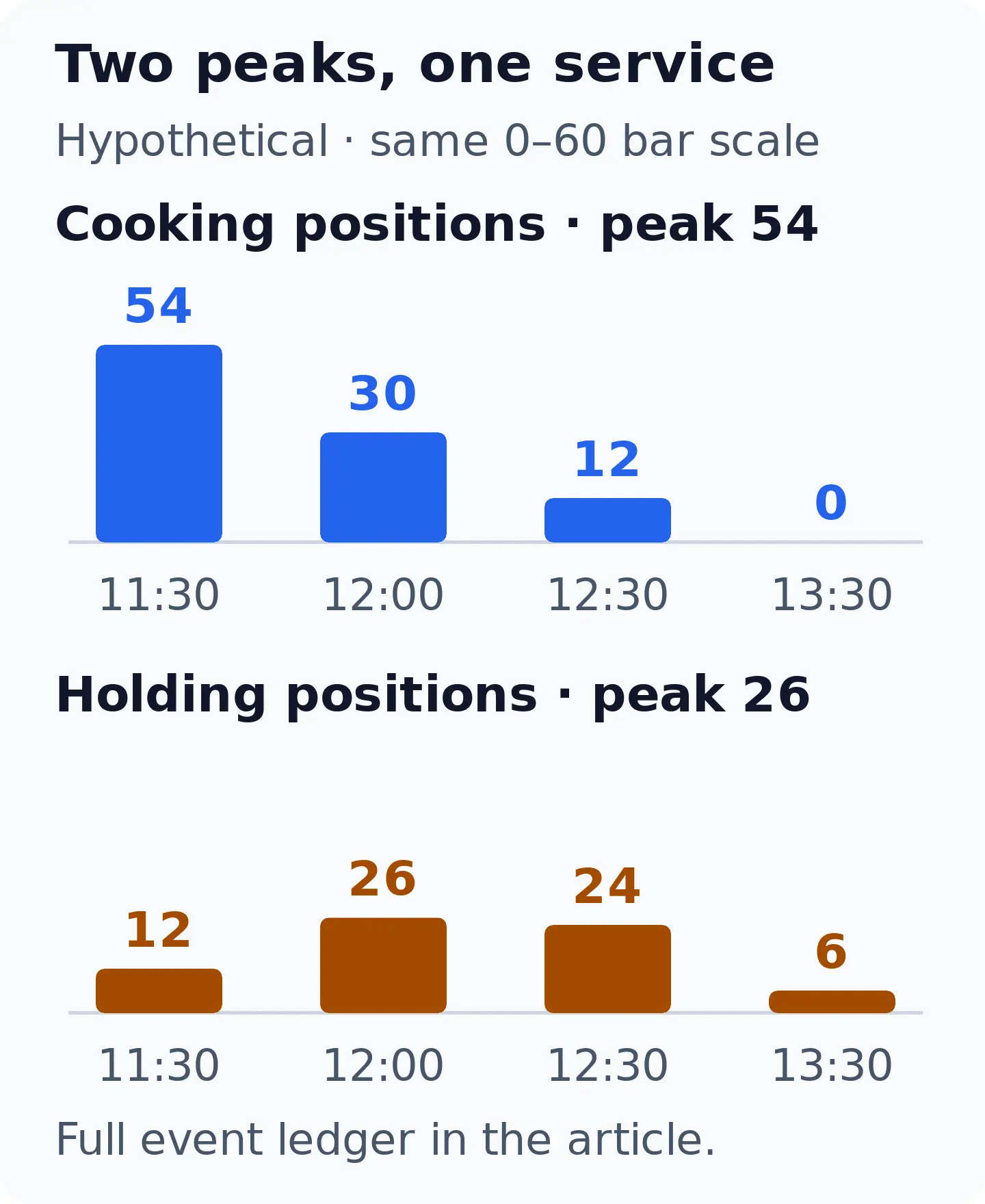
Just before opening, A, B and C are cooking: 12 + 24 + 18 = 54 positions. At 11:30, A leaves and D takes its place. Cooking occupancy remains 54, then falls to 30 at noon, 12 at 12:30 and zero at 13:00.
The supplier must show how the exact machine arrangement supports those overlapping batches, with start times, loading and unloading allowed for. A batch-only oven cannot be assumed to accept staggered loads. Until that is proven, 54 is a demand on the proposed arrangement—not a capacity label to shop for.
The holding peak happens after a release
Start with no cooked stock. At each event below, subtract sales since the previous row, then add the batch released. “Held” is the stock immediately afterwards; all quantities are whole chickens.
| Time | Sold | Released | Held |
|---|---|---|---|
| 11:30 | 0 | 12 (A) | 12 |
| 12:00 | 10 | 24 (B) | 26 peak |
| 12:30 | 20 | 18 (C) | 24 |
| 13:00 | 18 | 12 (D) | 18 |
| 13:30 | 12 | 0 | 6 left |
At noon, 12 − 10 + 24 = 26 chickens need holding space. The largest batch is 24; the cooking peak is 54; the holding peak is 26. Each number answers a different question.
The closing batch is a separate decision
The service releases 66 chickens and sells 60, leaving six. Reducing D from 12 to six would finish this model at zero, while the earlier peaks of 54 cooking and 26 holding stay unchanged. It changes the closing surplus without reducing the peak equipment requirement. Actual batch changes still need a supported cooking process and a demand forecast.
Turn sales records into a workable batch plan
Use the service you need to cover, including recorded stockouts: sales alone can understate demand when the counter ran empty. Keep whole birds, portions and materially different sizes separate so the units remain comparable.
- Set the release times. Mark the rush, then work backwards using evidenced cooking cycles and handling time. Missing cycle evidence leaves a proposed timetable, not an operating plan.
- Count both balances at every event. Total birds still cooking at each start and finish. For the counter, carry forward opening stock + releases − sales − other authorised removals. Check just after releases and during sales bursts.
- Track age as well as quantity. Keep each batch’s release time and permitted holding/quality limit. Twenty chickens at the counter says nothing about the age of the oldest one.
- Stress the plan. Try a late release, a stronger rush and slower sales. Look for shortages, crowded holding and closing surplus before choosing a larger machine.
Keep food checks beside the capacity numbers
FSANZ temperature-control guidance covers raw and cooked poultry. Potentially hazardous food generally needs to be at 5°C or colder, or 60°C or hotter, unless a safe alternative can be demonstrated. Check food temperature with a probe in the thickest part.
Safe Food Australia Appendix 4 recommends poultry reach 75°C internally in the thickest part and be held hot at a minimum of 60°C. These are food-temperature recommendations, not dial settings, cooking durations or permission for unlimited holding.
Count a batch as released only after its required cooking checks. Count only usable holding space that supports the venue’s controlled process. Keep raw and cooked handling separate; agree the action for unsold food with the food-safety owner before service.
Ask for the equipment that supports your service
If cooking is the constraint, test the supported loading arrangement and release timing. If holding is the constraint, test release size and timing alongside the counter capacity. A larger rotisserie can put more cooked food into an already crowded holder.
Send the supplier your event record, bird sizes, batch roster, both peaks, holding limits and closing plan. Include who loads, checks, unloads, packs and serves during the busiest overlap. Ask for the exact manual, accessory basis and the remaining evidence needed to validate the proposed schedule.
Compare the commercial rotisserie range against the cooking job, and commercial food warmers against the separate holding job. Take layout and services questions to KW’s commercial kitchen design service and the appropriate qualified project specialists.