
Gas vs Electric Commercial Fryers: The Oil Recovery Time Trap Costing Australian Operators $6,240 a Year
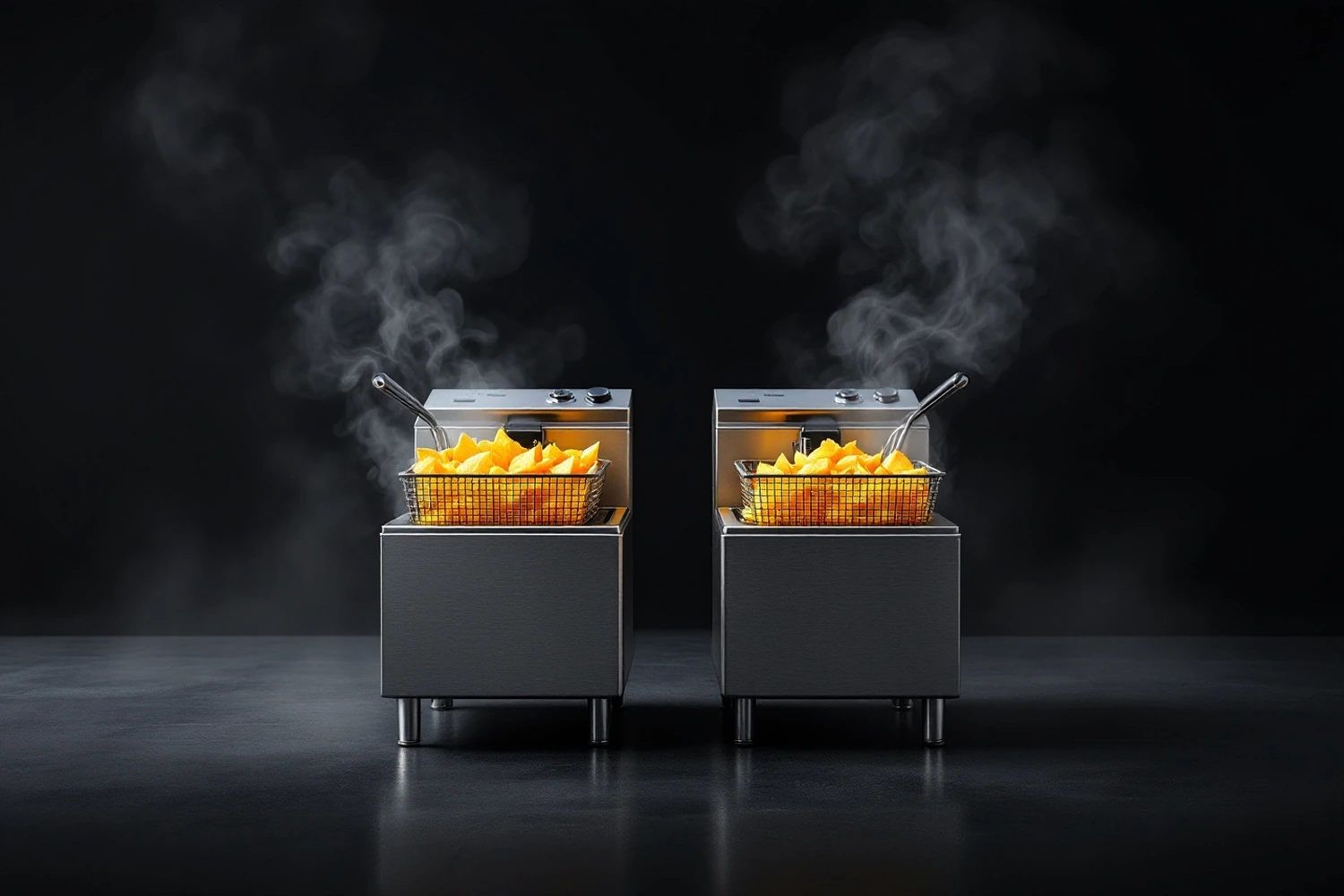
The most expensive number on a commercial fryer's spec sheet is not the price, the oil capacity, or the burner rating. It is the recovery time — how many seconds the oil takes to climb back to crisping temperature after you drop a basket of frozen chips into it. A 30-second difference between two fryers on the showroom floor is the difference between $6,240 a year in wasted oil and a smoothly-running Friday night dinner service.
This guide is for operators who currently buy fryers the way they buy stockpots — by litre capacity and price tag — and end up with a piece of equipment that turns premium frozen product into greasy, oil-saturated chips and burns through 40 litres of oil a week to do it. Recovery time is the metric that decides whether your fryer is a profit centre or a slow bleed.
By the end of this guide you will know how to read recovery time from a spec sheet, why a gas tube-burner fryer outperforms a cheaper open-pot model by a factor of 2, what the TPM (Total Polar Compounds) test actually measures and why it is the only objective trigger for dumping oil, and which Class K fire suppression rule will void your commercial insurance if your installer skipped it. The technical depth here matters because every detail is paid for in oil cost, customer complaints, or insurance excess every single trading week.
The 90-second fryer specification matrix
| Site type | Volume / hour at peak | Minimum fryer profile | Recovery target | Outcome if under-spec |
|---|---|---|---|---|
| Cafe (chips as side dish) | 5-10 kg frozen product | Single 8-10L tabletop electric, 9-12 kW, or 70 MJ gas | 3-4 minutes | Workable; oil dumped weekly |
| Brunch venue (chips + crumbed) | 15-25 kg | Single 14-18L gas tube or 14-21 kW electric | 2-3 minutes | Oil dump every 5-6 days |
| QSR / fish & chips | 40-80 kg | Twin-tank 18L heavy-duty tube fryer, 130+ MJ per tank | under 2 minutes | Oil dump every 4 days; minimal sogginess |
| Full restaurant (chips + sides) | 20-40 kg | Twin-tank gas tube or twin 18L electric, 21-28 kW per tank | 2 minutes | Oil dump every 5-7 days |
| Pub / bistro (high volume) | 50-100 kg | Twin tube 22L + dedicated filter system | under 90 seconds | Oil dump every 3-5 days with daily filtration |
| Cloud kitchen (multi-brand) | 60-120 kg | Twin-bank tube fryers + auto filtration | under 90 seconds | Oil dump every 4-5 days; auto-filter critical |
If your current fryer takes longer than the recovery target above, your operation is bleeding either oil cost, food quality, or both, every trading day. The Section 5 TPM test confirms this objectively. The rest of this guide explains the physics behind why and what to specify instead.
Section 1 — The Friday Night Soggy Cascade: $6,240 in Annual Oil Waste
This is the failure pattern that drives the majority of fryer replacement enquiries we handle. It plays out the same way in venues across Australia. Numbers below are real and conservative.
7:30 pm — Peak service hits
A 100-seat suburban restaurant on a Friday night. Three table orders for steak with chips and a fish-of-the-day platter land on the pass within 90 seconds of each other. The kitchen drops three consecutive baskets of frozen par-cooked chips into a budget 120 MJ/h gas open-pot fryer holding 18 litres of oil at 180°C. Each basket is 1.2 kg of frozen product at -18°C. The chef expects 3 minutes per basket to crispy.
7:31 pm — The temperature plunge
Frozen chips at -18°C absorb a huge amount of energy to thaw, evaporate their surface moisture, and reach 180°C themselves. Each basket pulls roughly 700 kJ out of the oil in the first 90 seconds. Three back-to-back baskets pull 2.1 MJ from the oil in under three minutes. The 18-litre oil bath drops from 180°C to 132°C — well below the 170°C minimum for crisping.
7:32 pm — The fryer cannot recover
The open-pot 120 MJ/h burner is rated for 120 megajoules per hour of heat input, which sounds substantial. In practice, the burner heats the exterior steel pot wall, which then transfers heat to the oil via conduction. Heat transfer efficiency on a flat-bottom open pot is roughly 50-55% — almost half the gas energy goes up the flue. Real net heat input to the oil is closer to 65 MJ/h, or about 18 kW equivalent. The fryer takes 7.5 minutes to recover from 132°C back to 180°C with the baskets still submerged. During that 7.5 minutes the chips are not crisping — they are slow-boiling in lukewarm oil.
7:39 pm — The chips go out wrong
The chips come out of the oil pale, limp, and visibly oil-saturated. Instead of a crisp shell that prevents oil ingress, the chip surface has been hydrated by the steam coming off the still-cold core, which then drew oil into the structure as the chip cooled in lukewarm fat. The customer eats them and rates them three stars. The next morning a Google review goes up: "chips were soggy." Three reviews like that and the venue's star average drops from 4.5 to 4.2, which translates directly to weekend cover decline over the following two months.
The ongoing bleed nobody calculates
The deeper damage is to the oil. When frozen product sits in oil below 170°C, three chemical processes accelerate simultaneously:
- Hydrolysis: water from the frozen product breaks down triglycerides into free fatty acids (FFAs). FFA concentration climbs from a fresh-oil baseline of 0.05% towards the 1.5% threshold where the oil tastes rancid.
- Oxidation: with the oil exposed to air for longer at sub-optimal temperatures, oxygen breaks down the unsaturated bonds in the fat, forming aldehydes and ketones that give old oil its characteristic acrid smell.
- Polymerisation: long-chain polar compounds form, viscosity climbs, and the oil darkens. Total Polar Compounds (TPM) reading climbs by 3-5% per shift instead of the normal 1-2%.
The operator notices the oil is "going off fast" and starts dumping it twice a week instead of weekly. A 36-litre twin-tank dump at $3.30/L (high-oleic foodservice blend) is $118.80 per dump. The extra dump per week is $120 per week, or $6,240 per year — uncosted in any budget line, paid out of cash flow, invisible to the P&L until year-end.
The fryer that "saved" $2,500 on the original purchase costs $6,240 every year it operates. The payback period for the slow fryer is negative.
Section 2 — The Chemistry: Why Oil Goes Bad Faster in Bad Fryers
Cooking oil is a chemical product with a finite shelf life under fryer conditions. Understanding what destroys it explains why some fryers extend oil life and others compress it.
The four enemies of frying oil
Every oil degradation pathway traces back to one of four inputs: water, heat, air, or carbon. Water enters via frozen product moisture. Excess heat drives polymerisation. Air drives oxidation. Carbon — the sediment that drops off frying product and settles at the pot bottom — burns continuously if it sits in the heat zone, releasing free radicals that attack the remaining oil.
The hydrolysis cascade
When water hits hot oil, it flashes to steam. Some of that steam carries hydrogen ions that break the ester bonds in triglyceride molecules, releasing free fatty acids and glycerol. Each free fatty acid is then a sitting target for further oxidation. The cascade accelerates: more water means more FFAs, more FFAs means faster oxidation, faster oxidation means more polymerisation, and so on.
The implication for fryer design: anything that minimises water contact time with hot oil extends oil life. This is why fast recovery time matters not just for food quality but for oil chemistry — a fryer that flashes the surface moisture off frozen product in 20 seconds protects the oil far better than one that takes 90 seconds and lets the moisture migrate through the oil body.
Why carbon sediment is the silent killer
Every basket of breaded or coated product sheds carbonised crumbs into the oil. In an open-pot fryer with a flat or sloped bottom and the heating elements in direct contact with the lower oil body, these crumbs continuously cook against the hot surface, blackening, then burning, then releasing acrolein and other reactive species into the bulk oil. A typical open-pot fryer turns its oil from gold to dark amber in 4-5 days of moderate use. Most of that colour change is carbon-driven, not heat-driven.
Tube-style fryers solve this by structural design — covered in detail in Section 4 — by physically separating the heat source from the sediment zone. The crumbs fall into a cold zone below the burner tubes, where they sit at 50-70°C rather than 180°C. They do not burn, they do not release reactive species into the oil, and the oil itself oxidises 30-40% slower as a result.
Section 3 — Recovery Time: Gas BTU/MJ versus Electric kW Reality
The recovery time on a fryer's spec sheet is the single number that determines whether the equipment can keep up with your service. Understanding what drives recovery time means understanding the heat transfer pathway from energy input to oil temperature.
Gas fryers: external heating, lower efficiency
A gas-fired fryer burns natural gas (NG) or LPG in a burner located either underneath the pot (open-pot design) or inside tubes that pass through the oil body (tube design). The combustion gases heat the metal pot wall or tube wall, which then conducts heat into the oil. Two efficiency losses occur: combustion losses (some heat escapes up the flue) and wall conduction losses (the metal wall heats up first, then transfers to oil).
Typical gas fryer efficiency from gas input to oil heating:
- Budget open-pot gas fryer: 45-55% net efficiency
- Mid-range tube gas fryer: 65-75% net efficiency
- Premium high-efficiency tube fryer: 80-85% net efficiency (with flue gas recovery)
This is why a "120 MJ/h" budget open-pot fryer puts roughly the same heat into the oil as an "85 MJ/h" premium tube fryer. The headline MJ number is misleading without efficiency context.
Electric fryers: submerged elements, near-100% transfer
Commercial electric fryers use heating elements submerged directly in the oil. Every watt of electrical energy drawn at the wall becomes heat in the oil, with the only loss being small radiation losses from the pot exterior. Net efficiency is consistently 95-98%.
The mechanical implication: a 14 kW electric fryer delivers approximately the same heating power to the oil as a 75-85 MJ/h premium gas tube fryer, despite the electrical model having much lower headline numbers. Operators comparing gas MJ ratings to electric kW ratings without an efficiency adjustment systematically over-buy gas and under-buy electric.
The recovery curve in practice
| Fryer type | Headline rating | Effective heat to oil | Recovery (1.2 kg frozen basket, 18L tank) | Oil dump cycle (moderate use) |
|---|---|---|---|---|
| Budget open-pot gas | 120 MJ/h | ~18 kW equivalent | 5-8 minutes | Every 3-4 days |
| Mid-range tube gas | 95 MJ/h | ~21 kW equivalent | 3-5 minutes | Every 5-6 days |
| Heavy-duty tube gas | 130 MJ/h | ~30 kW equivalent | 2-3 minutes | Every 6-8 days |
| Budget electric (15A) | 9 kW | ~8.5 kW | 4-6 minutes | Every 4-5 days |
| Commercial 3-phase electric | 14 kW | ~13 kW | 2-3 minutes | Every 6-8 days |
| Heavy-duty 3-phase electric | 22 kW | ~21 kW | under 2 minutes | Every 7-9 days |
| Premium fast-recovery | 28 kW or 150 MJ/h tube | ~25 kW equivalent | under 90 seconds | Every 8-10 days with filtration |
The oil dump cycle column is where the recovery time pays back. A heavy-duty tube fryer doing 7-day oil cycles versus a budget open-pot doing 3-day cycles means the budget fryer burns through more than twice as much oil for the same trading volume.
The power supply caveat for electric fryers
Electric fryers above 9 kW require 3-phase 415V power. Commercial electric fryers in the 14-28 kW range typically draw 20-40A per phase on a 3-phase circuit. If your site is not 3-phase equipped, the electric upgrade path is gated by a switchboard upgrade — see our companion guide on commercial kitchen power requirements for the network operator costs and lead times involved. Most QSR and high-volume fryer operations choose gas tube for this reason: easier to install in single-phase sites, simpler to upgrade later.
Section 4 — The Cold Zone Solution: Tube versus Open Pot
The single biggest structural decision in a fryer is whether the heating happens at the bottom of the pot (open-pot) or through tubes that pass through the oil body (tube-style). The difference dictates oil life, food consistency, and cleanability.
Open pot construction
The burner sits below a flat or slightly sloped pot bottom. All of the oil sits directly above the heat source. Sediment falls to the bottom of the pot and is in direct contact with the hottest metal surface — typically 200-250°C external wall temperature. Sediment burns continuously. Oil degrades fast. Cleanability is poor because sediment cakes onto the bottom surface and is hard to remove without scraping.
Tube construction
Heating tubes (typically 3-6 stainless steel tubes per tank) pass horizontally through the upper portion of the oil body, with the burner located at one end of each tube. Below the tubes is a substantial "cold zone" — a section of the pot, often 100-150mm deep, where the oil temperature stays at 50-70°C rather than 180°C. Sediment falls into this cold zone and accumulates harmlessly. The oil in the cold zone is not actively cooking, so no degradation reactions happen there.
The 40% oil life extension explained
Three mechanisms compound to give tube fryers their oil life advantage:
- Sediment isolation. The cold zone removes burning carbon from the active oil body, eliminating the largest source of free radical generation.
- Lower bulk oil temperature gradient. The tubes heat the oil locally and convection distributes heat across the body, but the average temperature gradient across the oil is more uniform than the steep gradient of an open pot. Less thermal stress on the oil.
- Faster recovery means less time at sub-optimal temperatures. As covered in Section 2, water-driven hydrolysis accelerates in the 100-160°C range. A tube fryer spends less time in this range during recovery, so less hydrolysis happens per basket.
The combined effect is consistently 30-40% longer usable oil life between dumps. On a venue burning $30,000 of oil annually, that is $9,000-$12,000 in saved oil cost.
Section 5 — TPM Testing: The Objective Oil-Dump Trigger
Most operators dump oil based on visual judgment ("it's gone dark") or smell ("smells off"). These are subjective and lag the actual oil degradation by 12-48 hours. The objective measure is Total Polar Compounds (TPM), which has been the regulated trigger for oil disposal in the European Union since 1989 and is increasingly used by Australian Environmental Health Officers as the audit benchmark.
What TPM measures
Total Polar Compounds are the breakdown products of fresh triglyceride oil — free fatty acids, polymers, oxidation products, and other reactive species. Fresh oil starts at roughly 2-4% TPM. As oil degrades, TPM rises. The European Union regulatory limit for foodservice oil discard is 24-27% TPM depending on the member state. Above this threshold the oil is no longer fit for food preparation.
Australia does not have a mandatory TPM limit, but FSANZ and most state Environmental Health Officers use 25% as the practical guideline. Some councils now request to see TPM testing records during routine kitchen audits. A documented TPM testing programme is increasingly part of the audit defence file we recommend for any high-volume frying operation.
How to test TPM
Two methods are commonly used in Australian commercial kitchens:
- Reagent test strips: $80-150 for a box of 50 strips. Dip the strip into oil at 50-70°C, wait 30 seconds, compare colour to the chart. Accurate within ±2% TPM. Adequate for daily go/no-go decisions.
- Digital TPM meters: $400-700 for a battery-powered probe that reads TPM directly. Accurate within ±1% TPM. Faster, more consistent, and the readings can be logged digitally for audit trail. Worth the investment for any site with two or more fryers.
The dump-cycle economics with TPM
Operators who switch from visual judgment to TPM testing typically discover one of two patterns. Either they are dumping oil 1-2 days too early (oil is still at 18-22% TPM, has another shift left), in which case TPM testing immediately saves them 15-25% in oil cost. Or they are dumping oil 1-2 days too late (oil is at 28-32% TPM, food quality is already suffering), in which case TPM testing protects food quality and reputation.
Either outcome saves money. The $80-700 cost of the testing equipment is recovered within the first month for most venues.
State-by-state EHO audit practices for frying oil
Food regulation in Australia is administered state-by-state under the framework of the Food Standards Australia New Zealand (FSANZ) Food Standards Code, with local councils delivering Environmental Health Officer (EHO) audits. The expectation around oil quality documentation varies by jurisdiction and is steadily tightening.
| State / Territory | Primary Food Act | EHO oil-quality expectation | TPM testing posture |
|---|---|---|---|
| New South Wales | Food Act 2003 (NSW) | NSW Food Authority + local council audits; oil quality records increasingly requested | Recommended for high-volume QSR; required for licensed food businesses in some metro councils |
| Victoria | Food Act 1984 (VIC) | Council-administered Class 1 and Class 2 audits; oil records expected for fish & chip and QSR operators | Recommended; some metro councils request TPM records during routine audit |
| Queensland | Food Act 2006 (QLD) | Council EHO audits under SafeFood program; oil quality part of HACCP-style review | Recommended for high-volume operators; QFES involvement on Class K compliance |
| South Australia | Food Act 2001 (SA) | SA Health + council audits; growing focus on frying oil quality in metro Adelaide | Recommended; increasingly expected in fish & chip premises |
| Western Australia | Food Act 2008 (WA) | Local government EHO audits under WA Health framework | Recommended for high-volume operators |
| Tasmania | Food Act 2003 (TAS) | State-level Department of Health framework with council delivery | Recommended for commercial fryer operations |
| ACT | Food Act 2001 (ACT) | ACT Health Directorate, centralised audit | Recommended; documented testing strengthens audit position |
| Northern Territory | Food Act 2004 (NT) | NT Health Department-administered | Recommended particularly for tourist-heavy seafood operators |
Three patterns are worth pulling out. First, no jurisdiction currently mandates TPM testing in legislation, but every jurisdiction's regulator increasingly treats documented testing as evidence of compliance with the FSANZ general food safety obligation. Second, the trend is unambiguously towards more documentation, not less — operators who establish a TPM testing routine now will not be retrofitting one under audit pressure later. Third, councils with active fish-and-chip clusters (coastal NSW, Hobart waterfront, Gold Coast, Perth northern beaches) audit oil quality more aggressively than councils without — context-aware to your local environment.
Section 6 — Acrylamide and the 165-180°C Sweet Spot
This section is about a food safety issue that most fryer guides do not cover but FSANZ and the World Health Organization care about increasingly.
What acrylamide is
Acrylamide is a chemical compound formed naturally when starchy foods (potatoes, bread, certain grains) are cooked at temperatures above approximately 120°C, particularly via frying or roasting. The International Agency for Research on Cancer (IARC) classifies acrylamide as a "probable human carcinogen" (Group 2A). FSANZ has published acrylamide reduction guidance for the Australian food industry, with frying temperature control identified as a primary intervention.
The temperature paradox
Acrylamide formation accelerates with temperature, so cooler frying might seem safer. But cooler frying takes longer, exposing the food to formation conditions for longer total time. The empirical sweet spot — minimum acrylamide formation across the full cook — sits at 165-180°C oil temperature with rapid cook time. Frying at 190°C is faster but spikes acrylamide. Frying at 150°C is slower and also spikes acrylamide via prolonged exposure. A fryer that cannot hold 175°C reliably during a service produces measurably more acrylamide-loaded product than one that can.
The fryer specification implication
Hold temperature stability is part of acrylamide control. Good thermostatic control (±2°C of setpoint) plus fast recovery (under 2 minutes) keeps the oil in the 165-180°C window for the maximum fraction of cook time. Cheap thermostats that allow ±10°C drift, combined with slow recovery that lets the oil sit at 130-160°C for minutes at a time, produce more acrylamide per gram of product. This is a food safety dimension that EHOs are increasingly aware of and is likely to feature in future Food Standards Code updates.
Section 7 — Daily Oil Filtration: The 30-50% Life Extension
The single highest-ROI operational practice in commercial frying is daily oil filtration. The principle is simple: remove the carbonised sediment from the oil at the end of each service before it can degrade further. Done daily, filtration extends usable oil life by 30-50% — a larger gain than upgrading from open-pot to tube construction.
How filtration works
At the end of service, the oil is pumped or drained from the fryer through a filter medium (paper or cloth) that catches solid particles down to 5-25 microns, then returned to the fryer. The process takes 10-15 minutes per fryer with portable filter trolleys, or 3-5 minutes with built-in filter systems on modern commercial fryers.
What filtration does and does not do
Filtration removes solid carbon and sediment. It does not remove dissolved polar compounds (the polymers and FFAs that drive TPM). This is why filtration extends oil life rather than restores it: removing carbon prevents the next 24 hours of accelerated polar compound formation, but yesterday's polar compounds remain dissolved in the oil and continue to climb until the next dump.
The integrated filter premium
Modern commercial fryers with integrated filter systems (built into the cabinet, automated drain and return) add $1,500-$3,500 to the equipment cost over the same fryer without filtration. Payback period for any venue using more than 30 litres of oil per week is typically 4-8 months. Portable filter trolleys ($2,000-$4,000) serve multiple fryers but require more manual handling and are less consistently used in busy kitchens.
The HowTo schema in the metadata for this article documents the daily filtration procedure for cabinet-integrated systems, the most common configuration we install.
Section 8 — Fryer Fires, Class K Suppression, and the Insurance Rule That Voids Claims
Commercial fryer fires are the number one cause of commercial kitchen fires in Australia, by a significant margin. Hot oil ignites at approximately 320°C; a fryer left unattended at high temperature with an extended heat-up cycle can reach that temperature in 8-15 minutes if the thermostat fails. The fire then climbs the hood, the ducting, and into the roof void. A single fryer fire commonly causes $80,000-$300,000 of damage to a commercial kitchen, plus weeks of business interruption.
Why standard fire suppression fails on oil fires
Water and standard ABE dry-chemical extinguishers do not effectively suppress burning cooking oil. Water flashes to steam on contact with oil at 320°C+ and physically ejects the burning oil from the fryer — making the fire dramatically worse. ABE powder smothers the flame momentarily but does not cool the oil below its autoignition temperature, so the fire frequently re-ignites within 30-60 seconds.
Class K (wet chemical) is the only adequate suppression
Class K wet chemical suppression uses a potassium-based agent (typically potassium acetate or potassium citrate) that reacts chemically with hot oil to form a saponified foam blanket. The foam smothers the fire, cools the oil rapidly via endothermic reaction, and prevents re-ignition. This is the only suppression method approved for commercial cooking oil fires in Australian Standards.
The relevant Australian standards stack:
- AS 1851-2012: Routine service of fire protection systems and equipment. Defines inspection and maintenance frequencies for installed fire systems.
- AS/NZS 2444: Portable fire extinguishers and fire blankets. Class F (the international term, used interchangeably with Class K in Australia) covers cooking oil fires.
- NCC Volume One Part E1: Fire-fighting equipment provisions in the National Construction Code.
- State-based Building Act + Fire Safety Regulation: Each state imposes additional requirements on commercial kitchens, typically via the local fire authority (FRNSW, FRV, QFES, MFS, DFES, ACTFR).
The insurance exclusion that catches operators
Commercial property insurance policies covering kitchen fires typically include an exclusion for "failure to maintain prescribed fire protection equipment" or similar wording. Three patterns trigger denied claims:
- Class K suppression not installed when the cookline includes a fryer. The premium for a 4-nozzle wet chemical system over the hood is $4,000-$8,000 plus annual servicing. Skipping it during fit-out is the most common exclusion trigger we see.
- Suppression system installed but not serviced per AS 1851. The system must be inspected every 6 months by a licensed contractor. A lapsed service history is treated as "not maintained".
- Manual activation pull station not accessible or trained. The hood suppression must have a manual pull within reach of the cookline, and staff must be trained on its use. Both of these are checked by post-incident insurance investigators.
The cost of the suppression system is small relative to the cost of a denied $200,000 fire claim. Specify it during fit-out, service it on schedule, train staff, and document everything. This is the single largest risk-mitigation step in any fryer-equipped commercial kitchen.
State-by-state fire authority requirements
Commercial kitchen fire safety in Australia is regulated through a combination of federal building code (NCC), Australian Standards, and state-based fire authorities, each of which can impose additional inspection or installation requirements on commercial cooking premises.
| State / Territory | Fire authority | Annual hood suppression inspection | Typical compliance ask |
|---|---|---|---|
| NSW | Fire and Rescue NSW (FRNSW) | 6-monthly under AS 1851-2012 | Annual fire safety statement signed by accredited practitioner |
| Victoria | Fire Rescue Victoria (FRV) + CFA | 6-monthly under AS 1851-2012 | Essential safety measures report; annual maintenance statement to council |
| Queensland | Queensland Fire and Emergency Services (QFES) | 6-monthly under AS 1851-2012 | Occupier statement annually; QFES audit if incident-triggered |
| South Australia | SA Metropolitan Fire Service (MFS) + CFS | 6-monthly under AS 1851-2012 | Form 3 statement annually under Development Act |
| Western Australia | Department of Fire and Emergency Services (DFES) | 6-monthly under AS 1851-2012 | Annual building maintenance report under Building Regulations 2012 |
| Tasmania | Tasmania Fire Service (TFS) | 6-monthly under AS 1851-2012 | Annual maintenance schedule under Building Act 2016 |
| ACT | ACT Fire & Rescue | 6-monthly under AS 1851-2012 | Annual fire safety report to ACT Government |
| Northern Territory | NTFRS | 6-monthly under AS 1851-2012 | Building Act compliance; insurance-driven in practice |
The unifying thread: 6-monthly inspection of Class K hood suppression under AS 1851-2012 is the national baseline, regardless of state. The variation is in the annual reporting form each state requires, which is administered by your fire protection contractor or a licensed building surveyor. Your contractor should provide a service report after each visit — this report is the evidence chain your insurer will request after any incident.
Two operational notes. First, the 6-monthly inspection often gets pushed to 9 or 12 months by operators trying to control costs. Any extension beyond 6 months invalidates the AS 1851 compliance and opens the insurance exclusion. Second, if your premises changes use class (for example, from light food service to high-volume QSR after a menu shift), the fire safety classification may also change and an updated assessment is required. This is rarely communicated to operators by anyone other than their broker at policy renewal.
Section 9 — Ventilation, AS 4674 Clearances, and the Ventless Hood Trap
Frying generates the most aggressive cooking aerosol of any commercial cooking process: fine droplets of oil suspended in steam, carrying carbonaceous particulate. This aerosol is the substrate for hood and duct fires once it deposits on cool surfaces. Ventilation specification for fryers is materially different from ventilation for grills or ovens.
The ventless hood reality
Ventless recirculating hoods (sometimes called "Type 2" or "non-vented" hoods) use filters to capture cooking aerosol and recirculate the cleaned air back into the kitchen. They are appropriate for steamers, low-grease ovens, and some grills. They are not appropriate for fryers under any Australian Standard or National Construction Code interpretation we are aware of. Fryer aerosol overwhelms filter media within hours and the filters either bypass or ignite. A ventless hood over a fryer is a fire incident waiting to happen, and any insurance review of a site so configured will flag it as uninsurable.
AS 1668.2 and proper exhaust
Fryers require an external-vented Type 1 exhaust hood with grease-rated filters (typically baffle-type stainless steel, never mesh) and ducting compliant with AS 1668.2 (mechanical ventilation in buildings). Hood capture velocity needs to handle the fryer's heat release plus the aerosol generation rate. A common error is undersizing the exhaust for the fryer's MJ rating — a 150 MJ/h fryer needs roughly 1,200-1,400 L/s of exhaust capacity, with matched make-up air supply.
AS 4674 wet area clearances
Commercial fryer installation must comply with AS 4674 (construction and fit-out of food premises). The key clearance requirements for fryers:
- Minimum 300mm from any sink or wet area (water splash to hot oil = explosive steam release)
- Minimum 500mm from any combustible surface unless protected by stainless steel cladding
- Floor under fryer must be smooth, impervious, and have grade-to-grate drainage
- Position must allow 600mm front clearance for operator and basket access
The fryer should be mounted on or built into a heavy-duty stainless steel cooking platform with these clearances designed in. The radiant heat the fryer emits also drives the climate class requirement for any nearby refrigeration — a fryer within 2 metres of an under-counter fridge will push that fridge's operating ambient into Class 5 territory regardless of building HVAC.
Section 10 — Real Australian Oil Cost Reference (2025-2026)
The single largest variable cost in commercial frying after labour is oil. Most operators have a rough sense of weekly oil spend but rarely calculate the true cost per kilogram of finished product. Below are the working numbers we use for fit-out economic modelling, sourced from foodservice distributor pricing in metropolitan Australia.
| Oil type | Typical 20L drum price (ex GST) | $/L | Smoke point | Notes |
|---|---|---|---|---|
| Standard canola | $30-40 | $1.50-2.00 | 205°C | Entry level; degrades fastest, neutral flavour |
| High-oleic canola blend | $45-60 | $2.25-3.00 | 225°C | Industry standard for QSR and mid-volume |
| Cottonseed | $50-65 | $2.50-3.25 | 216°C | Cleaner taste profile, popular for fish & chips |
| Rice bran | $55-70 | $2.75-3.50 | 232°C | Longest oil life, premium flavour neutrality |
| High-oleic sunflower | $60-75 | $3.00-3.75 | 225°C | Lowest saturated fat, marketing angle for health-positioned venues |
| Beef tallow / lard | $25-40 | $1.25-2.00 | 205°C | Used for traditional fish & chips; sensory premium |
Quick mental model: a twin-tank 18L fryer fills with 36 litres, costing roughly $60-130 per fill depending on oil choice. A venue dumping oil weekly pays $3,120-$6,760 per fryer per year in oil alone. A venue dumping twice weekly because of an under-spec fryer pays $6,240-$13,520. The TCO gap between a properly specified tube fryer and a budget open-pot, over a 5-year lease, sits between $15,000 and $40,000 — substantially more than the equipment price differential.
Section 11 — Seven Operator Mistakes That Quietly Multiply Oil Cost
Mistake 1 — Buying by capacity instead of recovery time
An 18-litre fryer with 5-minute recovery is operationally smaller than an 18-litre fryer with 2-minute recovery. The capacity is the same; the throughput is different. Always compare recovery times on the same product (typically 1.2 kg frozen chips, 18L tank) — manufacturers who do not publish recovery times are signalling something.
Mistake 2 — Dumping oil by visual judgment rather than TPM testing
Covered in Section 5. Visual judgment lags actual degradation; TPM measurement either saves oil cost (you were dumping too early) or saves food quality (you were dumping too late). Either way, the testing pays back.
Mistake 3 — Skipping daily filtration
Daily filtration extends oil life 30-50%. On a venue using $20,000 of oil annually, that is $6,000-$10,000 saved every year for a 10-minute end-of-shift task.
Mistake 4 — Frying frozen product without thawing or stage-drop
Three baskets dropped back-to-back compounds the recovery deficit and accelerates oil degradation. Either stage drops 60-90 seconds apart, or use a fryer with the recovery rating to handle continuous service. Avoid the small-fryer-large-volume mismatch that drives the soggy cascade.
Mistake 5 — Ignoring oil temperature during slow periods
Holding oil at 180°C with no product for hours accelerates oxidation. Modern fryers have melt cycles and idle-down features that reduce hold temperature to 130-140°C during quiet periods, then ramp back to setpoint. Oil life with idle cycling versus continuous full hold is roughly 20-30% longer.
Mistake 6 — Skipping Class K fire suppression
Covered in Section 8. The cost of the suppression system is paid back in one denied insurance claim avoided.
Mistake 7 — Positioning fryer next to refrigeration
Radiant heat from the fryer pushes nearby under-counter fridges into a hostile ambient, accelerating refrigeration compressor failure as detailed in our companion guide on commercial refrigeration climate class. Position fryers at the cookline extreme, with refrigeration in a separate prep zone where possible.
Section 12 — Frequently Asked Questions
Why are my commercial chips absorbing too much oil?
The most likely cause is slow fryer recovery time after the basket is dropped. When oil drops below approximately 170°C, the chip surface does not flash-crisp; instead, steam from the chip's internal moisture migrates outwards and draws oil into the chip structure as the chip cools. The fix is either a faster-recovery fryer (tube-style gas or 14+ kW electric), staging baskets 60-90 seconds apart instead of dropping three at once, or using oil with a higher smoke point and stability such as high-oleic canola or rice bran. Visual symptom: pale chips with shiny, greasy surface and limp texture.
What is the difference between a tube fryer and an open pot fryer?
An open-pot fryer has its burner directly below a flat or sloped pot bottom, heating the lower oil body and the metal floor where sediment accumulates. A tube-style fryer has stainless steel tubes passing horizontally through the upper oil body, with the burner heating these tubes and leaving a substantial cold zone below where sediment falls harmlessly. Tube fryers deliver 30-40% longer oil life, faster recovery time, and significantly easier cleaning. The premium over open-pot is typically $1,500-3,000 per tank, recovered within the first 6-12 months through oil cost savings alone.
How does fryer recovery time affect food quality?
Recovery time is the duration the oil takes to climb back to crisping temperature after a basket is dropped. During recovery, food sits in sub-optimal oil and absorbs fat rather than flash-crisping. Slow recovery means greasy product, customer complaints, and accelerated oil degradation via hydrolysis. Recovery times under 2 minutes deliver consistent product; over 5 minutes consistently produce sub-quality output during busy service. Recovery time is the single most important spec sheet number for any high-volume fryer purchase.
How long does commercial frying oil last in Australia?
With a properly specified fryer and daily filtration, premium foodservice oil (high-oleic canola, rice bran) typically lasts 7-10 days of moderate use before requiring discard. Standard canola in a budget fryer without filtration may last only 2-4 days. The objective measure is Total Polar Compounds (TPM) reaching 24-27%, at which point the oil is no longer suitable for food preparation. TPM testing strips ($80-150 per box) are the most reliable way to track oil life.
Do I need Class K fire suppression for my fryer?
Yes, in any commercial kitchen with a fryer installed under a Type 1 exhaust hood. Class K (also called Class F internationally) wet chemical suppression is the only approved suppression method for commercial cooking oil fires in Australia. Standard water sprinklers and ABE dry powder do not effectively suppress oil fires. The cost of installing a wet chemical system over the hood is $4,000-8,000 plus annual servicing under AS 1851-2012. Skipping this is the most common reason commercial kitchen fire claims are denied by insurers.
Can I use a fryer under a ventless recirculating hood?
No. Ventless recirculating hoods are not appropriate for fryers under Australian standards. Fryer aerosol overwhelms filter media within hours, creating a fire risk and a building code compliance issue. Fryers require external-vented Type 1 exhaust hoods compliant with AS 1668.2, with grease-rated baffle filters and a manual Class K wet chemical suppression system over the cookline. Any ventless installation should be reviewed by a mechanical services engineer before use.
Is a gas or electric commercial fryer better?
It depends on your site's power supply, the volume of frying, and the type of product. Gas tube fryers deliver high heat output at lower running cost in single-phase sites and recover faster than equivalent single-phase electric. Three-phase electric fryers (14-28 kW) deliver near-100% heating efficiency, no flue requirements, and precise temperature control. For high-volume QSR and fish-and-chip operations on 3-phase sites, electric is increasingly the preferred choice; for cafes and pub kitchens on single-phase, gas tube remains dominant. Either format can deliver excellent results if specified for adequate recovery time.
How often should I clean my commercial fryer?
Daily: filter the oil at end of shift (10-15 minutes). Weekly: full boil-out clean of the cooking pot with commercial fryer cleaner, scrubbing the cold zone if tube-style, replacing oil. Monthly: deep clean of the burner assembly, exhaust hood baffle filters, and ducting (the last may be a contracted service). Quarterly: inspect heating elements or burner tubes, verify thermostat calibration with a probe thermometer, and document the maintenance log for insurance purposes.
What does TPM testing measure and is it required in Australia?
Total Polar Compounds (TPM) measures the percentage of degradation products in the oil — free fatty acids, polymers, oxidation products. Fresh oil starts at 2-4% TPM and rises during use. The European Union requires oil discard at 24-27% TPM; Australia has no mandatory limit, but FSANZ and state EHOs use 25% as the practical audit threshold. TPM testing is increasingly requested during routine kitchen audits in NSW, Victoria, and Queensland. A documented testing programme protects you in EHO inspections and is increasingly expected for any high-volume frying operation.
The Recovery Velocity Verdict: Buy the Spec Sheet Number That Matters
The single specification that determines whether a commercial fryer is a working asset or a slow profit drain is recovery time. Capacity is secondary. Heat input rating is secondary. Price is tertiary. Recovery time directly controls food quality, oil life, oil cost, and customer satisfaction, and indirectly controls insurance risk via the Class K suppression rule and the position-driven impact on adjacent refrigeration.
Tube-style gas fryers with effective recovery under 3 minutes, or 3-phase electric fryers above 14 kW with recovery under 2 minutes, define the working envelope for serious frying operations in Australia. Open-pot budget gas fryers below 100 MJ/h or single-phase 9 kW electric models are appropriate only for low-volume cafe operations where chips are a side dish, not a category driver.
If you are at the equipment specification stage and want a sanity check on whether your fryer shortlist will keep up with your projected service volume, the KW team reviews kitchen layouts and fryer specifications routinely. Send through your menu's frying volume estimate, your power supply situation (single-phase or 3-phase), and your equipment shortlist; we will return a site-aware commercial fryer recommendation calibrated to your real recovery requirement, not the salesperson's headline MJ number. Dispatch on stocked tube gas and 3-phase electric models applies once your specification is confirmed.
This guide reflects general principles for commercial frying in Australian operating conditions and references AS 1668.2 (mechanical ventilation), AS 4674 (food premises construction), AS 1851-2012 (fire system maintenance), AS/NZS 2444 (portable fire extinguishers), FSANZ Food Standards Code 3.2.2, and EU regulatory practice for TPM oil disposal thresholds. It is not a substitute for site-specific advice from a mechanical services engineer, refrigeration mechanic, or licensed gas/electrical contractor. KW Engineering Team — 20+ years of Australian commercial kitchen specification.