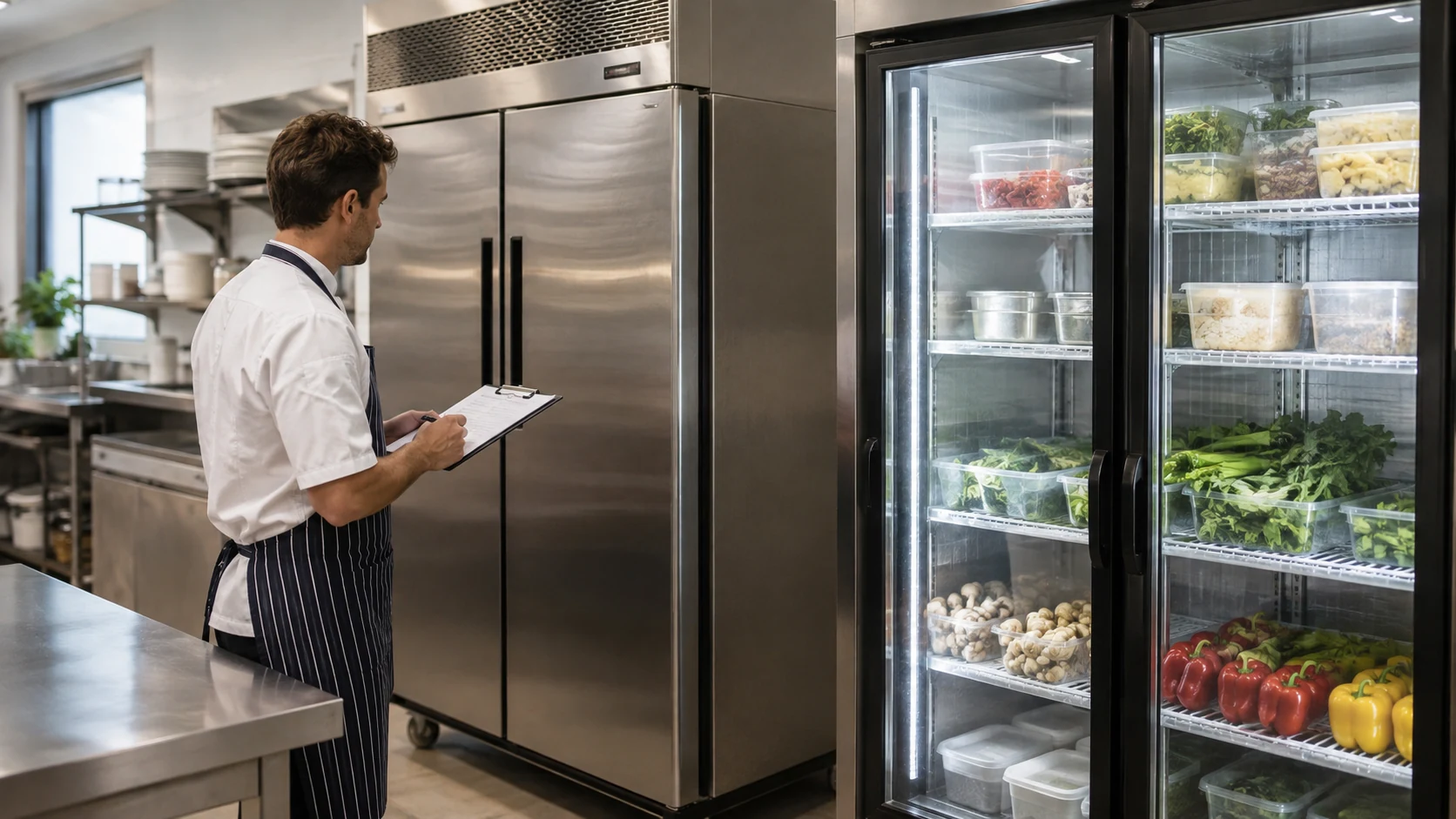
Your commercial fridge is rated for an ambient temperature that almost no Australian commercial kitchen actually has. The factory spec sheet quotes a tidy 25°C ambient room with 60% relative humidity. The real cookline at 1 pm on a January Saturday in Penrith sits at 44°C with the exhaust fans struggling. The gap between those two numbers is where $5,000 of wagyu, dairy, and prepped product gets quietly cooked overnight while the front of house wonders why the fridge "sounds louder than usual".
This is not a freak failure. It is a specification mismatch that happens every summer to operators who bought a fridge marked "commercial" without checking which climate class the manufacturer actually rated it to. The rating is on the nameplate inside the door, printed in 6-point type, and it is the single specification that determines whether your refrigeration survives an Australian summer.
This guide explains the ISO 23953 climate class system in plain English, walks through what happens thermodynamically when a Class 3 fridge sits in a Class 5 environment, and pulls out the insurance exclusion clause that turns a $2,400 stock loss into an uncovered loss. By the end you will know exactly which climate class your site requires, how to confirm it before buying, and the maintenance schedule that keeps your compressor alive past year three.
The 90-second climate class decision matrix
| Site profile | Typical ambient (summer peak) | Minimum climate class | Typical Australian description | Outcome if under-spec |
|---|---|---|---|---|
| Air-conditioned retail front (display only) | 22–25°C | Class 3 | "Standard commercial" | Works fine |
| Cafe back-of-house, separate room, cross-ventilated | 26–30°C | Class 4 | "Australian commercial" | Marginal in heatwaves |
| Cafe or restaurant on the cookline, near combi/fryer | 35–44°C | Class 5 | "Tropical" or "heavy duty" | Compressor failure within 18 months |
| QSR cookline, underbench fridge under salamander | 40–48°C | Class 5 with tropical compressor | "Cookline-rated" | Fridge dies within first summer |
| Northern Australia (Darwin, Cairns, FNQ) | 32–40°C ambient + 80% RH | Class 5 with anti-corrosion coating | "Tropicalised" | Coil corrosion + compressor failure |
| Coolroom in unconditioned plant room | 30–40°C | Heavy-duty Class 5 condensing unit | "Industrial" | Coolroom cannot pull down to setpoint |
If you are unsure where your kitchen sits on this matrix, the rule of thumb is: if you can feel radiant heat from a piece of cooking equipment standing in front of your fridge, you need Class 5. The manufacturer's ambient rating is measured in a still-air laboratory, not next to your double-stack combi.
Section 1 — The Mid-January Melt: a $5,000 stock loss in 18 hours
This is a real failure pattern we see between mid-December and mid-February every year. Names removed, sequence kept honest. Read it before you buy your next fridge.
10:00 am — The day looks normal
It is a Saturday in mid-January, Western Sydney. The Bureau of Meteorology forecast for Penrith is 41°C with a north-westerly. The cafe has the doors open for foot traffic, the cookline has a 4-burner induction running on two zones, a double-stack 6-tray combi finishing pastries, and a salamander on standby. The under-counter fridge under the salamander holds the breakfast and lunch prep — eggs, smashed avo mix, $400 of cured salmon, $900 of sliced beef and prosciutto, $300 of dairy. Total: about $2,400 of stock.
1:00 pm — The micro-climate hits 44°C
The kitchen exhaust hood is rated for 1,200 L/s but the make-up air supply is undersized. Heat builds along the cookline. The infrared probe at the cookline ambient reads 44°C. The under-counter fridge is rated Climate Class 3 — designed to operate up to 25°C ambient. It is now operating 19°C above its rated maximum. The compressor has been engaged continuously since 11:30 am.
3:00 pm — Head pressure climbs
The compressor discharge pressure rises with ambient temperature. At 25°C ambient the head pressure sits around 1,800 kPa. At 44°C ambient on the same refrigerant charge, head pressure climbs above 2,400 kPa. Current draw at the compressor windings goes up roughly 20% to maintain the same cooling output. The thermal overload klixon trips momentarily, the compressor restarts, and the cycle repeats. The internal cabinet temperature is now 11°C — already above the FSANZ Food Standards Code 3.2.2 maximum of 5°C for potentially hazardous foods.
5:30 pm — The evaporator freezes solid
Because the compressor has been running continuously without an effective defrost cycle, condensate has accumulated on the evaporator coil and frozen into a solid block of ice. Air can no longer circulate through the fins. The fridge is now insulated from its own cooling element. Internal temperature climbs to 16°C. The fridge alarm — if fitted — sounds. The operator notices because the espresso fridge in the front of house is also warm.
6:30 pm — Decision point
The operator calls a refrigeration technician. Saturday after-hours emergency call-out: $300 attendance fee plus $180/hour labour. The technician arrives at 8:15 pm, defrosts the coil manually with a heat gun, confirms the compressor windings are not yet burnt but the unit is operating outside its rated envelope, and recommends replacement. Total invoice: $620.
The next morning — Stock disposal
The operator photographs the stock, the cabinet temperature log if available, and contacts their local council Environmental Health Officer (EHO) for guidance. Anything that spent more than 4 hours above 5°C must be disposed of under FSANZ standards. The full $2,400 of stock goes in the bin. The cafe trades Sunday with a stripped-back menu, missing the brunch peak. Total commercial loss: $2,400 stock + $620 callout + roughly $1,800 of foregone Sunday revenue = $4,820. Round to $5,000 once you add the staff overtime to deep-clean the cabinet.
Two months later — The insurance claim
The operator lodges a stock spoilage claim with their commercial insurer. The adjuster requests the equipment compliance certificate, the cabinet's nameplate photograph, and the technician's failure report. The fridge is rated Class 3 (25°C ambient maximum). The site ambient at time of failure was 44°C. The claim is denied on the basis that the equipment was operated outside its rated environmental conditions, which is a standard policy exclusion under most stock spoilage covers. We explain why this is the rule in Section 7. The $5,000 is uninsured.
The entire chain of failures started with one purchasing decision two years earlier: choosing a Class 3 fridge because it was $1,200 cheaper than the Class 5 equivalent on the floor model. The 18 months of "we got a good deal" margin was erased in one January Saturday.
Section 2 — The Thermodynamics: Why Hot Ambients Kill Compressors
The physics of vapour-compression refrigeration is straightforward once you stop thinking of a fridge as a "cold box" and start thinking of it as a heat pump that moves heat from inside the cabinet to outside the cabinet. The compressor does the moving. Everything that makes refrigeration go wrong is a function of how hard the compressor has to work to dump heat into the surrounding air.
The four-stage loop in 60 seconds
Refrigerant gas enters the compressor at low pressure and low temperature, gets squeezed to high pressure (and high temperature) by the compressor piston, dumps that heat into the surrounding air via the condenser coil at the back or top of the fridge, condenses to a liquid as it cools, passes through an expansion valve that drops its pressure, evaporates back to a gas inside the cabinet by absorbing heat from the food, and returns to the compressor to start the cycle again. The condenser coil is where heat leaves the system. The condenser coil is also where high ambient air kills the cycle.
Why ΔT (the temperature differential) matters
For heat to flow from the condenser coil to the surrounding air, the condenser must be hotter than the air. The temperature differential, ΔT, is what drives the heat exchange. At 25°C ambient with a typical condenser running at 45°C, ΔT is 20°C — comfortable heat rejection, the compressor cycles on and off, life is good. At 44°C ambient, the condenser has to run at 60°C+ to maintain the same ΔT, which means higher head pressure, higher discharge temperature, higher current draw, and a compressor that runs continuously instead of cycling.
The compressor death spiral
Three things happen sequentially when a compressor runs continuously above its rated ambient:
- Head pressure climbs. Discharge pressure can exceed 2,400 kPa on a system designed for 1,800 kPa. The compressor's pressure relief is rarely engaged because the rise is gradual.
- Discharge temperature climbs. The gas leaving the compressor can exceed 100°C. The compressor oil at the bottom of the crankcase degrades, viscosity drops, and metal-on-metal wear accelerates inside the compressor.
- Windings overheat. The compressor's electric motor is cooled by the suction gas. With reduced cooling efficiency, the windings climb past their insulation rating (Class B = 130°C, Class F = 155°C). Insulation breaks down, a short develops between adjacent windings, and the motor fails. Typically the failure is one phase to ground, the thermal overload klixon trips repeatedly, and the unit shuts down for good.
The total time from "fridge is hot" to "compressor is dead" is rarely a single afternoon. It's usually 18 to 36 months of cumulative damage from operating just above the rated ambient, with one summer being the final straw. The operator experiences this as "the fridge was fine and then it just stopped" — but the technician opening it up will tell you the windings have been borderline for two summers. A cabinet that holds temperature in the morning and only loses it during service is showing this pattern, and our guide to why commercial fridges fail in hot kitchens walks through diagnosing it before you call a technician.
The R290 advantage at high ambient
Modern commercial fridges are increasingly running on R290 (propane) hydrocarbon refrigerant, which has thermodynamic properties that are particularly suited to high-ambient operation. Compared to legacy R134a, R290 has higher latent heat of vaporisation per unit mass, a flatter pressure-enthalpy curve, and lower discharge temperature for the same cooling output. In practice this means a R290 system at 40°C ambient maintains roughly 15-20% better coefficient of performance (COP) than a comparable R134a system. R290 also has a global warming potential (GWP) of just 3, against R134a's 1,430 and R404A's 3,922 — material under Australia's HFC phase-down obligations.
The catch: R290 is flammable, so its charge is capped by standard. The superseded 2010 edition held self-contained cabinets to 150 grams per circuit, which kept the technology in small under-counters. The current AS/NZS 60335.2.89:2020 (reissued with Amendment 1 in 2024) raised that to roughly 500 grams for self-contained cabinets, which is why R290 now turns up in larger uprights and display units. Cold rooms and most split systems still sit outside that allowance.
Section 3 — The Australian Climate Reality: Why Manufacturer Specs Underestimate
Most commercial refrigeration is designed and tested in Europe, where the climate baseline assumed by ISO 23953 is materially cooler and less humid than Australian summers. The Australian Bureau of Meteorology data tells the story.
The Sydney basin and the Western Sydney heat island
Sydney CBD's January average maximum sits around 26-27°C. Penrith and the Western Sydney basin run 5-7°C hotter on the same day because of the urban heat island effect, sparse tree cover, and topography that traps hot continental air. Penrith has recorded ambient temperatures above 47°C in recent summers; multiple Western Sydney suburbs routinely see consecutive days above 40°C in January and February. Bankstown, Parramatta, Liverpool, and Campbelltown all sit in the same heat envelope.
The Brisbane and SEQ humidity overlay
Brisbane summers run cooler than Western Sydney in absolute terms (high 30s rather than mid 40s) but with significantly higher relative humidity — 70-85% during the wet season. High humidity matters for refrigeration because it affects two things: the condenser's ability to reject heat (humid air carries more enthalpy, reducing effective ΔT) and the cabinet's susceptibility to condensation on glass doors and gaskets. SEQ operators need Class 5 with anti-condensation heating on glass-door cabinets, not just a hot-rated compressor.
Tropical North Australia: Darwin, Cairns, the Top End
The wet season in Northern Australia combines ambient temperatures in the low 30s with relative humidity above 80% and frequent salt-laden coastal air. Standard commercial refrigeration corrodes within 3-5 years in this environment. Cabinets specified for the tropical north should have anti-corrosion coating on the condenser coil (epoxy, blygold, or equivalent), stainless-steel external panels rather than painted steel, and ideally a hot-gas defrost system rather than electric defrost. Operators fitting out in the tropical north have a further set of traps to plan for, which we cover in the Queensland fit-out guide.
Adelaide, Mildura, and the interior
South Australia and the inland regions get the hottest temperatures in Australia but with low humidity. Mildura, Renmark, and the Riverland routinely hit 45°C in summer with single-digit relative humidity. Low humidity is actually easier for refrigeration than high humidity at the same temperature because the condenser rejects heat more efficiently into dry air. The challenge in these regions is the absolute temperature — Class 5 is mandatory, but anti-corrosion is less critical than in coastal regions.
The radiant heat layer most operators ignore
The temperatures above are ambient air temperatures measured in standard weather stations 1.2 metres above ground in shade. The temperature inside a commercial kitchen, on the cookline, next to operating equipment, is materially higher than the outside ambient. Field measurements from cafe fit-outs we've assessed show kitchen cookline ambient consistently 8-15°C above outdoor ambient during peak service (see our companion guide on commercial fryer ventilation and clearances). On a 35°C Western Sydney day, the cookline ambient where the under-counter fridge sits can easily reach 48-50°C. The fridge's nameplate climate class rating refers to the air immediately surrounding the cabinet, not the weather forecast.
This is why the rule "Class 5 if you can feel radiant heat from cooking equipment" is more useful than reading the BOM forecast. The forecast tells you the outdoor weather. The position of your fridge relative to your salamander tells you the fridge's actual operating environment.
Section 4 — ISO 23953 Climate Class Decoded
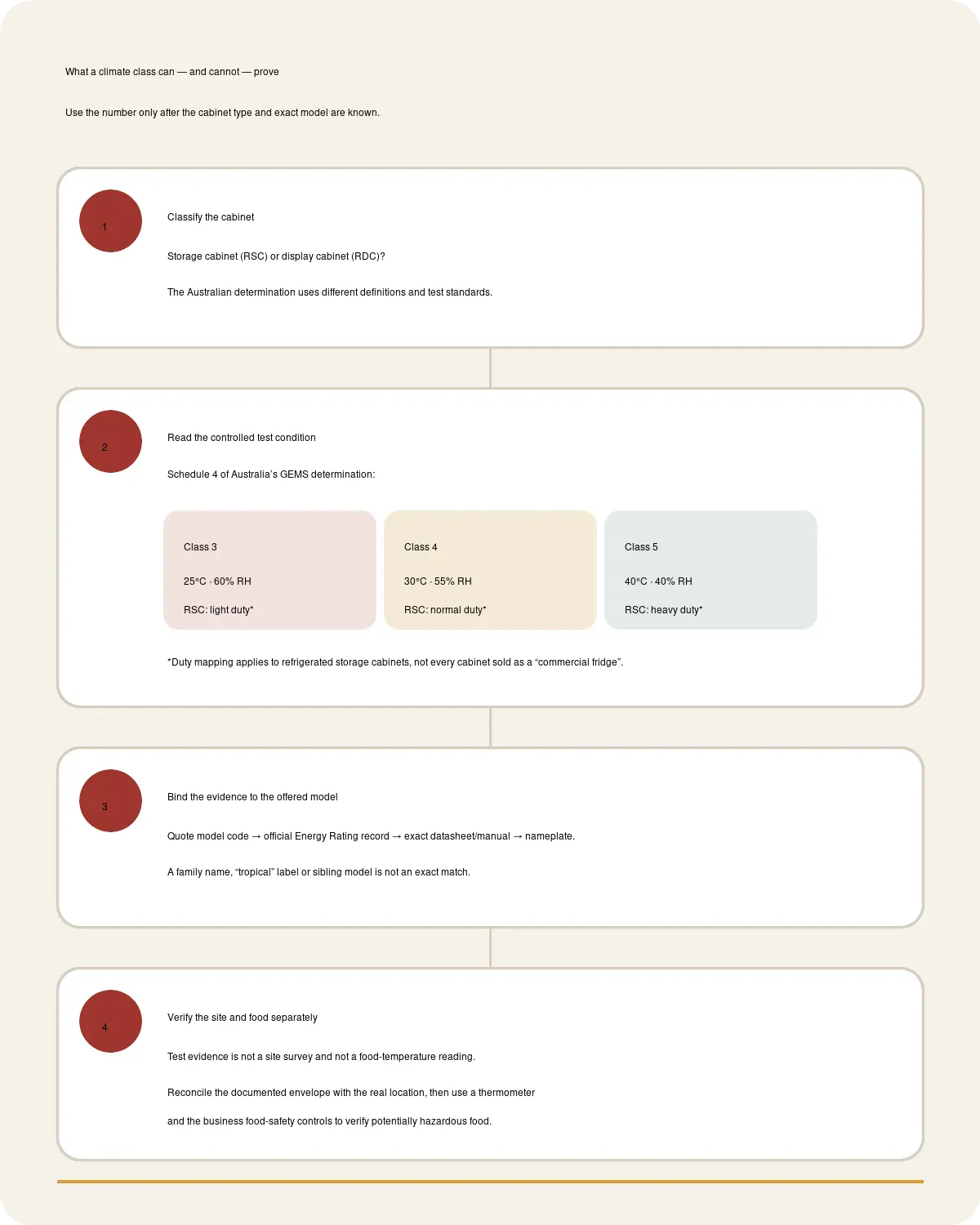
The international standard ISO 23953 (and its predecessor ISO 1496) defines the climate classes that appear on commercial refrigeration nameplates worldwide. The standard specifies an ambient temperature and a relative humidity that the cabinet must be capable of operating within while maintaining its internal temperature setpoint. Below is the practical Australian decoding.
| Climate class | Test ambient | Test humidity | Real Australian use case | Premium over Class 3 |
|---|---|---|---|---|
| Class 0 | 20°C | 50% RH | Laboratory only — not a commercial spec | n/a |
| Class 1 | 16°C | 80% RH | Cellar / temperature-controlled storage | n/a |
| Class 2 | 22°C | 65% RH | Air-conditioned retail back-of-house | None — cheaper |
| Class 3 | 25°C | 60% RH | Air-conditioned retail front, gentle environment | Baseline |
| Class 4 | 30°C | 55% RH | Cafe back-of-house, separate prep area, decent ventilation | +10-15% |
| Class 5 | 40°C | 40% RH | Active cookline, kitchens with limited ventilation, regional Australia | +25-40% |
| Class 6 | 27°C | 70% RH | Humid retail (rare in Australian commercial) | +15% |
| Class 7 | 35°C | 75% RH | Hot humid kitchens, coastal Northern Australia | +30-45% |
What "tropical rated" actually means
Australian importers use the term "tropical" loosely, and you should treat it with caution. A genuine tropical rating means Class 5 or Class 7, tested to those parameters, with documentation. A fridge sold as "tropical-style" or "suitable for hot climates" without a printed climate class on the nameplate is almost certainly Class 3 or Class 4 with marketing copy attached. What a genuine tropical rating buys you, and how to read past the marketing, is set out in our tropical-rated refrigeration guide.
What to look for: the nameplate inside the door (often near the top right) will print a single character — typically "3", "4", or "5" — under the "climate class" or "climate" heading. If the nameplate does not mention climate class at all, the cabinet does not have a verified rating and should be treated as Class 3 by default.
The under-spec failure curve
Operating a fridge above its rated climate class does not cause instant failure. It causes accelerated degradation. The empirical pattern we see in service records:
- Class 3 in Class 4 environment: compressor failure typically year 4-5 instead of year 8-10
- Class 3 in Class 5 environment: compressor failure year 2-3, evaporator fan motor failures from year 1
- Class 4 in Class 5 environment: compressor failure year 4-5 instead of year 8-10, gasket degradation accelerated
- Class 5 in Class 5 environment: full design life, typically 8-12 years on the compressor
The economics of buying Class 5 for a Class 5 environment are unambiguous once you amortise replacement costs across the lease term. The 25-40% premium on the equipment is recovered before the first replacement cycle of the cheaper alternative.
Section 5 — The Cake Display Trap: Glass, Humidity, and Open Doors
Cake displays and dessert cabinets fail differently to general refrigeration because they are designed to be looked at, not just stored. The glass, the lighting, and the open-front or curved-glass design that makes the product visible to customers also makes the cabinet thermally compromised compared to a solid-door upright. The failures in cake displays are typically not compressor death but product quality problems — condensation on the glass, fogged-up product, frost on the back wall, and temperatures that drift above 5°C during open-door peaks.
The relative humidity redline
Cake displays are typically positioned near the entry of a cafe or front-of-house counter, which means they see the building's incoming external air. On a humid Sydney or Brisbane summer day, every customer who walks in pulls 80% RH air across the display. The glass surface, which is being cooled from the inside, drops below the dew point of the incoming air, and condensation forms on the outside of the glass. Within 30 minutes the display is fogged, the cakes are no longer visible, and the cabinet is fighting both the radiant heat and the latent heat of condensation.
Properly specified cake displays have anti-condensation heaters embedded in the glass and the door frames — fine resistive wires that keep the glass surface just above dew point. These add about 80-150W of continuous load but eliminate fogging. Cheap imported displays often omit this feature to save cost, then fail in their first Australian summer.
The FSANZ classification trap
Cake displays sold as "pastry display" or "ambient display" are often rated for non-hazardous products only: dry pastries, biscuits, chocolates. They are not rated to hold dairy-based or meat-based products, which under FSANZ Food Standards Code 3.2.2 are classified as "potentially hazardous foods" and must be held at or below 5°C. If a display sold as a "pastry case" cannot guarantee 5°C in the middle of a January afternoon with the doors of the cafe open, holding a cream-filled item in it is a food safety breach that an EHO will write up.
The decision rule: any open-front display holding cream, custard, dairy, or meat products requires Class 4 or Class 5 rating and active anti-condensation heating, regardless of the marketing description on the supplier's website. The "pastry" rating sits in the Class 2 or Class 3 envelope and is for ambient display of stable products only.
The position is the spec
A correctly specified cake display positioned in a hot draft from the front door of a cafe will still fail to perform. The position is part of the specification. Site the display at least 2 metres from external doors, away from direct sunlight through windows, and outside the airflow of any air-conditioning supply diffuser. The display's nameplate ambient assumes none of these stressors. Add them and the cabinet runs continuously, the back wall ices up, and within a week the operator is calling the technician.
Section 6 — Coolroom Airflow Physics: Why a Full Coolroom Stops Cooling
Walk-in coolrooms and freezer rooms operate on the same vapour-compression cycle as a standalone fridge, but the physics of getting cold air to the product is completely different. In a small cabinet, the evaporator is centimetres from the food. In a 3-by-2 metre coolroom, the evaporator fan has to push cold air across the entire room, around the stock, and back to the evaporator return. Anything that blocks that circulation pattern stops the room from cooling.
The wall-pack mistake
The single most common coolroom failure mode is operators stacking boxes flush against the wall directly under the evaporator. The evaporator fan blows cold air down and across, expecting to return to the suction side via the gap between the stock and the walls. Boxes stacked tight to the wall block this return path. The fan continues running but moves no air. Front zones of the room stay cold; the back corners climb above 5°C. The probe sensor on the evaporator might still read 2°C while the meat on the back wall is at 9°C.
The remediation is 100mm of clear air space behind every shelf, and 50mm between vertical stacks of stock. This requires the right shelving — open-grid epoxy-coated wire shelving rather than solid panels — and disciplined storage practice. Solid shelves, solid pallets, and cardboard boxes pushed flush kill coolroom performance more reliably than any compressor problem. Pair the airflow discipline with quality epoxy-coated coolroom shelving rated for high-density commercial use and the room hits setpoint reliably.
The door-seal slow leak
Coolroom door seals (gaskets) are the second largest cause of coolroom performance loss. A gasket that has hardened, cracked, or pulled away from the door panel admits warm humid air continuously. The compressor runs longer, the evaporator ices up faster, and energy costs climb. A simple test: place a piece of A4 paper across the door seal, close the door, and try to pull the paper out. If it slides out easily, the gasket has lost its grip and should be replaced. Cost: $200-400 per door. Saving: typically $400-800 per year in electricity plus the avoided compressor cycle hours.
The defrost cycle and hot ambient interaction
Coolrooms running in hot ambient plant rooms (a common Australian setup where the condensing unit lives on a roof or in an unconditioned mezzanine) face a compounding problem: longer defrost cycles to clear ice from the evaporator, longer recovery cycles to pull room temperature back down after defrost, and reduced condenser efficiency throughout. Hot-gas defrost — where hot refrigerant from the discharge line is briefly routed back through the evaporator to melt frost — recovers faster than electric defrost and is worth specifying for any coolroom that handles high-traffic ingress in summer.
Section 7 — The Insurance Exclusion Nobody Reads
This section is the most expensive paragraph in this guide. We have rarely seen it surfaced clearly in equipment buying advice, and yet it determines whether a stock-loss event becomes a covered insurance claim or an uninsured operational loss.
What stock spoilage cover actually covers
Most Australian commercial property and business interruption policies include a stock spoilage extension for refrigerated and frozen stock. The headline cover typically reads something like: "loss of refrigerated stock following accidental breakdown of refrigeration equipment, up to $X per claim, $Y annual aggregate". The numbers look reassuring. The exclusions, which sit in the policy schedule and the underlying product disclosure statement, are where the cover narrows.
The standard exclusions that catch operators
Three exclusions appear in nearly every Australian stock spoilage policy and are the basis for the majority of declined claims we have seen:
- Equipment operated outside manufacturer's specifications. If the cabinet was rated Class 3 and the loss assessor measures or estimates the operating ambient above 25°C, the equipment was operated outside specification and the loss is excluded.
- Lack of maintenance documentation. Policies typically require evidence of regular maintenance — condenser coil cleaning, gasket inspection, temperature log records. Operators who cannot produce a maintenance log are often denied on this clause alone, regardless of the failure mode.
- Wear and tear or progressive deterioration. Compressor failures from cumulative high-ambient operation can be classified as "progressive deterioration" rather than "accidental breakdown", which is excluded under most policies.
The combined effect of these three exclusions is that an under-spec fridge failing in summer heat with no maintenance log is almost certainly going to deliver an uninsured stock loss. Operators discover this only when the claim is denied — usually 4-8 weeks after the event, by which point the cash flow gap is real.
What to do before you have a claim
Three actions that materially shift the insurance outcome:
- Match the climate class to the site. If your insurer or broker reviews the equipment, the nameplate class must match the operating environment. A Class 5 cabinet in a Class 5 environment is uncontestable. A Class 3 in a Class 5 environment is the foundation of a denied claim.
- Keep a maintenance log. Quarterly condenser coil cleaning, annual gasket check, annual refrigerant charge check by a licensed refrigeration mechanic. Keep the invoices in a folder with the equipment compliance certificate.
- Install temperature monitoring. A digital temperature logger ($150-400) records the cabinet's internal temperature continuously. If a claim ever arises, the log establishes the failure timeline objectively rather than relying on the operator's recollection. Several Australian insurers now offer a premium discount for operators who maintain continuous temperature logs.
The conversation to have with your broker, before any claim: "Are my refrigeration cabinets rated for the operating environment in my kitchen, and what evidence will you need from me at claim time?" The broker's answer is the cheapest insurance review you can run.
Section 8 — The Maintenance Schedule That Saves Compressors
Almost every commercial refrigeration failure traces back to one of three preventable maintenance lapses. The schedule below is the minimum that keeps a commercial cabinet running through its design life and keeps an insurance claim defensible.
Step 1 — Clean the condenser coil every 90 days
The condenser coil is the radiator at the back or top of the fridge that rejects heat from the refrigerant. In a commercial kitchen, this coil pulls in dust, grease aerosol, flour particulate, and whatever else floats in the air. Within 90 days the coil is partially insulated by debris. With each additional layer of dust, ΔT drops, the compressor runs longer, and energy consumption rises 5-15%. After 12 months of no cleaning, condenser efficiency can be 30% below baseline and the compressor is operating in an artificial high-ambient envelope of its own making. The same neglect shows up on the power bill, which we trace in why your electricity bill is higher than last year.
The cleaning process: power off the cabinet, remove the rear or top access panel, vacuum the coil with a soft brush attachment, then blow out residual dust with compressed air. Do not bend the coil fins. Total time: 15-20 minutes per cabinet. Skill: any kitchen staff member can do it. Frequency: every 90 days, more often in dusty environments (bakeries with flour, butchers with paper trim).
Step 2 — Inspect door gaskets monthly
Run the A4 paper test on every door of every refrigerated cabinet at the start of each month. Replace any gasket that fails. Document the inspection in the maintenance log even when no replacement is required — the log itself is the evidence.
Step 3 — Check evaporator drainage quarterly
Condensate from the evaporator drains through a small tube to either an external pan that evaporates or a plumbed drain. If the drain blocks, condensate backs up and pools in the cabinet base, then leaks onto the floor. Operators report this as "the fridge is leaking water" without realising the drain is the cause. Clean the drain tube with warm water and a flexible brush every quarter. Cost: $0. Avoided cost: floor damage, slip incidents, and refrigerant leak misdiagnosis.
Step 4 — Annual licensed refrigeration mechanic service
Once a year, a licensed refrigeration mechanic (ARC-licensed under the Refrigerant Handling Licence scheme) should inspect refrigerant charge, evaporator coil condition, compressor amp draw under load, control board function, and door seal integrity. Typical cost: $250-450 per unit. The service produces a written report that becomes the insurance maintenance evidence.
Step 5 — Temperature log review monthly
If you have temperature loggers, download and archive the data monthly. Look for any cabinet trending warmer over time — this is the early signal of compressor degradation or coil fouling, well before the cabinet visibly fails. A 1-2°C upward drift in mean cabinet temperature month-over-month is the cue to investigate before the next summer.
Section 9 — Seven Operator Mistakes That Quietly Destroy Refrigeration
The pattern of failure across hundreds of commercial kitchens we have seen comes down to these recurring mistakes. None of them are obvious in the moment. All of them are expensive.
Mistake 1 — Buying on price without checking the climate class nameplate
The $1,200 saving on a cheaper fridge is borrowed from your future operations budget at 100% interest. A Class 3 cabinet at $3,800 versus a Class 5 cabinet at $5,200 looks like a $1,400 saving on day one. By month 30, the Class 3 has failed once ($5,000 stock loss + replacement), and the running cost was 15-20% higher throughout. The true cost of the cheaper unit is approximately $7,000 above the Class 5 price. Always read the nameplate.
Mistake 2 — Positioning the fridge next to cooking equipment
Under-counter fridges placed directly under salamanders, next to fryers, or beside char-grills sit in radiant heat envelopes that far exceed the cabinet's rated ambient. The kitchen designer who specified the layout was thinking about workflow, not thermodynamics. Insert a stainless steel heat baffle, relocate the fridge, or specify Class 5 with a tropical compressor — but do not pretend the position does not matter.
Mistake 3 — Skipping the make-up air calculation
Commercial kitchen exhaust hoods extract air; that air must be replaced by make-up air supplied through the ventilation system. If make-up air is undersized, the exhaust draws hot air across the cookline from anywhere it can — including across your refrigeration. A properly sized make-up air system keeps cookline ambient 5-8°C cooler than an undersized one. The mechanical engineer's report from the fit-out should specify make-up air at 80-90% of exhaust capacity. Getting the clearances and make-up air right at install is covered step by step in our ventilation and clearances checklist.
Mistake 4 — Letting the condenser coil go a year between cleans
Detailed in Section 8. Cost of skipping: 30% efficiency loss after 12 months, compressor cycle hours doubled.
Mistake 5 — Buying a glass-door display for the wrong position
Glass-door displays in front-of-house positions face condensation, heat ingress from external doors, and customer-open-door cycles. They need active anti-condensation heating and Class 4 or 5 rating. A back-of-house glass display in an air-conditioned space is fine on Class 3. Position determines spec.
Mistake 6 — Stacking the coolroom against the walls
Detailed in Section 6. The fix is shelving discipline and 100mm air gaps, not a bigger compressor.
Mistake 7 — Ignoring the gasket until it fails
A failed gasket can add 20-30% to running costs and accelerate evaporator icing. Monthly inspection takes 30 seconds per door. The annual cost of not doing it is hundreds of dollars in energy plus the eventual compressor stress from continuous operation.
Section 10 — Frequently Asked Questions
Why is my commercial fridge leaking water from the bottom?
The most likely cause is a blocked evaporator condensate drain. The drain tube, which carries condensate from the evaporator pan to either an evaporation tray or a plumbed drain, can clog with dust, biofilm, or food debris. Condensate then overflows the internal pan and pools at the base of the cabinet. Clean the drain tube with warm water and a flexible brush. If the leak persists after the drain is clear, the next likely cause is a cracked or perished door gasket allowing warm humid air to enter and condense inside the cabinet — replace the gasket.
What does Climate Class 5 mean for Australian commercial fridges?
Climate Class 5 under ISO 23953 means the cabinet is tested and rated to operate in an ambient environment up to 40°C and 40% relative humidity while maintaining its internal setpoint. In Australian practice, Class 5 is the minimum specification for any fridge placed on an active commercial cookline, in regional or Western Sydney sites, or in any environment where radiant heat from cooking equipment is present. Class 5 cabinets typically use heavier-duty compressors, higher CFM evaporator fans, thicker cyclopentane foam insulation, and condenser coils sized for higher head pressure. Expect to pay 25-40% more than the Class 3 equivalent.
How often should I clean a commercial fridge condenser coil?
Every 90 days in a typical commercial kitchen environment. More frequently — every 30-45 days — in bakeries (flour dust), butchers (paper trim and fat aerosol), or any kitchen with heavy frying operations. A dust-loaded condenser coil reduces heat rejection efficiency by 5-15% per layer of debris, drives the compressor into longer cycles, and increases annual electricity consumption by 10-30%. The cleaning is a 15-20 minute task per cabinet using a soft brush and a vacuum.
What is the difference between Class 4 and Class 5 commercial fridges?
Class 4 is rated for 30°C ambient and 55% relative humidity; Class 5 is rated for 40°C ambient and 40% relative humidity. The practical difference is in the compressor specification, the condenser coil size, and the evaporator fan motor. A Class 5 unit can sustainably operate in environments that would cause a Class 4 unit to run continuously and eventually fail. For Australian commercial kitchens with active cooklines, Class 5 is the safe specification. Class 4 is acceptable for separate back-of-house prep rooms with proper ventilation.
Is R290 refrigerant safe in commercial kitchens?
Yes, when the cabinet is built and installed to Australian Standard AS/NZS 60335.2.89. R290 (propane) is flammable, so the safety case rests on design rather than the charge being too small to burn: the refrigerant runs in a sealed, hermetic circuit away from any ignition source, the cabinet is built and tested so a foreseeable leak disperses rather than pools, and only a licensed refrigeration mechanic opens the circuit. The current standard, AS/NZS 60335.2.89:2020 (reissued with Amendment 1 in 2024), permits self-contained cabinets up to roughly 500 grams per circuit, up from 150 grams under the superseded 2010 edition. The benefit in Australian conditions is materially better high-ambient performance and a global warming potential of 3 versus R134a at 1,430, which is why R290 now dominates new self-contained refrigeration, including larger uprights and display units.
Will my insurance cover stock loss if my fridge fails?
It depends on the policy, the failure mode, and crucially the climate class of the equipment relative to the operating environment. Most Australian stock spoilage policies exclude "equipment operated outside manufacturer's specifications" and "progressive deterioration". A Class 3 fridge failing in a Class 5 environment will typically be denied on the first exclusion. A maintained Class 5 fridge failing from an unforeseen compressor defect is typically covered. Speak to your broker before you have a claim, and confirm the documentation they require: nameplate photographs, maintenance log, temperature records.
What is "tropical rated" and is it the same as Class 5?
"Tropical rated" is an Australian industry term, not an ISO classification. Most reputable suppliers use "tropical rated" to mean Class 5 (40°C ambient) or Class 7 (35°C with 75% humidity) with documentation. Cheap importers sometimes use the term as marketing copy on cabinets that are actually Class 3 or Class 4. The reliable indicator is the nameplate inside the door, which prints the actual climate class. If the cabinet does not have a climate class on its nameplate, treat the "tropical" marketing description as unverified.
How long should a commercial fridge last in Australia?
A correctly specified, well-maintained Class 5 commercial cabinet should run 10-12 years on its original compressor in a standard commercial kitchen. An under-spec cabinet operated above its rated ambient typically fails at 3-5 years. A correctly spec'd cabinet that is never maintained (condenser coil never cleaned, gaskets never replaced) typically fails at 6-7 years. Maintenance is the multiplier between specification and lifespan — a well-maintained Class 4 will outlast an unmaintained Class 5 in many environments.
The Tropicalised Verdict: Why Class 5 Is the Only Honest Specification
The single decision that determines whether your commercial refrigeration lasts a lease term in Australia is matching the climate class to the operating environment. Class 3 is for air-conditioned retail. Class 4 is the minimum for any commercial kitchen back-of-house. Class 5 is the only honest specification for any cabinet positioned on a working cookline, in a regional Australian site, or in any environment where radiant heat from cooking equipment can be felt at the fridge's location.
The premium for Class 5 over Class 3 is typically 25-40% at point of sale. The total cost of operating an under-spec cabinet over a 5-year lease term — accounting for accelerated compressor failure, elevated energy consumption, uncovered stock loss events, and the daily revenue impact of equipment downtime — routinely exceeds the original purchase price of the cabinet. The maths is not subtle.
If you are at the equipment specification stage of a fit-out and want a sanity check on whether the cabinets in your shortlist match the operating environment they are about to live in, the team at KW reviews kitchen layouts and ambient profiles routinely. Send us a photograph of your kitchen line, a description of the cooking equipment within 2 metres of the proposed fridge position, and your equipment shortlist; we will return a site-aware tropicalised refrigeration shortlist calibrated to the real ambient your kitchen will produce in mid-January, not the laboratory ambient the manufacturer tested in.
Two-business-day dispatch on stocked Class 5 commercial refrigeration applies once your site profile and specification are confirmed. The cost of getting the spec wrong is paid by January. The cost of getting it right is recovered by year three.
This guide reflects general principles for commercial refrigeration in Australian operating conditions and references ISO 23953 climate class standards, FSANZ Food Standards Code 3.2.2, and AS/NZS 60335.2.89 for hydrocarbon refrigerant systems. It is not a substitute for a licensed refrigeration mechanic's site-specific assessment, which is recommended for any new installation or specification review. KW Engineering Team — 20+ years of Australian commercial kitchen refrigeration specification.