
Commercial Crepe Maker Capacity Planning: Test the Service System Before You Buy
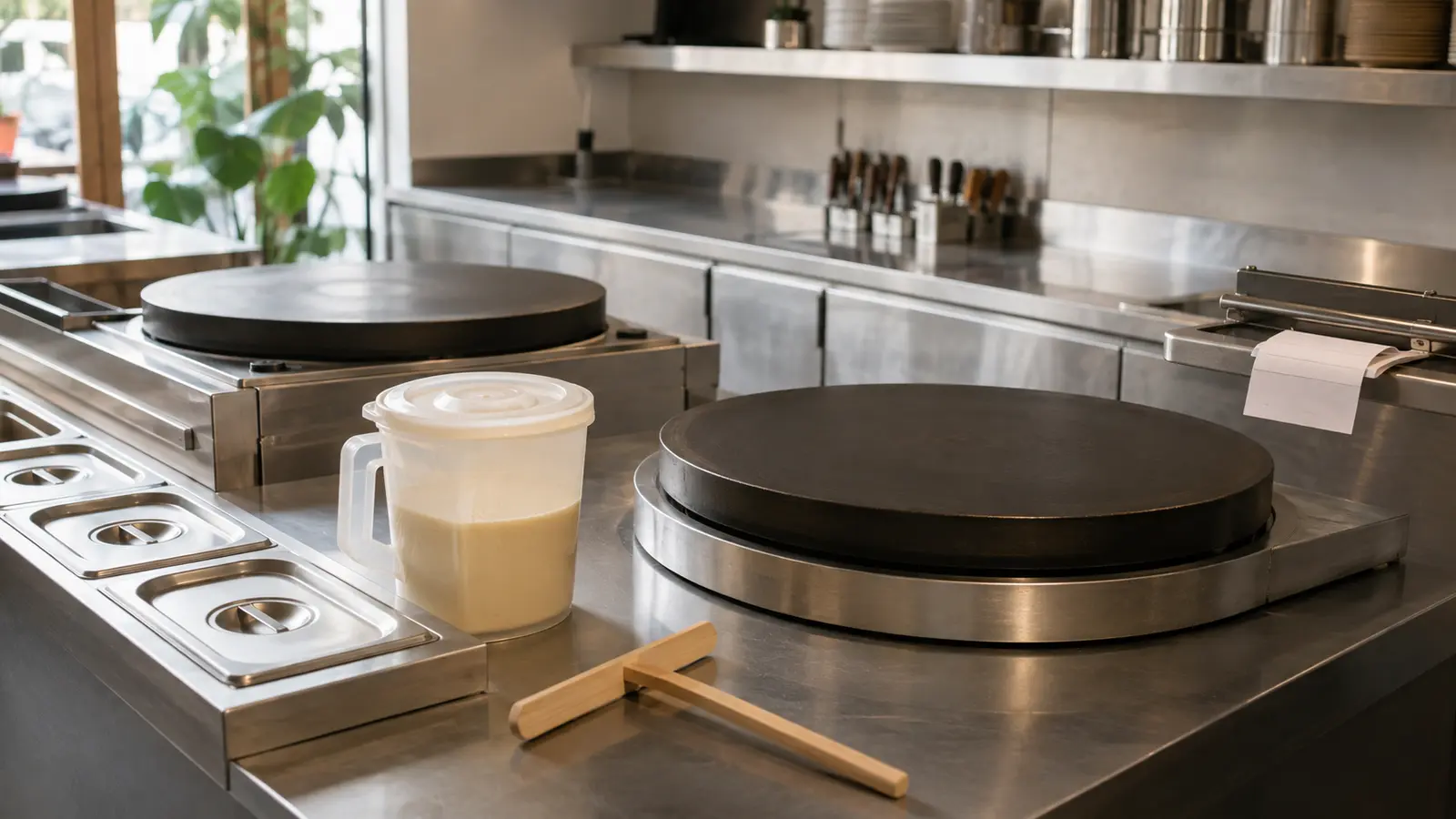
A second plate is useful only when the plate is what makes the queue late. In made-to-order crepe service, the delay may instead sit with spreading, turning, filling, garnishing, packing, order identification or the person trying to do several of those jobs at once.
Treat the station as a chain of occupied resources, not as a machine with a headline output. Capture one real rush, find the first resource that misses the venue's service target, then test whether one plate, a dual unit or independent machines actually removes that failure without creating another one.
The hot plate may not be the bottleneck
Daily covers hide the queue that matters. The same total number of crepe orders can be spread across a long day or concentrated into a short rush, and each shape asks a different question of the station.
The product mix changes the question again. A simple spread-and-serve item does not occupy the plate, operator and finishing bench in the same way as a filled, folded and garnished order. Two plates add hot surface; they do not automatically add another pair of hands or another clear place to finish the order.
The decision therefore starts with a tension the equipment label cannot resolve: is the queue waiting for a plate, or is the plate waiting for the rest of the station?
Turn one real rush into a timeline
Choose an interval short enough to expose how orders bunch. Use reliable point-of-sale timestamps or a structured manual count, and keep the menu item beside each order. An hourly average erases the bunching you are trying to plan for.
Then time three clocks on the intended process:
- Plate-occupied time: from the moment the surface becomes unavailable until it is genuinely ready for the next order, within the exact manual's operating limits.
- Operator touch time: dispensing, spreading, turning, removing and any intervention that prevents that operator advancing another order.
- Filling and hand-off time: filling, folding, garnishing, packing, identifying the order and handing it across the pass.
Record when those clocks overlap and when they cannot. That overlap is where a plausible plate calculation either becomes a workable service plan or falls apart.
Use plate load as a warning light, not a capacity promise
For each meaningful menu group and peak interval, keep the units consistent:
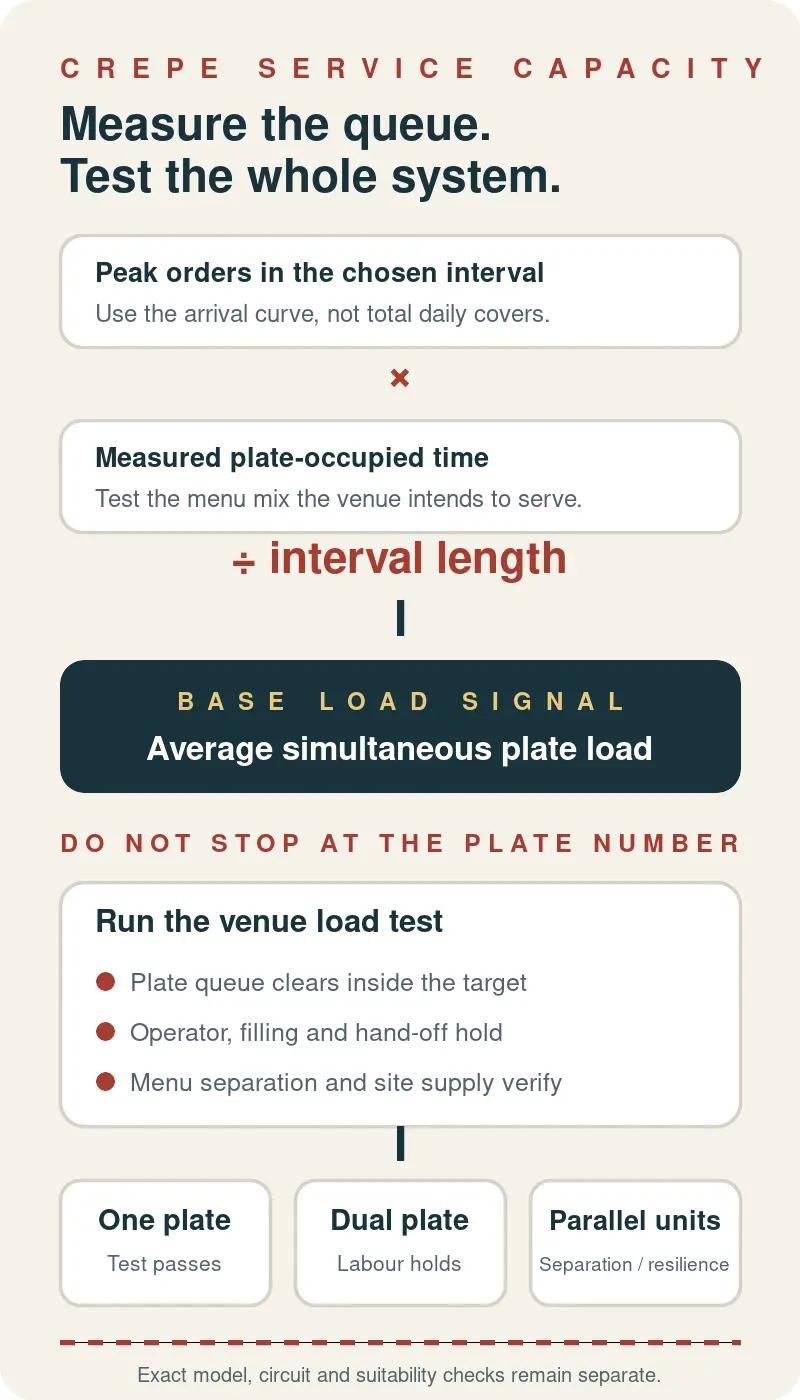
average simultaneous plate load = orders in the interval × measured plate-occupied time ÷ interval length
A result above one says that one plate cannot clear even the average plate workload in that interval. A result below one does not prove that one plate will meet the service target: orders bunch, timings vary, resets occur, and the operator or finishing bench may still control the queue.
Preserve the raw arrivals and timed observations. The useful evidence is not the tidy quotient; it is the ability to replay the same demand against a different station arrangement.
Let the first failed constraint choose the route
Replay the recorded arrival curve with the intended batter and menu sequence. Follow the exact equipment instructions and include ordinary cleaning and reset actions. Define the venue's order-to-hand-off target before the trial, then record order arrival, plate start, plate release, hand-off, queue length, operator, rework and the first point that falls behind.
Reject a flattering demonstration that uses an easier demand sequence, silently skips work or cannot be repeated. The representative load-test sequence needs to make the whole station carry the real rush.
| Observed result | Route worth testing next | What would disprove it |
|---|---|---|
| The complete queue clears inside the target and remains stable. | Keep one plate in contention. | Bunched orders, recipe variation, reset time or the absence of a resilience plan breaks the repeat trial. |
| The plate queue fails while operator and finishing capacity remain available. | Test a dual-plate arrangement. | One operator cannot spread or turn both surfaces, the finishing bench backs up, or the combined site load does not fit. |
| Two staffed positions, separation or resilience are distinct operating jobs. | Test independent parallel machines. | Bench, circuits, cleaning, communication or labour cannot support genuine independent operation. |
| The operator or finishing bench fails before the plate. | Repair the workflow before adding hot surface. | A repeat test proves plate occupation was actually the limiting resource. |
These are test routes, not product recommendations. Plate count, diameter, installed format, controls and electrical load still belong to the exact current manual, PDP and site check. None of those fields supplies the venue's throughput.
Some constraints cannot be averaged away
If the menu makes allergen-related representations or uses different batters, write the intended separation workflow before turning another surface into a capacity benefit. Ingredients, storage, utensils, dispensing, plate use, finishing surfaces, order identification, staff communication and cleaning all remain part of the business's control.
Food Standards Australia New Zealand advises food-service businesses to implement an effective allergen-management program, train staff and provide clear, current allergen information. Plate separation alone is not evidence that an order is safe for a person with an allergy.
Electrical supply is another veto, not an average. Confirm the exact proposed model's voltage, phase, current, connection, clearances and ventilation from current manufacturer evidence. Then use the governed commercial-kitchen power decision guide to frame the site questions and have a licensed electrician assess installed capacity where electrical work or judgement is required.
Take the failed constraint into the commercial conversation
A useful enquiry does not begin “single or double?”. It carries the peak orders and menu mix, measured plate-occupied time, operator-touch and finishing times, the plate-load calculation, the representative trial record, the first failed constraint, the separation plan, the bench envelope and the verified site-supply question.
If bench sequence, services or hot-surface interaction is still unresolved, take that evidence to KW's Kitchen Design team. If the complete station test points to more cooking surface, use the commercial waffle makers and crepe makers range to identify exact models whose configuration can be checked against the same trial.
A worthwhile shortlist is one that can explain how it deals with the bottleneck you actually observed. If it cannot, its plate count is just another number.