
Commercial Dishwasher Leaving Dishes Dirty? Safe Checks Before Calling for Service
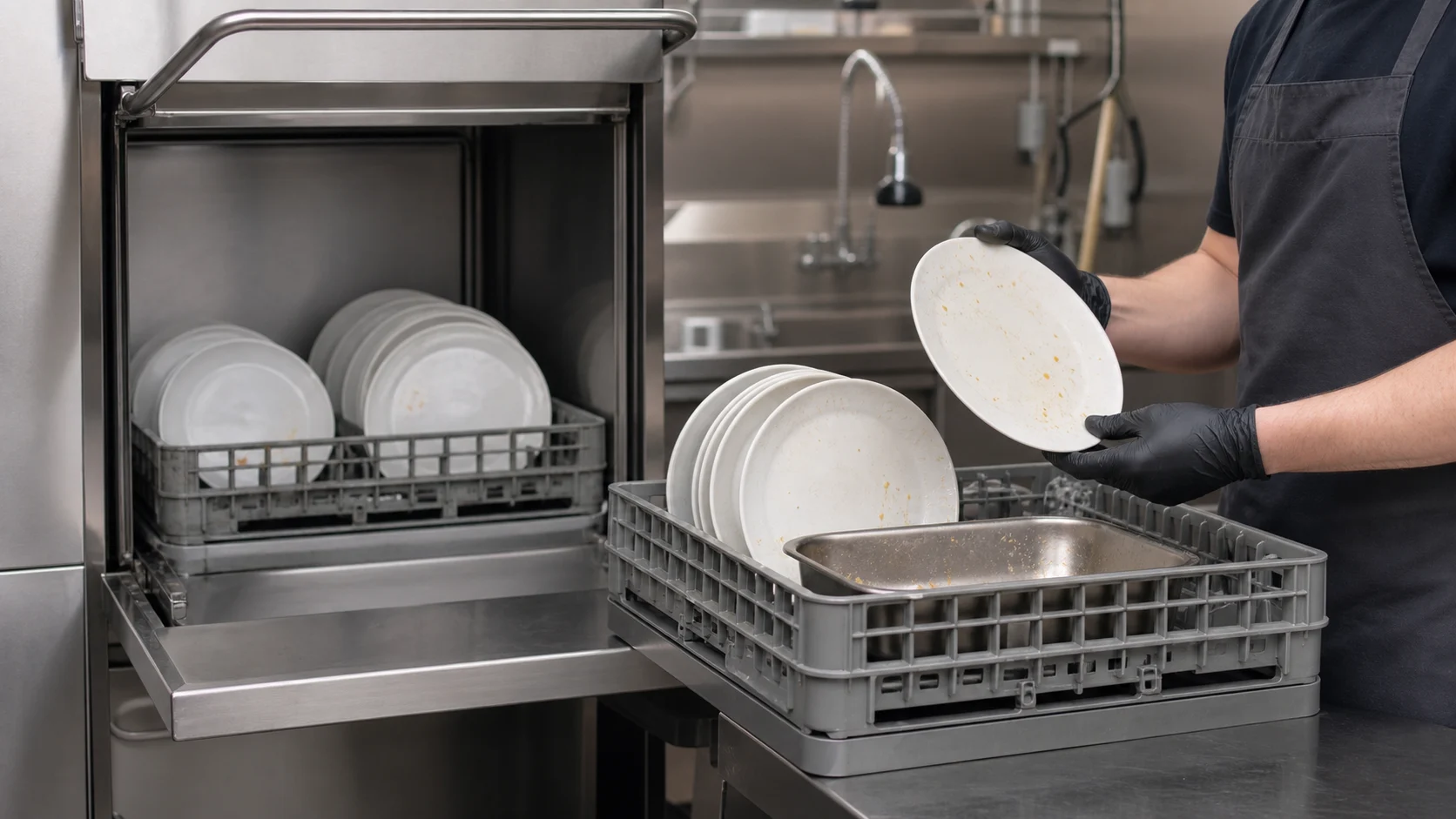
Quick answer: When a commercial dishwasher completes its cycle but the ware is still visibly dirty, do not start by adding detergent or changing settings. First identify what remains, where it appears in the rack and when the result gets worse. Correct obvious loading and scraping problems, clean only the filters or wash arms that the exact model manual assigns to the operator, confirm the approved chemical supply is present, and record the display and error code. A repeated pattern gives the chemical supplier or service technician much better evidence than “the dishwasher is not cleaning.”
Scope: This guide covers visible food soil, grease and residue after a completed cycle. If the chamber retains water, use the commercial dishwasher not-draining guide. If otherwise clean ware has white film, streaks or spots, follow the water-quality and chemical pathway. A temperature warning belongs with the machine manual and a qualified technician, not a remote compliance conclusion.
Is It Food Soil, Grease, Film or a Machine Warning?
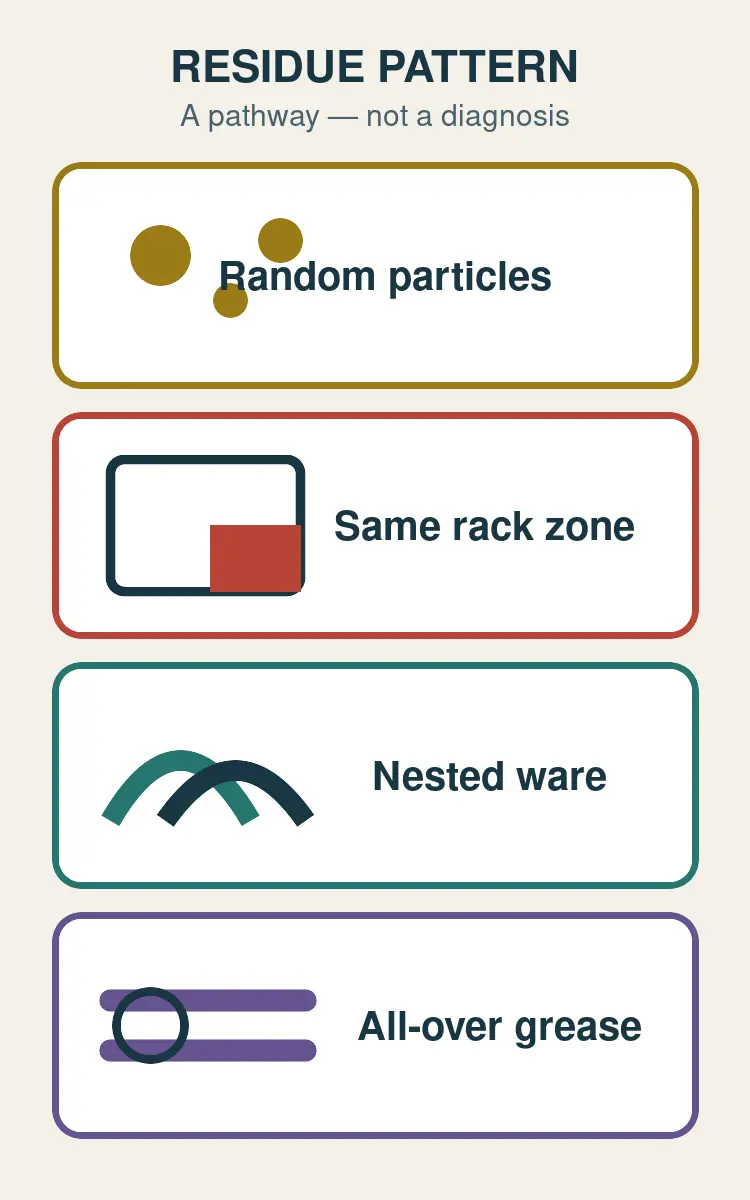
“Dirty” is too broad to be useful. Separate visible food from a surface film before anyone touches the machine. Loose crumbs, vegetable fibres, sauce, starch or baked food are visible-soil symptoms. A greasy feel across plates is a different path. White haze, mineral spots or streaks on ware that is otherwise visibly clean belong to water treatment and rinse chemistry. A temperature or fault warning is machine evidence that should be copied exactly.
| What remains after the cycle | More likely pathway | First safe check | Do not |
|---|---|---|---|
| Random loose food particles | Pre-scrape, filter load or tank soil | Check preparation and manual-approved filters | Add detergent as a guess |
| The same corner of every rack stays dirty | Water shielding, wash-arm coverage or a jet path | Correct the rack arrangement; consult the exact manual | Remove a pump or fixed panel |
| Soil remains inside bowls or cups | Nesting or blocked spray access | Expose every internal surface to spray | Use a longer cycle to hide poor loading |
| Results worsen through the shift | Filter load, tank soil or operating throughput | Record the time trend; follow the approved refresh routine | Change programmed settings |
| All ware has greasy residue | Cycle, chemistry, heat or mechanical action | Confirm cycle, chemical supply and display information | Adjust dosing or calibration |
| Only baked-on residue remains | Soil load exceeds the preparation/program combination | Check the exact manual for cycle and pre-soak guidance | Declare the machine faulty from one rack |
| Clean ware has white film, spots or cloudiness | Water quality or rinse chemistry | Use the separate water-treatment guide | Turn this into a TDS or RO experiment |
| The display shows a warning or error | Equipment or control path | Record the exact code and displayed values | Guess the code, bypass or recalibrate |
This table identifies a troubleshooting pathway; it does not remotely diagnose the machine. Do not remotely diagnose a pump, heater, dosing or plumbing fault from a residue pattern. Several causes can produce similar residue, and the exact model, installation, chemical program and service history still matter.
What the Residue Pattern Can Tell You
Before cleaning anything, run the observation through four questions: is it one item or every item; one rack position or the whole rack; the first cycle or only later in the shift; and visible food soil, greasy residue or mineral film? Write down the answers. A photograph of the loaded rack before the cycle and the same rack afterward is often more useful than a close-up of one plate.
One item versus every item
One badly nested bowl among otherwise clean plates is more consistent with a loading or soil-specific problem than a system-wide loss of wash action. Grease on nearly every plate across several correctly loaded racks points away from one isolated item. That still does not identify chemistry, temperature or pump performance by itself; it tells you that repeating the same rack without recording conditions will add little evidence.
One rack position versus the whole rack
If the front-right corner, centre or inside of cups repeatedly remains dirty, mark that position. A position that repeats across three to five racks may indicate spray shielding or an arm/jet coverage path that needs confirmation. Random particles moving between positions are more consistent with scraping, filter or tank-soil pathways. These are routing clues, not proof of a failed spray arm.
Clean early, dirty later
Compare the opening rack with racks after the peak. Results that degrade as the shift continues may track tank condition, filter loading, unusually heavy soil or throughput that exceeds the operating routine. Record when the tank was refreshed and when filters were last cleaned under the manual. Do not quietly compensate by increasing chemicals or altering a program; that destroys the evidence a specialist needs.
Make comparisons useful. Use the same selected cycle, the same rack type and a similar ware-and-soil mix when checking whether a pattern repeats. Record any deliberate change, such as correcting nested bowls or completing an approved filter clean, before the next rack. Do not run a series of uncontrolled experiments involving different chemicals, programs and loading patterns at once. If five variables change, neither staff nor the technician can tell which one affected the result.
A single clean rack after an intervention is encouraging, but it is not enough to close an intermittent problem. Check whether the improvement survives comparable racks and the busy part of the shift. Conversely, one heavily baked tray should not be used to condemn a machine that cleans the normal ware mix. The evidence should represent the venue’s actual operating problem.
Check Rack Loading and Water Shielding
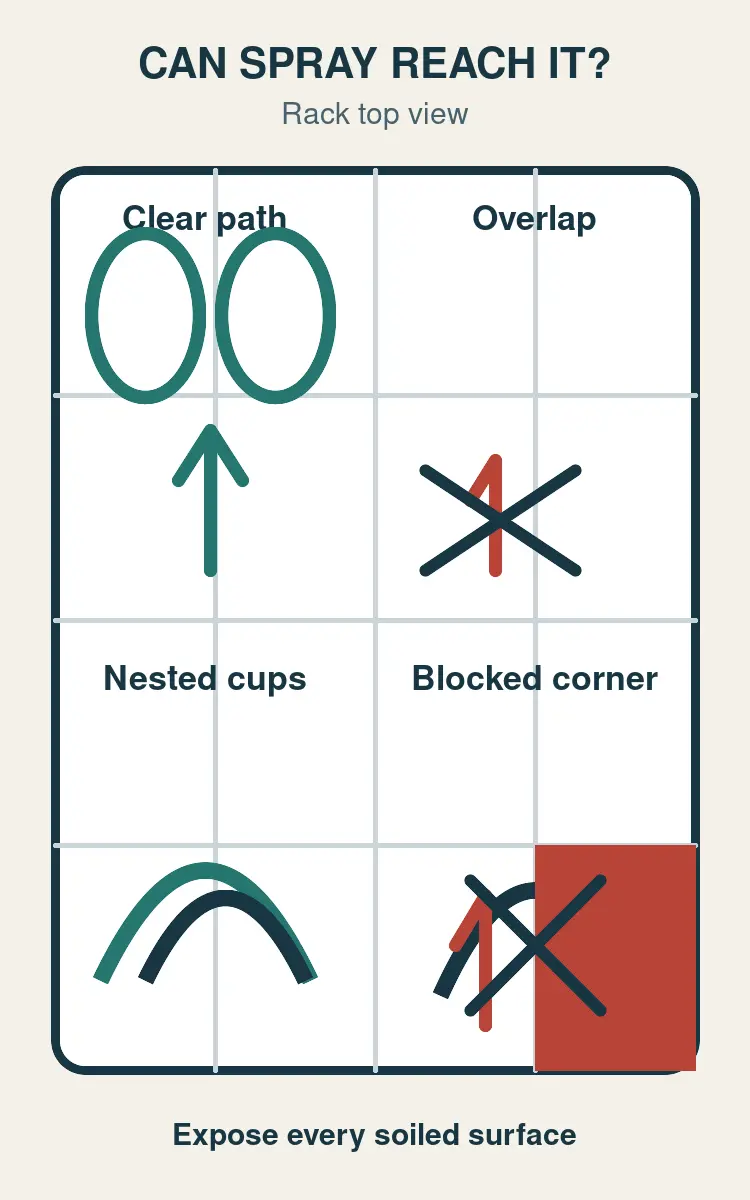
HOBART’s current undercounter material links optimum wash results with avoiding water shielding. In practical terms, the spray must reach the soiled surface. Plates should sit in the rack intended for them, bowls should not nest, cups should face as their rack and manual require, and utensils should not form a solid barrier above other ware. Do not assume that a rack is correctly loaded merely because the door closes.
Make a simple rack map: front left, front right, rear left, rear right, centre and inside bowls or cups. For three to five comparable racks, record where residue remains. Change only the loading arrangement first. If the repeated dirty zone disappears, preserve the improved loading pattern for staff training. If it remains in the same position with correctly exposed ware, take the map and photographs to the next check or technician.
| Rack position | Rack 1 | Rack 2 | Rack 3 | Rack 4–5 if needed |
|---|---|---|---|---|
| Front left | ___ | ___ | ___ | ___ |
| Front right | ___ | ___ | ___ | ___ |
| Rear left | ___ | ___ | ___ | ___ |
| Rear right | ___ | ___ | ___ | ___ |
| Centre | ___ | ___ | ___ | ___ |
| Inside bowls or cups | ___ | ___ | ___ | ___ |
Check Scraping, Filters and Tank Soil
A commercial dishwasher is not a food-waste disposal system. Remove the level of food soil required by the exact machine instructions and venue procedure before loading. The goal is not to hand-wash every plate; it is to stop solids from overwhelming screens, filters and recirculated wash water. The Commercial Dishwasher Survival Guide owns the broader operating routine.
Inspect only screens and filters that the exact model manual identifies as operator-removable. Stop the machine, allow it to reach the manual’s safe state, use the stated removal and refitting method, and never operate it without required filters correctly installed. A similar-looking machine may use a different stack, lock or self-cleaning sequence.
Also record the tank-water timeline. If the first racks are acceptable and later racks carry redistributed particles or grease, the relationship to peak volume and the approved refresh routine matters. Do not infer that every machine needs the same change-water interval: filtration and regeneration systems differ materially by model.
Inspect Wash Arms and Jets Only as the Manual Allows
Washtech troubleshooting material separates overloaded racks, arms that do not rotate, blocked jets and low wash action into different pathways. That distinction matters. First confirm that the loaded ware does not physically obstruct an arm. If—and only if—the exact operator manual says the arm is removable by staff, follow that procedure and inspect the manual-named jets. MEIKO and Winterhalter documentation similarly treats operator cleaning as model-specific.
Stop at the boundary. Do not insert wire into an unidentified opening, enlarge a jet, remove a fixed manifold, reach through a pump opening or dismantle a panel. If an approved arm does not move freely after the documented operator procedure, or the same rack zone remains dirty, record it and call the equipment technician.
Check Chemical Supply—Do Not Adjust the Dose
Staff can check whether the labelled detergent and rinse-aid containers are present and empty, whether an external pickup tube is obviously no longer in its intended container, whether the product was recently changed, and whether unusual foam appeared. Use the machine manual and site chemical procedure; wear the required PPE and never mix products.
HOBART states that underdosing can harm wash results, while overdosing provides no wash benefit; it also says an expert should determine the correct dosage during setup. That is why “turn it up” is not a diagnostic step. Too little chemistry, too much chemistry, unsuitable chemistry, hard water, short contact time and inadequate food removal can overlap. The chemical supplier or qualified technician should verify compatibility, dosing equipment and settings.
Never use domestic detergent or hand dishwashing liquid in a commercial machine. Do not prime a dosing pump unless the exact manual and authorised procedure assign that task to the operator. Do not swap products into existing lines without specialist instructions.
Follow Eight Safe Checks in the Correct Order
- Stop and identify the residue: visible particles, grease, baked soil, film or a warning.
- Record the machine: brand, exact model, serial, selected cycle, display and error code.
- Map the rack: note whether the pattern affects one item, one position or all ware.
- Correct loading: remove nesting, overlap and water shielding using the correct rack.
- Check preparation: compare scraping and soil load with the exact manual and site procedure.
- Clean approved components: only operator-removable filters, screens, arms or jets, exactly as the manual permits.
- Confirm chemical supply: present, approved and not empty; do not adjust the dose.
- Repeat once and escalate: record the comparable result and hand the evidence to the correct specialist if it persists.
Do not repeatedly send unacceptable ware back into service. Keep affected items out of the clean flow and follow the venue’s food-safety procedure. A completed cycle and a clean-looking display do not prove the ware was effectively cleaned or sanitised. Displayed values are evidence, not remote proof of compliance.
When the Problem Is No Longer an Operator Check
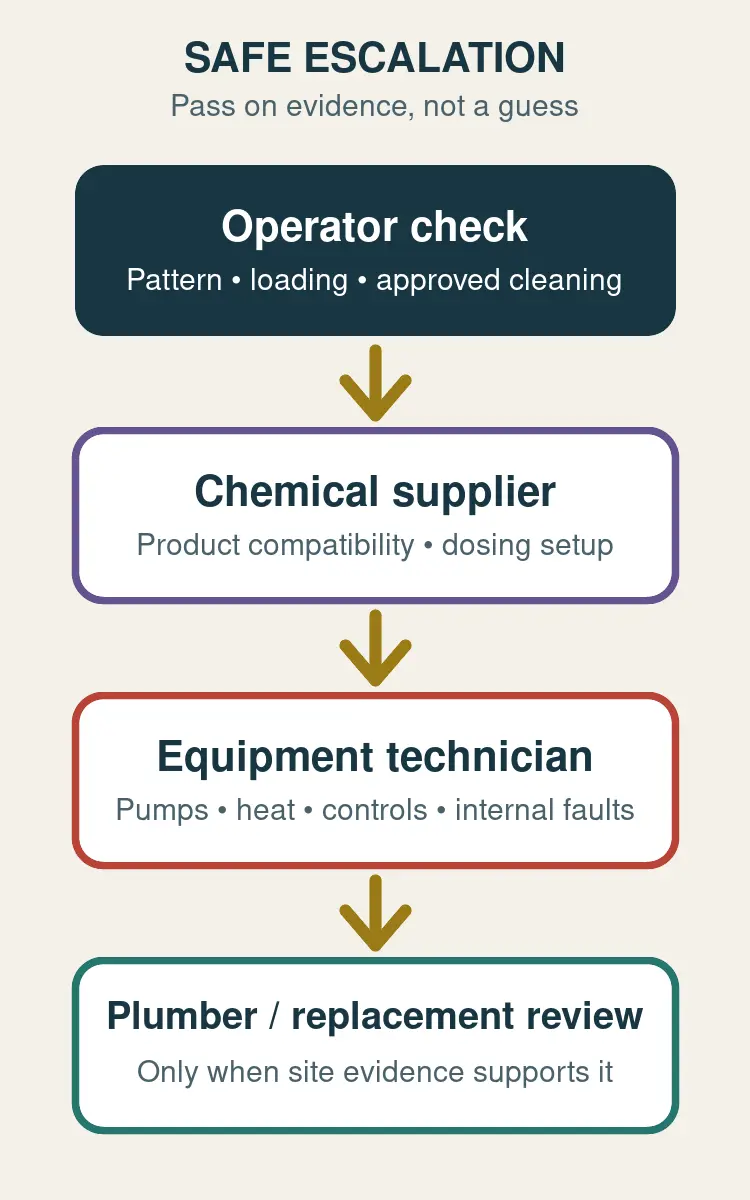
Escalate when the manual-approved checks are complete and the pattern persists; when a warning returns; when wash action, heating or dosing appears inconsistent; when a component is not designated for operator removal; or when leakage, electrical symptoms, abnormal noise or burning odour appears. Stop using the machine where the manual or site safety procedure requires it.
Internal dosing pumps, wash pumps, arm drives, heaters, boosters, sensors, controls and pressure faults are equipment-technician work. For deeper context on how pre-rinse, thermal and chemistry factors interact without turning them into an operator repair, use the commercial dishwasher engineering audit. Fixed inlet supply, drainage, backflow or site plumbing belongs to a licensed plumber where the site evidence points there. Do not turn an equipment symptom into a plumbing diagnosis without measurements and model requirements.
Staff, Chemical Supplier, Technician or Plumber?
| Pathway | Appropriate scope | Useful evidence |
|---|---|---|
| Staff or supervisor | Loading, scraping, correct cycle, approved tank routine and manual-approved cleaning | Rack map, timing, before/after photos |
| Chemical supplier | Approved product compatibility, site water context and dosing setup | Product labels, change date, container status and residue type |
| Equipment technician | Pumps, dosing equipment, heat, sensors, pressure, controls and internal faults | Model, serial, cycle, error, displayed values and repeated pattern |
| Plumber | Fixed inlet, waste or site supply problem supported by installation evidence | Exact machine requirements, installation details and measured site findings |
Repair, Retrain, Reconfigure or Replace?
Poor results do not automatically justify a new machine. Use the findings to choose the next commercial path.
| Outcome | When it is more reasonable |
|---|---|
| Retrain | The repeatable cause is rack loading, scraping, cycle selection or the approved tank routine. |
| Reconfigure | Rack choice, workflow, approved program, water treatment or specialist-set chemical system does not suit the actual ware and soil. |
| Repair | A technician confirms a pump, arm, dosing, heater, sensor, control or other internal fault. |
| Replace or resize | The machine remains overloaded at peak, lacks viable parts/support, or cannot meet the real soil load and throughput after workflow and technical findings are addressed. |
For capacity questions, use the dishwasher sizing and sanitising guide. Compare current commercial dishwashers, including underbench dishwashers and pass-through dishwashers, only after documenting the peak racks, ware mix, soil level, utilities and washline layout.
What to Record Before Calling for Service
| Evidence | Record |
|---|---|
| Brand and exact model | ________________ |
| Serial number | ________________ |
| Selected cycle | ________________ |
| Visible residue type | Food / grease / film / other |
| Pattern | One item / one rack area / all ware |
| Timing | First cycle / after peak / every cycle |
| Displayed wash/rinse values | ________________ |
| Exact error code | ________________ |
| Chemical containers | Present / empty / recently changed |
| Filter and wash-arm check | Completed only as exact manual permits |
| Tank water last refreshed | ________________ |
| Rack photos before and after | Attached / not attached |
Send the model and serial, not merely the brand. Include a wide photo showing the complete rack arrangement as well as the residue close-up. If the problem worsens during service, state the approximate rack count or time when the decline begins. For a machine-selection or replacement review, contact KW with this evidence and your peak rack requirement.
Frequently Asked Questions
Why does my commercial dishwasher leave food on plates?
The pattern may be consistent with inadequate scraping, shielded or nested ware, loaded filters, contaminated tank water, restricted wash-arm coverage, an unsuitable cycle or an equipment/chemistry problem. Start with the ordered safe checks and exact manual; do not select one cause remotely.
Should I add more detergent when dishes are greasy?
No. Confirm the approved supply is present, but have the chemical supplier or technician check compatibility and dosing. Both too little and too much can create poor results, and increasing the dose can obscure the real failure.
Can staff remove and clean the wash arms?
Only when the exact model’s operator manual identifies the arms as operator-removable and provides the procedure. Similar machines can have different locks and cleaning systems.
Why are dishes clean at opening but dirty after the rush?
That time pattern may be more consistent with filter load, tank-soil accumulation, changing soil load or actual throughput exceeding the routine. Record the decline and follow only the exact manual’s refresh and cleaning procedure before escalating.
Are cloudy glasses the same problem?
Not when the glass is visibly clean but has white film, streaks or spots. That belongs to the separate water-quality, rinse-chemistry and softener-versus-RO guide.
When should a dirty-result problem lead to replacement?
After loading, workflow, program, water and chemical configuration have been reviewed and a technician has assessed the machine. Replacement or resizing becomes reasonable when peak demand consistently exceeds capacity, support is no longer viable, or repaired equipment still cannot handle the documented ware and soil load.