Commercial Dishwasher Not Draining? Safe Checks Before You Call for Service

When a commercial dishwasher finishes a cycle and water is still sitting in the tank, the cause is usually one of six things: an obstruction the operator is allowed to clear, a removable part refitted incorrectly, a visible kink or blockage in the accessible drain hose, a drain-pump or internal appliance fault, a problem in the site drainage itself, or a program or error condition that interrupted the drain sequence.
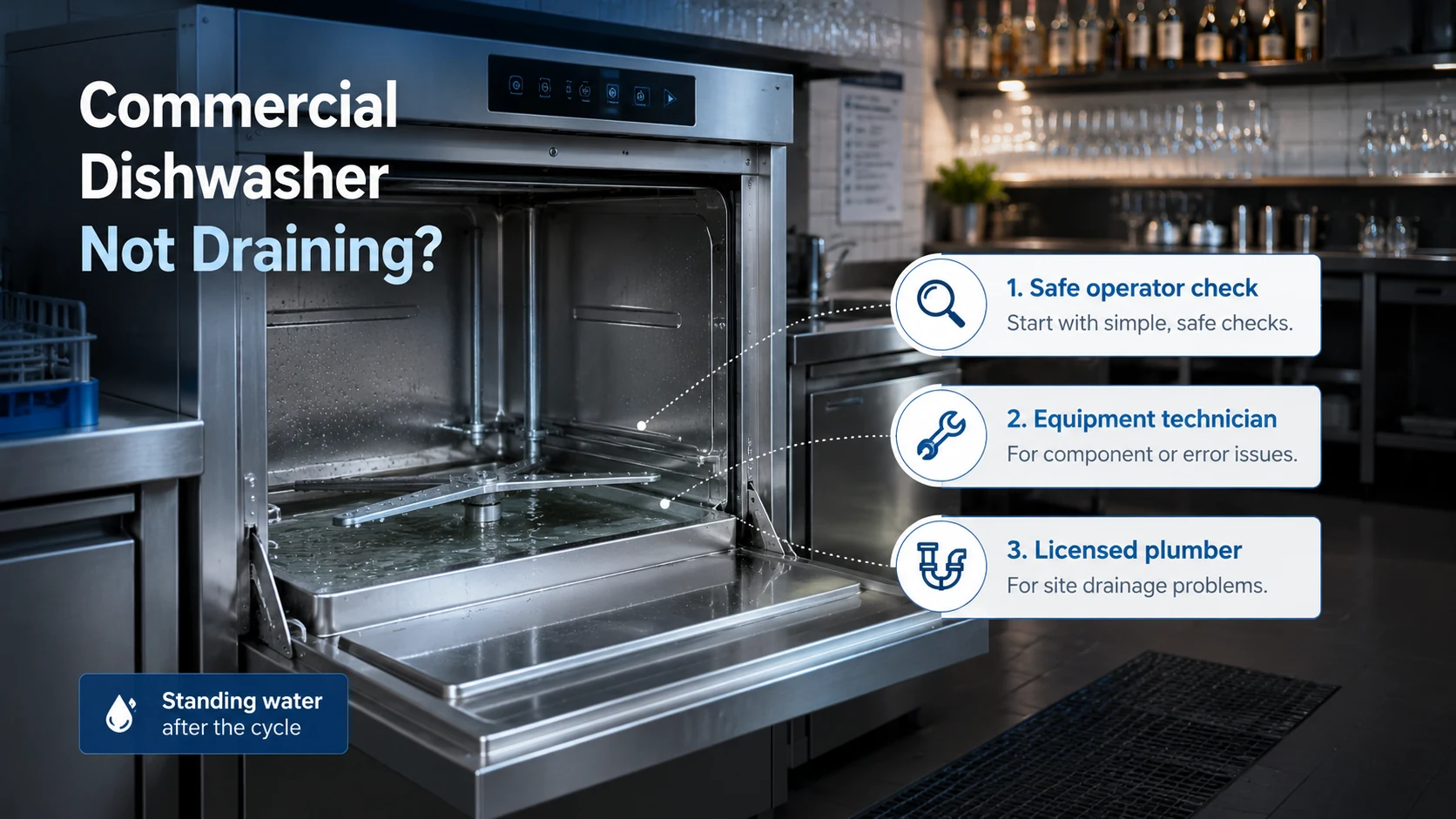
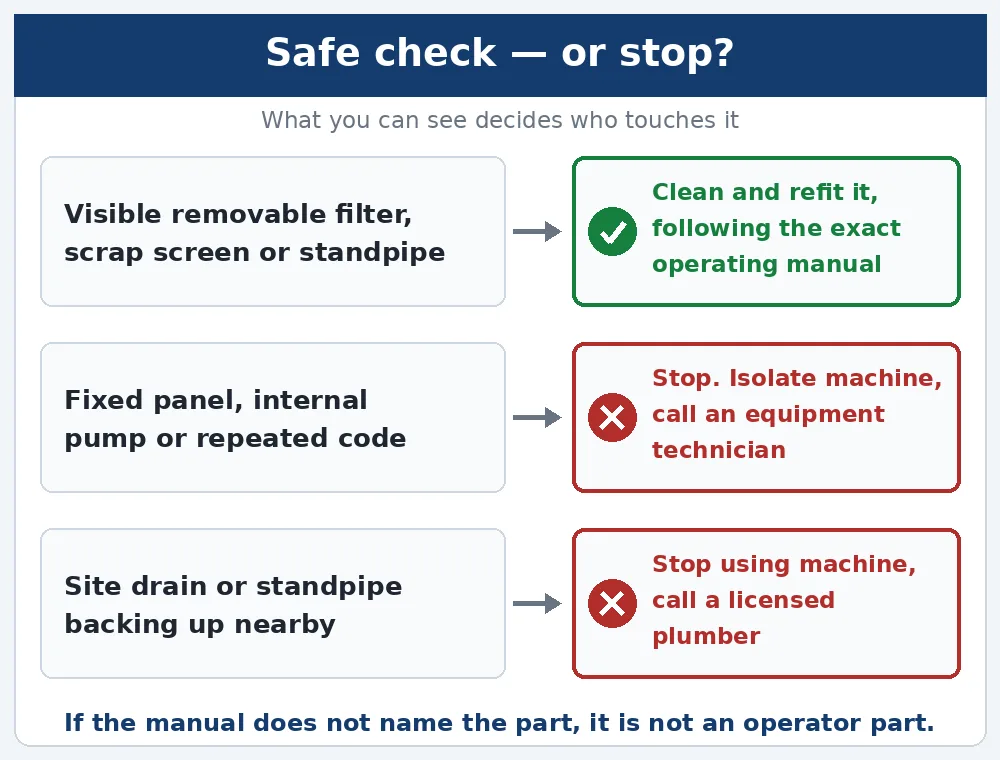
Only the first three can be checked safely by kitchen staff, and only in the way the machine’s own operating manual describes. The rest belong to an equipment technician or a licensed plumber. This guide walks through the safe checks in order, shows how to tell an appliance problem from a site-drainage problem, and explains exactly when to stop.
Commercial Dishwasher Not Draining: Quick Decision Table
Match what you can see to a safe first step. This is a triage aid, not a diagnosis — a visible symptom rarely proves a single cause, and several of these signs can appear together.
| What you see | Safe first check | Likely next contact |
|---|---|---|
| Water drains slowly | Clean the operator-removable filter or scrap screen, if the manual permits it | Technician if it recurs |
| Water remains after the drain sequence | Confirm the model’s drain procedure and that removable components are seated correctly | Technician |
| Drain hose visibly kinked or crushed | Stop the machine; inspect only the accessible section of hose | Technician, or plumber if the fixed connection is involved |
| Water backs up from the site drain or standpipe | Stop using the machine | Licensed plumber |
| Drain-related error code on the display | Record the exact code, model and serial number | Manufacturer-authorised technician |
| Excess foam in the tank | Stop; verify the approved commercial detergent and rinse aid are connected | Chemical supplier or technician |
| Water leaking onto the floor | Stop and isolate power safely at the wall, per the manual | Technician; plumber if a fixed connection is leaking |
Is Water Left in the Machine Always a Fault?
Not necessarily. Commercial dishwasher drainage systems differ by model, and the exact operating manual defines what the end of a normal cycle should look like — including which parts the operator may remove and how the machine drains down. Check the manual before removing filters, overflow components or drain fittings.
The most useful reference point is the machine’s own established behaviour. A Washtech UD underbench dishwasher, for example, is designed to run a self-cleaning cycle and completely drain when the operator presses the drain/standby control at night — on that machine, a tank that used to empty overnight and now holds water is a change worth investigating. MEIKO’s UPster U 400 M2 operating instructions instead describe a drain-down built around removing a stand pipe during the self-cleaning programme — a different procedure producing a different “normal”.
So compare against the baseline, not against another machine. Investigate when the water level after a cycle has newly increased, the drain sequence fails to complete, a drain-related code appears, or standing water shows up where the manual says there should be none. Do not assume every visible trace of water means the pump has failed — and do not ignore a clear change in behaviour just because the machine still limps through a cycle.
Safe Checks Before Calling for Service
Everything in this section is operator-level: no tools beyond what the manual describes, no fixed panels, no plumbing connections. Work through the checks in order and stop at the first point that requires anything more.
Stop the Machine and Record the Symptoms
Before touching anything, capture what a service call will need: brand, model and serial number; any error code; when the fault appears; whether water drains slowly or not at all; whether the site drain or standpipe is backing up; and any unusual noise, smell, leaking or foam. Two minutes of notes here routinely saves a second call-out later.
Check Operator-Removable Filters and Scrap Screens
Most commercial machines place a filter or scrap screen between the wash chamber and the drain path, and manufacturers design specific parts for routine operator cleaning. Washtech’s UD and XU operator manuals have the operator remove and rinse a wash/drain filter basket and scrap tray once the machine has cooled after the nightly drain-down, clear any waste from the drain sump, and refit the parts. MEIKO goes as far as colouring the parts an operator is meant to touch — filter, stand pipe, wash system — blue.
Follow the exact manual for your model. Do not force any component, and reinstall everything correctly — a filter basket sitting proud or a scrap tray askew can restrict water movement on its own. If the screens block up repeatedly, the fix is usually upstream: as Washtech’s installation guidance puts it, it is better to rinse and scrape plates before racking than to remove that waste from the machine afterwards.
Check the Overflow Tube, Standpipe or Drain Plug Where Applicable
Some machines control the tank level with a removable overflow tube, standpipe or drain plug; others manage the drain-down entirely through the control panel. On MEIKO’s UPster U 400 M2, removing the stand pipe is a documented step of the self-cleaning programme; on a machine without such a part, there is nothing for the operator to reseat. If your manual shows a removable overflow component, confirm it is present, undamaged and correctly seated. If it does not, skip this step — do not go looking for parts to remove.
Inspect the Accessible Drain Hose
This is a visual check only. Look at whatever section of drain hose is accessible without moving plumbing or removing panels: is it kinked, crushed by the machine being pushed back, or pinched behind cabinetry? Is the site drain visibly backing up around the connection? Washtech’s operator manuals also warn against a drain hose left coiled on the floor that only rises at the connection point — on their drain-pump underbench machines, that layout lets discharged water flow back into the machine.
Do not disconnect a fixed waste connection, and do not modify hose runs while troubleshooting. In Australia the drainage connection itself is plumbing work — MEIKO’s Australian installation notes, for example, require the drain hose to make a watertight connection to a compliant waste fitting — so anything beyond looking at the accessible hose belongs to a licensed plumber or technician.
Check the Selected Program and Drain Sequence
Many machines only pump out as part of a specific drain or shutdown sequence, and an interrupted sequence can leave water in the tank with nothing actually broken. On the Washtech UD, the operator presses the drain/standby control and the machine self-cleans, drains completely and switches itself off. On MEIKO’s UPster U 400 M2, the wash key starts the drain-pump process during the self-cleaning programme — and versions without a drain pump simply drain once the stand pipe is removed. Re-run the documented drain procedure once, exactly as written, before concluding the machine cannot drain.
Look for Excess Foam
Foam is worth checking because it confuses other symptoms. Washtech’s troubleshooting guidance attributes foaming to unsuitable or domestic detergent, to starting the first cycle before the wash water is up to temperature, and to insufficient water pressure or flow — which effectively overdoses the chemicals. If the tank is foaming, stop and confirm the approved commercial detergent and rinse aid are connected at the dose your chemical supplier set. Do not mix cleaning chemicals or add anything the manufacturer has not approved. Foam does not always cause a drain problem, but it is a reason to involve your chemical supplier before paying for a service call.
Record the Error Code
Error codes are model-specific, so record the exact code rather than interpreting it from a generic list. The manual that names the code will also say what to do about it — for drain faults, that is usually a technician. MEIKO’s UPster U 400 M2 documentation shows why: its codes 302 and 303 indicate the tank level is not falling during drain pumping, list causes such as a dirty or defective drain pump or a loose impeller, and instruct the operator that continuing is not possible — call a service technician. A recorded code plus model and serial number lets the service agent arrive with the right parts.
Gravity Drain or Drain Pump: Why the Difference Matters
Commercial dishwashers discharge water in one of two ways. A gravity-drain machine relies on the site: the waste connection must sit low enough, with suitable fall, for water to run out on its own. A drain-pump machine actively pumps its waste water out, within the limits the manufacturer publishes for that model.
The split is a genuine model-level configuration, not a category feature. Fagor Professional’s warewashing catalogue, for instance, lists a drainage pump as a “B”-variant option across its undercounter and passthrough ranges, and notes that machines installed without one drain by gravity. Two machines that look identical outside can behave completely differently when the drain misbehaves.
For troubleshooting, the difference matters in both directions. A drain-pump machine can still fail to empty — blockage, pump fault, unsuitable connection — and a gravity machine can be defeated entirely by a site problem it did not cause. Exact drain heights and connection requirements are model-specific installation-planning territory: if the real question is whether the site was ever suitable, see our guide to commercial dishwasher plumbing requirements in Australia rather than treating it as a fault to clear.
Is the Problem in the Machine or the Site Drain?
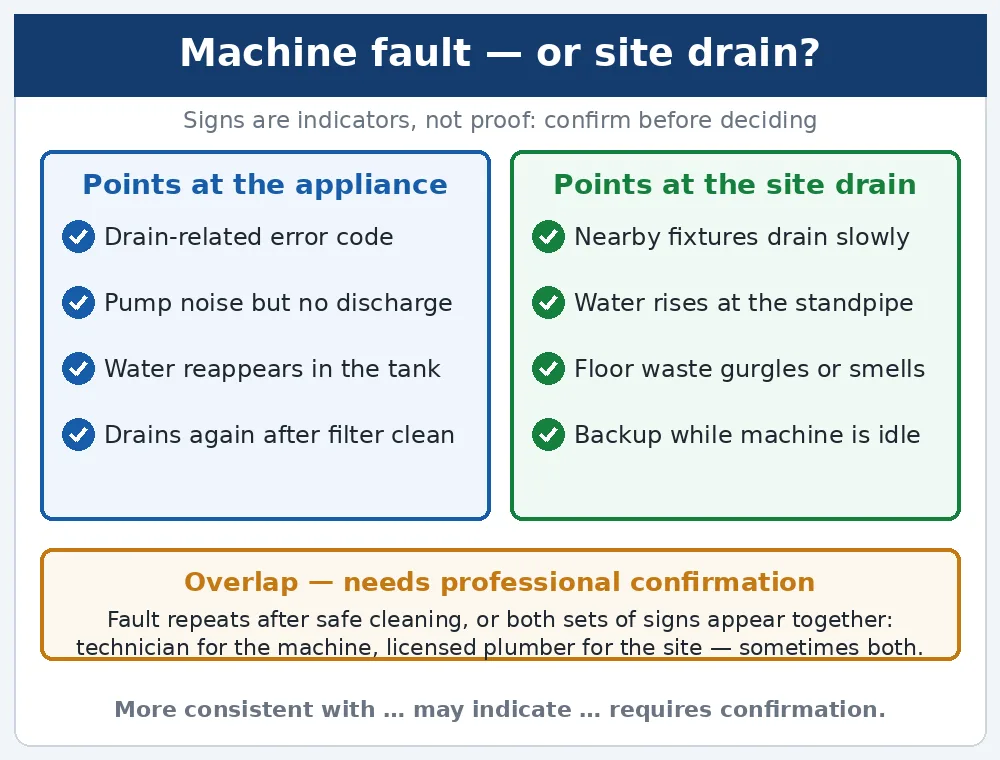
This is the question that decides who you call. The signs below are indicators, not proof — every row requires confirmation, and mixed signals usually mean two problems, not none.
| Sign | More consistent with an appliance issue | More consistent with site plumbing |
|---|---|---|
| Drain-related error code | Possible — codes read the machine’s own sensors | Less direct, though a blocked site drain can trigger one |
| Pump noise but no discharge | Possible internal blockage or pump issue | Possible downstream restriction |
| Multiple nearby fixtures drain slowly | Less likely to be the machine alone | Strong site-drain warning |
| Water backs up from the standpipe | Possible poor connection arrangement | Strong plumbing warning |
| Machine drains normally after filter cleaning | Operator-maintenance issue — likely resolved | Less likely |
| Fault repeats after safe cleaning | Technician investigation required | Plumber as well, if site symptoms are also present |
One habit strengthens every row: note whether the problem follows the machine or the drain. Water reappearing in the tank points into the appliance. Water rising around the standpipe, a floor waste gurgling or smelling, or other fixtures slowing down points at the site — and that is a licensed plumber’s job regardless of what the dishwasher is doing.
When to Stop Immediately
These boundaries are not caution for its own sake. Washtech’s operator manuals warn that wash water may exceed 60°C and contain caustic detergent, that rinse water can exceed 90°C, and that machine panels are only to be removed by qualified personnel because live electrics and very hot surfaces sit behind them — and they are blunt about the limit of the operator’s role: under no circumstances should the user attempt repairs. Repeatedly resetting an unexplained fault to get through service is how a drain problem becomes an electrical one.
Technician, Plumber or Equipment Supplier?
| Contact | Appropriate when |
|---|---|
| Equipment technician | Error codes, drain pump, valves, float switches, control faults or anything inside the appliance. For warranty work, use the manufacturer’s authorised service network. |
| Licensed plumber | Blocked site waste, standpipe problems, poor drainage fall, fixed-connection leaks, trade-waste and drainage changes outside the appliance. In Australia this is licensed work — dishwasher manufacturers themselves require installation and service to comply with codes such as AS/NZS 3500.1. |
| Equipment supplier | Sourcing the correct manual, confirming the exact model and configuration, warranty status, parts pathways, or discussing replacement options when repair stops making sense. |
| Chemical supplier | Detergent and rinse-aid selection, dosing calibration and foam problems. |
If you own a Hobart machine, the ecomax by HOBART document portal carries operation and installation manuals by model; Washtech publishes its operator manuals on the Washtech Australia resources page. Having the right manual open before you ring anyone shortens every one of these conversations.
When Repair May Not Be the Best Commercial Decision
A single cleared blockage is not a reason to think about replacement. A pattern is. The situations that justify a commercial comparison — alongside, not instead of, a technician’s verdict:
- The same drainage fault keeps returning after professional repair.
- Parts for the model are hard to source, or the controls are obsolete.
- Downtime keeps landing in service periods and costing covers.
- The machine is undersized for what the venue now does, so it runs blocked-up and overloaded.
- The site needs a drain-pump configuration the current machine simply does not have.
- A repair quote is approaching the price of a verified replacement, or the machine is out of warranty with a known internal fault.
Weigh the repair quote against a current replacement quote rather than a guess — and check site compatibility before assuming any specific machine solves the problem. If the site cannot provide gravity fall, drain-pump-equipped models exist across formats: KW currently stocks the Fagor CO-502BDD undercounter with a factory drain pump and the Hobart Ecomax Plus H615 passthrough with rinse and drain pumps, among others in the underbench and passthrough ranges. For throughput questions rather than drainage ones, start with the commercial dishwasher buyer’s guide, or talk to KW with your model, serial number and a photo of the drain arrangement.
Prevention Checklist
- Scrape and pre-rinse according to the machine’s intended workflow — the filter screens are a backstop, not a waste-disposal system.
- Clean operator-removable filters and screens at the frequency stated by the manufacturer — on some machines that is every night as part of the drain-down.
- Use the commercial chemicals your machine and supplier specify; never domestic detergent.
- Treat unusual foam as a signal worth a phone call, not a quirk.
- Keep the accessible drain hose protected from crushing when the machine is moved for cleaning.
- Train every shift on the correct drain and shutdown sequence — an interrupted sequence looks exactly like a fault.
- Write recurring error codes down with dates; patterns are diagnostic gold for a technician.
- Book preventive service — Washtech, for example, recommends a technician visit every 6 months or 15,000 cycles, and MEIKO’s schedule has the drain pump’s operation checked at least annually.
- Do not ignore a slow drain until it becomes a complete failure — slow is the early symptom.
Final Troubleshooting Checklist
- Stop and assess safety — leaks, smells, noise, electrical signs.
- Record the exact model, serial number and any error code.
- Follow the manufacturer’s documented drain procedure once, exactly as written.
- Clean only the operator-removable filters and screens, after the machine has cooled.
- Inspect only the accessible hose, and look for visible site-drain backup.
- Restart only if the manual permits it and no safety warning applies — a restart is not always safe.
- Escalate anything repeated or internal: technician for the machine, licensed plumber for the site.
Frequently Asked Questions
Why is water left in my commercial dishwasher?
It depends on the model. Some machines hold tank water between cycles by design and only empty during a documented drain-down; others should finish a drain sequence empty. Compare against your machine’s manual and its own normal behaviour — newly increased water, a failed drain sequence or a drain code is the signal to act.
Can I clean a commercial dishwasher drain pump myself?
No. Operator cleaning stops at the parts the manual names — typically filters, scrap screens and, on some models, an overflow tube or standpipe. The pump sits behind fixed panels with live electrical components, and manufacturers such as Washtech state plainly that users must not attempt repairs. Pump work is a technician’s job.
How do I know whether the site drain is blocked?
Look around the machine, not inside it. Water rising at the standpipe or floor waste, gurgling, smells, or other nearby fixtures draining slowly all point at the site rather than the appliance. Those signs mean stop using the machine and call a licensed plumber — a dishwasher cannot pump its way past a blocked building drain.
Does every commercial dishwasher have a drain pump?
No. Drain pumps are a model-level configuration. Fagor’s official catalogue lists the drainage pump as a “B”-variant option across its ranges, with other versions draining by gravity, and MEIKO documents both arrangements within the same machine family. Check the exact model’s documentation — or its data plate and supplier — before assuming either way.
Can too much detergent stop a commercial dishwasher draining?
Wrong or overdosed chemicals cause foam, and foam confuses drain symptoms and wash performance. Washtech’s guidance links foaming to domestic detergent, cold starting water and low water pressure effectively overdosing the chemical. Foam will not always stop a machine draining, but it is a legitimate reason to stop, verify the approved chemicals, and involve your chemical supplier.
Who should repair a commercial dishwasher drain fault?
Inside the machine — pump, valves, sensors, controls — an equipment technician, and for warranty work the manufacturer’s authorised service network. Outside the machine — waste pipe, standpipe, fall, trade waste — a licensed plumber. The supplier’s role is manuals, model confirmation, parts pathways and replacement options.
Should I replace a machine that repeatedly fails to drain?
Not automatically — age alone is not a verdict. Replacement earns consideration when the same fault returns after professional repair, parts are unavailable, downtime is hurting service, or the site genuinely needs a different drainage configuration. Compare a real repair quote against a real replacement quote, with site compatibility checked first.
Can a glasswasher have the same drainage problem?
Yes. Commercial glasswashers use the same drainage arrangements — gravity or drain pump — and the same operator boundaries apply: cleanable screens and documented drain sequences for staff, everything internal for the technician. The safe checks in this guide apply to a glasswasher that will not drain, subject to its own manual.
Fix the Cause, Not Just the Puddle
A commercial dishwasher that will not drain is nearly always telling one of three stories: it needs the cleaning routine its manual already prescribes, it has an internal fault that belongs to a technician, or the site drainage has a problem no appliance can outrun. The safe checks in this guide settle the first story and gather the evidence that makes the other two quick to resolve.
Broader running-and-maintenance context lives in our Commercial Dishwasher Survival Guide, and if the fault traces back to how the site was set up, the plumbing requirements guide covers what a compliant installation needs. When the answer turns out to be a machine that matches the site, browse commercial dishwashers or contact KW Commercial Kitchen with your model, the recorded error code and a photo of the drain arrangement — enough for a useful conversation about manuals, parts pathways or a compatible replacement.