
The Commercial Dishwasher Survival Guide for Australian Kitchens (2026)
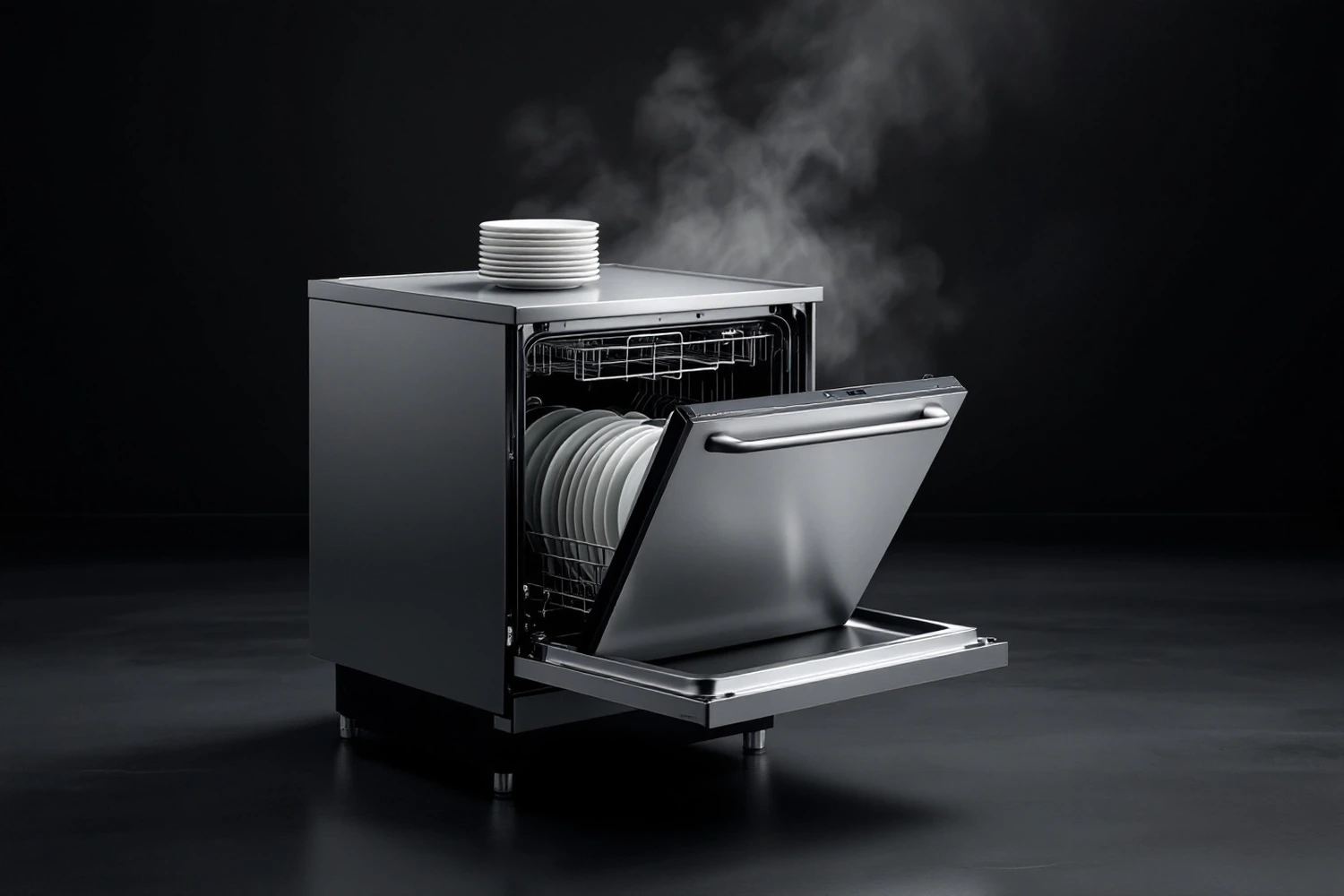
In a busy commercial kitchen, the dishwasher is the one machine that can shut the whole room down in under an hour. A fryer fault, you work around. An oven down, you change the menu. But when the dishwasher stops on a Friday night, the front of house runs out of plates and the back of house runs out of pots and bowls at the same time, and service grinds to a halt.
Most dishwasher articles only tell you which brand to buy. This guide does something more useful. It explains why commercial dishwashers actually fail, what a failure costs you in labour and lost trade, what the Australian rules genuinely require (and where the common claims are wrong), how to choose between an underbench, pass-through and conveyor machine, and how to safely clear the six most common faults yourself before you pay for an after-hours call-out.
Why commercial dishwashers fail
Almost every dishwasher problem traces back to one of four causes. Understanding them is what separates an operator who loses a service from one who clears the fault in ten minutes, and it is the difference between buying the right machine and buying the same problem again.
Installation errors
The most expensive faults are built in on day one. The classic is the drain: a gravity-drain machine relies on the waste outlet sitting below the machine, so if your drain pipe runs up a wall or the machine sits underbench with the drain above the outlet, the water has nowhere to go and you flood the floor. That installation needs a model with a built-in drain pump. Water pressure and temperature are the other two: a machine plumbed to the wrong supply, or fed pressure outside its range, will either stretch every cycle out or damage its own valves.
Chemical errors
Commercial machines are dosed for commercial chemicals. The single most common self-inflicted failure is staff wiping a plate with domestic dishwashing liquid and loading it, which turns the wash tank into a foam flood. The second is rinse aid: when the rinse-aid container runs dry or its pickup tube falls out, dishes come out wet and streaked, and staff start hand-drying. Wrong detergent, wrong dose, or empty chemicals account for a large share of the faults that get blamed on the machine.
Temperature errors
A commercial dishwasher sanitises with heat, chemistry, or both, and temperature is where it most often slips. A boiler that cannot recover between heavy cycles, a scaled-up heating element in a hard-water area, or a failing thermostat all leave the rinse below the temperature it needs. The dishes look washed but are not properly sanitised, which is both a food-safety problem and the reason a machine that ran fine in winter struggles under a summer rush.
Operator errors
The machine is a sanitiser, not a bin. Loading racks without scraping or pre-rinsing packs the filters and the wash arms with food and drops cleaning performance fast. Running the same tank water for a whole shift means washing in cold soup. And shutting the door on a wet machine overnight breeds odour and rots the seals. None of these is a fault in the machine, and all of them get logged as one.
If a completed cycle still leaves visible food or grease on ware, use the residue-pattern guide for dishes that remain dirty before changing settings or assuming an internal fault.
What a dishwasher failure actually costs you
It is easy to read the faults above as inconveniences. In a trading kitchen they are money, and seeing the cost is what makes the maintenance and the buying decisions worth taking seriously.
Start with the obvious one: downtime. Because the dishwasher is a single point of failure, an hour down in the middle of service is an hour of compromised trade, not a minor delay. An after-hours technician call-out to get it running again can run into the hundreds of dollars, with weekend and emergency rates higher again, before any parts.
The quieter costs come from a machine that runs but runs badly. If the rinse aid has failed and the dishes come out wet, someone has to hand-dry them. A cafe turning over 250 covers a day can put more than 600 cups, plates and pieces of cutlery through the machine in a shift; hand-drying that volume can add twenty to thirty minutes of labour to every service, every day. If the rinse is not hitting sanitising temperature, you are rewashing whole racks, which doubles the water, detergent, energy and labour for those loads and slows the pass when you can least afford it. A foam flood stops the section dead and can burn out a wash pump if the machine keeps running.
Even water and energy add up. A water-efficient commercial machine uses in the order of two to four litres per rack; a busy hundred-cover restaurant running sixty to eighty racks a service can get through 120 to 250 litres in a single service, and tens of thousands of litres a year. A machine running cold, foaming, or being rewashed is quietly inflating every one of those numbers. The point is not a single headline figure, it is that a dishwasher problem is rarely just a dishwasher problem.
Australian compliance requirements
This is where a commercial dishwasher stops being an appliance and becomes a regulated part of a food business. Four areas matter, and the detail is worth getting right because some of what gets repeated online is wrong.
Food safety and sanitising temperature
Under the Food Standards Code, Standard 3.2.2 requires food businesses to keep equipment and utensils clean and sanitary. What the Code does not do is name a single dishwasher temperature. There is no prescribed dishwasher method in the standard itself, which is the source of a lot of confusion.
In practice there are two compliant ways to sanitise. A high-temperature machine sanitises with heat: a wash of roughly 60 to 71°C followed by a final rinse at about 82°C, which is enough to bring the surface of the items to around 71 to 74°C. That 82°C figure is the recognised hot-water benchmark, drawn from international standards rather than written into Australian food law, and FSANZ guidance references the European standard of a 60 to 65°C wash and an 80 to 85°C rinse where no chemical sanitiser is used. The alternative is a low-temperature machine that sanitises chemically at lower temperatures using a sanitiser such as chlorine. Both are legitimate; the choice changes your running cost, your ventilation, and your chemical handling.
AS 4674, the standard for the design and fit-out of food premises, refers to dishwasher sanitising but is deliberately non-specific, requiring only that the combination of time and temperature is sufficient to sanitise. The practical consequences are clear enough: a domestic dishwasher cannot reach thermal sanitising temperatures and is not a compliant fit for a commercial venue, and your obligation is that the machine actually sanitises, which a food authority may ask you to demonstrate. Keep it simple by checking the rinse with temperature test strips, and keep the machine's specification sheet on file.
Water connection and drainage
This is the compliance area operators most often overlook, and the one a cheap install most often gets wrong. Water and drainage must be installed by a licensed plumber to the AS/NZS 3500 plumbing and drainage standard. A commercial dishwasher is a connected appliance under that standard, which means the water connection requires backflow prevention so that contaminated water cannot siphon back into the drinking supply. Backflow prevention is mandatory under the Plumbing Code of Australia, the device must be WaterMark-certified (to AS/NZS 2845.1), and a testable device has to be commissioned on install and tested every year by an accredited backflow plumber. On the waste side, the drainage is usually arranged with an air gap so dirty water cannot be drawn back into the machine.
There is a cost attached, and it is worth knowing before you sign a fit-out: a backflow device commonly runs in the hundreds to low thousands of dollars installed, plus a smaller annual testing fee. Many kitchens also fall under a trade-waste agreement with the local water authority and need a correctly sized grease arrestor upstream of the drain. None of this is optional, and a quote that leaves it out is a quote that will cost you more later.
Electrical supply
The electrical connection must be carried out by a licensed electrician to the AS/NZS 3000 wiring rules. Commercial dishwashers are frequently 15A single-phase or three-phase rather than a standard 10A plug, and the wrong supply means constant tripping or a boiler that cannot heat. Confirm the machine's electrical requirement against your site before you buy, because a supply upgrade is a cost and a lead-time item. The detail on plugs, phases and switchboard capacity is covered in our guide to commercial kitchen power and electrical requirements.
Steam and ventilation
A pass-through or hood-type machine releases a large burst of hot steam every time the hood is lifted. Left unmanaged, that steam condenses on the ceiling and breeds mould, and it can put you on the wrong side of an inspection. Commercial kitchen ventilation is governed by AS 1668.2, and many councils will expect a dedicated condensation hood or proper extraction over a pass-through machine. Plan the extraction with the machine, not after it.
Installation mistakes that cost thousands
The faults that cost the most are the ones designed in before the machine ever runs a cycle. A cheap or rushed install is a leading cause of premature dishwasher failure in Australian kitchens, and four mistakes account for most of it.
Gravity drain versus drain pump
Water runs downhill. A gravity-drain machine works only when its waste outlet sits above the drain, so the dirty water can fall away. The moment the drain is higher than the outlet — a pipe that runs up a wall, or an underbench machine draining to a higher waste point — gravity cannot move the water and the machine overflows onto the floor. The fix is to specify a model with a built-in drain pump, which lifts the waste up and out. Get this wrong and day one is a flood; it is the most common and most avoidable installation failure there is.
Water pressure, too high and too low
Every machine has an inlet pressure range. Too low, and the rinse cycle will not operate properly, so the dishes never get their sanitising rinse. Too high, and the incoming pressure damages the solenoid (fill) valve over time. The standard protection is a pressure-limiting valve fitted to the supply, which holds the pressure in the machine's range and protects the valve. It is a small part that prevents an expensive one from failing.
Hot or cold water to the right inlet
A machine's boiler is designed around a particular incoming water temperature. Plumb cold water into an inlet built for hot and the boiler has to do far more work, stretching every cycle out and choking throughput at the worst possible time. Confirm the machine's required inlet — cold-fill, hot-fill, or both — and plumb it accordingly. This is a five-minute decision at install that decides whether the dishpit keeps up during service.
Power and steam
The other two install traps are the electrical supply and the steam, both covered above: confirm the machine's power requirement (often 15A or three-phase) against your site before you order, and plan condensation extraction for a pass-through machine so steam does not end up in your ceiling. Both are far cheaper to get right at install than to retrofit.
Underbench, pass-through or conveyor: which machine fits
The single most valuable buying decision is the machine type, because it is set by your throughput and your space, and getting it wrong means either a bottleneck at the dishpit or a large machine you cannot fill. Match the type to your peak racks per hour, not to your average day.
| Machine type | Best for | Typical throughput |
|---|---|---|
| Underbench | Cafes, bars, bakeries, bubble tea, small venues | ~20–30 racks per hour |
| Pass-through (hood-type) | Restaurants, clubs, hotels, busy bistros | ~40–80 racks per hour |
| Conveyor (rack or flight) | Hospitals, aged care, universities, large function venues | ~100–300+ racks per hour |
Underbench
An underbench machine fits beneath a standard bench and suits a cafe, a bar, a bakery or a bubble-tea shop where the volume is steady rather than savage. It is compact and easy to fit into a small footprint. The trade-offs are capacity and ergonomics: throughput is limited, and staff bend to load and unload it through a shift, which adds up over a long day. For most small-format venues it is the right machine.
Pass-through (hood-type)
A pass-through machine is the workhorse for full-service restaurants, clubs and hotels. Paired with inlet and outlet benches, it lets a dishie load dirty racks on one side, drop the hood, and slide clean racks out the other, which roughly doubles the speed of a busy dishpit and keeps the operator upright. It needs more floor space and the inlet and outlet benches to work properly, but for a restaurant doing fifty to two hundred covers it is usually the correct call.
Conveyor (rack or flight)
For the highest-volume sites, a conveyor machine moves racks (or, in a flight machine, the items themselves) continuously through wash and rinse zones. Hospitals, aged-care facilities, universities and large function venues run these because nothing else keeps up with the rack counts. They are a major piece of plant with the floor space, power, water and ventilation to match, and they are specified, not impulse-bought.
Glasswashers: a separate machine for the bar
Bars, wine bars and any venue with serious glassware are usually better served by a dedicated glasswasher alongside the main dishwasher, rather than running glasses through a machine built for plates. Glasswashers run a gentler, faster cycle tuned for stemware and tumblers, deliver the spot-free finish that matters at the pass, and protect glass from the chipping that comes with heavier plate racks. They also keep the bar self-sufficient at peak, so glasses are not competing with the kitchen's plates for one machine. Where glassware volume is high, budget for both.
How to size the machine to your kitchen
Size to your peak service, not your average day. Work from covers to items to racks: a service of a hundred covers can generate several hundred plates, glasses and pieces of cutlery, which sort into racks, and you want a machine whose racks-per-hour comfortably clears your busiest hour with headroom to spare. Undersize it and the dishpit becomes the bottleneck that backs up the whole kitchen; oversize it and you have paid for capacity, water and power you never use. The racks-per-hour figures in the table above are the starting point, and a venue with a sharp peak should size toward the top of its band.
High-temperature versus low-temperature machines
There is a second axis to the choice: how the machine sanitises. A high-temperature machine uses a hot final rinse near 82°C to sanitise thermally, and the residual heat helps flash the dishes dry. A low-temperature machine sanitises with a chemical sanitiser at lower temperatures, which draws less power and puts less heat into the room, but relies on correct chemical dosing and means handling and stocking sanitiser. High-temperature machines are the more common choice in Australian kitchens and dry faster; low-temperature machines can suit sites where electrical supply or heat load is the constraint. Both sanitise to the required standard when set up and run correctly, so the decision is about running cost, drying, ventilation and chemical handling rather than compliance.
The six most common failures and how to clear them safely
Safety first. Before any hands-on check, turn off the machine at the wall isolator and let hot water cool before you touch it. These steps are for clearing simple, common faults and for temporary relief only. Anything involving the machine's internal electrics, the plumbing connection, the boiler, or a pump is work for a licensed electrician, plumber or service technician. If you smell burning, see sparks, or find water near electrical components, stop and call a professional.
One symptom now has its own dedicated decision path: if water is left in the machine after a cycle or the tank will not empty, work through the safe checks for a commercial dishwasher that is not draining before booking anyone.
1. Foam everywhere
The cause is almost always domestic detergent on the items, or occasionally a wash temperature low enough to let food proteins foam. The wrong chemistry overwhelms the machine. To clear it: turn the machine off at the isolator, drain the tank completely, add a small amount of a commercial defoamer (a little cooking oil also breaks the surface tension in a pinch), then refill with fresh water and the correct commercial detergent. If foam returns every cycle once the chemistry is right, the rinse-aid dosing or a temperature sensor may be at fault, which is a technician job.
2. Not heating or unstable temperature
If the rinse is not reaching temperature, the usual culprits are scale on the heating element in a hard-water area, a boiler that cannot recover under heavy use, or a failing thermostat. Check the temperature on the display if the machine has one, and confirm the incoming water is not running cold. Descaling on schedule prevents most of this. If the rinse stays below sanitising temperature after descaling, stop relying on the machine for sanitation and call a technician, because this one is a food-safety issue as much as a repair.
3. Dishes come out wet or cloudy
Most commercial machines do not dry with a heating element the way a domestic one does. They rely on a hot final rinse and rinse aid, which breaks the surface tension so water sheets off and the residual heat flashes it dry. Wet or streaked dishes almost always mean the rinse aid is empty or its pickup tube has come loose, or the rinse is not hitting temperature. Check the rinse-aid level and the tube first, then the rinse temperature. Some higher-end machines add a fan-assisted or turbo-dry stage; if yours has one, use it, but the rinse aid and temperature are still doing most of the work.
4. Machine will not fill
Work through the simple checks before assuming a fault. The door micro-switch may be stuck or misaligned so the machine thinks the door is open and will not start a fill. The inlet filter screen may be blocked with grit or debris. And the water supply may be turned off or the pressure too low for the fill valve to operate. These are quick to check and clear a surprising share of no-fill calls.
5. Leaking from the bottom
A leak rarely means a broken machine. The most common causes are a standpipe or overflow tube that has not been seated properly, a worn or dirty door gasket, or a loose drain-hose connection. Check the standpipe is fully in, wipe and inspect the door seal, and look at the hose connections. If the machine still leaks with those ruled out, it needs a technician.
6. Completely dead, no power
Before you call anyone, check the obvious in order: is the wall isolator switch on, has a circuit breaker tripped in the switchboard, and is the power lead undamaged. A machine that has taken on water can trip its protection, so a tripped breaker can be a symptom rather than the cause. If it trips again immediately after resetting, leave it off and call an electrician rather than resetting it repeatedly.
The three-minute daily maintenance protocol
A commercial dishwasher that is looked after lasts years longer than one that is not, and the routine is short enough to build into every shift. Train the dishie to treat these as non-negotiable.
- Scrape and pre-rinse everything. The machine sanitises, it does not dispose of food. Clearing scraps before loading keeps the filters and wash arms clear and the wash water clean.
- Change the tank water each shift. After roughly forty to fifty racks the tank water is effectively dirty, and washing in it just moves soil around. Drain and refill at least every shift, more often when it is busy.
- Clean the filters and check the arms. Pull and rinse the filters, and make sure the wash and rinse arms spin freely and their jets are not blocked.
- Check the chemical levels. Confirm detergent and rinse aid are not running low before service, not halfway through it.
- Descale on a schedule in hard-water areas. Scale is the slow killer of heating elements and boilers; a regular descale protects both.
- Leave the door open at close. An open door dries the cavity, prevents the stale-water smell, and extends the life of the door seal.
The daily routine handles the wear that builds up shift to shift. A few jobs run on a longer cycle and matter just as much:
- Descale to a schedule set by your local water hardness, before scale quietly costs you rinse temperature.
- Inspect the door seal and wash-arm jets for wear, perishing or blockage, and replace a tired gasket before it starts to leak.
- Book a professional service at the manufacturer's recommended interval, especially for a high-volume machine. A short preventive-maintenance habit costs far less than the emergency call-out it prevents.
When to stop and call a technician
Self-help has a clear boundary, and crossing it on a commercial machine is dangerous and usually voids your standing with the installer. Call a licensed electrician, plumber or service technician when any of the following is true:
- The fault is electrical, the machine keeps tripping its breaker, or there is water near electrical components.
- The rinse will not reach sanitising temperature after descaling, since this is a food-safety risk.
- There is a persistent leak you cannot trace to the standpipe, gasket or a hose connection.
- A pump or motor is noisy, or the machine fails to drain.
- The work involves opening the machine's internal electrics, the boiler, or the plumbing connection.
The simple checks in this guide are there to save an unnecessary call-out. They are not a substitute for a licensed trade when the fault is real.
Choosing the right machine and the accessories that prevent problems
Pulling the buying decision together, a machine that does not cause Friday-night disasters comes down to a handful of choices made correctly:
- Match the type and throughput to your peak service, using the underbench, pass-through and conveyor guide above.
- Specify a drain pump if your waste outlet sits above the machine, which is most underbench and wall-drain installs.
- Confirm the power and water before you order: the electrical supply (often 15A or three-phase), and a compliant water connection with backflow prevention.
- Plan the benches and pre-rinse. Inlet and outlet benches and a pre-rinse spray tap are what turn a pass-through machine into a fast, ergonomic dishpit rather than a bottleneck.
- Get the chemistry right. Commercial detergent and rinse aid (never domestic), a defoamer on hand for emergencies, and a water softener or scale inhibitor if your water is hard.
What to read on the spec sheet
Before you commit, a few numbers tell you whether a machine fits your kitchen. Check the racks-per-hour rating against your peak service; the electrical requirement (10A, 15A or three-phase) against your supply; the water consumption per rack and the WELS rating, which drive your running cost; the cycle time, which sets how fast the dishpit moves; and whether a drain pump is fitted or optional, which your drain layout decides. Confirm the external dimensions, and for a pass-through the clearance the hood needs to lift. Reading these against your site before you buy is what prevents the expensive surprises after delivery.
KW Commercial Kitchen stocks underbench and pass-through commercial dishwashers built for Australian conditions, along with the inlet and outlet benches, pre-rinse spray units and chemicals that keep them running. The benches and surfaces around a dishpit take a constant hot-and-wet beating, so the grade of stainless they are built from matters; we cover that in our guide to 304 versus 430 stainless steel.
Common questions
What temperature does a commercial dishwasher need to reach in Australia?
It depends on the type. A high-temperature machine sanitises with heat, typically a wash around 60 to 71°C and a final rinse near 82°C, which brings item surfaces to roughly 71 to 74°C. A low-temperature machine sanitises chemically at lower temperatures. The Food Standards Code requires effective sanitising rather than a single fixed number, so the practical test is whether your machine sanitises, which you can confirm with temperature test strips.
Why are my dishes coming out wet?
Most commercial machines flash-dry using a hot rinse and rinse aid rather than a heating element. Wet or streaked dishes almost always mean the rinse aid is empty or its pickup tube has come loose, or the final rinse is not reaching temperature. Check the rinse-aid level and tube first, then the rinse temperature.
My commercial dishwasher won't fill with water. What should I check?
Check three things before calling for service: the door micro-switch (if it is stuck or misaligned, the machine thinks the door is open), the inlet filter screen (it may be blocked with grit), and the water supply (turned off, or pressure too low for the fill valve). These clear a large share of no-fill faults.
Why is my commercial dishwasher full of foam?
Almost always because domestic dishwashing liquid has ended up on the items, or the wash temperature is too low. Turn the machine off, drain the tank, add a little commercial defoamer or cooking oil to break the foam, then refill with fresh water and the correct commercial detergent. Persistent foaming once the chemistry is right needs a technician.
Can I use a domestic dishwasher in a commercial kitchen?
No. A domestic machine cannot reach thermal sanitising temperatures or the throughput a commercial kitchen needs, and it is not a compliant fit for a food business. A commercial machine is either a high-temperature (thermal) or a low-temperature (chemical) unit designed to sanitise to the required standard.
What is the difference between a high-temperature and a low-temperature dishwasher?
A high-temperature machine sanitises with heat, using a hot final rinse around 82°C, and tends to dry dishes faster through residual heat. A low-temperature machine sanitises with a chemical sanitiser at lower temperatures, which uses less energy but relies on correct chemical dosing and adds steam and chemical handling considerations. Both are compliant when set up and run correctly.
Do I need backflow prevention for a commercial dishwasher?
Yes. Backflow prevention on the water connection is mandatory under the Plumbing Code of Australia and AS/NZS 3500, the device must be WaterMark-certified, and a testable device must be commissioned on install and tested annually by an accredited backflow plumber. A licensed plumber handles this as part of a compliant connection.
Underbench or pass-through: which should I buy?
Match it to throughput. An underbench machine suits cafes, bars and bakeries with steady volume and limited space. A pass-through machine suits restaurants, clubs and hotels, and paired with inlet and outlet benches it roughly doubles dishpit speed. The highest-volume sites such as hospitals and aged care move up to a conveyor machine.
How often should I change the dishwasher water?
At least every shift, and more often when busy. After roughly forty to fifty racks the tank water is effectively dirty, and continuing to wash in it just redistributes soil. Drain, rinse the filters, and refill.
How long should a commercial dishwasher last?
With a correct install, the right chemicals and a daily maintenance routine, a quality commercial machine should give many years of service. The biggest life-shorteners are scale on the heating element in hard-water areas, running dirty tank water, and a poor install that stresses the pump or valves. Descaling on schedule and changing the water each shift do more for longevity than almost anything else.
Do I need a water softener?
If your water is hard, a water softener or scale inhibitor protects the heating element and boiler from scale, which is the most common reason a machine loses rinse temperature over time. It also improves drying and reduces spotting. In soft-water areas it is less critical, so check your local water hardness and factor it in if you are in a hard-water region.
Why does my dishwasher smell?
A stale or sour smell usually comes from old tank water, food trapped in the filters, or shutting the door on a wet machine overnight. Drain and refill the tank, pull and clean the filters, and leave the door open at close to dry the cavity. If the smell persists, check the drain and the standpipe area.
How much water does a commercial dishwasher use?
A water-efficient commercial machine uses roughly two to four litres per rack, so a busy hundred-cover restaurant running sixty to eighty racks a service can get through 120 to 250 litres in a single service, and tens of thousands of litres a year. A higher WELS-rated model uses less, which adds up quickly. Water use, cycle time and power draw are all worth checking on the spec sheet against your volume.
Do I need a service contract or regular servicing?
For a high-volume machine, a preventive service at the manufacturer's interval, and a service agreement in larger operations, catches scale, worn seals and failing components before they cause a mid-service breakdown. For a low-volume cafe machine, a scheduled descale and the daily routine may be enough. Either way, the cost of planned servicing is small against an emergency call-out and the lost trade that comes with it.
The KW position
A commercial dishwasher should be the most reliable machine in your kitchen, not the one that causes the most stress. Most of the disasters are avoidable: the right type for your throughput, a compliant install with the correct drain, power and backflow prevention, the right chemicals, and a three-minute daily routine prevent the great majority of failures, and the rest you can often clear yourself before reaching for the phone.
KW Commercial Kitchen stocks underbench and pass-through machines suited to Australian kitchens, plus the benches, pre-rinse sprays and chemicals that keep them running, and we can help you specify the right machine and installation so the expensive mistakes never happen.
Shop the range of commercial dishwashers, or view specs on any model to check throughput, power and drainage. Australia-wide delivery.