
One Ice Machine or Two? Calculate Your Backup Supply
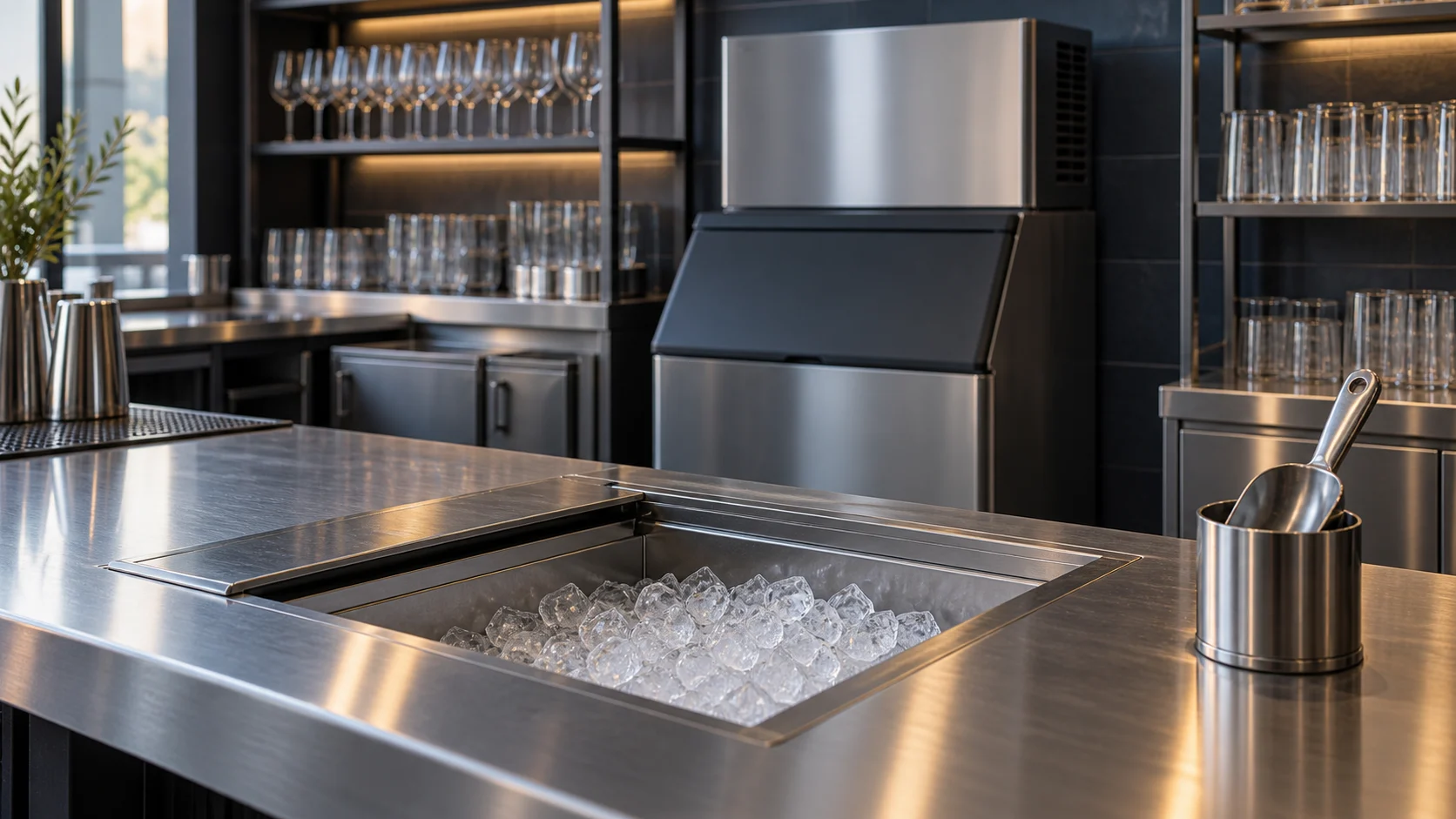
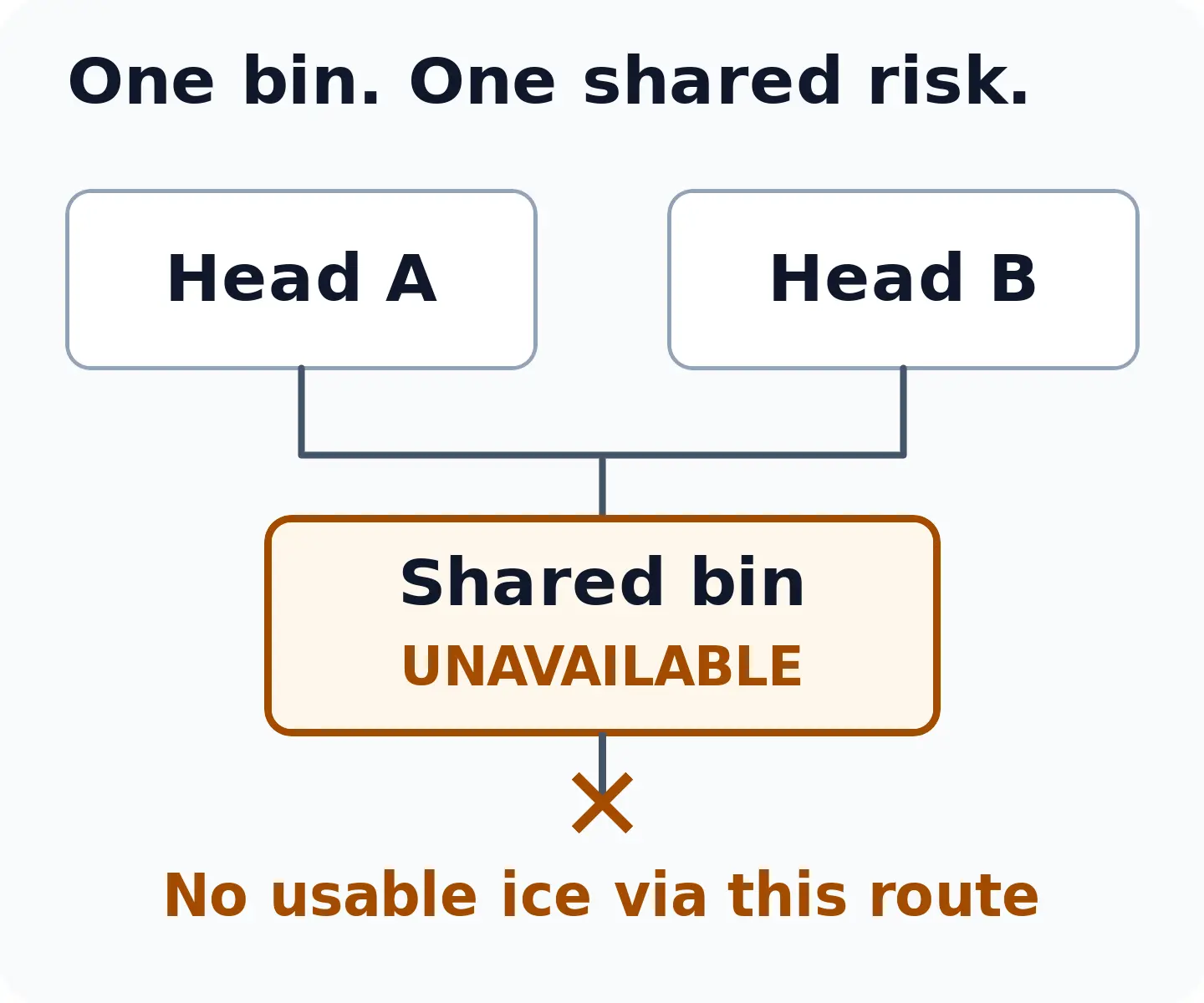
A second ice machine earns its place when it keeps usable ice reaching the bar during the interruption you need to cover. Two heads sharing affected water or an unavailable bin can still leave you with no supply.
Compare how long your reserve lasts with when replacement ice will actually be ready to use. That turns “one ice machine or two?” into a service decision: one machine plus reserve or bought-in ice may be enough; a second, separately usable path matters when it closes a gap the first plan cannot.
Decide what must survive the interruption
Choose the event: one head fails, the bin needs cleaning, a water alert affects the premises, or a utility becomes unavailable. Define the menu and service window you intend to maintain. A full cocktail menu and a temporarily reduced menu draw different amounts of ice.
Count only stock that will remain safe, accessible and available after that event. Rated bin capacity is not starting stock. Ice in a bin that must be emptied contributes zero to that scenario.
If the machine is already falling behind, the commercial ice machine troubleshooting and low-production guide helps separate a fault from demand or service-access issues. Here, the job is to sustain a defined service while a supply path is unavailable.
Find the time your reserve runs out
The stock balance, in kilograms, is:
Opening usable ice
+ usable production + replenishment received
− service draw − other stock losses
= closing usable ice
Count bought-in ice when it reaches the venue and is ready for safe use—not when it is ordered. Keep losses separate from withdrawals so the same ice is not counted twice.
For a constant-rate screen, divide starting stock by service draw + losses − surviving production. The denominator must be positive. A zero or negative net draw means this simplified balance does not run down; it does not prove protection against demand bursts or gaps between harvests.
A three-hour delivery can arrive nine minutes too late
Illustrative inputs: 40 kg available, service draw of 12 kg/h and an assumed additional 2 kg/h of losses. Replacement ice becomes usable after three hours. These are constructed inputs, not typical loss rates or measured machine performance.
With no surviving production: 40 ÷ (12 + 2) = about 2 hours 51 minutes. The planned three-hour balance has a 2 kg supply gap, including the assumed losses.
With a separately usable path supplying an assumed 6 kg/h: net draw falls to 8 kg/h. The reserve lasts five hours, leaving 16 kg immediately before the three-hour delivery.
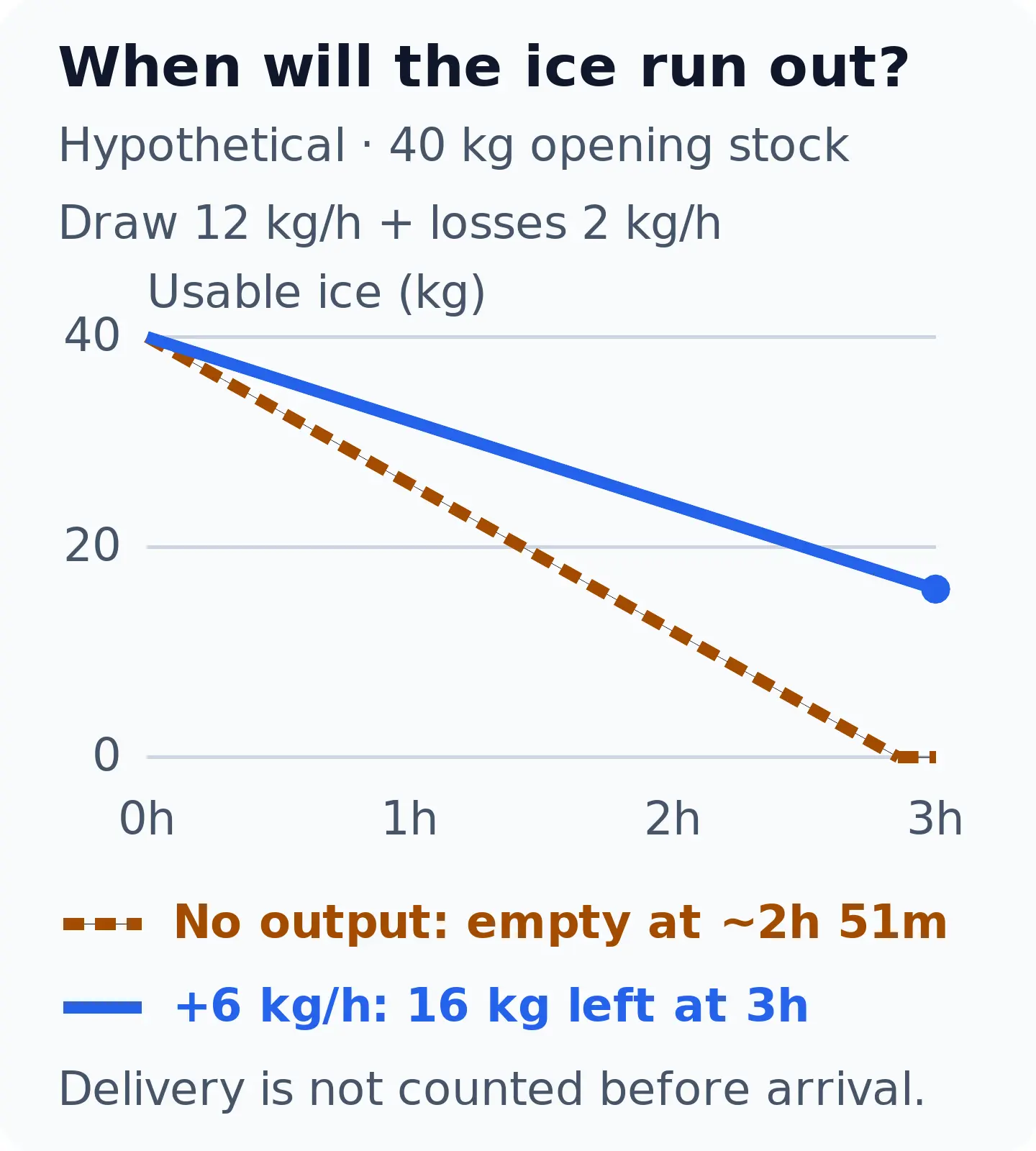
Now make the assumptions less comfortable. Start the second-path example with 28 kg and only 4 kg remains at hour three. Keep the original 40 kg but delay replenishment until hour five, and the balance reaches exactly zero. A plan that just reaches zero has no margin for another delay.
A daily rating cannot promise the next three hours
Hoshizaki Australia’s IM-240DNE-28 data lists approximately 205 kg per 24 hours at 21°C air/15°C water, and 160 kg at 32°C air/21°C water. Those figures belong to that model and those conditions.
Dividing either daily total by 24 does not establish guaranteed hourly backup. Use timed production evidence under the proposed conditions. Put withdrawals, harvests and replenishment on the same timeline: a harvest arriving after a drinks rush cannot meet that earlier demand.
Check the lowest balance between arrivals, not just the closing balance. Repeat with less starting stock and a later delivery. Keep normal machine-and-bin sizing separate from this test of a specific interruption.
Check what both machines depend on
Remove the failed component from the proposal on paper. Trace the surviving path all the way to service.
- One head fails
Confirm the other can operate while the failed unit is safely isolated and accessed. Credit only that surviving output for the exact head/bin and service arrangement.
- The shared bin is unavailable
Count neither its stock nor output through it as usable. Another approved storage and handling route must exist before it can be credited.
- Water or power is affected
Two machines on the same affected supply retain that dependency. Alternative connections need qualified site assessment.
NSW Health’s boil water alert advice for food businesses includes ice preparation. A second machine on the same affected water is not an independent safety solution; follow the relevant local supplier and regulator’s instructions.
Cleaning can remove the reserve too
The manual linked by Bromic for IM0160HDM, IM0250HDM, IM0320HDM and IM0485HDM includes emptying the bin during cleaning and prohibits use of ice affected by cleaning solution. Its cover uses SIMAG SVD model names: confirm the applicable document for your exact unit with the supplier or service agent.
This is a planning example, not a cleaning procedure. Staggering head cleaning may still leave a shared bin out of service. Establish where safe ice will be available before choosing the cleaning window.
For bought-in ice, confirm type, quantity, availability, lead time, receipt and safe storage/transfer. Queensland Health’s ice-handling guidance explains contamination controls. A nearby shop is a possible supply option until that complete arrangement is checked.
Give the supplier a problem to solve
Use this brief to make proposals comparable:
We need to sustain [menu] from [start] to [finish] after [specific interruption]. Usable starting stock is [kg]. Our event record shows [withdrawals, losses and arrivals]. Replacement ice becomes usable at [time]. Identify the surviving components, supported output under our conditions and the interruptions this arrangement cannot cover.
Compare commercial ice makers and storage options against that brief. Include bins, compatible components, installation, access and service arrangements in the quoted scope. Take unresolved layout and services questions to KW’s kitchen design service and the appropriate qualified site specialists.
The purchase should close the tested supply gap. A second machine planned for next year can shape today’s layout, but it contributes nothing to today’s backup.