Commercial steamer vs combi oven: route the production load
A combi oven's ability to steam does not prove it is available when your steam batch is due. Choose the production route by recording what must cook at the same time: steam loads, dry-heat loads, products that need separation, loading formats and the exact services the site can support.
If those jobs can be sequenced inside the real peak window, a combi-only route may remain credible. If recurring steam work collides with roasting, baking, regeneration or finishing in the same chamber, evaluate a dedicated steamer or a hybrid system. This is a route to an equipment brief, not a claim that one format is universally faster or better.
The scarce resource is chamber time
Feature lists invite the wrong comparison. “Can this appliance steam?” is a capability question. The buying question is whether the required chamber, pan position and operator attention are available at the deadline.
Start with one representative peak production window. Use actual menu and service records where available. For each steam task, name the product, batch or pan, planned start, required finish, loading format and what else must occupy the combi during that interval. If the time is only an estimate, label it as an estimate and validate it before purchasing.
| Steam job | Deadline and overlap | Separation or loading constraint | Competing combi job | Evidence owner |
|---|---|---|---|---|
| Product and batch identity | Planned start, required finish and any simultaneous steam load | Pan or basket format; recipe, allergen or raw/ready-to-eat separation | Roast, bake, regenerate, finish or clean cycle due in the same interval | Venue production record and validated process |
| Equipment translation | Which chamber must be free, and for how long under the validated programme? | Which loads may share a cycle, and which require another chamber or time slot? | Can the dry programme move without shifting a service deadline? | Exact model document, supplier and kitchen planner |
| Site response | Landing space and operator access at unload time | Safe movement and clean-down between incompatible work | Ventilation, cleaning and service access around the proposed route | Relevant licensed trades and project professionals |
The ledger is deliberately not a throughput calculator. Power, tank volume and shelf count are useful exact-model fields, but none converts safely into portions per hour without the product, programme, load, operator and service conditions that produced the result.
Put every material batch through four collision checks
First, test the deadline. Two jobs collide when delaying either one would move a real production or service requirement. A batch that can be moved to a quiet preparation period is different from a steam load due while the combi is committed to a roast or regeneration programme.
Second, test separation and loading. Products may have different programmes, aromas, allergen controls or raw/ready-to-eat boundaries. They may also use incompatible pans, baskets or shelf arrangements. Do not count nominal positions until the exact loading system and the venue's validated process are known.
Third, test the rest of the chamber demand. List the combi jobs that are not steam jobs. The broad capability of a combi is commercially useful only when its required programmes fit the production sequence. A chamber cannot perform two incompatible programmes at once merely because both appear in its feature set.
Fourth, test exact services. A route that works on paper can still fail at the proposed location. Gas or electrical supply, water, waste, treatment, clearances, ventilation, loading access and service access belong to the selected model and site—not to a generic equipment label.
Read the route from what still collides
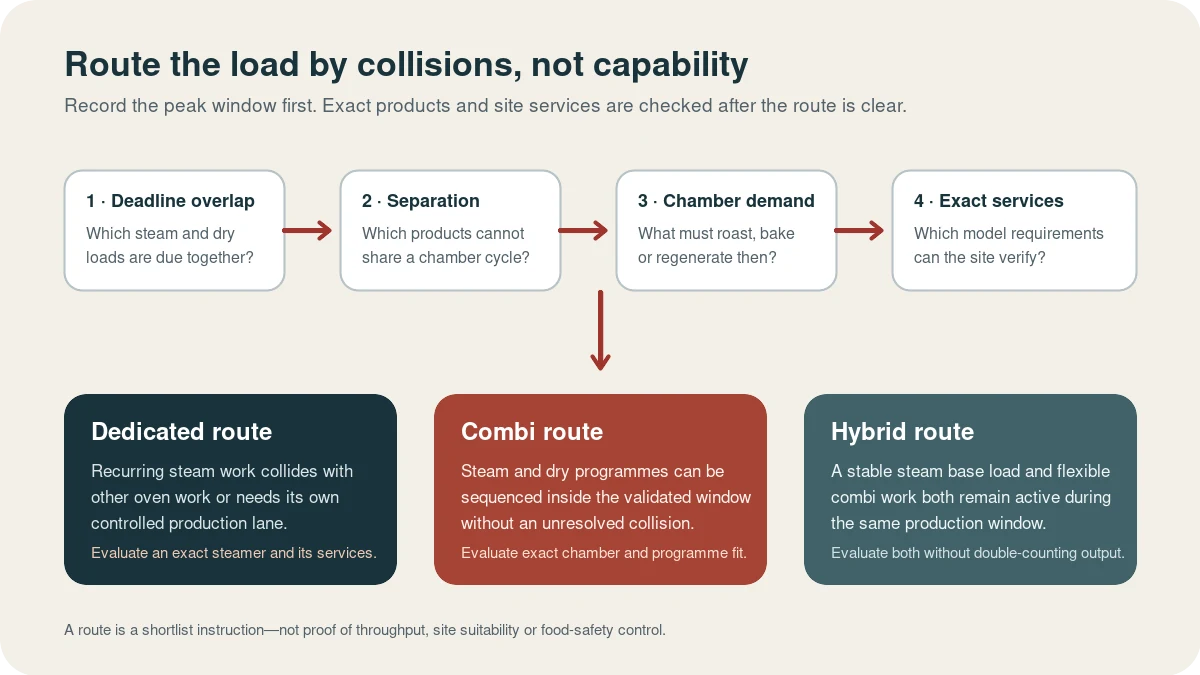
Evaluate a dedicated-steamer route when a stable steam workload repeatedly occupies the combi chamber at the same time as material dry-heat work, or when separation and loading constraints create a defensible independent lane. The next question is not “which steamer has the biggest number?” It is which exact configuration accepts the required vessels, programme and service conditions.
Evaluate a combi-only route when the steam and dry programmes can be sequenced inside the validated peak window, the required loads fit the documented chamber system, and the site's exact service response is supportable. Leave contingency and cleaning time in the schedule; a theoretical back-to-back plan is not yet an operating result.
Evaluate a hybrid route when repeatable steam work and flexible combi work both remain material in the same window. Define what the dedicated unit owns and what the combi owns. Otherwise the shortlist can double-count the same batch, leave cleaning cycles unallocated or assume both appliances are freely interchangeable.
A single day may not settle the route. If production varies, repeat the ledger for the service patterns that materially change chamber demand—such as a banquet day and a standard à la carte day—without blending them into an average that represents neither.
Two exact sheets show why services cannot be guessed
These examples are not recommendations and do not represent their whole categories. They show how differently two steam-capable products can present the site question.
The exact B+S K+ KYCJSF-1HE specification sheet identifies a single-hole heat-exchange steamer with a 37 L tank and 7-hole perforated steaming plate. It lists a 600 × 840 × 1030 mm body, 87.5 MJ/h natural-gas or 84 MJ/h LPG input, plus separate gas, water, tank-drain and waste connections. Those numbers belong only to that model and configuration; they do not state the venue's batch output.
The exact Moffat Blue Seal Sapiens EC611RSDW specification sheet identifies an electric direct-steam combi with six 1/1 GN positions at 60 mm spacing. It lists 7.75 kW total connected load, 400–415 V three-phase supply, two R3/4 water connections, an R40 waste connection and model-specific clearance requirements. Again, those fields describe the appliance—not the supply already available at a proposed site.
The practical comparison is therefore not “gas steamer versus electric combi” in the abstract. It is a document-to-site reconciliation for the exact shortlisted equipment. The existing combi oven installation-evidence guide explains how to separate appliance requirements, measured site conditions and professional ownership after the production route is chosen.
Keep food control outside the equipment shortcut
Food Standards Australia New Zealand's processing guidance says food businesses must use safe processing techniques, protect food from contamination and know the critical limits for their own processing steps. It also calls for separate equipment or areas for raw and ready-to-eat food, or thorough cleaning between uses.
That evidence affects the ledger's separation column. It does not supply a universal steam programme, prove a recipe safe or turn equipment selection into food-safety approval. Keep recipe validation, allergen controls, monitoring records and jurisdictional requirements with the venue's documented food-safety system and responsible advisers.
Send one completed sheet to the right owners
When the rows point to a dedicated or hybrid route, compare the current commercial steamer range. When they support a combi or hybrid route, compare the current commercial combi oven range. Ask for the exact model documents before carrying any dimension, service or loading claim into the plan.
Give the same collision ledger to commercial kitchen design and the relevant licensed trades. It should identify unresolved service, ventilation, landing-space, movement and access questions without pretending that the article has designed or approved the installation.
The route is complete when every material steam batch has an owner, every simultaneous chamber conflict has a disposition and every shortlisted appliance can be checked against the real site. Until then, “the combi can steam” and “the steamer is dedicated” are capabilities—not a production decision.