
How to Choose a Commercial Waffle Maker in Australia
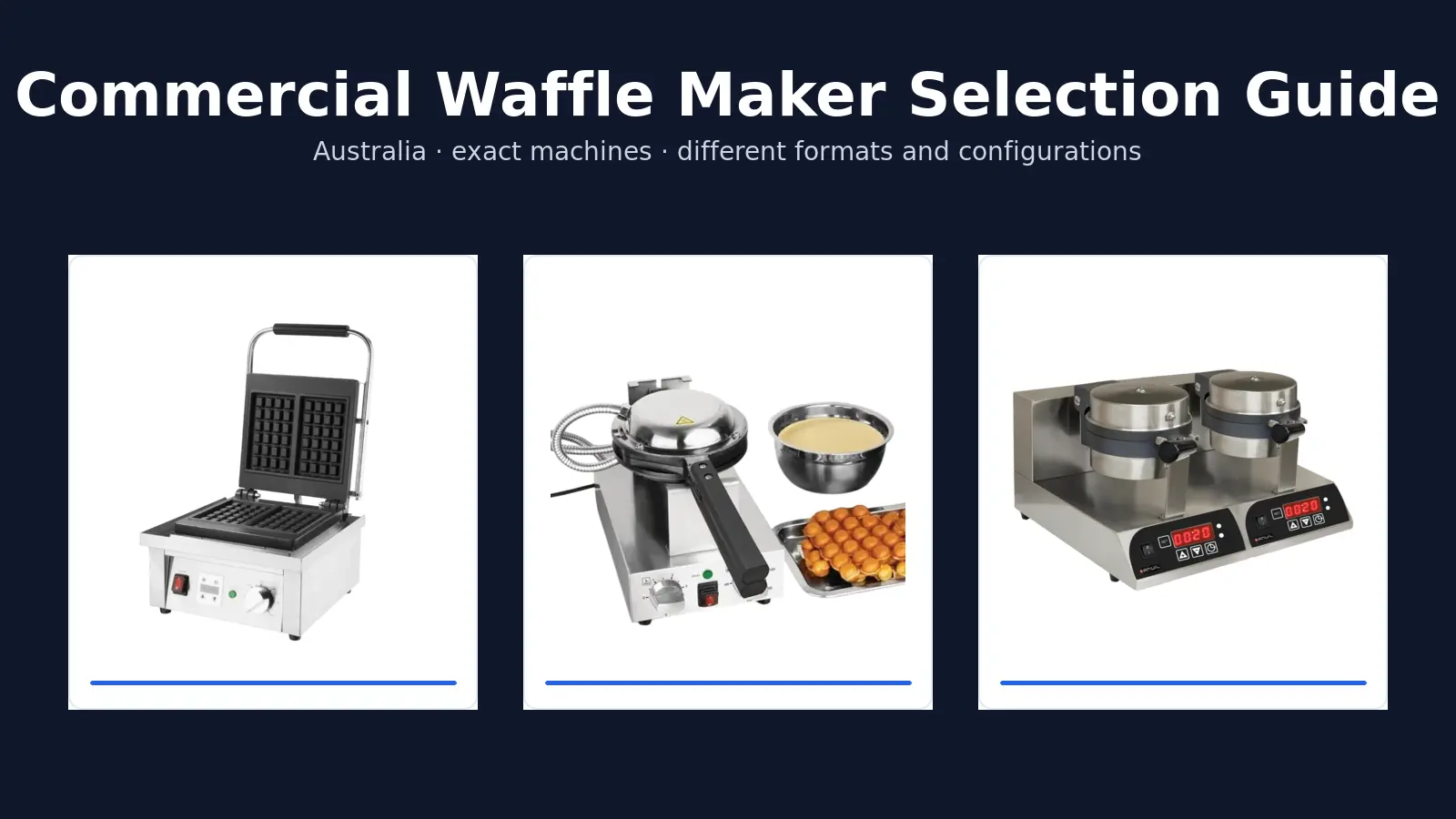
A commercial waffle maker proves itself during the Saturday brunch rush, not on the day it is unboxed. Once a café, dessert shop or restaurant has a dozen dockets queued, only a few things matter: how long each batch actually takes, whether the plates release cleanly when nobody has time to coax them, and whether the circuit behind the bench can carry it alongside everything else already running.
Those questions are rarely settled by buying the largest or most expensive unit. The differences that change a service are more specific than price. Plate format decides what you can sell — a round Belgian, a bubble waffle and a contact-grill plate are three different menu items, not three versions of the same one. Machine configuration decides your batch rhythm. Electrical requirements decide where the machine can physically go.
This is where the exact model earns its keep. Some models have a stated output per hour and a stated power draw on record; others have neither. Those figures belong to the model that carries them; they cannot be inferred from wattage, plate size or price. A heavier commercial waffle machine is not automatically a faster one.
This guide is about choosing a waffle maker for a working café or restaurant kitchen: which plate format suits your menu, which configuration suits your service pattern, and what the stated specifications do and do not tell you. KW's commercial category also carries crepe makers; this guide covers waffle makers specifically. Start with the question that decides everything after it — what actually makes a waffle maker commercial?
What actually makes a waffle maker commercial?
Commercial waffle makers can look similar on a specification sheet, but the buying decision changes when a café or restaurant needs repeatable service through a busy period. Plate material, plate configuration, controls and exact-model output are more useful selection signals than wattage alone.
Start with what the plates are made of, because this range splits on it. Cast iron is listed on the Benchstar UWB-S contact grill, the Apuro DB170-A, the Apuro DK229-A and the Anvil WBA1002. The Benchstar WB-03D lists ceramic-coated cast iron. The others are coated: triple-coated non-stick on the Waring DM874-A and the Waring DK079, non-stick on the Apuro CJ564-A, coated die-cast aluminium on the Apuro HS985-A, and teflon-coated aluminium on the Benchstar WB-04A. Check the exact model rather than the brand: Apuro and Benchstar each list both cast iron and coated aluminium across their waffle range.
Next, check the plate configuration. A rotating or rotary plate is listed on the DK229-A, the WB-04A and the Anvil WBA1001 (both 180°), the WBA1002, the DM874-A and the DK079 (180°). The UWB-S is a contact grill taking two 10 × 16 cm waffles per cycle, the WB-03D record lists a fixed plate, and the CJ564-A and DB170-A records list no rotating plate. This is a configuration difference to match to your service, and as the table below shows, it is not a proxy for how many waffles a machine will make.
Controls are the third thing to check. Most records in this range list a timer and a thermostat rather than a single control: a digital timer and variable temperature dial on the CJ564-A, a digital timer and dial thermostat on the DB170-A, a manual thermostat and timer knob on the DK229-A, independent timer and temperature controls on the HS985-A, a PCB digital control panel on the WB-04A, and programmable digital controls on the WBA1001 and WBA1002. The WB-03D is the exception, listing one temperature knob. Controls of this kind let a temperature and a time be set and repeated. They do not by themselves produce an identical finished waffle, which still depends on batter, fill and how the machine is worked during service.
Stated hourly output, and what it does not tell you
Eight machines in KW's current range state an hourly output in their product record. Others, including the UWB-S and the two Anvil bakers, state none at all.
| Model | Stated output (KW product record) | Plate and waffle format |
|---|---|---|
| Apuro CJ564-A | 60 waffles/hr | non-stick, 165 × 100 mm waffle |
| Apuro DB170-A | 60 waffles/hr | cast iron, 160 × 100 mm cooking area |
| Waring DM874-A | 50 waffles/hr (stated as 200 portions) | double, rotary, 175 mm Ø per waffle |
| Apuro DK229-A | 30 waffles/hr | rotating cast iron, 199 mm bubble plate |
| Apuro HS985-A | 30 waffles/hr | coated die-cast aluminium, 180 mm round Belgian |
| Benchstar WB-03D | 30 waffles/hr | ceramic-coated cast iron |
| Waring DK079 | 25 waffles/hr | 180° rotary, 228.6 × 177.8 mm bubble cooking area |
| Benchstar WB-04A | 20 waffles/hr | 180° rotating 18 cm plate, Belgian |
These figures come from KW's current product records, not from manufacturer test documents held on file. Where a number has to be contractual — a tender, a lease schedule, a fit-out spec — request the manufacturer's specification sheet for that exact model.
Do not infer hourly output from wattage, plate configuration or the word “double”. Use an exact-model output figure only where that figure is actually published for that model. This range shows why. Three machines are listed at 1.4 kW — the DM874-A, the DK229-A and the WB-04A — and they state 50, 30 and 20 waffles an hour. The two highest figures, both 60, belong to machines whose records list no rotating plate, while every model that does list one states less. And the only machine here whose title says “double” states a lower figure than two machines that make no such claim.
The DM874-A also states its figure two ways — 50 waffles, or 200 portions, an hour. That is worth noticing before comparing anything: where the waffle format or the counting unit differs, hourly figures are not directly comparable benchmarks.
So the commercial difference in this range shows up in four places you can check on the exact model: what the plates are made of, whether they rotate, whether the controls can be set and repeated, and whether an output is stated for that model at all. Which of those matters most depends on the waffle you intend to sell — so the next decision is format.
Choose the waffle format before you choose the machine
A waffle maker does not make waffles in general. It makes one shape, at one size, in one arrangement, and the plates are matched to the machine. The format you buy defines the waffle your machine is built to produce, so settle it before comparing the rest of the specification sheet.
Start with the format names, because they are less precise than they look. Four records in KW's current range designate a Belgian waffle, and their stated plate sizes are not the same; waffle depth is stated on only some of them. A fifth machine produces a round waffle of a similar size, and its record does not name a format at all. Two listings that both say Belgian will not necessarily hand you the same waffle.
Bubble is the clearest case. The Apuro DK229-A lists a round cooking area; the Waring DK079 lists a rectangular one. Both are sold as bubble waffle makers, and neither produces the other's waffle. If a quote says “bubble waffle maker”, the format name has told you very little until you have that model's plate dimensions.
The rest of the range spreads across three further arrangements: a rectangular plated waffle, a twin-plate contact grill that produces two waffles per cycle, and one machine whose record states no waffle dimension at all. The Apuro DB170-A product record describes its rectangular size as suited to plated presentation. The Benchstar WB-03D gives only a plate type, fixed ceramic-coated cast iron — if the finished format matters to your menu, that is a question to settle before ordering rather than after.
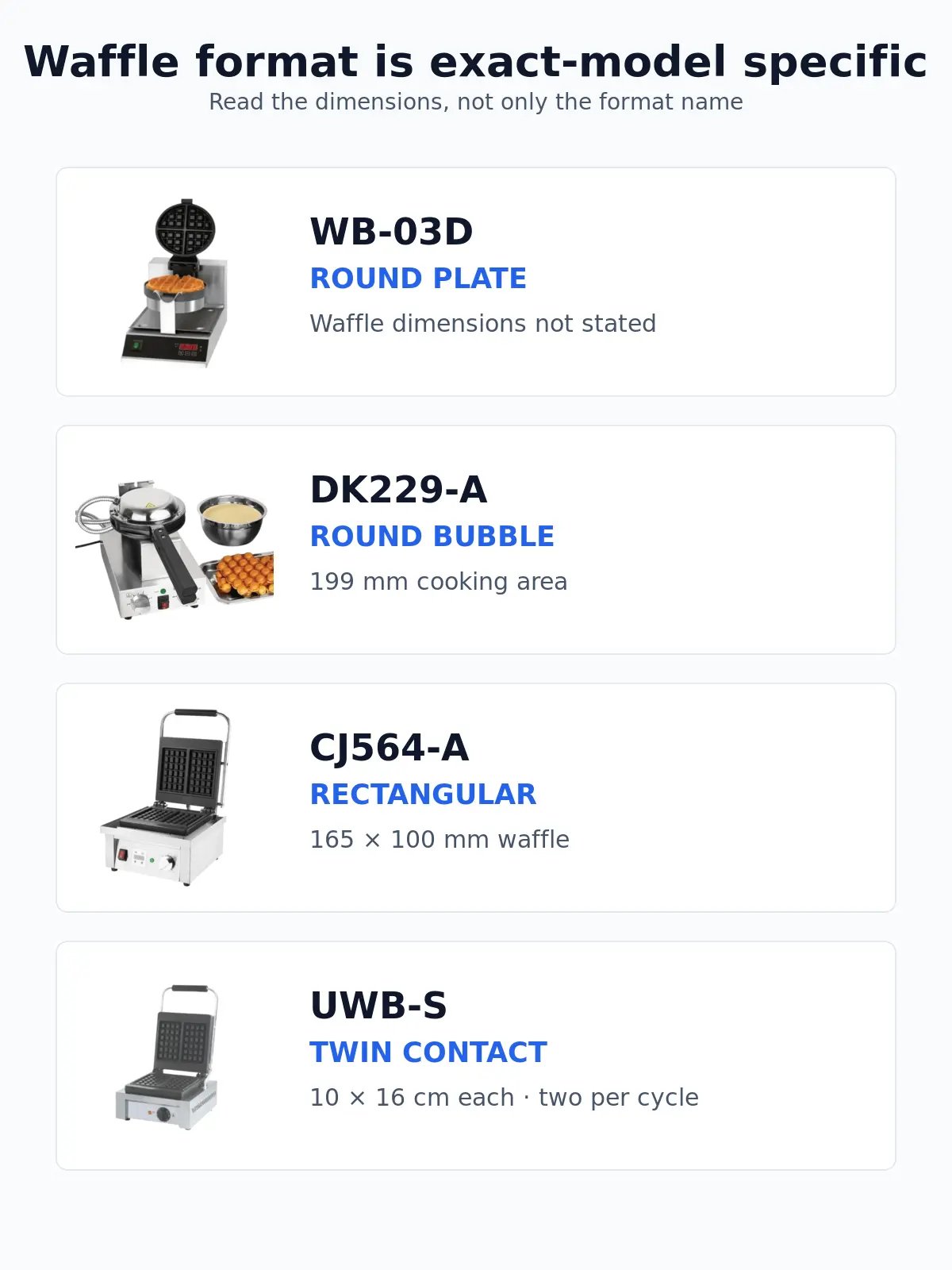
Format map for KW's current range
| Format on the record | Model | Stated plate or waffle dimension | Configuration |
|---|---|---|---|
| Belgian, round | Apuro HS985-A | 180 mm diameter | no rotation listed |
| Belgian style | Benchstar WB-04A | 18 cm diameter, one inch thick | 180° rotating |
| Belgian, single | Anvil WBA1001 | 190 mm plate diameter | 180° rotating, one plate |
| Belgian, double | Anvil WBA1002 | 190 mm diameter per plate | rotating, two plates |
| Round; format not named | Waring DM874-A | 175 mm Ø × 32 mm H per waffle | double, rotary |
| Bubble | Apuro DK229-A | 199 mm diameter cooking area | rotating |
| Bubble | Waring DK079 | 228.6 × 177.8 mm cooking area | 180° rotary |
| Rectangular; format not named | Apuro CJ564-A | 165 × 100 mm waffle | no rotation listed |
| Rectangular; format not named | Apuro DB170-A | 160 × 100 mm cooking area | no rotation listed |
| Twin contact plate | Benchstar UWB-S | 10 × 16 cm, two waffles per cycle | fixed contact grill |
| Not stated | Benchstar WB-03D | no waffle dimension on record | fixed plate |
Read down the dimension column rather than the format column. Belgian spans 180 mm to 190 mm here, bubble covers both a round plate and a rectangular one, and two machines produce a shape their records never name. The format name gets you to the right shelf; only the exact model tells you what lands on the plate.
Single, double, and two waffles at once
Configuration is a separate question from format, and the records describe three arrangements rather than two. The WBA1001 has one 190 mm plate. The WBA1002 has two plates, each 190 mm, with four 500 W elements totalling 2000 W. The UWB-S produces two waffles per cycle from a single contact grill. So “double” on a specification sheet can describe different physical arrangements; confirm the exact configuration before comparing models.
Portioning is also worth reading off the product record rather than assuming. The DM874-A product record states 50 waffles or 200 portions per hour, implying four stated portions per waffle for that exact model. That is the portion convention on that record, not a rule about 175 mm waffles. No other model in this range states a portion count, so the same arithmetic cannot be carried across to a 180 mm or 190 mm waffle without checking the exact model.
One boundary is worth stating plainly. The measurements above tell you what comes off the plate: a 199 mm bubble waffle, two 10 × 16 cm rectangles per cycle, or a 175 mm round that one product record expresses as four portions. They are a sound basis for deciding portion size and plating. They are not a basis for deciding that one format suits a dessert bar and another suits a breakfast buffet — the product records make no such claim, and neither will we. That match is a menu decision, and your own service data answers it better than any specification sheet.
With the format settled, the remaining constraints are physical: what the machine weighs, how much bench it takes, and what it needs from the power point behind it.
Bench space, weight and electrical requirements
This is the part of the decision that gets settled by measuring rather than reading. A waffle maker has to occupy a specific piece of bench, sit under whatever is above that bench, and draw from the electrical supply available at that bench.
Across the records that state both a width and a depth, the dimensions vary substantially: widths run from 255 mm to 520 mm, and depths from 250 mm to 600 mm. The Apuro HS985-A is left out of that comparison because its record states a width but no depth. Check depth as carefully as width — five of the models listed below exceed 500 mm in stated depth, and the Benchstar WB-04A is listed at 600 mm, so measure it against your actual bench and against anything mounted behind it. On height, the Apuro DB170-A product record lists 395 mm, so check that one against any overhead shelf or obstruction.
Within the models compared here, a larger stated footprint does not consistently correspond to a higher stated hourly output. The DB170-A occupies 302 × 250 mm and states 60 waffles an hour. The WB-04A occupies 255 × 600 mm and states 20. The largest footprint in this group states no hourly figure at all. Bench dimensions alone do not tell you hourly output.
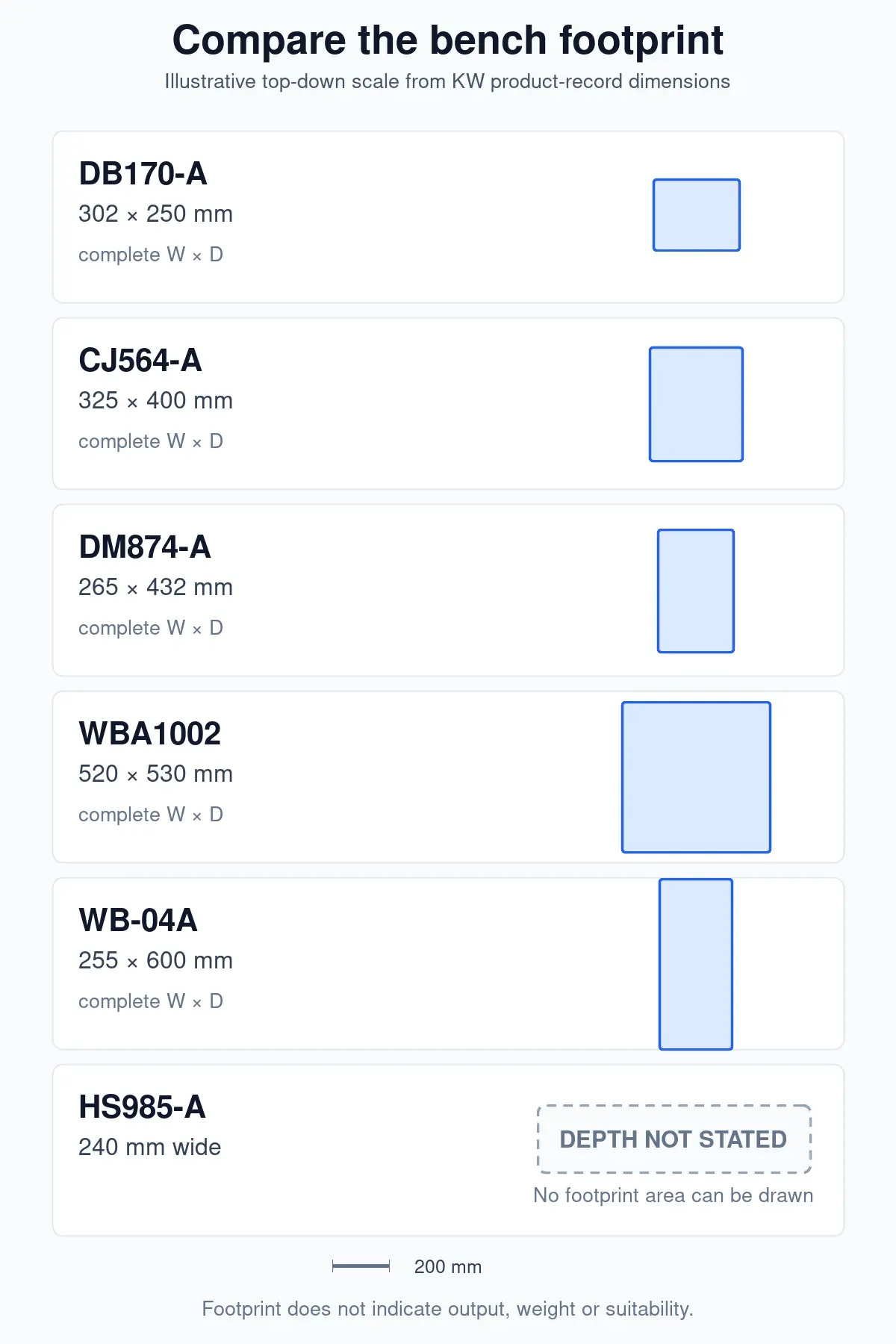
| Model | Footprint W × D | Weight as stated | Electrical supply / power on record | Plug or outlet on record |
|---|---|---|---|---|
| Apuro HS985-A | 240 mm wide; depth not stated | 5.1 kg | 1 kW / 240 V | plug-in (AU); rating not stated |
| Waring DK079 | 260 × 508 mm | 6 kg | 220–240 V; wattage not stated | rating not stated |
| Apuro DK229-A | 275 × 540 mm | 8 kg | 220–240 V; wattage not stated | standard 10 A |
| Waring DM874-A | 265 × 432 mm | 8.5 kg | 230 V / 1.4 kW; 6.1 A draw | 10 A plug fitted |
| Apuro CJ564-A | 325 × 400 mm | 10 kg | 220–240 V; wattage not stated | 10 A plug |
| Benchstar WB-03D | 255 × 440 mm | 11 kg net | 1000 W / 240 V | 10 A outlet |
| Benchstar WB-04A | 255 × 600 mm | 11 kg net | 1.4 kW / 220–240 V | 10 A plug |
| Anvil WBA1001 | 255 × 515 mm | 12 kg net | 1000 W / 240 V | 10 A plug |
| Benchstar UWB-S | 470 × 320 mm | 17 kg net | 1.5 kW / 240 V | 10 A plug |
| Apuro DB170-A | 302 × 250 mm | 20 kg | 2000 W / 230 V | 10 A plug |
| Anvil WBA1002 | 520 × 530 mm | 23 kg net | 2000 W / 240 V | 10 A plug × 2 |
Two notes on reading that table. Weights are quoted as the records write them: five records specify a net weight and six give a weight without qualifying it, and they are not treated here as the same measurement. And the HS985-A record gives a width and a height but no depth, so its footprint is incomplete rather than small.
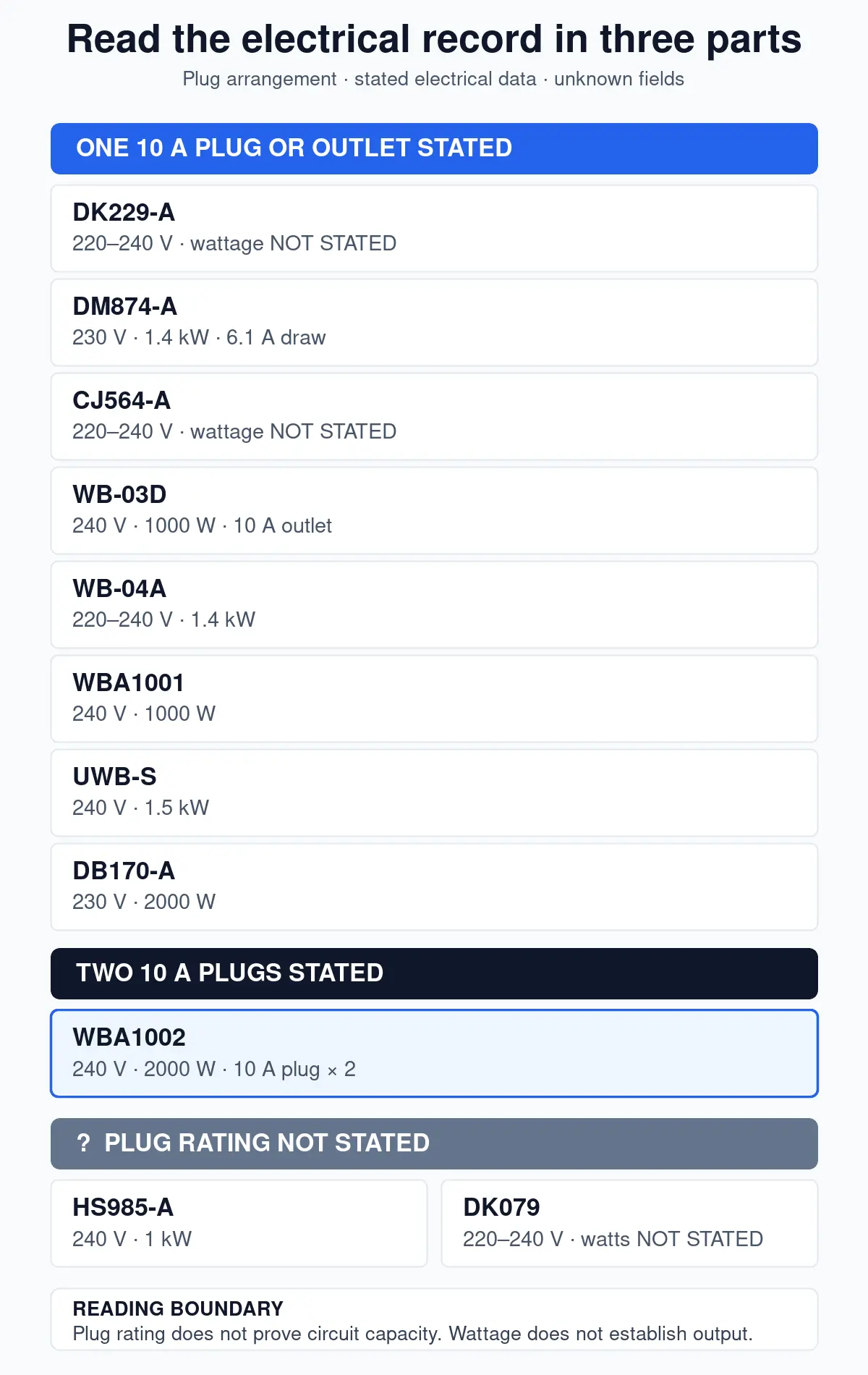
The power point is the constraint people find last
Nine of the eleven records state a 10 A plug or outlet; the HS985-A and DK079 records give a supply voltage without a plug rating. Stated wattage, where a record gives one, runs from 1 kW to 2000 W. Three records — the CJ564-A, DK079 and DK229-A — state no wattage at all, which is worth requesting before you commit a circuit to one of them.
One entry on that table deserves reading twice. The Anvil WBA1002 product record specifies two 10 A plugs, so a single available outlet does not match the stated connection arrangement. Confirm that the intended electrical supply is suitable before installation. The DB170-A records the same 2000 W with a single 10 A plug, so the two models have different stated plug arrangements.
Only one record states the current the machine actually draws as distinct from the plug it is fitted with: the DM874-A lists 6.1 A behind a 10 A plug. That distinction matters more than it looks. A plug rating tells you the socket the machine expects; it does not tell you what headroom is left on the circuit once your grill, toaster and coffee grinder are all running. Two records address this directly — the UWB-S states that a standard 240 V/10 A outlet is required and no special wiring is needed, and the WB-03D states that it plugs into a standard 10 A outlet — but each of those statements covers only its own model.
The appliance record cannot tell you whether the existing circuit has sufficient capacity once the rest of the connected load is considered. If the supply, circuit capacity or wiring needs to be assessed or altered, have a licensed electrician check it before installation.
Format, footprint and supply between them decide which machines are genuinely available to you. Everything after that is a narrower comparison between the few that fit.
Cleaning, maintenance and serviceability
All eleven product records use easy-to-clean language, so that claim does not differentiate the models in this comparison. Two narrower questions are worth asking before you buy: what actually comes off the machine, and what the records say about plate care.
The daily routine is close to identical across the range, and that is a finding rather than a disappointment. Seven of the eleven records tell you to let the unit cool first. Seven say to wipe with a soft or damp cloth. Six say to avoid abrasives or metal tools. Three say not to immerse the unit in water. Two give the reason in as many words — to preserve the non-stick surface. The published cleaning routines overlap substantially, so cleaning instructions alone provide little basis for choosing between these models.
What comes apart does differ. Three records state that the plates are fixed: the Waring DK079, the Benchstar UWB-S, and the Benchstar WB-03D, whose record lists its plate type as fixed outright. One record says the opposite — the Benchstar WB-04A's teflon-coated aluminium plates are described as removable with a screwdriver for easier maintenance. The remaining seven product records do not state whether the plates are removable. If plate serviceability matters to your operation, confirm it for the exact model rather than assuming either way.
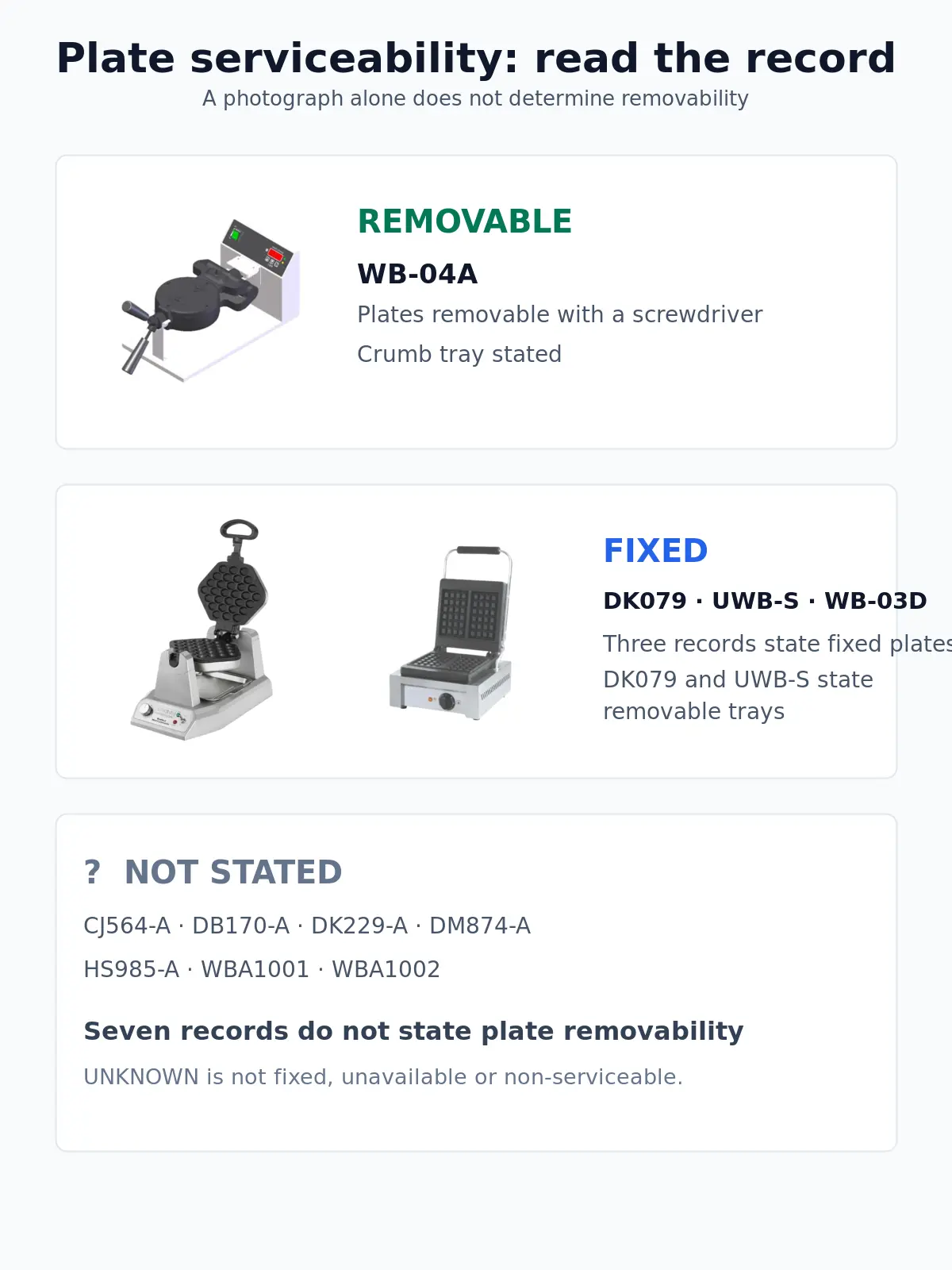
Trays are the other removable part, and five records name one: a drip tray on the Apuro DB170-A and the DK079, drip trays and a batter cup on the Waring DM874-A, a grease tray on the UWB-S, and a stainless crumb tray on the WB-04A. Only the DK079 record states that its tray is dishwasher safe.
| Model | Plates on record | Removable tray on record |
|---|---|---|
| Benchstar WB-04A | removable with a screwdriver | stainless crumb tray |
| Waring DK079 | fixed | drip tray, dishwasher safe |
| Benchstar UWB-S | fixed, cleaned in place | grease tray |
| Benchstar WB-03D | fixed | not stated |
| Apuro DB170-A | not stated | drip tray |
| Waring DM874-A | not stated | drip trays and batter cup |
| Apuro CJ564-A | not stated | not stated |
| Apuro DK229-A | not stated | not stated |
| Apuro HS985-A | not stated | not stated |
| Anvil WBA1001 | not stated | not stated |
| Anvil WBA1002 | not stated | not stated |
What the records say about plate care
Across these product records, plate and coating care is a recurring maintenance theme. Two records explicitly connect the cleaning method with preserving the non-stick surface. The HS985-A product record also recommends a small brush of oil on the plates for added release longevity, while the WBA1002 record directs the user to maintain its cast plates in line with the user guide.
That tells you where the maintenance instructions focus. It does not tell you which component will wear first, how long the coating will last, or when any part will require replacement.
Replacement plate availability is exact-model specific. Waring does sell the Waring FD469 replacement plate kit for the WW180XCK, supplied as two plates, screws and a screwdriver. It does not fit any of the eleven machines compared in this guide. That is exactly the point: plate availability is a per-model question, and it is worth asking before you need the answer rather than after.
Here is what none of these records tell you: how long a coating lasts, how many services or cycles it is good for, what a maintenance interval should be, whether a worn plate can be re-coated rather than replaced, or how long any of these machines is expected to last in service. Those figures are not in the product records, and we are not going to estimate them for you. The DB170-A record points to the manufacturer's maintenance guide for longevity, which is the right place to take the question. Current warranty terms are shown on the relevant product page and can differ by brand.
Cleaning will not decide this purchase for you. Plate serviceability might.
Match the machine to your service workflow
A useful shortlist is not the machine with the longest specification sheet. It is a small group of exact models that has passed the constraints you can verify, with any remaining unknowns still visible. One practical screening framework is to work from format through site fit and stated product facts before deciding which models deserve a closer look.
If the menu job is made-to-order crepes rather than waffles, stop this format-led path here. Use the separate crepe service-capacity test to measure the plate, operator and finishing queue before comparing crepe-machine configurations.
This is not the only possible order. Its value is that it deals with the decisions that can remove a machine from contention before comparing details that may never matter.
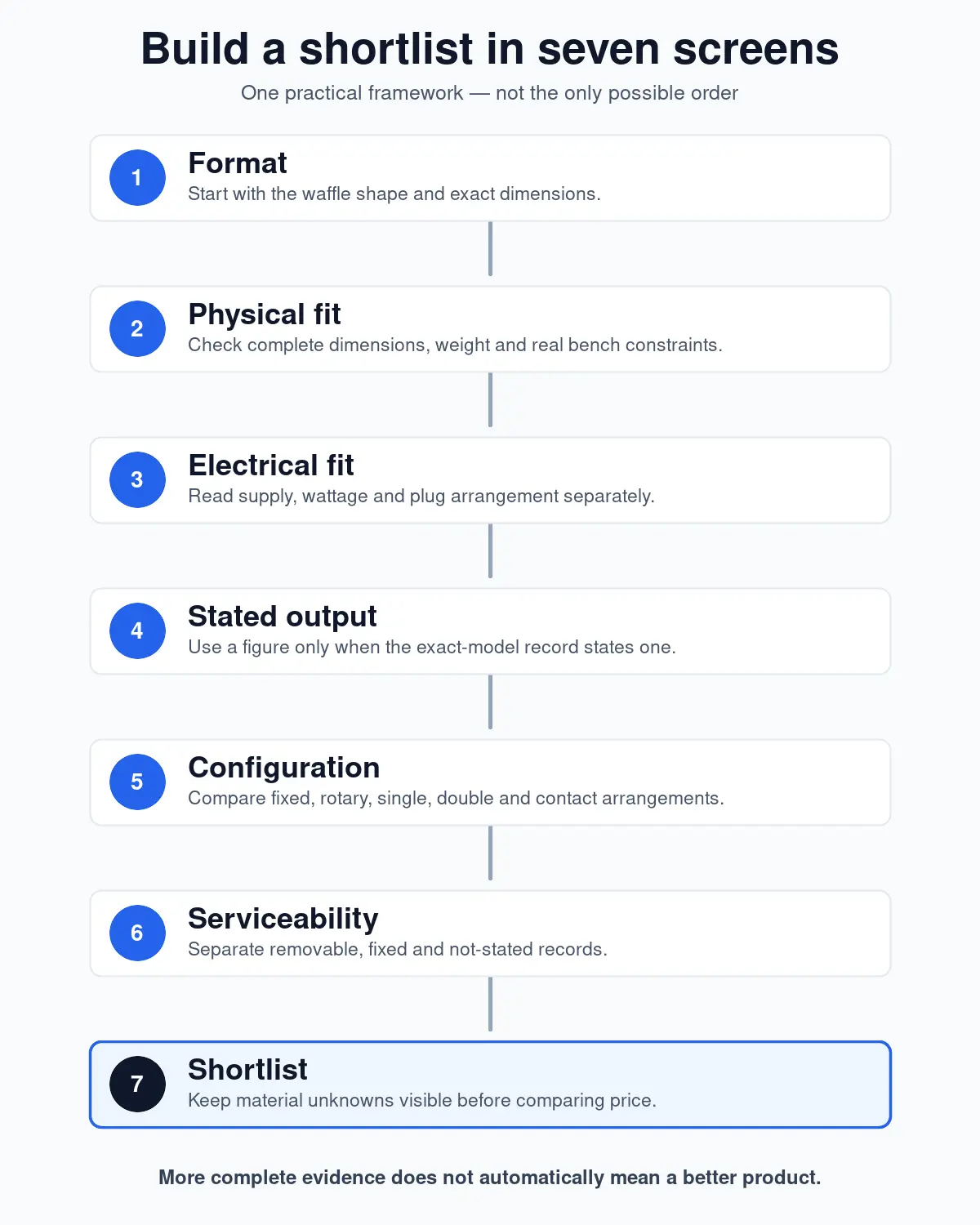
A practical screening framework
- Format. Start with the finished waffle required by your menu and plating plan. Compare that requirement with the exact plate or waffle dimensions on the product record. A format name alone is not enough: Belgian and bubble labels cover different dimensions and arrangements within this range.
- Physical fit. Check stated width and depth against the measured bench, and height where an overhead shelf or obstruction makes it relevant. Treat an incomplete dimension set as incomplete. A missing dimension does not make a machine small.
- Electrical fit. Compare the exact voltage, wattage and plug information with the intended supply. A 10 A plug describes a connection; it does not prove that the existing circuit has capacity for the appliance and the other connected equipment. Have a licensed electrician assess the supply where circuit capacity or wiring needs to be confirmed.
- Stated output. Among the models still in contention, note an hourly figure only where the exact model record publishes one, and keep its counting unit attached. Do not convert wattage, rotary action, a double configuration or plate count into an output estimate.
- Configuration. Read single, double, rotary and fixed as descriptions of how the exact machine is arranged. They do not supply a missing output figure and do not create a ranking by themselves.
- Serviceability. Record any explicit statement about removable plates or trays. If the record does not say whether a plate is removable, write not stated. Do not turn that unknown into fixed or non-serviceable.
- Shortlist. Keep only the models that pass the requirements you have established. Carry every material not stated field into the enquiry for that exact model rather than filling it from another product or brand.
| Screening question | Evidence to check | What not to infer |
|---|---|---|
| What waffle do I need? | exact plate or waffle dimensions | the format name alone defines the exact finished dimensions |
| Will it physically fit? | width, depth, weight, and height where reliably stated | a missing dimension means the machine is small |
| Can the site supply it? | exact voltage, wattage and plug record | a 10 A plug means the circuit has capacity |
| What output is stated? | the exact model's hourly figure and counting unit | power or plate count predicts throughput |
| How is it configured? | exact single, double, rotary or fixed statement | configuration supplies a performance result |
| What is explicitly serviceable? | removable plate and tray statements | not stated means fixed or non-serviceable |
| What reaches the shortlist? | models that pass the chosen requirements, with unknowns retained | a more complete record proves a better machine |
Use an exact-model example for one question at a time
For stated output, the Apuro DB170-A product record publishes 60 waffles an hour. That figure answers the stated-output question for the DB170-A. It does not answer the other screening questions and does not make the model a general recommendation.
For configuration, the Anvil WBA1002 product record describes two rotating waffle plates. That tells you how the WBA1002 is arranged. It does not provide an hourly output figure, and the double configuration is not a substitute for one.
Neither example is a ranking. Each exact-model fact answers one screening question and stops there.
Keep the unknowns in the comparison
A working shortlist can be simple: record the required format, whether the stated dimensions fit, whether the electrical information has been checked, the exact-model output or not stated, the configuration, and any removable-parts statement. Where a missing field affects the purchase, request evidence for that exact model before ordering.
Do not substitute a figure from another model in the same brand. Do not treat a missing field as a negative product fact. And do not let a more complete record make a less documented machine look better or worse than the evidence allows.
The result is not a universal winner or a claim that this is the only way to choose. It is a practical shortlist tied to the waffle you have defined, the site you have checked and the exact-model facts the records actually state.
What should you budget for a commercial waffle maker?
As observed on 17 August 2026, the eleven standard listings in this comparison run from $336.18 to $1,445.00 ex GST at KW's current listed sale prices. That is a snapshot of KW's range, not a price range for the Australian market. Prices can change, so the figures and the complete denominator must be refreshed immediately before publication.
What is included in the range
The denominator is deliberately narrow. It contains the eleven identity-clean waffle machines used throughout this guide. Draft, discontinued and superseded records are excluded. Replacement-plate accessories are excluded. The held CH996 identity is excluded. Crepe makers and other neighbouring equipment categories are not part of the population.
The 2NDs WB-04A-QLD336 listing is also excluded from the range for the standard listings in this comparison and shown separately below. A condition-specific listing should not silently change the entry price for the standard range.
Current KW price snapshot
| Model | Current listed price | Exact-model context from the product record |
|---|---|---|
| Apuro HS985-A | $336.18 ex GST | 180 mm round Belgian plate |
| Apuro DK229-A | $399.00 ex GST | 199 mm round bubble cooking area |
| Benchstar UWB-S | $435.20 ex GST | fixed contact configuration, two waffles per cycle |
| Benchstar WB-03D | $537.20 ex GST | fixed ceramic-coated cast iron plate; waffle dimensions not stated |
| Apuro CJ564-A | $593.91 ex GST | 165 × 100 mm rectangular waffle |
| Benchstar WB-04A | $598.40 ex GST | 18 cm rotating Belgian plate |
| Anvil WBA1001 | $765.00 ex GST | single 190 mm rotating plate |
| Waring DK079 | $794.67 ex GST | 228.6 × 177.8 mm bubble cooking area |
| Apuro DB170-A | $861.52 ex GST | 160 × 100 mm rectangular cooking area |
| Waring DM874-A | $1,121.92 ex GST | double rotary configuration |
| Anvil WBA1002 | $1,445.00 ex GST | double rotating configuration with two plates |
The context column describes each exact model; it does not explain why one model costs more than another. Plate dimensions, configuration, material or a stated output figure should not be treated as evidence that a higher price means higher output, durability or quality.
2NDs is a separate budget case
The 2NDs Benchstar WB-04A-QLD336 was listed at $440.00 ex GST on the same observation date. It is not included in the $336.18 to $1,445.00 range for the standard listings in this comparison. Treat its price and condition as specific to that exact listing, and check the listing again if it enters your shortlist.
Use price after the operational screen
Price becomes useful after the screening framework above has narrowed the field to models that meet the format, physical and electrical requirements you have set, with material unknowns still visible. At that point, compare the current price of those exact models. Do not use a lower price to overlook a site mismatch, and do not use a higher price as a proxy for performance or service life.
This price snapshot is time-bound. Keep the observation date with the comparison and check the linked product pages for current pricing before ordering. As observed on 17 August 2026, the standard listings in this comparison range from $336.18 to $1,445.00 ex GST, with the 2NDs listing treated separately.
Before you order: verify the exact model
Before money changes hands, close the evidence gaps on the exact model. Keep the model name and SKU with every specification you rely on; a dimension, output figure or replacement part from another machine in the same brand does not fill a blank in the model you intend to order.
Run one final exact-model check
- Plate and waffle format: confirm the stated shape, plate arrangement and finished dimensions match what you intend to serve. Do not rely on Belgian, bubble, single or double as complete descriptions.
- Complete dimensions: check width, depth and height against the intended position. Where a field is not stated, keep it open and request the missing exact-model measurement rather than treating the machine as small.
- Electrical information: confirm the stated voltage, wattage and plug arrangement. If circuit capacity or wiring needs to be confirmed, have a licensed electrician assess the intended supply.
- Stated output: if hourly output is material to the purchase, ask for the figure and its evidence for that exact model. Do not estimate it from power, plate count or configuration.
- Serviceability: confirm any removable-plate or removable-tray statement you need. For replacement parts, match the compatibility statement to the exact machine; the existence of a plate kit for another model proves nothing about yours.
- Current commercial details: check the exact product page for the latest displayed price, availability status and warranty information, and confirm any material point before ordering. These details can change and should not be carried over from a dated comparison.
If two records disagree, or the title, SKU and specification do not identify the same machine cleanly, stop the comparison at that point. Ask for the conflict to be resolved before using either value. A visible number is not safer than an honest unknown when the product identity is uncertain.
Move from the guide to the exact listing
Browse the Commercial Waffle Makers & Crepe Makers category to compare the current listings. This guide covers waffle makers only; the category also contains crepe makers, so keep the equipment type clear as you move from the guide to a product page.
If a material field is still unresolved, contact KW Commercial Kitchen with the exact model, SKU and the specific facts you need confirmed. That may include an exact-model specification, current availability, warranty terms or documented replacement-part compatibility.
The enquiry is a verification step, not a guarantee of stock, lead time or technical suitability for the intended site and use. Those points remain unconfirmed until they have been checked for the exact model, the intended site and the time of order.
Frequently asked questions
Should I choose a Belgian, bubble or egg waffle maker?
Choose the finished waffle before the machine. A format name is only a starting point: the exact plate shape and dimensions determine what the model is built to produce. Even two listings using the same format name may state different dimensions, while bubble-waffle records in this comparison include both round and rectangular cooking areas.
Is a double commercial waffle maker automatically faster?
No. “Double” describes a configuration, not a verified hourly output. Use an hourly figure only when it is stated for that exact model, and check what the figure counts. Do not estimate throughput from the number of plates, wattage or price.
Do commercial waffle makers have removable plates?
Some exact product records in this comparison state removable plates or removable parts, while the remaining records do not say either way. A silent record does not prove that the plates are fixed or removable. If plate serviceability matters, confirm it for the exact model before ordering.
How much should I budget for a commercial waffle maker from KW?
As observed on 17 August 2026, the eleven standard listings in this comparison ranged from $336.18 to $1,445.00 ex GST. A 2NDs listing was treated separately. This is a time-bound KW snapshot, not an Australian-market range; check the latest displayed price and confirm any material point before ordering.
What should I confirm when an exact-model listing is incomplete?
Keep the missing field marked not stated. Ask for the exact plate or waffle dimensions, complete machine dimensions, electrical and plug information, stated output if it matters to the purchase, and any plate-removal or replacement-part evidence you need. Do not fill a gap with data from another model or from the same brand.
Choose from the evidence the exact model can support
A practical shortlist starts with the waffle you intend to produce, then removes machines that do not fit the available bench or electrical supply. For the models left, compare stated output, configuration and serviceability as separate questions. A double plate, higher wattage or higher price does not fill an absent hourly figure, and a missing specification remains unknown until it is confirmed.
That discipline matters most at the point of purchase. Match the model number and SKU across the quote, product page and any specification sheet; check the latest displayed price, availability status and warranty information; and confirm the details that materially affect the intended site and use. The Commercial Waffle Makers & Crepe Makers category is the next place to compare current listings, noting that this guide covers waffle makers only. If a material field is still unresolved, contact KW Commercial Kitchen with the exact model, SKU and the specific fact you need verified before ordering.