NSW FOGO 2026: Commercial Kitchen Waste Rules & Setup Guide
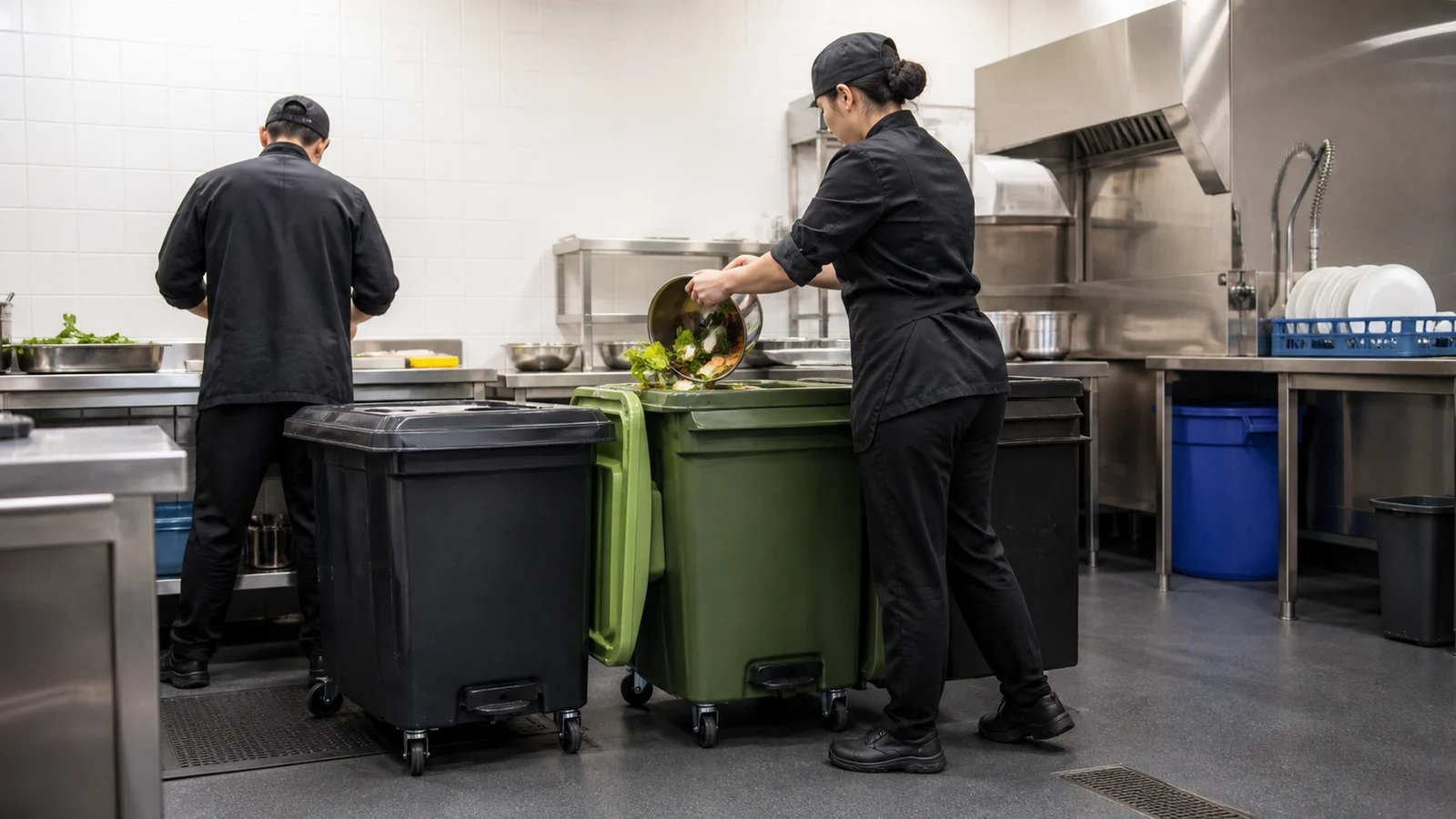
NSW's first stage of mandatory business food-waste separation commenced on 1 July 2026. It does not capture every café or restaurant at once. The staged trigger is the weekly capacity of a relevant premises' residual or general-waste bins—not the kilograms of food waste it produces, and not an estimate of how full its bins usually are.
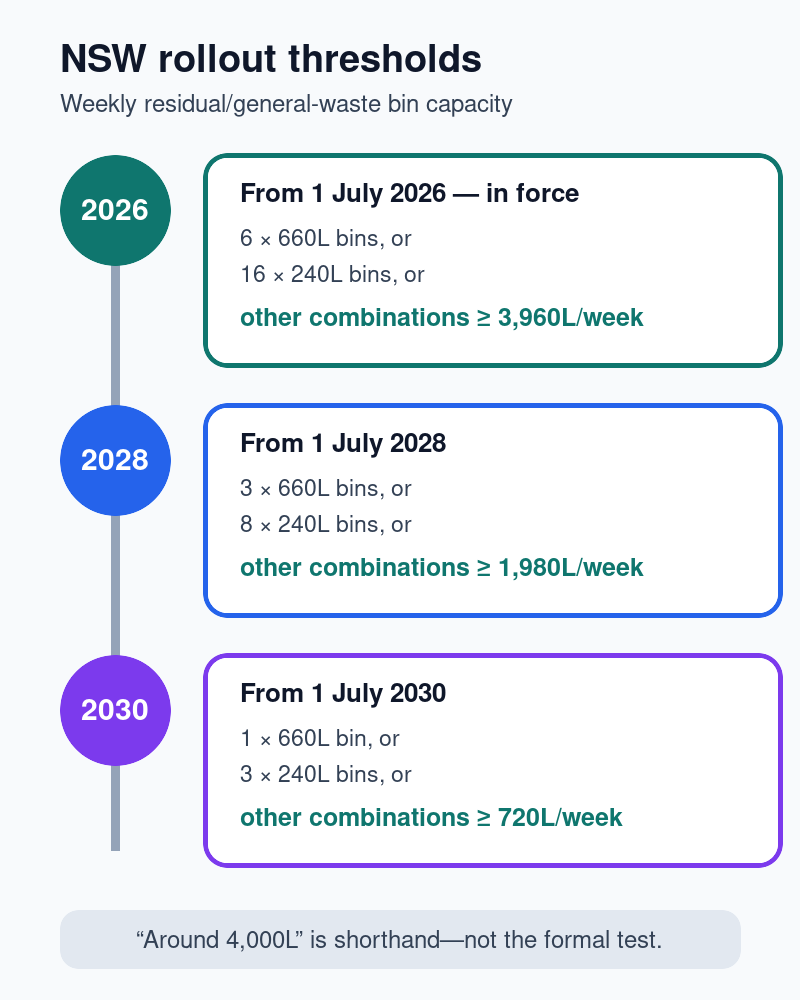
For phase 1, the exact threshold is six 660-litre bins, sixteen 240-litre bins, or another combination providing at least 3,960 litres of weekly general-waste bin capacity. You may see this described as “around 4,000 litres a week”, but that is only a plain-English shorthand. Use the exact threshold and the current NSW EPA guidance when assessing your premises.
This guide helps NSW restaurant, café and commercial-kitchen operators identify the applicable rollout stage and plan a workable back-of-house separation system. It is practical guidance, not legal advice or a decision about whether a particular premises qualifies for an exemption.
What the NSW business food-waste rule now requires
The NSW requirements apply to statutory “relevant premises”, which include specified food-and-drink and institutional premises. A café or restaurant may fall within that class, but being a food business does not by itself mean the phase-1 threshold has been met.
Where the mandate applies, the occupier must provide sufficient food-organics collection bins in each area where food-organics waste is generated. Collected food organics must be transported away at least weekly and must not be mixed with non-organic waste during transport. These duties are set out in sections 170B and 170F of the Protection of the Environment Operations Act 1997 (NSW).
Those requirements define outcomes; they do not make every bin, liner or collection arrangement universal. Confirm accepted materials, liners, pickup arrangements and contamination rules with the service provider or receiving facility that will handle your business's food-organics stream.
NSW FOGO rollout thresholds for businesses
| Commencement | 660L-bin alternative | 240L-bin alternative | Other bin combinations | Status at 20 August 2026 |
|---|---|---|---|---|
| 1 July 2026 | Six 660L bins | Sixteen 240L bins | At least 3,960L per week | In force |
| 1 July 2028 | Three 660L bins | Eight 240L bins | At least 1,980L per week | Future phase |
| 1 July 2030 | One 660L bin | Three 240L bins | At least 720L per week | Future phase |
The alternatives in each row are distinct. In 2030, for example, the rule is not a generic 660-litre threshold. It is one 660L bin, three 240L bins, or at least 720L when other bin combinations apply. The current phase table and assessment tools remain available from the NSW EPA business food-waste page.
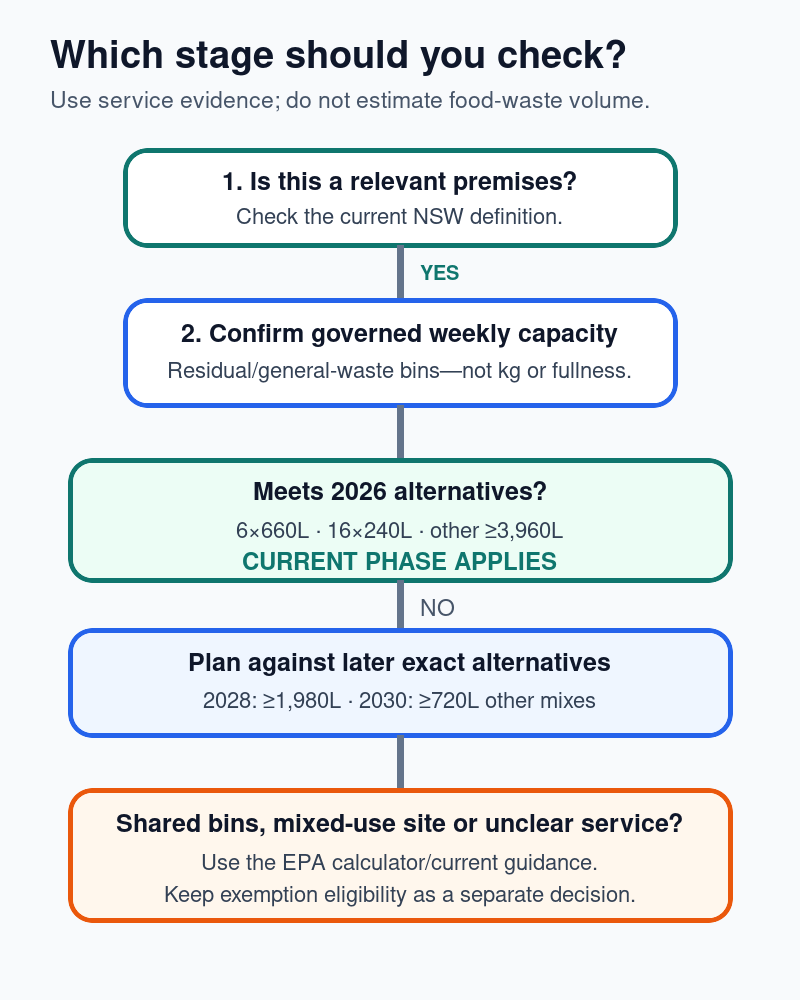
Decision tree: which rollout stage should you check?
- Confirm the premises class. Check whether the site is a relevant premises under the current NSW rule. If its classification is unclear—particularly in a shared, mixed-use or institutional setting—use the EPA guidance and seek confirmation rather than assuming.
- Identify the residual/general-waste service. Use current waste-service records to identify the capacity relevant to the staged rule. Do not substitute food-waste weight, kitchen output, bin fullness or an informal weekly estimate.
- Test phase 1. If the governed weekly capacity meets six 660L bins, sixteen 240L bins or at least 3,960L in another combination, the 1 July 2026 stage is already in force for the relevant premises.
- If phase 1 is not met, test the later stages. Compare the service with the 1 July 2028 alternatives, then the 1 July 2030 alternatives in the table above. A later commencement date is planning information; it does not change the exact current duty for a site already in phase 1.
- Verify uncertain cases. Use the EPA calculator/current guidance where collection frequency, shared bins or service arrangements make the assessment unclear. Do not rely on a homemade formula.
- Keep exemptions separate. A governed exemption process exists, but this article cannot decide whether an individual venue is eligible. Use the current NSW EPA exemption process and obtain the necessary confirmation.
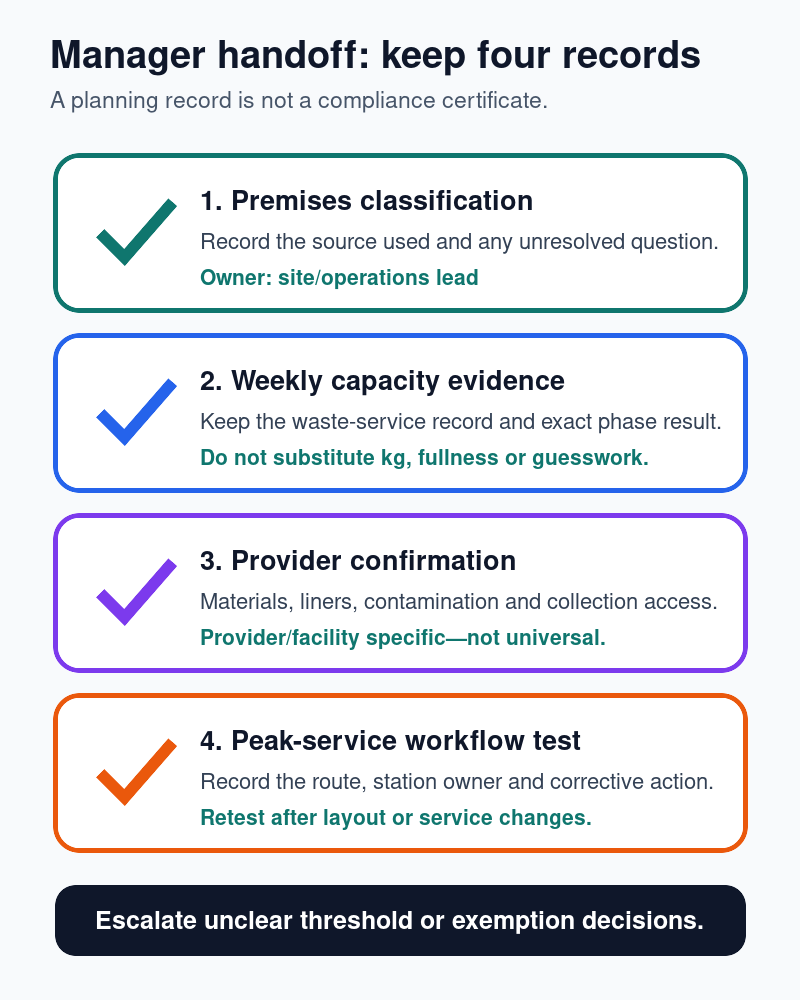
The practical output of this decision tree should be a recorded threshold check: premises classification, the waste-service evidence used, the applicable date and any question that still needs authoritative confirmation. It should not be a guessed litre figure.
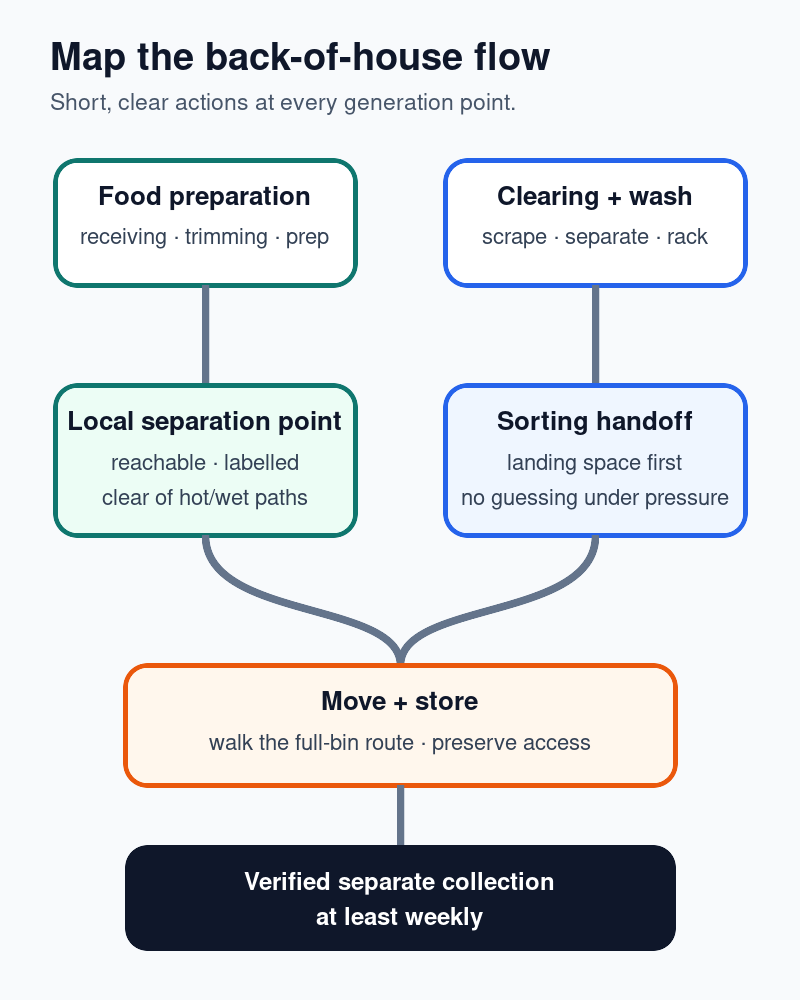
Turn the rule into a workable back-of-house flow
A source-separated collection service can still fail operationally if the bin is remote from the task, staff must cross a busy aisle, or one station accepts several visually similar streams. Start with movement, not equipment.
1. Map where food organics are generated
Walk the actual service path and mark generation points: receiving and trimming, cold prep, hot line preparation, pass returns, plate clearing and dishwashing. The legal duty refers to sufficient collection bins in each area where food organics are generated, so a single distant bin should not be assumed to suit every kitchen.
Record what happens in a peak period. A station that works before service may break down when doors, trolleys and staff are moving at the same time.
2. Design the shortest clear separation action
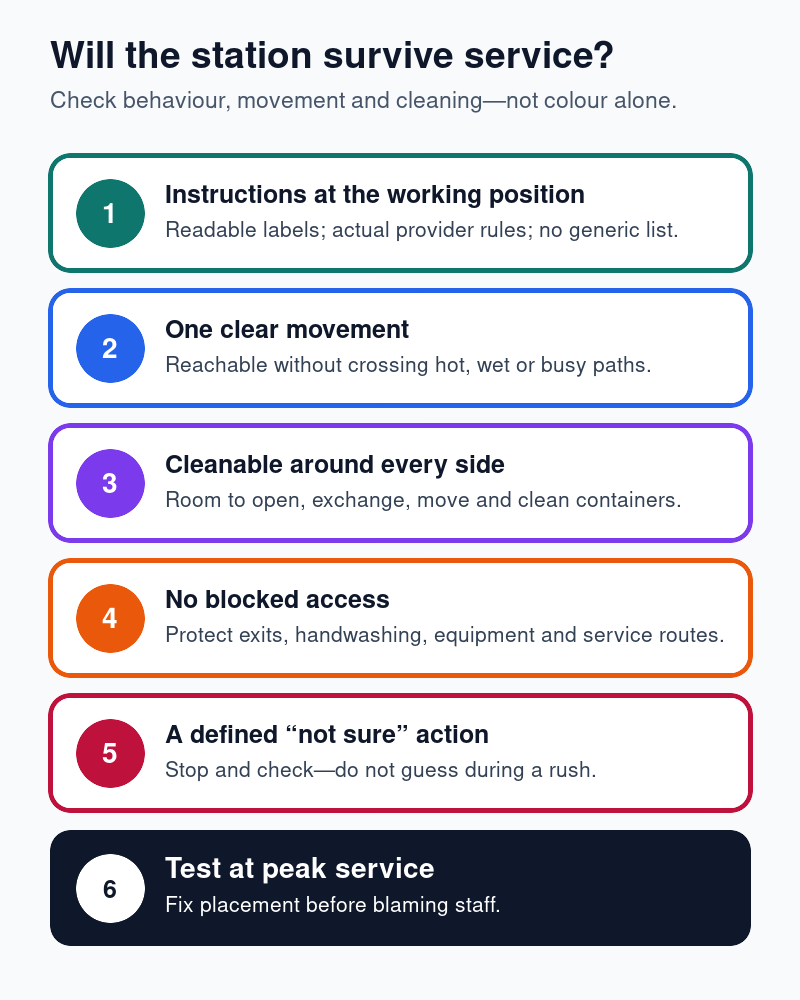
At each generation point, define the intended action: scrape, separate, close or transfer. Place the organics stream where staff can use it without stepping into a hot, wet or high-traffic path. Keep labels readable from the working position, and distinguish streams through words and layout rather than colour alone.
Do not copy a generic accepted-material list into the station. The correct list and any liner rule must come from the business's provider or receiving facility.
3. Protect clearing and dishwashing from contamination
The clearing and dishwashing area is a handoff point between front-of-house returns, food scraps, packaging and washware. Give staff enough landing space to separate these items before racks, tubs and waste streams compete for the same surface. Keep the organics opening obvious and reachable without obstructing the wash path.
Assign a simple response for uncertainty: stop, check the station instruction, and use the provider's accepted-material rule. Guessing under pressure is how contamination becomes routine.
4. Plan cleanability, storage and collection access
Check that staff can remove, move and clean the bins without blocking exits, handwashing facilities, equipment access or the main service route. Allow room to open lids and exchange containers. Confirm how full bins travel from the kitchen to the collection point and whether collection crews can reach that point under the agreed service arrangement.
The collection service must take food organics away at least weekly, but a venue's required container capacity and pickup pattern remain site- and service-specific. The article therefore does not prescribe a universal bin size or collection frequency beyond the statutory minimum.
5. Keep food safety as a separate control
Waste separation does not override food-safety obligations. The FOGO station should deal with material that has been classified for disposal; it is not a permission to re-serve, repurpose or extend the safe life of food. Keep any food-retention decision within the venue's established food-safety system and current FSANZ food-safety guidance.
Back-of-house separation and equipment-planning checklist
Use this checklist during a site walk with the kitchen manager, operations lead and waste provider. A checked box records a planning decision; it does not certify compliance.
Rule and service evidence
- Confirm whether the site is a relevant premises under current NSW guidance.
- Retain the waste-service records used for the weekly residual/general-waste capacity check.
- Record the exact applicable threshold and commencement date.
- Use the EPA tool or seek confirmation for shared bins, uncertain collection patterns or mixed-use premises.
- Confirm accepted materials, liners, contamination rules and service logistics with the actual provider or facility.
Food-preparation areas
- Mark every prep point that generates food organics during normal and peak service.
- Provide a clear collection point for each relevant area rather than relying on a remote bin.
- Check that lids and openings can be used from the working position.
- Keep the separation action away from hot equipment, wet-floor pinch points and escape paths.
Clearing and dishwashing
- Provide a landing and sorting sequence before plates or racks enter the wash flow.
- Separate food organics from packaging and other non-organic waste before transfer.
- Make labels readable at the scrape point and understandable during a rush.
- Define what staff should do when they cannot identify the correct stream.
Movement, cleaning and collection
- Walk the full-bin route and check doors, corners, slopes, lifts and shared access.
- Confirm there is space to move and clean containers without blocking kitchen work.
- Check storage capacity between collections and the collection crew's access.
- Confirm at-least-weekly food-organics collection and separate transport with the service provider.
Staff handoff
- Name who owns provider instructions, station labels and service changes.
- Show each team the route from generation point to collection point.
- Check the workflow during a real busy period, then adjust placement rather than blaming staff for a poor layout.
- Keep a short record of the threshold check, provider confirmation and any corrective action.
Choosing fitout items without confusing equipment with compliance
Once the required streams, locations and movement paths are known, equipment selection becomes a narrower planning task. You can review commercial waste bins for the station roles you have defined, and stainless-steel benches and shelving where a cleanable landing or separation surface is genuinely needed.
No product makes a venue compliant by itself. Suitability depends on the complete premises, service contract, provider rules, layout and operating system. If those inputs are not settled, finish the site and service plan before selecting equipment.
What to do next
If your premises meets the phase-1 threshold, treat the requirement as current: verify the service evidence, map generation points and close any workflow gaps. If it falls into a later threshold, record the relevant commencement date and plan the space and collection path before that phase begins. If the classification, threshold assessment or exemption position is uncertain, use the NSW EPA's current guidance and seek authoritative confirmation.
The aim is not to fill a kitchen with more bins. It is to create a source-separation path that remains clear during service, preserves food-safety boundaries and connects to a verified collection arrangement.