
What Your Site Needs Before a Commercial Dishwasher Can Be Installed
A commercial dishwasher is not a plug-and-play appliance. Before a model can be selected with confidence, the site must be checked for water supply, drainage, electrical capacity, available space and any local authority requirements that may affect the installation.
These checks matter because two machines that appear similar on a product page may require different connections. An underbench dishwasher, pass-through dishwasher or glasswasher may have different inlet, drain and electrical requirements depending on the exact model and the way the manufacturer has designed it.
This guide explains the practical questions an Australian hospitality business should resolve before ordering a commercial dishwasher. It is intended to help owners, builders, consultants and trades identify missing information early—not to replace model-specific installation instructions or the work of appropriately licensed professionals.
What Should Be Checked Before Ordering a Commercial Dishwasher?
Start with the site, not the catalogue. A product can only be matched correctly when the available services and the intended workflow are understood.
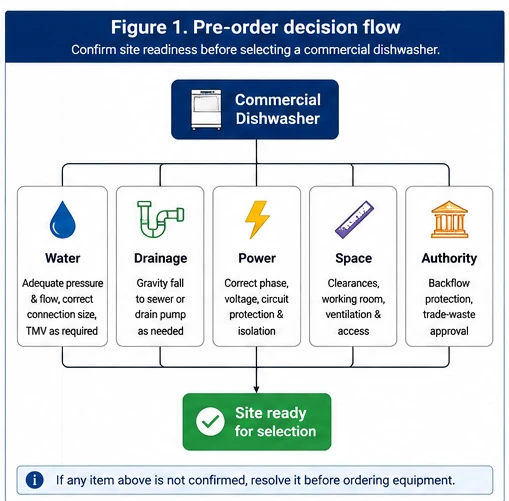
The following five checks should be completed before the final model is approved:
| Pre-order check | What needs to be confirmed | Why it affects the machine choice |
|---|---|---|
| Water supply | The connection location and the conditions required by the selected model. | Different machines may specify different inlet arrangements, pressure conditions or flow requirements. |
| Drainage | The waste location, its height relative to the machine and whether the selected model uses gravity drainage or a drain pump. | The site waste position may determine which drainage configuration is suitable. |
| Electrical supply | The available voltage, phase, connection type and circuit capacity. | Electrical requirements vary between models and cannot be assumed from the machine category alone. |
| Space and access | The installation dimensions, clearances, service access and delivery path. | A machine must fit both the final position and the route used to bring it into the premises. |
| Authority and site obligations | Any relevant backflow, trade-waste, landlord, building or local water authority requirements. | These obligations may sit outside the dishwasher itself and can affect the final plumbing arrangement. |
Why the Exact Model Must Be Known
Terms such as underbench dishwasher, pass-through dishwasher and glasswasher describe broad equipment formats. They do not provide a complete installation specification.
The exact manufacturer and model should be identified before the plumbing and electrical arrangements are finalised. The relevant installation manual or official product documentation should then be checked against the actual site conditions.
Who Should Confirm the Site Information?
The equipment supplier can explain the published requirements of the selected machine. A licensed plumber should confirm the proposed water, drainage and backflow arrangement, while a licensed electrician should confirm the electrical supply. Local water or trade-waste authorities may also need to confirm obligations that apply to the property or business.
Where the site information is incomplete, the safest commercial decision is to pause the final equipment selection until the missing condition has been verified.
Water Supply Requirements for a Commercial Dishwasher
The water connection should be checked against the installation requirements of the exact dishwasher model. A commercial dishwasher may require specific inlet conditions, and those conditions can vary between manufacturers and machine types.
Do not assume that an existing sink connection, flexible hose or nearby tap automatically makes the site suitable. The connection point, pipework, isolation arrangement and available supply conditions should be reviewed as part of the site assessment.
What Water-Supply Information Should Be Confirmed?
| Item to confirm | Why it matters | Who should verify it |
|---|---|---|
| Connection location | The inlet must be accessible and compatible with the final machine position. | Equipment supplier and licensed plumber |
| Manufacturer-specified inlet conditions | The selected machine may require particular supply conditions to operate as intended. | Equipment supplier and licensed plumber |
| Isolation and service access | The connection should be accessible for commissioning, servicing and future maintenance. | Licensed plumber |
| Water treatment requirements | The manufacturer may recommend or require treatment depending on the machine and local water conditions. | Equipment supplier, manufacturer documentation and licensed plumber |
| Backflow obligations | Backflow requirements may apply at the property, zone, fixture or appliance level. | Licensed plumber and relevant authority |
Why Water Pressure and Flow Should Not Be Guessed
A single pressure figure should not be applied to every commercial dishwasher. The required conditions are model specific, and the final assessment should also consider the actual supply available at the connection point.
If the site conditions are unknown, the correct next step is to obtain the relevant installation documentation and have the proposed connection checked by a licensed plumber. Ordering first and investigating later can lead to commissioning delays, additional plumbing work or a machine that is poorly matched to the site.
Does Every Dishwasher Need a Water Filter or Softener?
Not every installation uses the same water-treatment arrangement. The need for filtration, scale control or other treatment depends on the selected machine, the manufacturer's guidance and the local water conditions.
Water treatment should therefore be treated as a model-and-site decision rather than a universal accessory. Any treatment equipment should be sized and installed for the actual dishwasher and the conditions at the premises.
Commercial Dishwasher Drainage Requirements
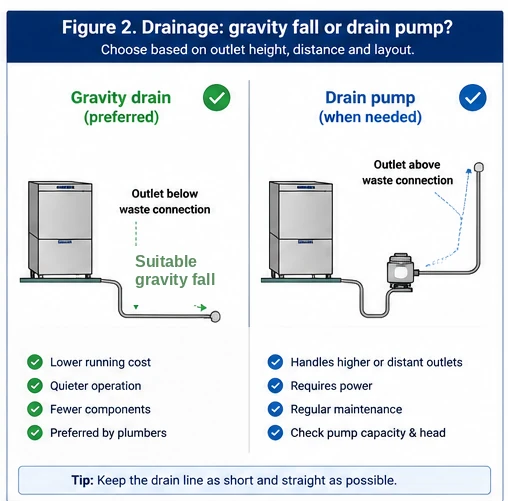
Drainage is one of the most common reasons a dishwasher installation becomes more complicated than expected. The critical questions are where the waste connection is located, how high it sits relative to the machine outlet and whether the selected dishwasher relies on gravity drainage or includes a drain pump.
A waste point that works for one model may not suit another. The drainage arrangement should therefore be confirmed before the final machine is ordered.
This page covers planning a new installation. If an installed machine is already holding water after a cycle, that is an operating fault rather than a site-planning question — use the guide to diagnose an operating drain problem first.
Gravity Drainage
A gravity-drain dishwasher depends on a suitable fall from the machine outlet to the waste connection. Whether the arrangement is workable depends on the actual outlet position, hose route, waste height and the installation requirements of the selected model.
The phrase gravity drain does not mean that any nearby floor waste or sink connection will automatically be suitable. The proposed route should be assessed as part of the plumbing design.
Drain-Pump Models
A dishwasher with a drain pump may provide more flexibility where the waste connection is positioned higher than the machine outlet. However, the permitted discharge arrangement remains model specific.
A drain pump should not be treated as a substitute for checking the site. The connection point, discharge route and waste arrangement still need to comply with the manufacturer's instructions and the requirements applicable to the premises.
What Should Be Recorded During the Site Check?
| Drainage detail | What to record | Why it matters |
|---|---|---|
| Waste location | Its position relative to the planned dishwasher location. | Determines the likely hose route and connection layout. |
| Waste height | The relative height of the waste point and the machine outlet. | Helps determine whether gravity drainage may be suitable or whether a pumped model should be considered. |
| Connection type | The existing waste arrangement and how the dishwasher is proposed to connect. | Allows the plumber to identify whether alteration or additional work is required. |
| Access | Whether the connection remains accessible after the machine and surrounding benches are installed. | Supports commissioning, cleaning and future servicing. |
| Trade-waste implications | Whether the discharge arrangement is subject to requirements beyond the appliance connection itself. | Trade-waste obligations can affect the wider drainage design. |
Who Should Confirm the Final Drainage Arrangement?
The equipment supplier can provide the published drainage requirements for the selected dishwasher. A licensed plumber should then assess those requirements against the actual waste position and the plumbing conditions at the site.
Where the existing drainage has not been inspected, avoid treating a product-page description such as gravity drain or drain pump as final installation approval.
Backflow Protection for Commercial Dishwashers
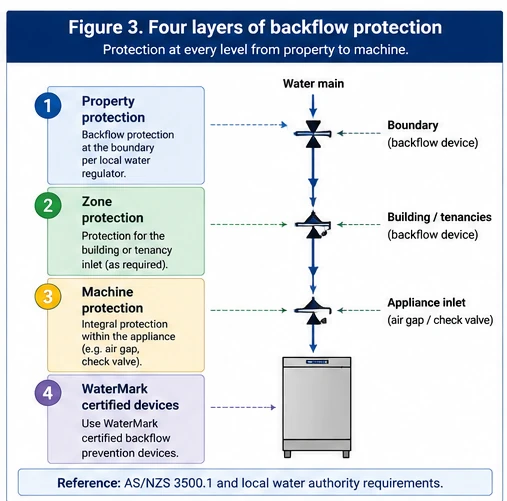
Backflow protection is often misunderstood as a single fitting attached to the dishwasher. In practice, the final arrangement may involve several separate layers of protection, each addressing a different part of the water service.
A device supplied inside or with the machine does not automatically confirm that every property-level, zone-level or fixture-level obligation has been satisfied. The complete arrangement should be assessed for the actual premises and the selected dishwasher.
The Four Backflow Layers
| Layer | What it relates to | Who normally helps confirm it |
|---|---|---|
| Property containment | Protection associated with the water service entering or serving the property. | Relevant water authority and licensed plumber |
| Zone or fixture protection | Protection applied to a particular area, branch or fixture within the premises. | Licensed plumber |
| Machine protection | Protection incorporated into, supplied with or specified for the dishwasher itself. | Equipment supplier and manufacturer documentation |
| Product certification | Whether relevant plumbing products are certified for their intended use under the applicable certification framework. | Licensed plumber, supplier documentation and the relevant certification register |
Why an Internal Device May Not Be the Whole Answer
A dishwasher may include an internal air break, valve or another form of appliance-level protection. That feature relates to the machine, but it does not by itself establish whether separate protection is required elsewhere in the plumbing system.
The plumber should review the appliance documentation together with the property conditions, any requirements imposed by the relevant water authority and applicable plumbing standards such as the AS/NZS 3500 Plumbing and Drainage Standards Series. This avoids assuming that one component satisfies every layer.
What Is WaterMark?
WaterMark is the Australian certification framework used for specified plumbing and drainage products. Where a product used in the installation is required to be certified, its certification status should be checked for the intended application.
WaterMark certification and backflow risk assessment are related but different questions. Certification concerns the product, while the final protection arrangement concerns how the complete water service and appliance installation are configured.
Trade-Waste Requirements for Commercial Dishwasher Discharge
A commercial dishwasher does not discharge only clean rinse water. Its wastewater can contain food residue, grease, detergent and suspended solids from the washing process. For that reason, the wider drainage arrangement may be subject to trade-waste requirements that sit beyond the appliance connection itself.
The applicable conditions vary by location, authority, property and business activity. A drainage point being physically available does not by itself confirm that the proposed discharge arrangement has been accepted.
What Should Be Confirmed Before Ordering?
| Trade-waste question | Why it matters | Who may need to confirm it |
|---|---|---|
| Is a trade-waste approval already in place? | An existing approval may contain conditions that affect the proposed equipment or drainage arrangement. | Business owner, landlord or relevant authority |
| Does the dishwasher discharge through existing pre-treatment equipment? | The existing system may have capacity, access or maintenance limitations. | Licensed plumber and relevant authority |
| Is additional pre-treatment required? | The authority may require controls before wastewater enters the sewer system. | Relevant authority and licensed plumber |
| Who is responsible for approvals? | The tenant, owner, landlord or project contractor may hold different responsibilities under the lease or project scope. | Business owner, landlord and project team |
| Will the new machine change the discharge load? | A replacement or larger machine may alter the operating pattern of the existing drainage system. | Equipment supplier, licensed plumber and relevant authority |
Trade Waste Is Not the Same as the Dishwasher Drain Connection
The dishwasher outlet is only one part of the drainage path. A compliant appliance connection can still lead into a wider system that requires separate approval, pre-treatment or modification.
This distinction is particularly important when fitting a dishwasher into an existing café, restaurant, bar or shared commercial property. The premises may already have a trade-waste arrangement, but its suitability for the proposed equipment should not be assumed without checking.
Who Should Be Contacted?
Start with the licensed plumber and the party responsible for the property. Where trade-waste conditions apply, the relevant local water or sewer authority should be consulted before the installation arrangement is finalised.
The equipment supplier can provide the dishwasher's published discharge information, but cannot approve the property's trade-waste arrangement on behalf of an authority.
Electrical Requirements for a Commercial Dishwasher
Commercial dishwasher electrical requirements vary significantly between models. Machines that look similar externally may require different voltage, phase, connection methods or circuit capacity.
The electrical supply should therefore be checked against the exact model specification before the order is approved. A nearby outlet is not evidence that the available circuit is suitable.
What Electrical Information Should Be Confirmed?
| Electrical detail | What needs to be checked | Who should confirm it |
|---|---|---|
| Voltage and phase | Whether the site's supply matches the selected dishwasher. | Equipment supplier and licensed electrician |
| Connection method | Whether the machine uses a plug connection or requires another approved connection arrangement. | Manufacturer documentation and licensed electrician |
| Circuit capacity | Whether the available circuit and protective equipment are suitable for the machine load. | Licensed electrician |
| Isolation and access | Whether the required isolation arrangement is accessible in the completed installation. | Licensed electrician |
| Site limitations | Whether switchboard capacity, tenancy restrictions or other existing conditions affect the proposed installation. | Licensed electrician, landlord or project team |
Single-Phase and Three-Phase Models
Some commercial dishwashers are available in different electrical configurations, while others are supplied in only one configuration. The machine category does not reliably indicate which supply will be required.
Where more than one version of a model exists, the selected variant should be recorded clearly on the quotation and order. This helps prevent a machine configured for one type of supply from arriving at a site prepared for another.
Why the Existing Outlet Is Not Enough
An outlet may be present but connected to a circuit that is unsuitable, shared, inaccessible after installation or inconsistent with the selected machine's requirements. Visual inspection alone cannot confirm circuit capacity or the condition of the existing electrical installation.
A licensed electrician should confirm the available supply and any required work before delivery and commissioning are scheduled.
How Dishwasher Type Changes the Site Requirements
Commercial dishwashers are available in several broad formats, but the category name alone does not determine the final plumbing or electrical specification. Two underbench machines, for example, may differ in drainage method, electrical configuration, water-treatment guidance or installation clearances.
The machine type is useful for understanding workflow and likely service complexity. The exact model remains the controlling source for the final connection requirements—for example, the published Washtech M2 installation and product information.
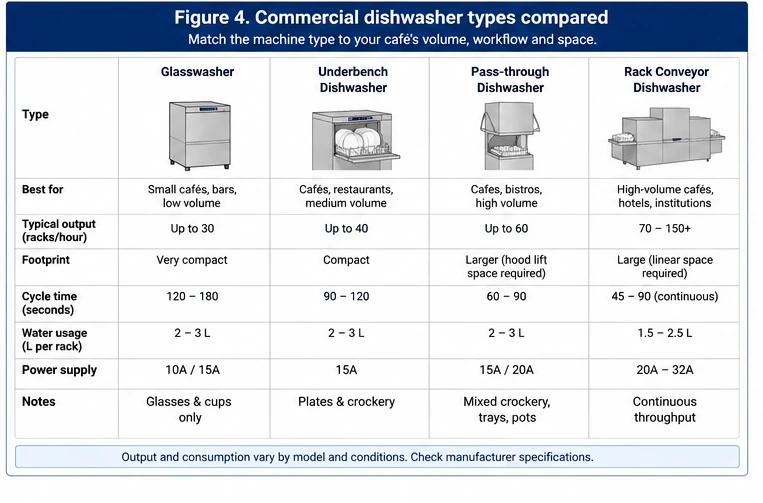
Glasswashers
Glasswashers are commonly selected for bars, cafés and beverage-service areas where glassware is the main workload. Their compact format can make them easier to position under a counter, but the available water, drainage, power and service access must still be checked.
A nearby bar sink does not automatically confirm that the existing services are suitable for the selected glasswasher.
If the machine type is not yet settled, first compare glasswasher and commercial dishwasher workflows, then confirm the selected model's site requirements.
Underbench Dishwashers
Underbench dishwashers are widely used in cafés, restaurants and smaller commercial kitchens. They can suit a compact wash area, but the bench height, door clearance, waste position and access to services should be recorded before the model is approved.
Some underbench models use gravity drainage, while others may include or offer a drain-pump configuration. The electrical supply can also vary between models.
Pass-Through Dishwashers
Pass-through dishwashers are designed for a rack-based workflow and are usually integrated with inlet and outlet benches. The planning process therefore needs to consider more than the footprint of the machine itself.
Hood clearance, bench layout, operator movement, service access and the position of all connections should be coordinated before the surrounding wash area is built.
Rack-Conveyor Dishwashers
Rack-conveyor systems serve higher-volume operations and usually require more detailed coordination between the equipment supplier, plumber, electrician, builder and project designer.
Their capacity and service requirements vary substantially by model and configuration. Selection should be based on documented workflow, site services and manufacturer information rather than a general equipment-category description.
| Dishwasher type | Typical installation considerations | Best suited to |
|---|---|---|
| Underbench dishwasher | Check bench fit, door clearance, accessible services and the exact model's water, waste and electrical arrangement. | Compact wash areas with batch rack loading. |
| Pass-through dishwasher | Coordinate inlet/outlet benches, hood clearance, operator flow, service access and every connection before the washline is built. | Rack-based washlines needing a faster, directional workflow. |
| Rack-conveyor dishwasher | Requires project-level coordination of footprint, rack direction, drainage, water, electrical supply, ventilation where specified and service access. | Documented high-volume, continuous rack workflows. |
These are planning differences, not connection specifications. Compare the full commercial dishwasher range, then use the exact model sheet and a site assessment to confirm utilities.
How Exact Commercial Dishwasher Requirements Differ by Model
The examples below are current KW models with live product pages and exact-model supplier PDFs. They show why a category-level answer cannot safely prescribe one inlet, drain or power supply. Blank cells are deliberate: the field was not clear enough in the retained evidence to publish here.
| Model | Type | Electrical supply | Water inlet | Drain | Rack / throughput | Dimensions (W × D × H) |
|---|---|---|---|---|---|---|
| Washtech UL-B | Underbench dishwasher / glasswasher | 240 V, single phase, 3.4 kW; supplied specification lists a 15 A plugset | Hot water; 200–350 kPa; 15 L/min | — | 500 mm rack; up to 1,080 plates or 1,500 glasses/hour | 600 × 635 × 845 mm |
| Washtech AL | Pass-through dishwasher | 400 V, three phase, 15 A/phase, 9.0 kW | 65°C hot; 3/4-inch male connection with hose supplied; 100–500 kPa; 10 L/min | 25 mm flexible hose; drain pump | Compatible with 600 × 500 mm racks; 40, 60 and 90 second cycles | 775 × 710 × 1,530 mm |
| Washtech CD120 | Rack-conveyor dishwasher | 400–415 V, three phase, 25 A/phase; rated power withheld pending source reconciliation | 65°C hot; 3/4-inch male connection with hose supplied; 250–350 kPa; 20 L/min | 1.5-inch BSP male; 2-inch / 50 mm line | 120 racks or 2,160 plates/hour | 1,500 × 765 × 1,455 mm |
| Washtech CD180 | Rack-conveyor dishwasher | 400–415 V, three phase, 27 A/phase, 18.0 kW | 65°C hot; 3/4-inch male connection with hose supplied; 250–350 kPa; 20 L/min | 1.5-inch BSP male; 2-inch / 50 mm line | 180 racks or 3,240 plates/hour | 2,100 × 765 × 1,455 mm |
These values apply only to the named configurations and retained specification sheets. They are comparison evidence, not a substitute for the latest installation manual, a site measurement or trade approval.
Who Confirms Each Commercial Dishwasher Requirement?
Installation problems often occur because responsibility is assumed rather than assigned. The equipment supplier, plumber, electrician, landlord and relevant authority do not perform the same role.
A clear responsibility matrix helps prevent important checks from being missed before the order is placed.
| Party | What they can usually confirm | What they should not be assumed to approve |
|---|---|---|
| Equipment supplier | The published requirements, available configurations and documented features of the selected machine. | The condition or compliance of the site's plumbing, electrical installation or authority approvals. |
| Licensed plumber | The proposed water, drainage and backflow arrangement against the actual site conditions. | The electrical capacity of the premises or authority decisions outside the plumber's scope. |
| Licensed electrician | The available electrical supply, circuit suitability, isolation and required electrical work. | The plumbing or trade-waste arrangement. |
| Manufacturer documentation | The model-specific installation, connection, operating and maintenance requirements published for the machine. | Whether the property satisfies local authority, lease or project-specific obligations. |
| Water or sewer authority | Requirements within its jurisdiction, which may include containment backflow or trade-waste conditions. | The suitability of the selected dishwasher as commercial equipment. |
| Landlord or property manager | Property restrictions, existing approvals, access conditions and responsibilities under the tenancy arrangement. | Technical certification of plumbing or electrical work unless appropriately qualified. |
| Business owner or project manager | That the required information has been collected and each responsibility has been assigned. | Technical approval that legally or professionally belongs to a licensed trade or authority. |
A Practical Order of Confirmation
- Identify the intended dishwasher format and shortlist an exact model.
- Obtain the official installation requirements for that model.
- Record the existing water, waste, electrical and spatial conditions.
- Ask the relevant licensed trades to compare the machine requirements with the site.
- Confirm any landlord, backflow or trade-waste obligations that sit outside the machine itself.
- Approve the final model only after the critical unknowns have been resolved.
This sequence does not replace professional design or installation. It simply ensures that the purchasing decision is based on verified information rather than assumptions.
Commercial Dishwasher Site-Readiness Checklist
A useful site check should produce evidence that can be reviewed by the equipment supplier and relevant trades. Measurements, photographs and clearly identified connection points are more useful than a general statement that the site is “ready”.
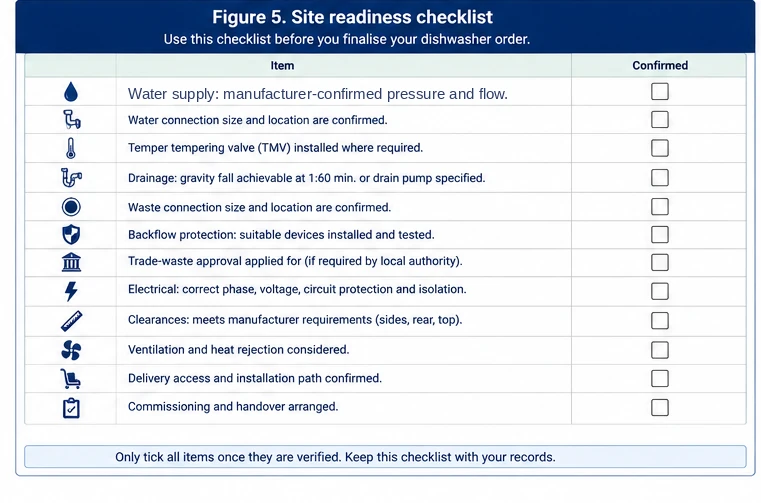
Information to Collect
| Checklist item | Evidence to collect |
|---|---|
| Selected machine | Manufacturer, exact model, configuration and official installation documentation. |
| Installation space | Width, depth, height, surrounding benches, wall clearances and service access. |
| Water connection | Location, accessibility and any conditions confirmed by the plumber. |
| Waste connection | Location, relative height, proposed route and drainage type required by the selected model. |
| Electrical supply | Voltage, phase, connection method and electrician-confirmed circuit suitability. |
| Backflow and trade waste | Known property requirements, existing approvals and any outstanding authority questions. |
| Delivery access | Doorways, corridors, stairs, lifts, loading areas and any restricted delivery times. |
| Photographs | Wide views of the wash area and close views of water, waste, power and access constraints. |
When Is the Site Ready?
A site is ready for final equipment selection when the critical connection requirements of the exact model have been matched to verified site conditions and any necessary authority or property questions have been addressed.
If a critical item remains unknown, record it as an open issue rather than replacing it with an assumption.
Commercial Dishwasher Plumbing and Power FAQs
Does a commercial dishwasher need hot water?
Many models specify a hot-water inlet, but not every machine uses the same inlet temperature or arrangement. The AL, CD120 and CD180 examples above specify 65°C hot water; that value must not be applied to another model. Use the exact installation sheet and confirm the site supply.
Does a commercial dishwasher need a floor drain?
Not as a universal rule. The required waste connection depends on the model, its gravity or pumped drainage design, the permitted hose route and the site's plumbing and trade-waste arrangement. A nearby floor waste is not proof that the installation is suitable.
Can a commercial dishwasher run on a standard 10 A outlet?
Do not assume so. The UL-B example is specified with a 15 A plugset, while the AL and conveyor examples require three-phase supplies. Even where a model is plug-connected, a licensed electrician should confirm that the outlet and circuit match the exact appliance.
What plumbing is needed for an underbench dishwasher?
Plan an accessible manufacturer-specified water inlet, a compatible waste connection and enough service access around the installed machine. The exact pressure, flow, drain method and connection positions vary by model; the UL-B row is one verified example, not a category-wide specification.
How is a pass-through dishwasher different to install?
A pass-through machine must be coordinated with the rack direction, inlet and outlet benches, hood clearance and operator path as well as its utilities. Use a site layout and the exact model documentation before benches or connection points are fixed.
Do conveyor dishwashers need three-phase power?
The CD120 and CD180 examples above are three-phase machines, but that does not prove every conveyor configuration has the same supply. Confirm voltage, phase, current and rated power for the exact model and variant with the supplier and a licensed electrician.
Choose the Dishwasher After the Site Has Been Confirmed
The most reliable commercial dishwasher purchase starts with the site. Water, drainage, electrical supply, available space, backflow obligations and trade-waste conditions can all affect which model is suitable and what work is required before commissioning.
The machine category provides a starting point, but the exact manufacturer and model determine the published installation requirements. Those requirements then need to be checked against the actual premises by the relevant licensed trades and authorities.
Before approving an order, confirm the following:
- The exact dishwasher model and configuration are recorded.
- The official installation documentation has been reviewed.
- The water and drainage arrangement has been checked by a licensed plumber.
- The electrical supply has been checked by a licensed electrician.
- Backflow, trade-waste, landlord and property obligations have been identified where relevant.
- Space, service access and delivery access have been measured.
KW Commercial Kitchen can help you compare suitable commercial dishwasher options and provide the published requirements for the shortlisted equipment. Final site approval and connection work should be completed by the appropriate licensed professionals and relevant authorities.
Keep the decisions separate: use the dishwasher sizing and racks-per-hour guide for capacity, the glasswasher versus dishwasher comparison for ware mix, and the Commercial Dishwasher Survival Guide for operating and maintenance context. If an installed machine is already failing to empty, follow the safe drainage troubleshooting checks rather than redesigning the installation from symptoms alone.
Browse commercial dishwashers or contact KW Commercial Kitchen with the proposed machine type, site photographs and available service information.