
Glasswasher or Dishwasher? The Right Choice for Your Venue
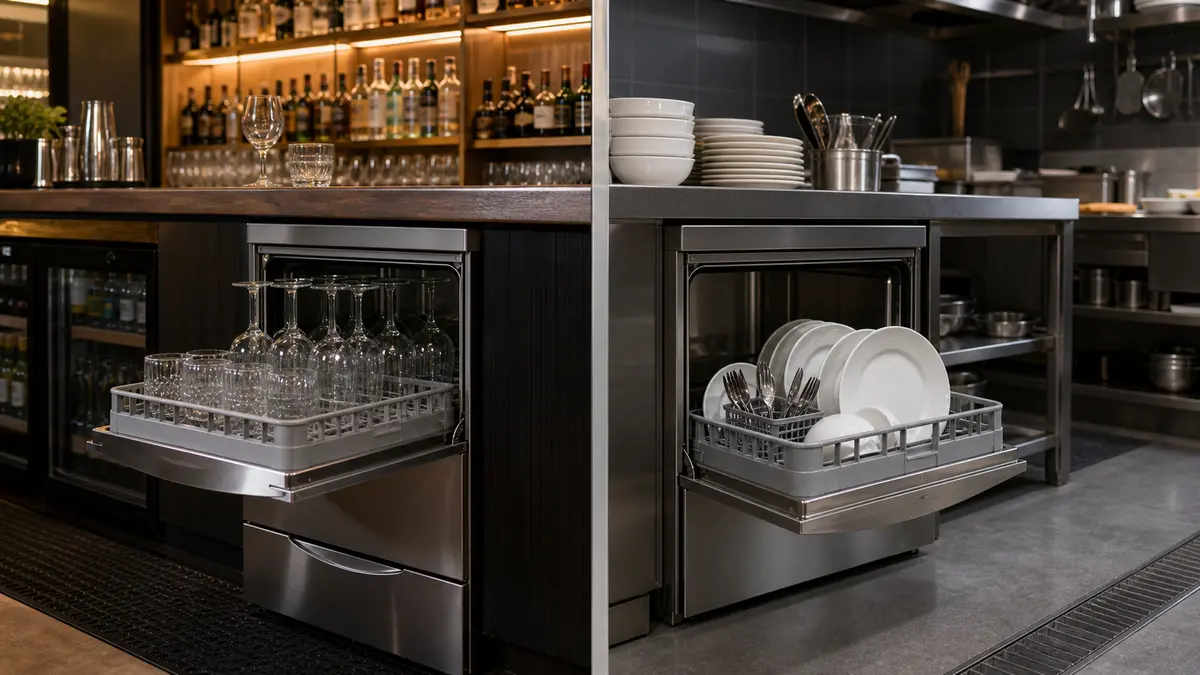
Quick answer: choose a glasswasher when beverage glassware is the main load and the bar needs fast, local turnover. Choose a commercial dishwasher when plates, bowls, cutlery and mixed tableware drive the workload. Consider both when bar and kitchen peaks happen together or when one shared machine would make glasses compete with tableware.
The right choice depends less on the venue label and more on what must be washed at the busiest time, where dirty items return, how staff move, which racks and loading clearance the machine accepts, and whether one wash station can support both bar and kitchen service.
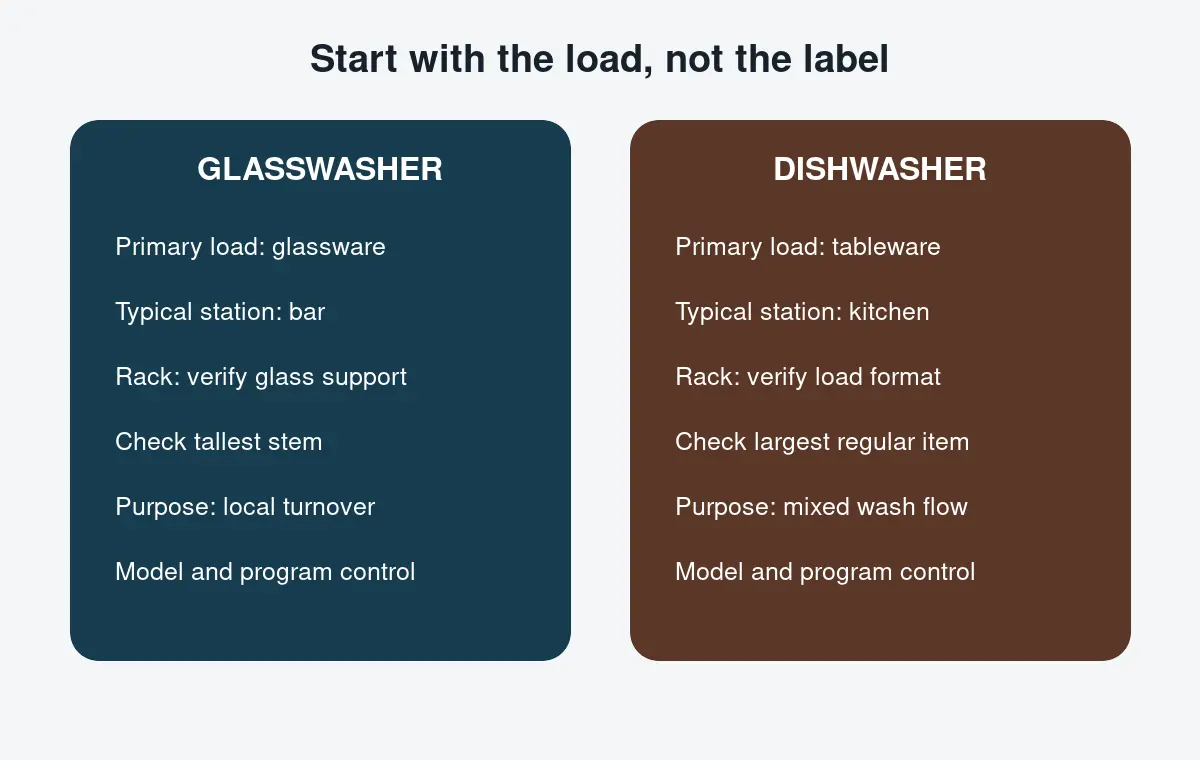
A commercial glasswasher is a warewashing machine configured primarily around glass racks and beverage-service workflow. A commercial dishwasher is configured primarily for dish racks, mixed tableware and kitchen wash flow. Some manufacturer-approved machines can process both loads; others are more specialised.
Glasswasher vs Commercial Dishwasher: Quick Answer
| Decision factor | Glasswasher | Commercial dishwasher | What the buyer should verify |
|---|---|---|---|
| Primary load | Wine, beer and beverage glasses, cups or other approved ware | Plates, bowls, cutlery, cups and approved mixed tableware | Approved load types in the current manual |
| Common placement | Behind or near the bar | Kitchen wash area | Dirty return, clean landing and staff route |
| Rack format | Often supplied with a glass rack; size varies | Often supplied with dish, cup and cutlery racks; size varies | Exact rack dimensions and accessories |
| Loading clearance | Must suit the tallest intended glass | Must suit the largest intended plate, bowl, tray or utensil | Usable opening height, not cabinet height |
| Workflow purpose | Returns beverage stock at the point of service | Moves kitchen tableware from dirty landing to clean storage | Peak return rate plus handling time |
| Mixed-load suitability | Some accept dish or cup racks; others are glass-focused | Some accept glass racks and programs; suitability varies | Approved racks, programs and chemistry |
| Venue types | Bars, pubs, wine bars, cafés and beverage stations | Cafés, restaurants, pubs, hotels and caterers | Actual load and peak, not venue type alone |
| When one may be enough | Beverage-led site with minimal tableware | Small mixed venue with a verified model and non-conflicting peaks | Whether every regular load fits and can wait |
| When separate machines are stronger | When bar and kitchen need clean stock simultaneously or operate at separate stations | Measure simultaneous demand and congestion | |
What Is a Commercial Glasswasher Designed to Do?
A commercial glasswasher is designed to return beverage glassware to service through a compact, rack-based workflow. Locating it near the bar can shorten the journey from collection to washing, drying and reuse, avoiding the need to send every glass to a kitchen dish area.
Correct racking matters. Glasses need to sit securely without crowding, and the rack and chamber must accept the intended stems or tumblers. Presentation also depends on suitable chemistry, dosing, clean filters and spray components, water quality, loading and the approved program. A machine label alone cannot guarantee a spot-free finish.
For a verified example, the Washtech XG glasswasher available through KW uses a 365 mm rack and offers 60- and 120-second programs in the current Moffat Australia XG specification. Practical output depends on rack loading, glass size and handling time; compare the venue’s measured peak with the exact quoted configuration.
Glasswashers differ. The official Washtech GL specification, for example, lists compatible glass and dish rack options and a selectable cold-rinse option. Buyers must check the exact model rather than assume every glasswasher has the same racks, programs, chemistry or approved loads.
What Is a Commercial Dishwasher Designed to Do?
A commercial dishwasher is designed around the kitchen’s mixed tableware flow: scraping or pre-rinsing where required, loading plates, bowls, cutlery and cups into suitable racks, then moving clean items to a landing or storage point. The machine has to fit the largest regular load and the way racks move through the wash area.
Underbench models can suit compact kitchens and lower rack demand. Larger pass-through formats can support a directional rack flow with inlet and outlet benches. A busy restaurant may need the stronger kitchen workflow while the bar retains its own glasswasher.
The Washtech XU undercounter dishwasher available through KW includes a 500 mm dish rack, 500 mm cup rack and cutlery container. The official Washtech XU specification publishes 60- and 120-second program options. These figures identify one machine’s configuration and should not be applied to other dishwashers.
A commercial dishwasher is not automatically unsuitable for glasses. The official Washtech M2 specification lists dish and cup racks and publishes plate and glass loading assumptions. The questions are whether the exact machine, rack and program suit the glassware, and whether routing bar glasses through the kitchen works during service.
The Differences That Affect Daily Service
What You Are Washing
List what returns during the busiest 30 to 60 minutes. A cocktail bar may receive stems, coupes and tumblers continuously. A restaurant wash area may receive plates, bowls, cups, cutlery and utensils together. A café may see cups and saucers dominate breakfast before plates increase at lunch. Daily total alone hides these peaks.
Rack Format and Loading Clearance
Rack size affects useful load and spare-rack storage. Loading height affects the tallest stem, plate or utensil that can enter. Check the supplied rack, approved alternatives, usable chamber height and how intended items sit; do not rely on category labels or cabinet dimensions alone.
Location and Staff Workflow
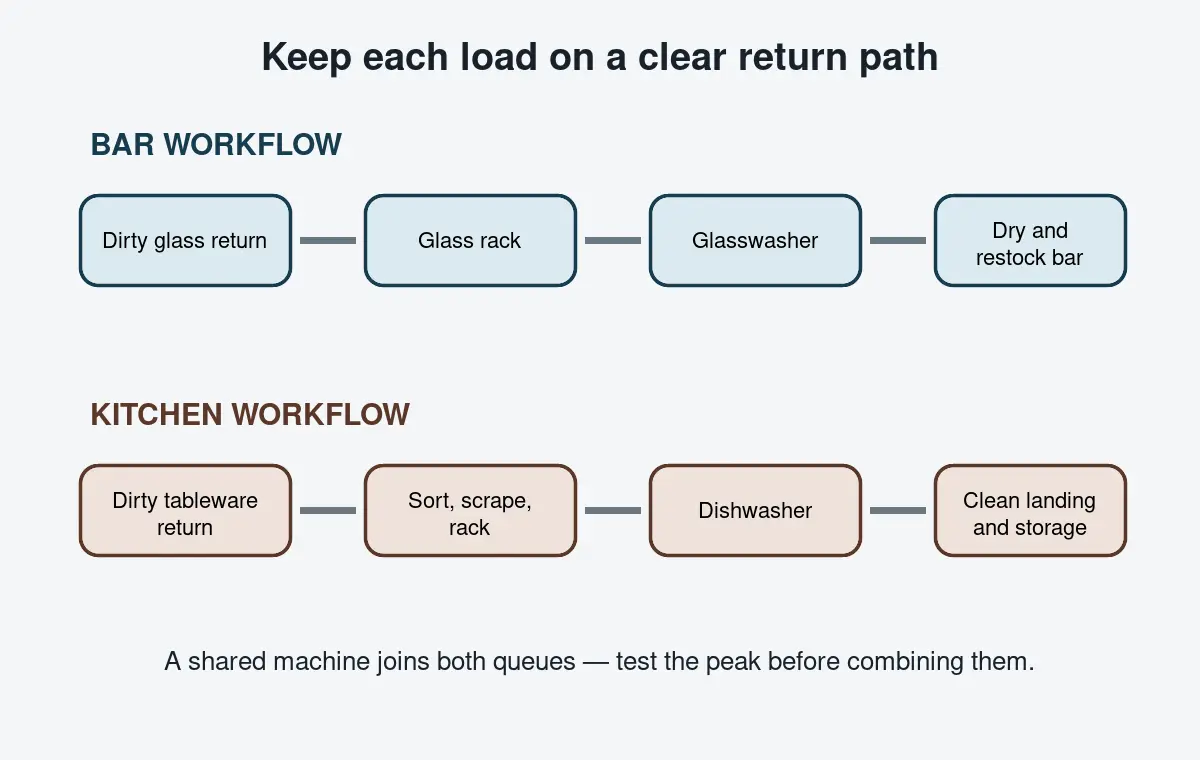
A bar glasswasher keeps collection, washing and restocking near beverage service. A kitchen dishwasher supports a dirty-to-clean kitchen route. Sketch dirty return, sorting, loading, machine, clean landing, drying and storage. Crossing routes and a lack of landing space can create a bigger bottleneck than cycle time.
Peak Turnover
Published cycles and output are shortlist data, but usually assume defined racks, loads and continuous operation. Real throughput includes collection, sorting, loading, unloading, any approved drying interval and returning stock. A machine with adequate daily capacity can still fail when glasses and plates peak together.
Glass Finish, Chemistry and Water Quality
Glass presentation depends on water quality, compatible detergent and rinse aid, dosing, filters, spray components, loading and program. No machine type guarantees every glass under every water condition. The guide to glasswasher water softeners and reverse osmosis covers that separate decision.
Mixed Loads and Contamination Risks
Mixed glass and food-soiled tableware loads can be inconvenient even where a machine is capable of both. Operators may need different racks, careful sorting, suitable programs and manufacturer-specified tank refresh. This is not a universal claim that mixed loads are prohibited: verify the model.
Space, Power and Installation Checks
Measure machine space, door or hood movement, clearance, rack landing and service access. Water, drainage, power, dosing, ventilation and clearance vary by model. Check the exact manufacturer datasheet before purchase and use the commercial dishwasher plumbing and site-readiness guide for installation pre-checks.
Already installed and dealing with standing water after a commercial wash cycle? The safe checks apply to glasswashers and dishwashers alike.
Calculate Your Peak 30-Minute Washload
Measure the busiest overlapping 30 minutes, not average daily covers. A venue can have a manageable daily total and still run out of clean glasses or plates when bar and kitchen return stock together. Record actual returns during a representative busy service and repeat the check when trading patterns vary.
| What to measure | Venue figure | Why it changes the decision |
|---|---|---|
| Glasses returned in the busiest 30 minutes | ___ | Reveals bar glasswashing demand |
| Plates, bowls and cups returned in the same period | ___ | Reveals kitchen dishwashing demand |
| Do the bar and kitchen peak together? | Yes / No | Shows whether one machine becomes a bottleneck |
| Tallest regular glass | ___ mm | Must fit the verified loading clearance |
| Largest regular plate or item | ___ mm | Must fit the verified rack and chamber |
| Distance between return point and machine | ___ m | Affects staff movement and queue time |
| Rack changes during peak service | ___ | Frequent rack changes reduce practical throughput |
| Required turnaround time | ___ min | Defines operational capacity rather than brochure capacity |
A theoretical cycle time is not the same as practical service throughput. Loading, unloading, sorting, rack changes, staff movement and returning clean stock all take time. Published hourly output depends on stated rack-loading and operating assumptions; it is not a promise that a venue will achieve the same result.
Mixed queues matter as much as the total. One machine may accept glasses and plates yet make one team wait while the other team’s rack cycles. Compare each measured peak with the exact machine, racks, programs and electrical configuration quoted. Ask what loading assumption supports any output figure, then allow for real handling time. If one shared queue cannot meet the required turnaround at the overlapping peak, separate machines are operationally stronger.
Which Machine Suits Your Venue?
Venue type is a starting clue, not the decision. Change the likely arrangement when measured load, distance or simultaneous peaks point elsewhere.
| Venue | Likely arrangement | Why | Condition that could change it |
|---|---|---|---|
| Café, limited alcohol | Verified underbench dishwasher may suffice | Cups and light tableware share a compact workflow | High beverage turnover or separate bar |
| Cocktail bar | Dedicated glasswasher | Mixed glass shapes return locally | Substantial food operation |
| Pub | Glasswasher plus kitchen dishwasher | Beer glasses and plates often peak together | Small drinks-only operation |
| Wine bar | Dedicated glasswasher | Stemware presentation and turnover | Low tableware demand and verified shared machine |
| Casual restaurant | Dishwasher; add glasswasher if bar is busy | Tableware controls the washline | Limited alcohol service |
| Full-service restaurant | Kitchen dishwasher plus bar glasswasher | Separate streams reduce competition | Actual bar volume and distance |
| Hotel bar and restaurant | Separate machines, potentially by outlet | Multiple points and simultaneous peaks | Measured central washroom and enough stock |
| Catering/events | Often separate glass and dish capacity | Returns arrive in waves | Event style and turnaround window |
| Separate bar and kitchen | Glasswasher at bar, dishwasher in kitchen | Each team controls its route | Very low demand at one station |
Can One Machine Wash Everything?
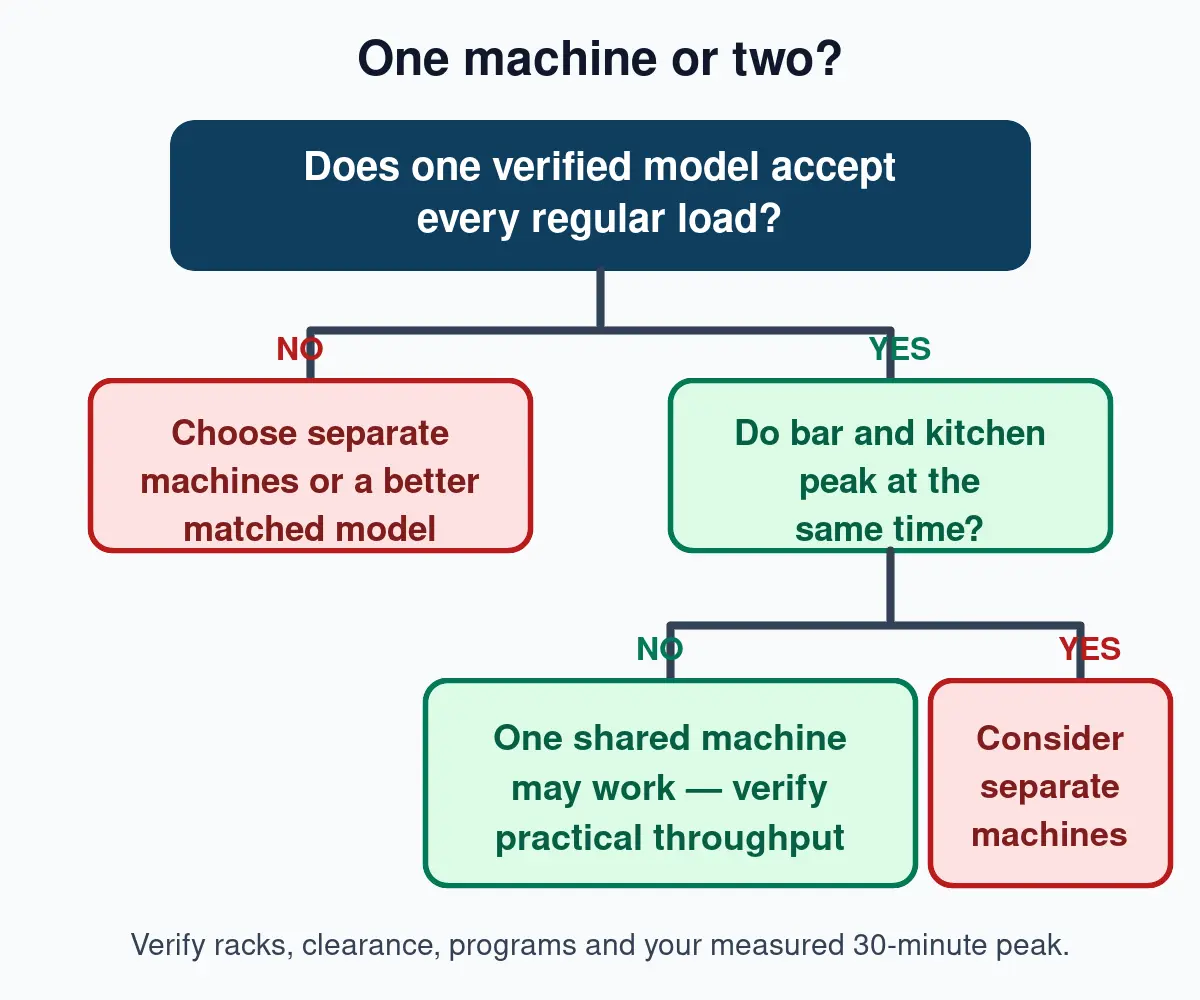
Sometimes—but only when the manufacturer approves the loads, racks and programs, and one station can handle peak workflow. A dual-purpose machine can suit a small café, bistro or mixed venue where returns do not conflict.
The MEIKO Australia UPster U 500 technical datasheet identifies it as a glass and dishwasher and publishes separate glass, dish and intensive programs with a 500 × 500 mm rack. Washtech’s M2 includes dish and cup racks and has manufacturer-published plate and glass assumptions. Crossover capability exists, but not every dishwasher suits every glass.
One machine becomes inconvenient when staff repeatedly swap racks, glassware queues behind plates, the machine is remote from the bar, or presentation needs a controlled process. Ask whether both teams can wait for one cycle queue at the busiest moment.
When Does a Venue Need Both?
Consider separate machines when simultaneous bar and kitchen peaks, sustained glass turnover, separate staff stations, premium presentation requirements, rack or clearance compromises, workflow congestion, or an inability to wait for one shared machine occur together.
Two machines add space, services, cleaning and maintenance. The case is strongest when separation removes a measured bottleneck.
Five Buying Mistakes That Create Service Bottlenecks
1. Buying by Machine Label Instead of Regular Load
“Glasswasher” or “dishwasher” describes a role, not proof that every item fits. List the tallest regular glasses, largest plates, cups, trays and utensils, then confirm each against the approved rack, chamber and program. A familiar label is not a substitute for a load test.
2. Treating Brochure Cycle Time as Real Throughput
A published wash program excludes parts of the service loop. Staff still sort, load and unload items, change racks, move stock and wait for the return path. Use cycle time for comparison, but base capacity on the complete process measured at the venue.
3. Ignoring Loading Height and Rack Geometry
Nominal rack width does not prove tall stemware or large plates sit securely inside the usable opening. Stem height, glass diameter, plate angle, rack dividers and spray-arm clearance affect fit. Check usable loading height and the approved rack, then test representative items where practical.
4. Positioning the Machine Away from the Return Point
A fast machine can support a slow workflow when staff repeatedly carry dirty and clean ware across the venue. Measure the route through sorting, machine, clean landing and storage. Poor placement adds labour and queue time even when cycle capacity is adequate.
5. Expecting One Machine to Serve Two Simultaneous Peak Queues
A shared machine can work when bar and kitchen peaks are separated or modest. When both teams need clean stock at once, every glass rack delays a dish rack and every dish rack delays the bar. Use the worksheet to decide whether one verified machine has practical capacity or separate stations remove a recurring bottleneck.
What to Check Before Buying
- Approved loads: confirm glasses, cups, plates and utensils the manufacturer permits.
- Rack dimensions: record supplied and approved optional racks.
- Usable loading height: test the tallest regular item.
- Programs: match approved options to loads and soil.
- Cycle and output claims: read assumptions behind published figures.
- Water and drainage: verify supply requirements and drain arrangement.
- Electrical supply: match the exact configuration to the site.
- Chemical dosing: confirm pumps, compatible products and commissioning.
- Water treatment: follow manufacturer guidance and local water conditions.
- Ventilation and clearance: allow loading, heat, steam and service access.
- Warranty: check coverage, exclusions and required maintenance.
- Service support: confirm local technicians and spare-parts availability.
This specification varies by model. Check the exact manufacturer datasheet before purchase. Compare current commercial glasswashers, underbench dishwashers and pass-through dishwashers only after defining the load and workflow.
Final Decision
Choose a glasswasher when glassware is the dominant load, fast bar-local turnover matters and the model’s rack, clearance and program suit your glass range.
Choose a commercial dishwasher when plates, bowls, cutlery and mixed tableware dominate and the machine fits the kitchen washline.
Consider both when bar and kitchen peak together, use separate stations or cannot wait for a shared cycle queue.
Browse KW’s verified commercial glasswasher range and commercial dishwasher range, then send the team your peak loads, rack needs, available space and site details for a model-specific shortlist.
Frequently Asked Questions
What is the main difference between a glasswasher and a commercial dishwasher?
A glasswasher is configured primarily for glass racks and beverage-service turnover. A commercial dishwasher is configured primarily for dish racks and mixed kitchen tableware. Exact approved loads vary by model.
Can a commercial dishwasher wash wine glasses?
Some can when the manufacturer approves the glass rack, loading, program and chemistry. Check stem height and support, then assess whether the kitchen workflow can return glasses quickly enough.
Does a café need a glasswasher?
Not automatically. A café with limited alcohol service may use one verified underbench machine. A separate glasswasher becomes stronger when beverage turnover, glass presentation or station layout creates its own peak.
Can a bar use one dishwasher for glasses and plates?
Yes, if the exact machine is approved for both and the shared queue works at peak. It may be inconvenient when food-soiled tableware and bar glasses return simultaneously.
Is a glasswasher the same as an underbench dishwasher?
No. “Underbench” describes installation format; “glasswasher” describes the intended warewashing role. Many glasswashers are underbench machines, but underbench dishwashers can have different racks, clearances and programs.
When should a venue install both machines?
Install both when measured simultaneous demand, separate stations, glass-presentation needs or rack compromises make one shared machine a recurring bottleneck.