
Commercial Bain-Marie Buying Guide: Map Peak Service Load
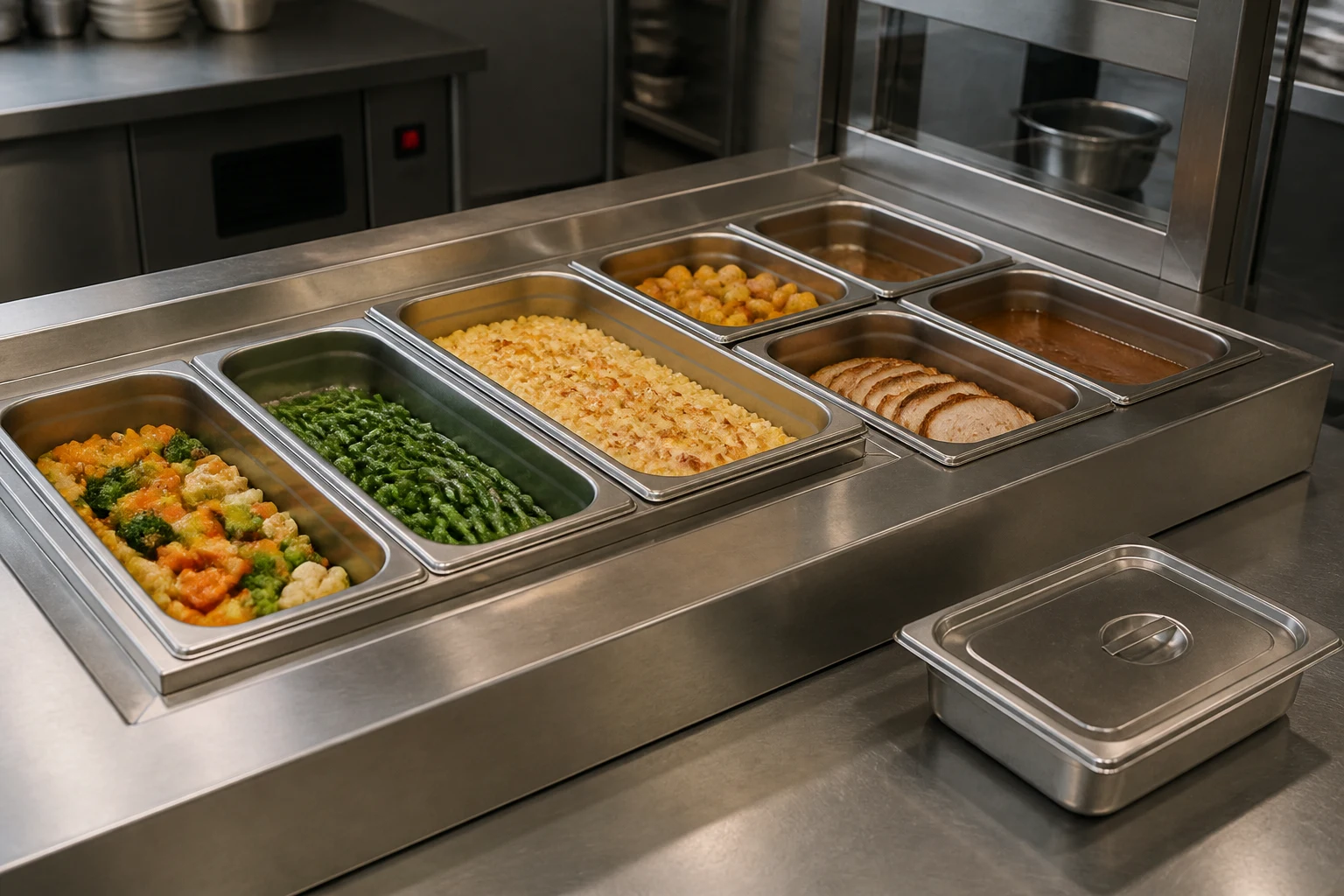
Choose a commercial bain-marie from the food that must be available at the busiest moment—not from daily covers or a bay count alone. Write down the dishes, their gastronorm (GN) pan formats, how each pan will be replenished, who needs access and what the site can support. Then ask each exact product to prove that it fits that service load.
This approach does not predict holding performance or food-safety compliance. It gives you a cleaner buying brief before you compare the current commercial bain-marie range and each model's current datasheet and manual.
Start with the busiest service moment
A daily cover count compresses several different periods into one total. Your bain-marie decision happens at the peak: which hot dishes must be available together, in what quantities, and how the line is replenished while customers or staff are using it.
Build the first version of the load map from an observed service, not a sales estimate. For each dish, record:
- the GN pan fraction and depth you actually intend to use;
- how many pans must be open at the same time;
- whether a smaller pan is used for variety or a larger pan for sustained demand;
- where a replacement pan waits and how it reaches the line;
- whether the change happens during the peak or between service periods; and
- whether access is staff-side, customer-side or both.
The map is a statement of work, not a sizing formula. It does not turn one busy service into a universal rule for cafés, buffets, schools or hotels.
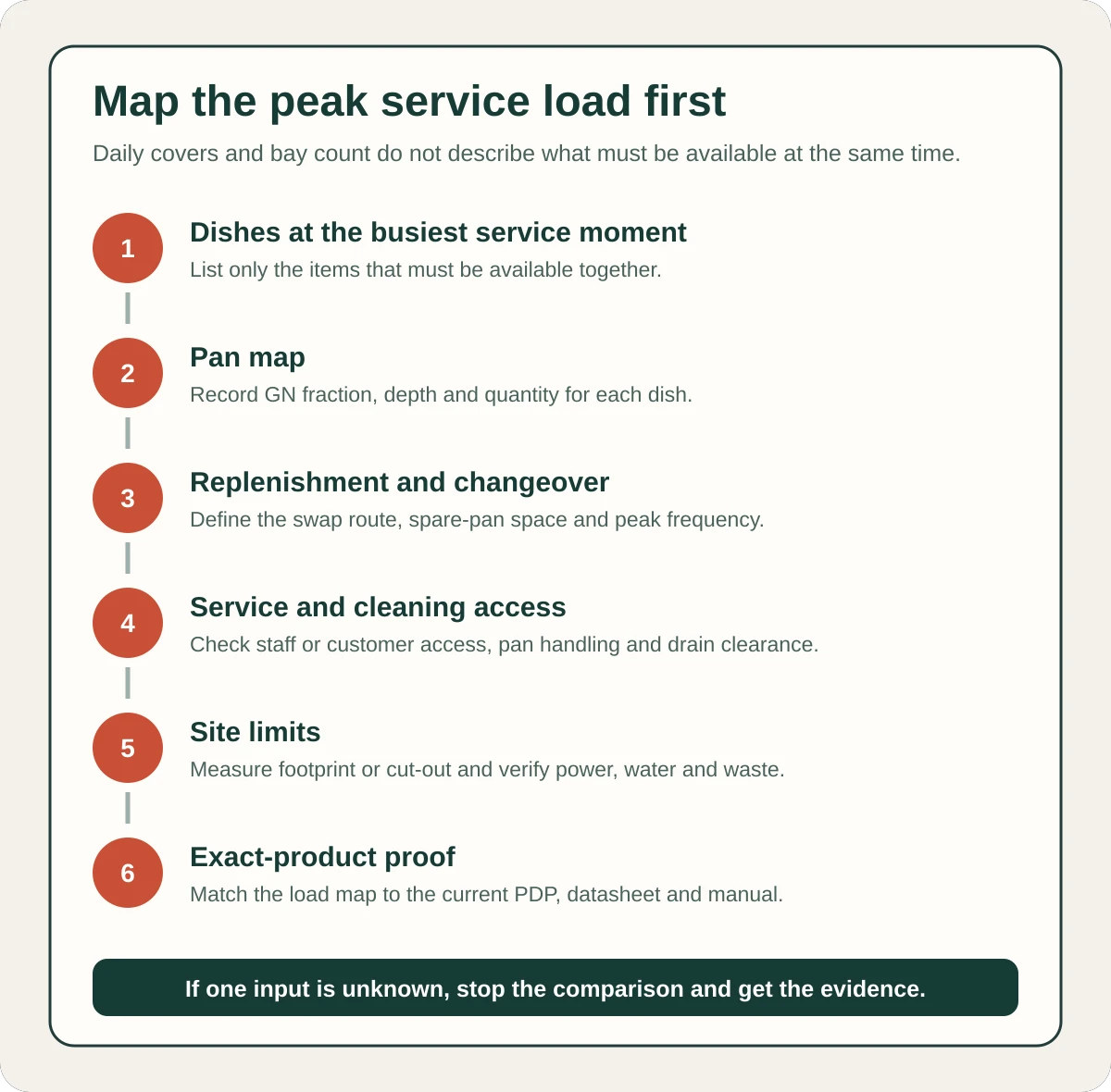
Translate dishes into a pan map
“Six bay” is not a complete description of menu capacity. A well or module may accept different GN fractions and depths, but the supported combinations belong to the exact product documentation. For example, the Woodson W.BMA family manual documents several 1/1, 1/2, 1/3 and smaller pan combinations within its named modules. That is evidence for those products—not permission to assume every unit accepts the same layout.
Draw the intended pan rectangles inside the proposed well. Label each rectangle with the dish and depth. If support bars, dividers, lids or pans are required, record whether the exact SKU includes them or lists them separately. A nominal capacity can fail the service brief if the required fractions do not fit together.
Design replenishment before choosing capacity
Replenishment changes the equipment decision because the service line needs a route for replacement pans, hot-pan handling and temporary landing space. It also changes how much food needs to sit in the display at once.
FSANZ's food-display guidance says not to top up dishes; use a clean replacement dish instead. That makes the swap method a real design input. Ask where the replacement waits, how staff approach the unit and whether opening lids or removing pans obstructs customers, guards or adjacent equipment.
For self-service, the same FSANZ guidance identifies protective barriers, separate serving utensils and supervision. Do not treat the bain-marie alone as the whole display system. Capture those access requirements in the brief and have the applicable food-safety owner validate the final layout.
Use exact configurations to expose missing proof
Products with similar bay labels can demand very different sites. Current exact Culinaire documents distinguish, for example:
- a six-bay drop-in model that has a bench cut-out plus water, waste and three-phase requirements;
- a four-bay island model incorporating a hot cupboard and two-tier gantry; and
- a three-bay mobile model with its own footprint and electrical connection.
These are not recommendations. They show why bay count cannot prove footprint, cut-out, service access, electrical connection, water, waste or operating method. Verify every current value on the exact PDP and manufacturer document before specifying or ordering.
Check the site and clean-down route
Measure more than the outer width. A drop-in unit needs an exact cut-out and installation clearances. A benchtop or mobile unit still needs a stable location, safe cable routing and room to load, cover and remove pans. Gantries, sneeze guards, cupboard doors and pass shelves can change access even when the well count looks suitable.
Also map how the unit is emptied and cleaned. A drain tap may make the route different, but it does not prove that the tap is reachable in the proposed layout or that the procedure is safe. Confirm the exact model's method, drain clearance, hot-liquid warnings and isolation requirements in its manual. Electrical, plumbing and installation work belongs to qualified people under the applicable requirements.
Keep holding temperature separate from equipment selection
A thermostat setting, dial or equipment gauge is not proof of food temperature. The Woodson manual, for example, states that its named gauge measures water or air rather than food and calls for a food probe. FSANZ states that potentially hazardous food held hot must generally be kept at 60°C or hotter unless the business can demonstrate another safe control.
A bain-marie is a holding system, not a shortcut for reheating. For the operating rules, monitoring and reheating boundary, use KW's protected Australian bain-marie hot-holding guide and the current food-authority guidance. This buying guide deliberately stops before repeating that job.
Take this evidence sheet to the shortlist
- Peak load: dishes and pan formats required at the same time.
- Pan proof: supported GN fractions, depths, dividers and included accessories.
- Replenishment: clean replacement-pan route, landing space and peak access.
- Service mode: staff service, self-service or both, including barriers and utensils where applicable.
- Site: footprint or cut-out, clearances, electrical connection, water and waste.
- Clean-down: drain or emptying route, access, isolation and exact-manual procedure.
- Control boundary: separate food-temperature verification from the equipment display.
If a shortlist cannot answer one of those rows from current exact evidence, mark it unresolved. Do not repair the gap with a venue rule, a guessed pan arrangement or a generic claim about wet or dry operation.
Once the map is complete, compare it with the current Bain Maries Category. Use each exact PDP and manual for the final configuration, services and operating requirements, and involve the appropriate installer or food-safety owner where the project crosses into their scope.