
Cake Display Temperature and Climate Class: What the Numbers Mean
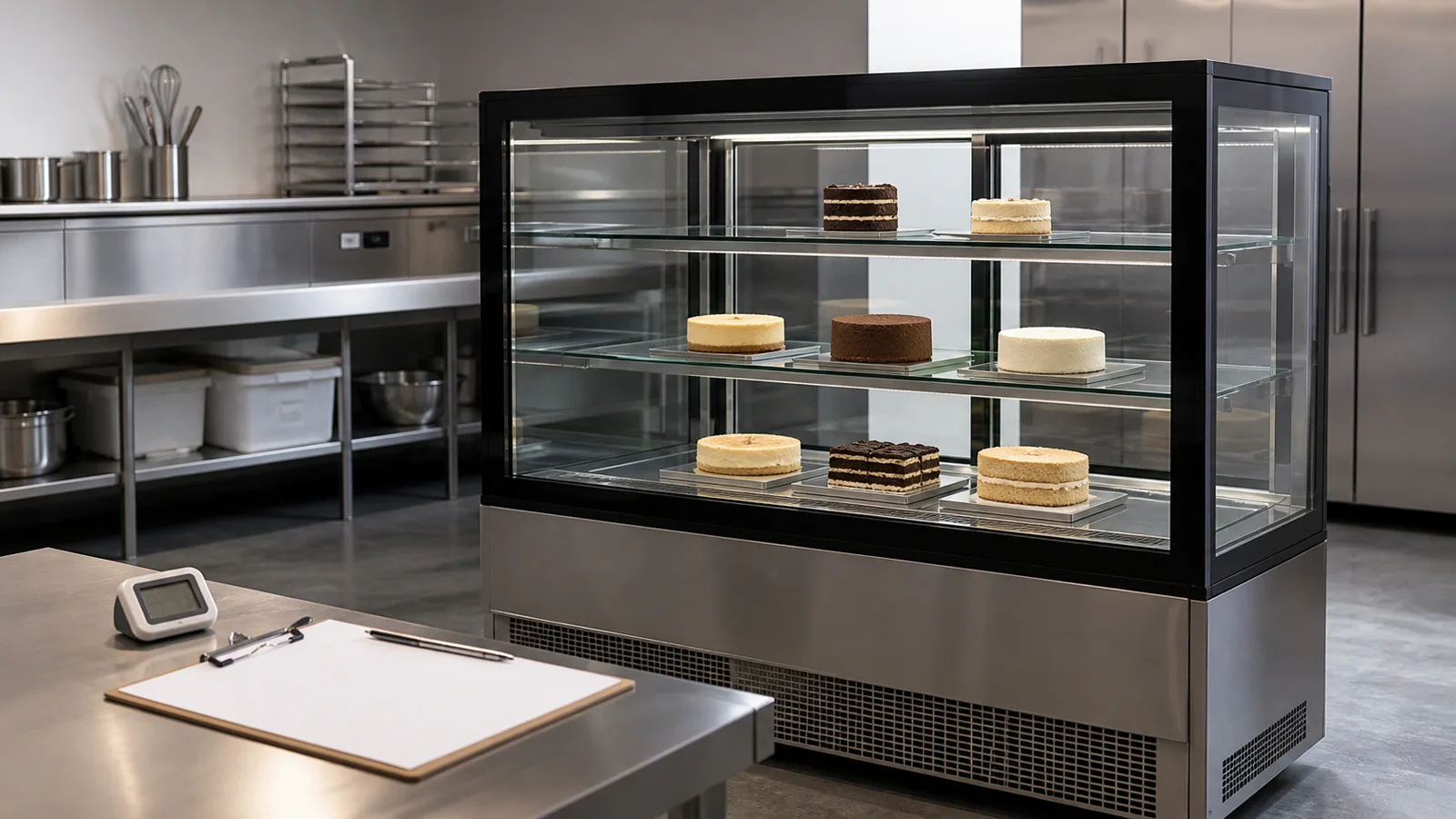
If a cake-display specification lists M1 and climate class 4, those two classifications describe different parts of a cabinet test. M1 concerns the temperatures reached by test packages inside the cabinet. Climate class 4 describes the temperature and humidity of the room around the cabinet during testing.
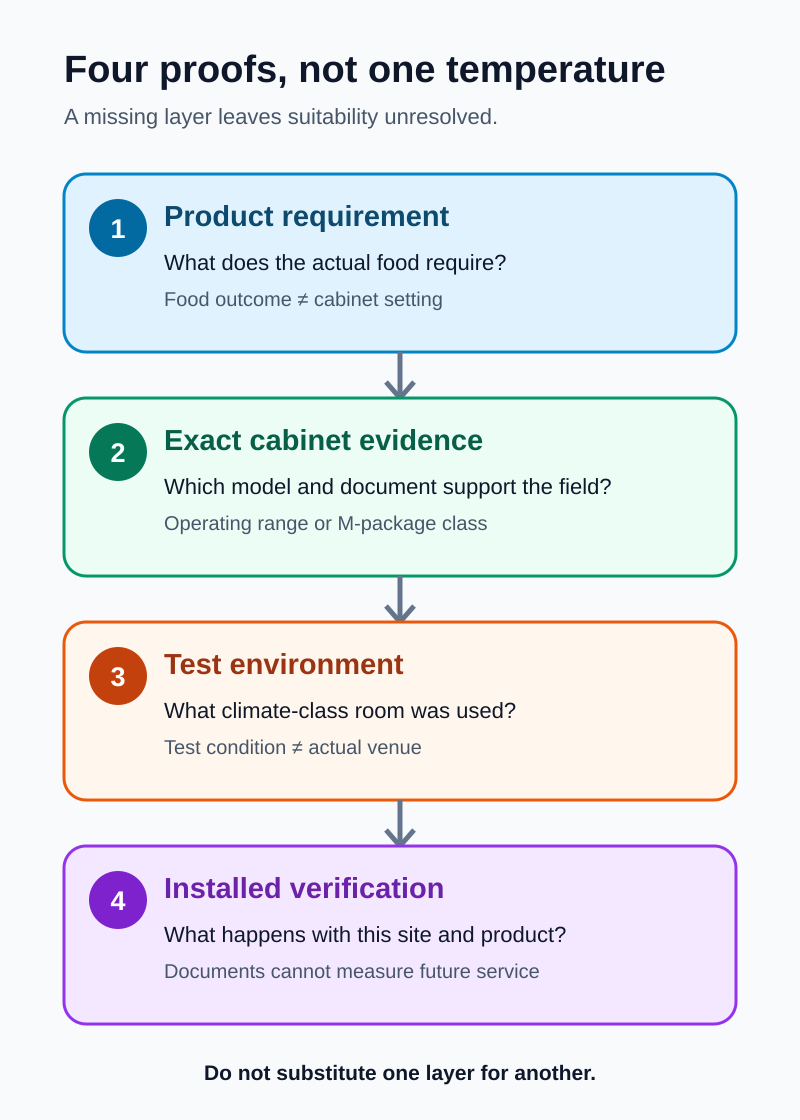
Neither classification, on its own, proves the temperature of a cake during service. A buyer has to reconcile four separate pieces of evidence: what the product requires, what the exact cabinet was tested or rated to do, the ambient conditions attached to that evidence, and what happens after installation.
Start with the product, not the cabinet number
Australian food-safety requirements apply to the food, not to a thermostat label. FSANZ states that potentially hazardous food must generally be kept at 5°C or colder or 60°C or hotter while it is received, stored, displayed or transported, unless the business can demonstrate that another temperature-control system is safe.
That does not create one storage temperature for every cake. Whether a product is potentially hazardous depends on the food itself, including its ingredients and formulation. Some products may still need refrigeration for quality or spoilage control even when the potentially hazardous food rule is not the reason. The business therefore needs to establish the requirement for the actual product before it tries to match that requirement to a cabinet.
The FSANZ 2-hour/4-hour rule addresses cumulative time that potentially hazardous food spends between 5°C and 60°C. It is not a cabinet operating range and it does not turn an unsuitable cabinet into a suitable one. Time out of refrigeration across preparation, storage, transport and display is counted together.
Once the product requirement is known, the next question is narrower: what does the exact cabinet evidence prove?
Climate class describes the room used for testing
The Greenhouse and Energy Minimum Standards (Refrigerated Cabinets) Determination 2024 defines test-room climate classes. For the classes commonly encountered in cabinet documentation, class 3 uses 25°C and 60% relative humidity, class 4 uses 30°C and 55% relative humidity, and class 5 uses 40°C and 40% relative humidity.
These values describe standardised test conditions around the cabinet. They do not mean “air-conditioned café”, “near a doorway” or “hot bakery”, and they do not establish the temperature at an actual installation. A class number is useful only when it is attached to exact-model evidence and compared with the conditions in which that model will be used.
The same determination separately defines M-package temperature classes. For example, M1 limits the warmest test package to 5°C or colder and the coldest to −1°C or warmer; M2 permits a warmest test package of 7°C or colder while retaining the −1°C lower boundary. These are test-package classifications. They are not thermostat settings, display readings or universal storage instructions for cakes.
This is the central inference boundary: climate class describes the test room; an M-package class describes test-package results inside the cabinet. Neither substitutes for the product requirement or for checking the installed operation.
Read each specification field for the question it answers
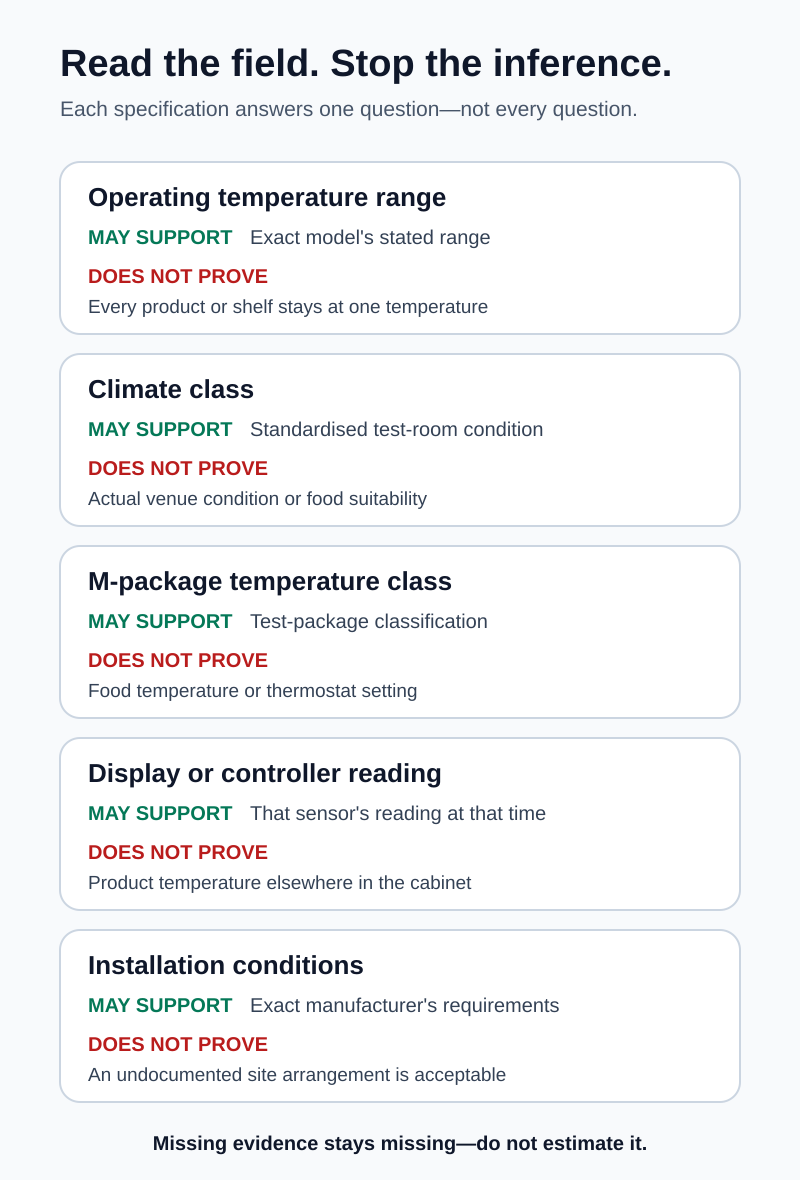
Annotated specification translation
“Operating temperature: …”
What it may support: the range stated by the manufacturer for that exact model, subject to the document's test and operating conditions.
What it does not prove: that every shelf, every product or every service period remains at the same temperature. The range must not be generalised to other models.
“Climate class: 3, 4 or 5”
What it may support: the standardised ambient test condition associated with the exact cabinet evidence.
What it does not prove: that the actual site stays within that condition, or that the cabinet is suitable for a particular cake merely because the class number is higher.
“Temperature class: M1 or M2”
What it may support: the relevant test-package classification when the exact-model identity and source are established.
What it does not prove: the temperature of the food in service, the cabinet-air temperature at every point, or a thermostat setting the operator should copy.
Digital display or controller reading
What it may support: the reading from the cabinet's controller or sensor at that time, interpreted according to the exact manual.
What it does not prove: the temperature of a product elsewhere in the cabinet. Sensor location, loading, door openings and site conditions can make different measurements answer different questions.
Installation and ambient conditions
What they may support: the manufacturer's stated conditions for installing and operating the exact model.
What they do not prove: that an undocumented clearance, ventilation arrangement or room condition is acceptable. Those details must come from the exact installation documentation rather than a category-wide rule of thumb.
A specification that omits one of these fields has an evidence gap; it does not invite a reasonable-looking estimate. Ask for the exact manufacturer or supplier document, check that its model identity matches the product being considered, and keep any test conditions attached to the value.
What the documents still cannot prove at your site
Even a complete specification cannot record the future site's ambient temperature, humidity, airflow, loading pattern or door-opening behaviour. Nor can it prove the temperature of the food after the cabinet is stocked and operating. Those are installed and operational questions.
The practical sequence is therefore not “find the highest climate class and set the display to 5°C”. It is to define the product requirement, verify the exact-model evidence and its test conditions, confirm the manufacturer's installation requirements, then check the relevant conditions and food temperatures in operation. Where a business relies on an alternative temperature-control system, it needs evidence that the system is safe; the existence of a display reading is not that evidence.
If the exact model document is missing, the model identity is unclear, or the site falls outside the documented conditions, suitability remains unresolved. A seller's general statement that a cabinet is “ideal for cakes” cannot close any of those gaps.
Take the verified requirement to the range
Use the Cake Display Fridges category to identify possible models only after the product and site requirements are defined. Then verify each shortlisted model against its current manufacturer documentation. The category helps with range navigation; it does not replace the exact-document and operational checks above.
Primary sources: FSANZ temperature-control requirements, FSANZ 2-hour/4-hour rule, and the Greenhouse and Energy Minimum Standards (Refrigerated Cabinets) Determination 2024.