
Commercial baker mixers power every professional bakery, patisserie and dough-focused kitchen. They control gluten development, friction heat, dough structure and batch consistency—far beyond simple ingredient mixing.
This category showcases commercial-grade bakery mixers engineered for Australian commercial kitchens, covering spiral, planetary and artisan-style mixing actions.
Use this guide to match mixer type, capacity and workflow to your dough styles, hydration levels and production volume.
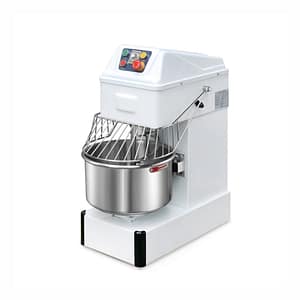


Buying Guide: Commercial Baker Mixers
Commercial baker mixers sit at the core of every bakery workflow, influencing gluten development, dough rheology, friction heat, and batch consistency. Choosing the right mixer ensures predictable fermentation timing, stable texture, and efficient labour use—key factors in any commercial bakery or patisserie. This guide breaks down the engineering principles and practical considerations that help you choose correctly the first time.
1. Understand Your Dough: Hydration, Texture & Fat Content
Dough hydration determines mixer load and heat generation:
- 50–60% hydration: stiff dough requiring high torque, strong bowl-lock stability.
- 60–70% hydration: standard bread dough, ideal for spiral mixers.
- 70–90% hydration: high-moisture dough (ciabatta, focaccia) requiring gentle, aligned gluten development.
High-fat doughs (brioche, panettone) need stable torque and minimal heat to protect butter structure and prevent separation. The right mixer prevents oxidation, maintains dough integrity, and preserves flavour.
2. Mixer Types & Their Ideal Applications
Each mixer type creates a distinct mechanical action that suits different bakery products:
- Spiral mixers: Two-speed dough specialists with predictable gluten development and low friction heat.
- Planetary mixers: Multi-tool versatility for creams, fillings, batters and light doughs.
- Fork or double-arm mixers: Gentle, artisan-style action that maintains dough temperature and structure.
A bakery with diverse menus may require more than one mixer to maintain quality across dough types, pastries and patisserie items.
3. Capacity: Dough Weight vs Bowl Volume
Commercial kitchens often misjudge mixer size. Bowl litres do not equal dough capacity. Most bakeries operate at 50–80% bowl loading for optimum kneading. Overloading causes heat spikes, torque surges and structural stress. Underloading reduces mechanical energy transfer, affecting gluten development.
4. Torque Reserve & Duty Cycle
Mixer performance depends on torque—not wattage. Professional baker mixers must handle transient load spikes caused by dough adhesion. Continuous-duty motors (S1 rating) maintain stable torque without overheating, creating consistent batch results through long shifts.
5. Final Dough Temperature (FDT)
Mixing friction raises dough temperature. FDT controls yeast behaviour and fermentation timing. If mixing overheats the dough, fermentation accelerates, oxidation increases, and dough weakens. Spiral and fork mixers naturally minimise friction heat compared to planetary mixers.
Engineering Deep Dive
1. Mechanical Stress, Fatigue & Stability
Bakery mixers perform high-load repetitive tasks that create cyclic stress. Weak frames or bowl-lift systems lead to vibration, torsion and alignment drift over time. Harmonic vibration—when the dough’s force aligns with motor rhythm—is especially damaging to structure longevity.
2. Transmission Systems
Gear-drive: Delivers stable torque and durability; requires lubrication and heat management.
Belt-drive: Quieter but may slip under stiff dough loads, reducing kneading efficiency.
3. Bowl Geometry
Dough behaviour depends on bowl shape. Diameter, taper angle and wall thickness influence folding path, gluten alignment and hydration uniformity. Two mixers with identical motors may produce different results simply due to bowl geometry differences.
4. Motor Physics
High-torque mixing increases current draw. Commercial kitchens must ensure circuits handle peak amp loads. AC motors excel in smooth torque delivery; DC motors provide superior variable-speed control.
5. Common Failure Modes
- Gear wear from prolonged heavy dough cycles
- Belt stretching causing torque loss
- Bowl wobble due to bearing misalignment
- Seal breakdown from heat and flour dust
Application Scenarios
1. Bread Production
Spiral mixers provide predictable gluten development and temperature control for sourdough, baguettes, ciabatta and hydration-sensitive dough.
2. Pastry & Patisserie
Planetary mixers perform whipping, creaming and blending tasks essential for mousse, sponge, fillings and toppings.
3. High-Fat Dough & Artisan Products
Fork and double-arm mixers maintain dough temperature and prevent butter separation.
4. Central Production Kitchens
High-volume facilities require consistent torque delivery, strong bowl-lock systems and controlled cooling intervals between batches.
FAQ
Which mixer should I choose?
Bread dough → Spiral mixer
Pastry & patisserie → Planetary mixer
Artisan or high-fat dough → Fork / double-arm mixer
Why is bowl volume different from dough capacity?
Dough volume depends on hydration, density and expansion. Mixers perform best at 50–80% bowl utilisation.
Why does my dough overheat?
Friction from kneading increases temperature. Planetary mixers generate more heat under load; spiral mixers the least.
Do mixer speeds matter?
Yes. Two-speed spiral mixers create a controlled development phase for predictable gluten formation.
Common Mistakes
- Choosing by litres instead of dough weight.
- Using planetary mixers for stiff dough.
- Ignoring FDT (Final Dough Temp) during long mix cycles.
- Placing the mixer in a cramped space with poor airflow.
- Confusing wattage with torque performance.
- Expecting one mixer type to handle all bakery tasks.
Brand Overview
Baker mixer brands differ in engineering focus: some prioritise high torque stability, others excel in planetary multi-tool versatility, while premium models optimise thermal control and bowl geometry for artisanal dough. This parent page remains brand-neutral to protect the ranking of child categories.
Related Categories
Where to Next?
Explore our commercial bakery range to build a more consistent, efficient and productive commercial kitchen workflow.