
Commercial fridges and freezers form the backbone of every professional kitchen’s cold chain, stabilising ingredients at safe temperatures even during peak service. Built for Australia’s heat, these systems offer stronger insulation, faster recovery and reliable duty cycles that domestic units cannot match.
Use the categories below to choose chilled or frozen storage engineered for W2 workflow integration, food safety, smart energy use and long-term commercial performance.




Buying Guide: Commercial Fridges & Freezers
A high-performance commercial fridge or freezer is not merely a storage appliance — it is the W2 Cool Storage engine that stabilises food safety, supports prep efficiency and protects ingredient quality across every shift. Whether you operate a café, restaurant, bakery, bar, supermarket or QSR venue, the right cold-storage system ensures reliable temperature control at 1–5°C for chilled goods and –18°C or colder for frozen stock.
1. Understanding W2 in the Kitchen Workflow
Commercial refrigeration sits at the centre of the professional workflow:
W1 Receiving → W2 Cool Storage → W3 Prep → W4 Cookline → W5 Service → W6 Display → W7 Dishwash.
When W2 operates with stable air circulation, recovery speed and correct humidity, the entire workflow remains smooth and food-safe. When W2 fails, every downstream zone suffers.
2. Types of Commercial Refrigeration Systems
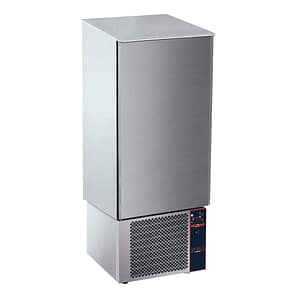
- Upright fridges & freezers: High-volume BOH storage with stable cooling and quick access.
- Underbench units: Positioned within W3/W4 for seamless prep-line efficiency.
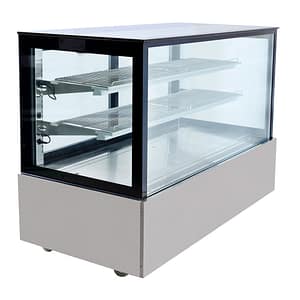
- Glass-door displays: FOH merchandising for beverages, cakes and chilled food.
- Chest freezers: Low-energy deep freeze with excellent insulation performance.
- Dual-temperature units: Combined chilled/frozen zones for compact venues.
3. Tropical Ratings & Climate Class
Australian kitchens frequently operate at 32–43°C. Only commercial, tropical-rated units withstand these temperatures while maintaining consistent performance. Look for:
- Climate Class 4: Suitable up to ~30°C ambient.
- Climate Class 5: Suitable up to ~40°C ambient — ideal for Australia.
4. Why Domestic Units Fail in Commercial Service
Domestic fridges are not engineered for:
- Frequent door opening during busy shifts.
- Long operating hours and continuous compressor duty.
- High ambient temperatures near cooking equipment.
- Large thermal loads from constant restocking.
As a result, they experience temperature swings, poor recovery and food-safety risks.
5. Airflow & Cooling Methods
- Fan-forced cooling: Fast recovery, even temperature; ideal for busy BOH.
- Static cooling: Higher humidity; preferred for delicate display items.
Shelf loading must respect airflow. Blocking ducting creates dead zones that run warmer, compromising safety.
6. Compressor, Condenser & Refrigeration Engineering
- Compressor position: Top-mount resists heat rising from cooklines; bottom-mount is easier to service.
- Condenser design: Microchannel dissipates heat quickly; fin-and-tube tolerates dust better.
- Refrigerant choice: R290 delivers stronger efficiency and is standard for compliant systems.
- Thermal inertia: Food warms/cools at different rates — dense liquids respond slower than dry goods.
7. Temperature Recovery & Door-Open Performance
Commercial units withstand repeated door openings through:
- High-velocity evaporators
- Optimised ducting geometry
- Thick insulation envelopes
- Thermal-break door frames
8. FSANZ, HACCP & Food Safety
Commercial fridges and freezers support compliance with FSANZ 3.2.2A. Key principles include:
- Food placement hierarchy: Raw foods low, ready-to-eat foods high.
- Temperature checks: Food temperature is the compliance measure — not air temperature.
- Auto-defrost cycles: Temporary air-temp increases are normal and safe.
- Hot food loading: Never place hot food directly inside; use a blast chiller.
9. Energy Consumption & Lifetime ROI
Over a 5–10 year lifespan, running cost far exceeds purchase cost. Consider:
- Energy (kWh/24h): Lower usage saves hundreds annually.
- Storage density (L per m² footprint): Critical for tight kitchens.
- Compressor quality: Directly impacts lifespan and power efficiency.
10. Workflow Layout for Different Venues
- Cafés: Underbench units for rapid prep.
- Restaurants: Upright fridges + line fridges for continuous W3/W4 supply.
- Bakeries: Stable dough and filling storage alongside display fridges.
- Bars: Glass-door units for drink visibility and replenishment speed.
- Supermarkets: High-efficiency FOH displays for 12+ hour operations.
Engineering Deep Dive
Commercial refrigeration engineering revolves around pressure differentials, controlled evaporation and heat rejection. The evaporator absorbs internal heat; the compressor compresses the refrigerant; the condenser releases heat to the ambient environment. When airflow to the condenser is obstructed — by dust, oil or poor placement — recovery weakens and energy usage rises sharply.
Defrost cycles maintain evaporator function. During defrost, air temperature rises temporarily, but food remains stable due to thermal inertia. Understanding this prevents misdiagnosing normal behaviour as faults. Shelving, door gaskets, insulation density, electronic controllers and fan lifespan all influence long-term stability.
Application Scenarios
- High-volume kitchens: Fast recovery uprights with strong evaporators.
- Bars & clubs: Clear-glass displays with rapid pull-down cooling.
- Bakeries: Humidity-stable chilled units for dough and pastry structure.
- QSR venues: High-frequency door-open tolerance and fast load cycling.
FAQ
My fridge shows 2°C but my food reads 5°C — why?
Air changes temperature quickly; food responds slowly due to thermal inertia. FSANZ compliance relies on food temperature.
Why does temperature rise during defrost?
Air temperature increases briefly to melt ice on the evaporator. Food stays safe.
Can I overload shelves?
No — it blocks airflow and creates warm zones.
Common Mistakes
- Placing units in unventilated areas or near heat sources.
- Loading hot food directly into the cabinet.
- Blocking airflow with oversized containers.
- Ignoring condenser cleaning, leading to major performance loss.
Need Help Choosing a Fridge or Freezer?
Call 1300 001 366 for expert advice on capacity, workflow planning, energy efficiency and model selection for Australian commercial kitchens.
Technical Integrity Statement
This content integrates professional cold-chain engineering, workflow design models and Australian food-safety logic structured specifically for commercial kitchens. Its unique terminology, multi-layered relationships and internal architecture are designed to ensure contextual accuracy. Any reproduction without full structural context will cause semantic and functional degradation.